
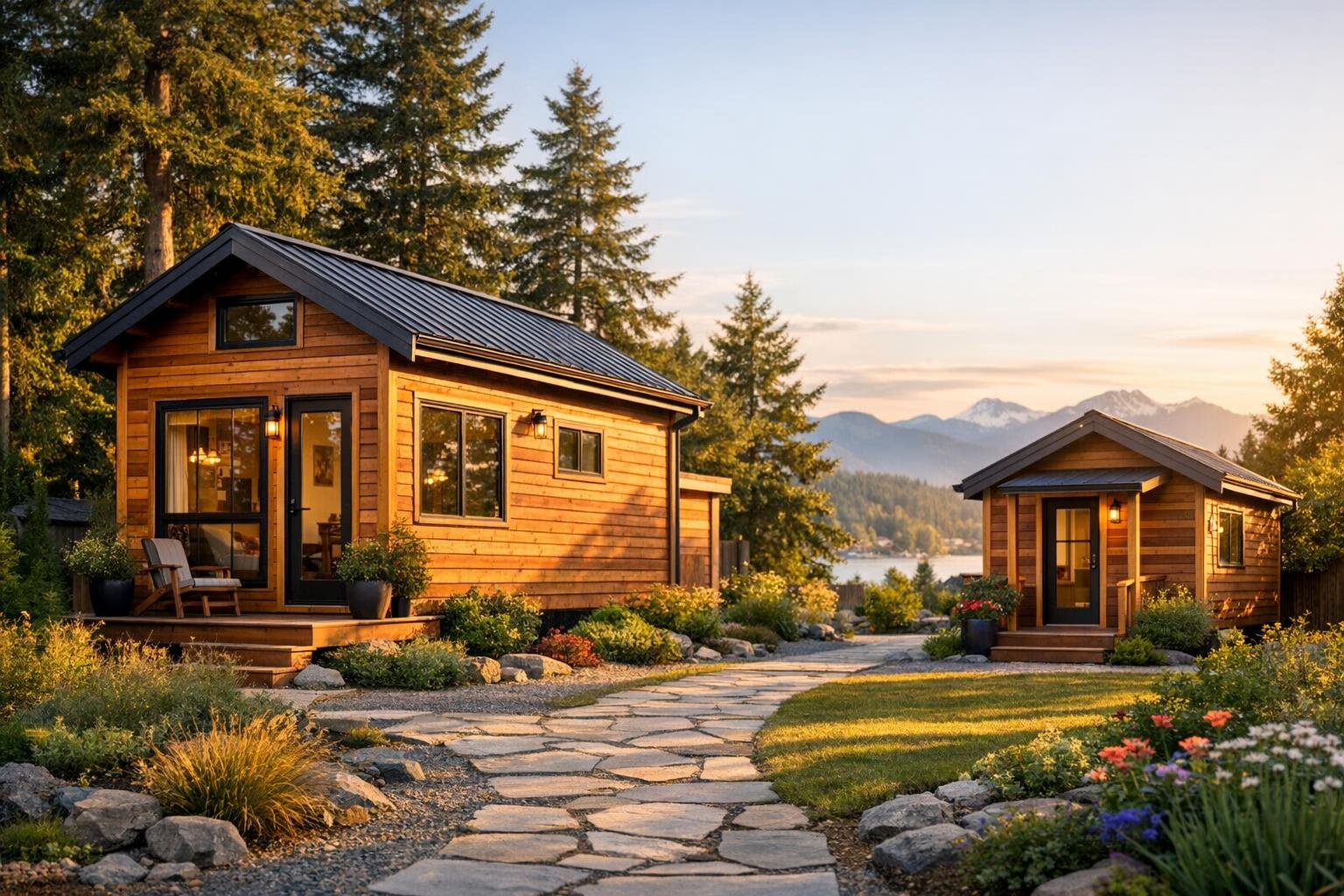
Tiny home bed & breakfast financing is the process of funding a tiny-home-based short-term accommodation business using Canadian loans, grants, equity, and owner capital. In 2026, a tiny home B&B can be a lower-overhead way into the hospitality industry than a traditional inn, but financing is more complex because lenders look closely at land ownership, foundations, zoning, and business viability.
This guide explains how to plan, fund, and launch a tiny home B&B in Canada. It covers Canadian financing, lending options, grants, budgeting, regulations, and small business planning from the first idea to the first guest. Tiny homes appeal to many hosts because they can cost less to start than larger properties while meeting demand for unique stays. Helpful background resources include financing in Canada, tiny homes and modular builds financing, a tiny home financing Canada guide, tiny home rental business planning, and tiny home eco-tourism in Canada.
Tiny Home Bed & Breakfast Financing in Canada: 2026 Guide to Funding, Launching, and Growing a Small Hospitality Business
Estimated reading time: 13 minutes
Key Takeaways
- A tiny home B&B can offer a lower-cost entry into hospitality than a traditional inn, but financing is more specialized.
- Lenders usually care most about land control, foundation type, zoning, code compliance, insurance, and a credible business plan.
- Typical startup costs often fall in the $100,000 to $250,000 range before land purchase, depending on site work and finish level.
- Common funding routes include bank mortgages, credit unions, BDC loans, CSBFP-backed borrowing, private lenders, HELOCs, RV financing, and grants.
- Blended financing is common because many projects combine owner equity, debt, and selective incentives.
- A tiny home B&B only works well when the site is legal, the budget is realistic, and the local tourism demand is proven.
Table of contents
- Why a tiny home B&B is an attractive hospitality small business in Canada in 2026
- Is a tiny home B&B right for you? Viability checklist before you spend money
- Legal, zoning, and regulatory basics in Canada
- Startup cost breakdown and sample budget for a tiny home B&B
- Revenue model, break-even, and tiny home B&B small business planning essentials
- How Canadian financing for a tiny home B&B actually works
- Grants, incentives, and non-dilutive funding sources in Canada
- Lending options for a tiny home B&B in Canada — detailed comparison
- How to improve your chances of getting approved
- Insurance, risk management, and guest safety
- Operations and hospitality best practices that improve profitability
- Marketing and distribution strategy for a tiny home B&B
- Two realistic Canadian mini-case studies
- Step-by-step launch timeline from idea to first guest
- Lender-ready checklist readers can use immediately
- Next steps and resources
- Frequently Asked Questions
Why a tiny home B&B is an attractive hospitality small business in Canada in 2026
A tiny home B&B can be an attractive hospitality business because the starting cost is usually much lower than a lodge, motel, or multi-room bed and breakfast. That lower capital need makes it easier for first-time owners to enter the market.
In Canada, a professionally built tiny home often costs about $60,000 to $120,000 or more before full site development. That is still a major investment, but it is often more reachable than buying a larger accommodation property, according to resources on Canadian tiny home financing and what to know before buying a tiny home in Canada.
Demand also helps the case. Unique stays continue to attract travellers who want something different from a standard hotel room. Tiny homes fit well in:
- eco-tourism markets
- glamping-adjacent stays
- rural retreats
- cottage-country escapes
- wellness travel destinations
In many markets, peak-season occupancy for unique stays may land in the 60% to 80% range. Some locations have also seen yearly growth in tiny-home bookings. Areas often linked with stronger demand include:
- rural BC
- Ontario cottage country
- Quebec Laurentians
Guests often choose a tiny home B&B for simple reasons:
- novelty
- privacy
- nature access
- strong design appeal
- lower price than some resorts
Still, “attractive” does not mean easy. A tiny home B&B only works as a small business if the land is suitable, the rules allow the use, and the financing is built properly from the start. That is why tiny home bed & breakfast financing matters so much. For broader market context, see investing in a tiny house, tiny home living benefits, and tiny home eco-tourism in Canada.
Is a tiny home B&B right for you? Viability checklist before you spend money
Use this as a go/no-go screen before you pay deposits or apply for financing.
1. Site control
Do you own the land, or do you have a long-term lease?
A lease of at least 5+ years is far safer than a short-term arrangement. Short leases raise risk and can weaken a financing application.
2. Utilities and servicing
Can the site support guests year-round?
Check:
- power
- water
- septic or sewer
- road access
- snow removal
- winter access
A pretty site is not enough if servicing is weak.
3. Guest access
Can guests reach the property easily and park safely?
Bad access can lower occupancy and may create insurance issues. Guests expect simple arrival instructions, safe walking paths, and enough parking.
4. Target guest profile
Who is this for?
Common guest types include:
- couples
- hikers
- skiers
- wellness travellers
- city escape visitors
Your tiny home B&B should match a clear guest need.
5. Local draw
Is there a real reason for people to stay nearby?
A location usually needs meaningful attractions within about a 50+ km radius, such as:
- trails
- lakes
- ski hills
- wineries
- festivals
- national parks
Without a draw, marketing gets much harder.
6. Seasonality
How many months can you book well?
Many operators may see stronger demand for 6 to 8 months of the year. That means your small business plan must include slower shoulder seasons and low seasons.
7. Accessibility and guest expectations
Will guests be comfortable?
Travellers care more than ever about:
- reliable heating and cooling
- Wi-Fi
- easy check-in
- basic safety
- comfort
- clean design
If your site cannot deliver the basics, reviews may suffer.
Quick decision guide
- If the site is compliant and tourism demand is proven: move on to budgeting and financing.
- If the site is weak but the market is strong: consider an urban-adjacent lot or different parcel.
- If both site and demand are weak: do not proceed until the fundamentals improve.
This step protects you from building a hospitality business on the wrong property. Useful references include financing alternative housing in Canada, tiny house investing considerations, tiny-home-friendly municipalities, and rural tiny home opportunities.
Legal, zoning, and regulatory basics in Canada
This is a foundation step because financing often depends on legal feasibility.
Zoning means the rules that decide how land can be used. It tells you whether a property can legally support a tiny home, short-term accommodation, or tourism-related use.
Rules vary by province and municipality. Always contact your local planning department early.
What to confirm
Zoning use permissions
Make sure both of these are allowed:
- the tiny home itself
- the short-term rental or B&B use
One without the other is not enough.
Foundation status
A permanent foundation can make financing and code compliance easier in some markets. On-wheels units may be treated more like RVs or movable dwellings, which can limit mortgage choices.
Building code compliance
National Building Code expectations and local interpretation can differ. Some places may require a variance or added approval if the unit is below standard square footage.
Short-term rental bylaws
Some municipalities have:
- licensing rules
- night limits
- principal residence rules
- caps on short-term rentals
These bylaws can directly affect your business model.
Septic, water, and environmental approvals
These are often critical on rural land. They can change both cost and timing in a big way.
Permitting timeline
Approvals can commonly take 3 to 6 months, and sometimes longer in busy or rural areas.
Tax registration
If annual taxable revenue exceeds $30,000, the operator generally must register for GST/HST.
Who to contact
Before final land or build commitments, speak with:
- municipal planning office
- building department
- bylaw or short-term rental licensing office
- public health or environmental office if required
- insurer
- lender
This is not paperwork for later. It directly affects whether Canadian financing is possible.
A lender will want to see that the project is legal, insurable, and realistic. For more detail, review tiny home permits in British Columbia, tiny home permits in Ontario, and ADU permits across Canadian cities.
Startup cost breakdown and sample budget for a tiny home B&B
Before you compare lending options, you need a realistic capital plan.
A tiny home B&B commonly costs about $100,000 to $250,000 to launch, depending on:
- whether you already own the land
- servicing needs
- finish quality
- whether the unit is on wheels or on a foundation
In some examples below, land purchase cost is excluded because the owner already controls the property. If you still need to buy land, total cost may be much higher.
Sample budget table
| Cost item | Low | Medium | High |
|---|---|---|---|
| Tiny home purchase/build | $60,000 | $90,000 | $120,000 |
| Land and site prep | $10,000 | $25,000 | $50,000 |
| Construction/shipping/install | $10,000 | $20,000 | $20,000 |
| Furnishings and amenities | $5,000 | $10,000 | $15,000 |
| Permits and insurance | $5,000 | $10,000 | $15,000 |
| Marketing and contingency | $10,000 | $20,000 | $30,000 |
| Estimated total | $100,000 | $175,000 | $250,000 |
What each cost includes
Tiny home purchase or build
This is the unit itself. A basic professionally built model may sit near the low end. Premium finishes, custom layouts, and larger footprints push cost up fast.
Land and site prep
This includes:
- grading
- pads or foundation
- utility hookups
- septic
- driveway work
- landscaping
This is one of the biggest cost variables. Rural septic and utility work can change the whole budget.
Construction, shipping, and install
This covers transport, crane or set fees where needed, and final installation.
Furnishings and amenities
This includes:
- beds
- linens
- kitchenette items
- décor
- outdoor seating
- hot tub, if used
Premium amenities can support higher nightly rates, but they raise capital and upkeep costs.
Permits and insurance
This covers permit fees, professional reports, and the first stages of insurance setup.
Marketing and contingency
A contingency reserve matters because site work often overruns budget. Marketing costs may include photos, listing setup, branding, and early promotion.
For a tiny home B&B small business, a clean budget is one of the most important parts of the financing file. See also hidden construction costs in Canada and budget tips for tiny homes in Canada.
Revenue model, break-even, and tiny home B&B small business planning essentials
This is the bridge between the idea and a lender-ready plan.
Choose a business structure
A tiny home B&B may operate as:
- sole proprietorship: simpler and cheaper, but with less legal separation
- corporation: more setup and admin, but may help with liability and tax planning
Confirm the best structure with an accountant.
Key numbers to model
Lenders and owners usually want to see these assumptions:
- ADR: average daily rate, meaning average nightly price
- occupancy: the share of nights booked
- turnover cost: cleaning and reset cost between guests
- operating cost ratio: the share of revenue used for day-to-day operations
A simple working example:
- ADR: $200 per night
- annual occupancy: 60%
- turnover cost: about $50 per turn
- operating cost ratio: about 30% of revenue
Sample annual revenue math
60% occupancy × $200 ADR × 365 days = $43,800 gross revenue
If operating costs are about 30%, net revenue before financing and tax may be about:
$43,800 × 70% = about $30,660
That gives a rough idea of income potential, not guaranteed profit.
Another example from research
At $200 per night and about 60% occupancy, one research example states 131 nights per year, which gives revenue near $26,000. If annual costs are about $20,000, payback on annual operating expenses may happen in 10 to 12 months.
The difference between this and the first example is simple: break-even examples may refer to different things. Some refer only to covering annual operating costs. Others look at larger annualized revenue assumptions. Total capital recovery is a separate question again.
Break-even formula
Monthly fixed costs ÷ expected revenue per booked night = nights needed to break even
Example:
- monthly fixed costs: $2,000
- expected revenue per booked night after variable costs: $140
Break-even nights per month:
$2,000 ÷ $140 = about 15 nights
That means you need about 15 booked nights a month to cover fixed costs.
Planning tips
- use conservative occupancy assumptions
- model strong peak season and weaker shoulder season
- build in cleaning, platform fees, repairs, and supplies
- use dynamic pricing tools to adjust rates
- create shoulder-season packages to smooth revenue
A small business lender will care less about hope and more about a sensible plan.
For added context, review house hacking and income planning alongside general financing sources.
How Canadian financing for a tiny home B&B actually works
Canadian financing for a tiny home B&B is more complex than financing a normal home because the project blends real estate, movable asset issues, and hospitality business risk.
Lenders usually ask five main questions:
- Is the home permanently affixed or mobile?
- Is the land owned?
- Is the project code-compliant and insured?
- Does the borrower have strong credit and a down payment?
- Does the business plan show realistic occupancy, ADR, and debt service coverage?
Debt service coverage means whether the business can produce enough cash to cover loan payments. A common target is about 1.25x debt service coverage, which means the business should make about 25% more than the debt payments require.
Common lender expectations
Research suggests lenders may look for:
- around 700+ credit score
- 5% to 20% down payment
- collateral such as land or property equity
- income verification
- business plan and financial projections
- pro formas that support about 1.25x debt service coverage
Mortgage vs alternative financing
Permanent foundation units
These may have access to more traditional mortgage routes if zoning, code compliance, and land title are clear.
Mobile or on-wheels units
These may be financed more like RVs or movable structures. That can change term length, down payment, and lender choice.
Some lenders may also worry if the project depends heavily on short-term rental income, especially where bylaws are uncertain.
What makes an application stronger?
A strong file usually includes:
- clear zoning
- fixed builder quote
- proof of site control
- real budget
- realistic revenue plan
- strong borrower profile
- evidence that the unit can be insured
That leads directly into the best lending options. Helpful reads include tiny home mortgage Canada and ADU mortgage options in Canada.
Grants, incentives, and non-dilutive funding sources in Canada
Grants rarely pay for the whole project, but they can reduce the debt you need.
Non-dilutive funding means money that does not require you to give up ownership equity.
Realistic expectations
For a tiny home B&B, grants are usually:
- competitive
- limited to certain project types
- paid after approved expenses are incurred
- slower than a loan
Processing may take 3 to 6 months. Awards may often range from $5,000 to $50,000. In many cases, grants cover only part of the project, such as 20% to 30% of total costs when combined with debt and owner capital.
Common support sources to research
- Canada Small Business Financing Program (CSBFP): government-backed financing, not a grant
- BDC: startup lending and advisory support
- provincial tourism programs
- regional development programs
- sustainability and energy-efficiency support
- examples mentioned in research such as BC tourism innovation support, Ontario tourism or green support, Quebec regional development support
- CMHC efficiency-related support where relevant
Program details can change, so all 2026 availability and eligibility should be verified before applying.
A simple process
- Search federal and provincial databases.
- Read eligibility line by line.
- Match your project to the right category:
- tourism
- sustainability
- rural development
- women entrepreneurs
- Indigenous business
- regional growth
- Prepare:
- budget
- timeline
- proof of site control
- permit status
Grants work best as a supplement to loans, HELOCs, or owner equity, not as the only source of capital. A useful starting point is Canadian ADU grants and municipal incentives.
Lending options for a tiny home B&B in Canada — detailed comparison
There is no one-size-fits-all answer. The right lending options depend on whether the unit is on wheels, fixed to land, owner-occupied, or run as a dedicated small business.
Financing comparison table
| Option | Rough rate range | Typical term | Down payment | Best fit | Main drawback |
|---|---|---|---|---|---|
| Traditional bank mortgage | Under 5% in some cases | Up to 25 years | Around 5% in some cases | Permanent foundation, clear zoning | Less flexible for non-standard units |
| Credit union | 4.99%–6.99% | Around 20 years | Around 10% | Local, unconventional properties | Terms vary by region |
| BDC loan | 6%–8% | Around 10 years | 10%–20% | Tourism small business startups | Higher rates than prime mortgages |
| CSBFP | Verify current 2026 terms | Up to 15 years in some cases | Varies | Business assets, startup access | Must meet program rules |
| Private lender | 10%–15% | 1–5 years | 20%–30% | Fast closings, flexible files | High cost |
| HELOC/personal loan | 6%–36% | Varies | Depends on product | Supplemental funding | Can be expensive |
| RV/builder financing | 4.99%–6.99% | Up to 20 years | 0%–10% in some cases | Certified on-wheels units | Certification matters |
| Crowdfunding/community investment | Varies | Varies | None in usual sense | Strong brand/story | Less predictable |
Traditional bank mortgage
Best for permanent foundation units with straightforward zoning and compliance. In some cases, research points to rates under 5%, terms up to 25 years, and around 5% down.
Main limits:
- mobile units may not qualify
- unconventional sites may fail underwriting
- STR-heavy income may concern lenders
Credit unions
Credit unions are often more flexible with local collateral and non-standard housing. Research suggests rough ranges of 4.99% to 6.99%, terms around 20 years, and about 10% down.
Why they help:
- local knowledge
- relationship banking
- more comfort with unusual property types
BDC loans
BDC can fit a small business startup with a tourism angle. Rough ranges mentioned in research include 6% to 8%, terms around 10 years, and 10% to 20% down depending on structure.
BDC may be especially useful when:
- the project is clearly a business
- planning is strong
- advisory support adds value
CSBFP
The Canada Small Business Financing Program is government-backed financing meant to improve access to borrowing. Research notes loans up to $1M and terms up to 15 years, but all 2026 details must be verified.
It may help with:
- equipment
- leaseholds
- startup business assets
Eligibility matters, so read current program terms carefully.
Private lenders or hard money
These loans are often faster and more flexible. Research suggests rough pricing of 10% to 15%, terms of 1 to 5 years, and 20% to 30% down.
Pros:
- speed
- flexibility
- willingness to look at unusual files
Cons:
- higher cost
- short timeline to refinance
- pressure if occupancy builds slowly
HELOC, personal loans, and unsecured lines
These are often supplemental rather than full-project solutions. Pricing can range widely, from about 6% to 36% depending on the product and borrower profile.
A HELOC can work well if you already have home equity and need:
- site prep funds
- permit costs
- contingency money
RV or builder financing
This is often best for certified on-wheels tiny homes. Research suggests rough ranges of 4.99% to 6.99%, up to 20-year terms, and possibly 0% to 10% down.
The key point is certification. If the unit is not properly certified, financing may narrow fast.
Crowdfunding, community investment, or revenue-sharing
These options can help validate demand and build an audience. They tend to work best when the host already has:
- a local brand
- a strong story
- community support
They are less predictable than standard debt.
Plain-language takeaway
- the lowest rates usually have the strictest property requirements
- the fastest money is usually the most expensive
- blended financing is common in tiny home bed & breakfast financing
Lender document checklist
Most lenders will want:
- business plan
- pro forma financials
- permits or zoning confirmation
- land deed or lease
- builder quote and specs
- credit report
- income documentation
- insurance quote
- appraisal or valuation if needed
That package turns an idea into something financeable. Additional references include tiny home financing guide and tiny home financing Canada guide.
How to improve your chances of getting approved
Approval is not only about credit. It is about reducing risk.
Practical ways to strengthen your file
- build a 3-year pro forma with conservative assumptions
- show an occupancy ramp, not instant full demand
- save or document a stronger down payment, ideally 10% to 20% if possible
- use collateral such as land equity or a HELOC where appropriate
- get zoning clarity before formal application
- gather builder certifications and a fixed-price quote
- show proof of demand through comparable market data, a waitlist, past hosting, or an existing STR
- consider staged financing for land, then build, then operating line
- approach credit unions first if the project is unconventional
- use a co-borrower or co-signer if it clearly strengthens the application
Proof of concept matters
Proof of concept means showing evidence that the business is likely to book. This could include:
- tourism demand data
- nearby occupancy performance
- strong local attractions
- prior hosting reviews
- social audience interest
The less speculative the project looks, the better your Canadian financing odds may be. For early validation ideas, see tiny home open house strategies and tiny home festivals in Canada.
Insurance, risk management, and guest safety
Insurance is not optional. It affects legal compliance and financing approval.
A standard home policy is usually not enough for guest stays. A tiny home B&B generally needs commercial or short-term-rental coverage designed for hospitality risk.
Research points to about $1,500 to $3,000 per year for a commercial hospitality-type policy, though actual cost varies.
Key coverages
- general liability, ideally $2M+
- fire and property damage
- guest injury
- business interruption where available
- water damage
- weather-related losses
Safety basics
- smoke alarms
- carbon monoxide alarms
- emergency exits
- electrical safety checks
- propane safety checks where relevant
- handrails
- exterior lighting
- slip prevention
- hot tub rules if applicable
- annual inspections
- documented maintenance
Waivers can help support your risk process, but they do not replace insurance.
Insurers may ask about:
- occupancy type
- distance to fire services
- whether the unit is mobile or fixed
- winter use
- maintenance practices
A safe, well-documented property is easier to insure and easier to finance. Helpful resources include insurance in Canada for ADUs, tiny home insurance in Canada, and tiny home fire safety.
Operations and hospitality best practices that improve profitability
Financing gets the unit built. Operations turn it into a real hospitality business.
Core operating basics
- frictionless check-in with smart locks or codes
- clear guidebooks and house rules
- dependable cleaning and turnover timing
- inventory systems for linens, toiletries, and kitchen items
- fast responses to guest questions
Ways to increase revenue
- premium amenities can lift ADR
- hot tubs may support meaningful nightly rate premiums
- strong design and professional photos improve click-through and conversion
- local bundles can add value
- shoulder-season promotions can fill slower periods
Review management
Reviews drive future bookings. Aim for a practical quality benchmark of 4.8+.
Good review management includes:
- prompt messaging
- quick issue recovery
- clear expectations
- polite follow-up for reviews
Staffing and systems
Use local cleaners or seasonal contractors where needed. Document SOPs, meaning standard operating procedures, so the business does not rely fully on the owner every day.
Partnerships
Local partners can help improve both visibility and guest value:
- tourism boards
- guides
- wineries
- ski operators
- wellness providers
A tiny home B&B with strong systems often performs better than a prettier property with weak operations.
For hosting insight, explore hosting guests in ADUs and tiny homes.
Marketing and distribution strategy for a tiny home B&B
Financing gets the business started, but distribution gets it booked.
Core booking channels
- Airbnb and VRBO for early demand
- a direct booking website to reduce fees
- local SEO for terms like “[location] tiny home B&B”
- tourism organization listings
- social media content focused on design, scenery, and experiences
Platforms may bring the majority of bookings at first. Over time, direct bookings can improve margins.
Why direct booking matters
- lower commission costs
- email list growth
- repeat guest capture
- package and upsell options
Pricing tactics
- dynamic pricing tools
- minimum stay rules
- premiums for peak dates
- bundled experiences such as hikes, meals, or wellness add-ons
For a small business in hospitality, good marketing is not just promotion. It is part of the revenue model. Extra inspiration can come from tiny home staging and tiny house investment positioning.
Two realistic Canadian mini-case studies
These are illustrative examples, not guaranteed outcomes.
Case study 1: Urban-adjacent Ontario example
- project size: about $150K
- site: leased lot near a high-demand city or outdoor corridor
- funding mix: 70% CSBFP and 30% builder RV loan
- timeline: about 9 months to first guest
- year-1 revenue: around $35K
Why it can work:
- closer to urban demand
- easier guest access
- lower need to buy land if the lease is secure
Case study 2: Remote BC tourism market
- project size: about $200K
- site: off-grid or semi-rural property with strong tourism draw
- funding mix: HELOC plus provincial grant
- timeline: about 12 months
- occupancy: around 65%
Why it can work:
- destination strength offsets remoteness
- distinct guest experience
- tourism partnerships support visibility
Lesson from the examples
- urban-adjacent sites may reduce marketing friction
- remote sites can still do well if the attraction is strong
- Canadian financing mixes are often blended, not single-source
For related examples, see Canadian income case studies and tiny home eco-tourism examples.
Step-by-step launch timeline from idea to first guest
Actual timing can stretch if permits, septic approvals, or financing are delayed.
Phase 1: Months 1–2 — Feasibility and planning
- site check
- zoning inquiry
- target guest and market analysis
- initial budget
- operating model
- early lender conversations
Phase 2: Months 3–5 — Permits and financing prep
- confirm builder and specs
- gather land title or lease documents
- prepare business plan and pro forma
- submit permit applications
- apply for grants where relevant
- seek financing pre-approval
Phase 3: Months 6–8 — Financing close and build/install
- finalize loan terms
- pay deposits
- complete site servicing
- delivery and install
- foundation or pad work
- bind insurance
Phase 4: Months 9–10 — Setup and soft launch
- furnish and style the unit
- photograph the property
- build listings and direct website
- create SOPs
- write house manual
- set cleaning systems
- start with soft-launch pricing
Phase 5: Months 11–12 — Optimization
- collect reviews
- adjust pricing
- refine amenities
- improve operations
- compare cash flow and debt service against projections
This phased approach makes tiny home bed & breakfast financing easier to manage because each step has a clear purpose. Useful planning reads include construction delay solutions and tiny home building checklist.
Lender-ready checklist readers can use immediately
This is the package that turns a vague idea into a financeable file.
- Business plan summary — Explain the concept, market, and operating model.
- 3-year revenue and expense forecast — Show how the small business should perform over time.
- Break-even analysis — Prove how many nights you need to cover costs.
- Proof of site ownership or lease — Show legal control of the property.
- Zoning or planning confirmation — Prove the use is allowed.
- Builder quote and certifications — Show what will be built and to what standard.
- Permit status — Confirm whether approvals are filed, pending, or granted.
- Personal credit and income documents — Help the lender assess borrower strength.
- Collateral details — List land equity, home equity, or other assets if relevant.
- Insurance quote — Show the project can be insured properly.
- Contingency budget — Prove you planned for overruns.
- Launch and marketing plan — Show how bookings will start.
This checklist supports both Canadian financing discussions and lending options comparison because it gives every lender the same clean picture of the project. Additional resources include ADU financing in Canada and tiny home financing guide.
Next steps and resources
A tiny home B&B can be a viable 2026 small business and hospitality venture if you get four things right:
- legal site
- realistic budget
- appropriate Canadian financing
- strong guest experience
Start in this order:
- contact the municipal planning office
- build the budget and pro forma
- compare 3 to 5 lending options
- search grants and regional support
- speak with an accountant, broker, insurer, and, if needed, a hospitality consultant
Helpful resource categories include:
- BDC
- CSBFP
- provincial tourism offices
- regional development agencies
- grants databases
Tiny home bed & breakfast financing works best when you start with zoning and budget discipline, then compare lending options, then build a lender-ready package. That approach lowers risk and gives your tiny home B&B a much better chance to launch on solid ground. For continued reading, see tiny home rental business in Canada, grants and municipal incentives, and tiny home eco-tourism opportunities.
Frequently Asked Questions
Can I get a mortgage for a tiny home B&B in Canada?
Yes, it is usually more feasible when the unit is on a permanent foundation and complies with local zoning and building rules. On-wheels homes may instead use RV or other alternative Canadian financing. For more, see Canadian financing details, alternative housing financing, and tiny home mortgage options.
What grants are available for a tiny home B&B?
Grants vary by province and may include tourism, regional development, sustainability, or energy-efficiency programs. They usually cover only part of the project, not all costs. A useful place to start is Canadian grants and municipal incentives.
What credit score do lenders want?
A common benchmark in research is around 700+, but lenders also look at down payment, collateral, and whether the business plan is credible. See also tiny home mortgage guidance.
How much does it cost to start a tiny home B&B?
A typical startup range is about $100,000 to $250,000, depending on land, servicing, permits, finish level, and whether the unit is mobile or fixed. Related references include buying a tiny home in Canada and cost to build in Canada.
Are credit unions better than banks for tiny home financing?
Sometimes. Credit unions can be more flexible with non-standard properties and local collateral, but rates and approval rules still depend on the file. See tiny home financing options for comparison points.
Important note
This article is for educational purposes only and is not legal, tax, or financial advice. Verify all 2026 program details, rates, and eligibility before applying.
For complex projects, it is wise to confirm your plan with:
- an accountant
- a mortgage broker or commercial lender
- the municipal planning office
- an insurance broker
- a lawyer if lease or zoning issues are complex
Leave a Reply