

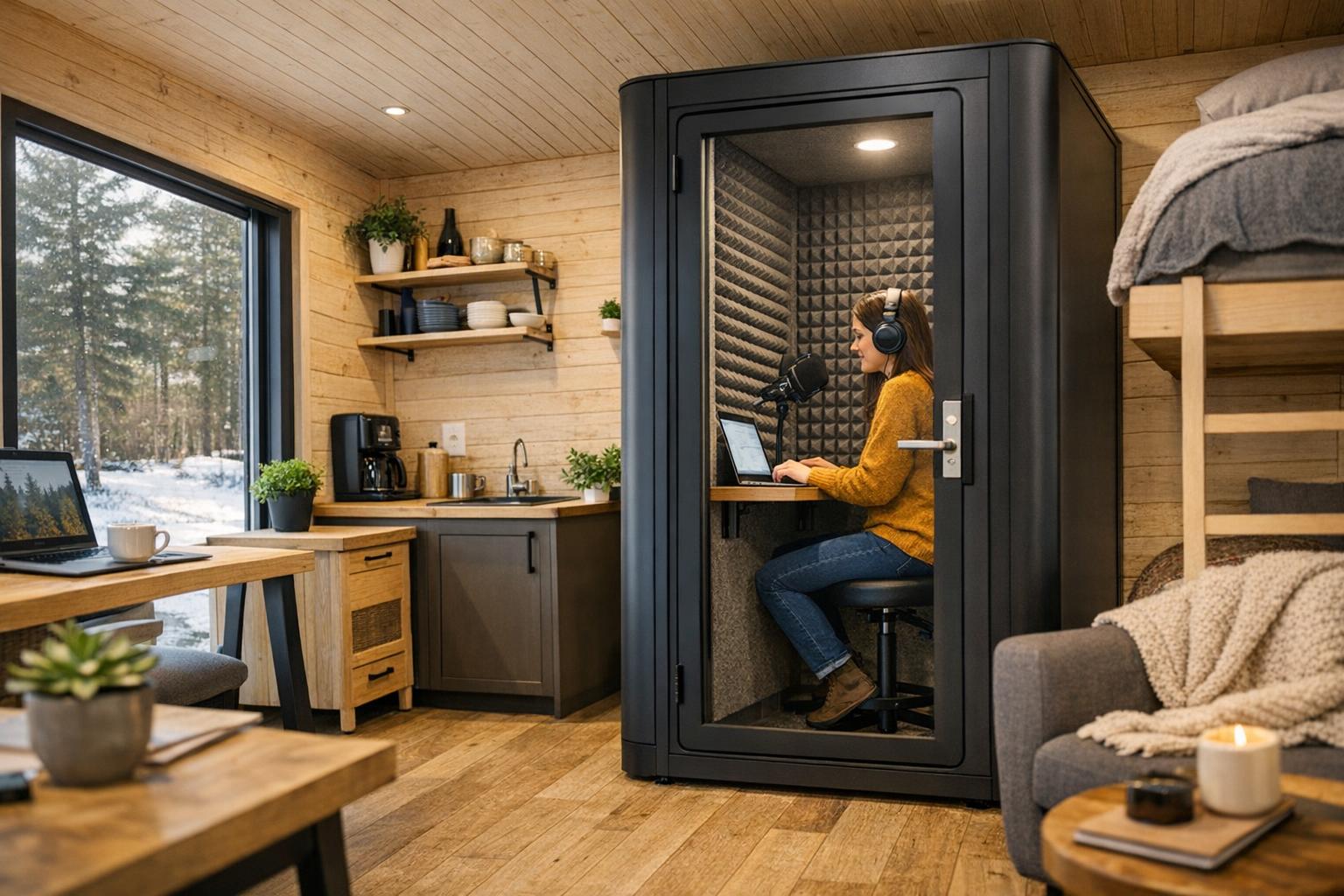
Why Every Tiny Home Needs a Soundproof Booth for Canadian Remote Work
Estimated reading time: 8 minutes
Key Takeaways
- Enhanced Privacy: Soundproof booths provide a dedicated workspace, ensuring confidential calls and meetings remain private even in compact environments.
- Optimized Small Spaces: Integrating soundproof booths transforms tiny homes and ADUs into functional micro offices with superior acoustic design.
- Adaptability for Remote Work: As Canadian remote work trends evolve, these innovative solutions support flexible and hybrid work models.
Table of Contents
- Introduction: Soundproof Booths, Canadian Remote Work, and Tiny Home Privacy
- The Rise of Canadian Remote Work and Its Impact on Home Design
- Tiny Home Privacy: Challenges of Privacy and Noise Control
- Introducing Soundproof Booths and Their Role in Compact Workspaces
- Advanced Acoustic Design Principles for Tiny Spaces
- Soundproof Booth Solutions Tailored for Tiny Homes and ADUs
- Styling, Space Efficiency, and Aesthetic Considerations
- Practical Tips for Choosing and Setting Up a Soundproof Booth in Canada
- Conclusion: Soundproof Booths Make Remote Work Success Possible in Tiny Canadian Homes
- Frequently Asked Questions
A soundproof booth is a compact, self-contained space meticulously engineered to block outside noise and provide a private environment. In today’s world of remote work—especially in Canada—the need for personal, quiet zones inside tiny homes and ADUs is rapidly growing.
As remote work trends evolve, many Canadians are working in limited spaces where every square inch counts. Maintaining privacy while ensuring that confidential calls remain secure is both a challenge and a necessity.
Modern acoustic design paired with innovative micro office solutions offers a way forward. By integrating advanced soundproof booths into small dwellings, Canadians overcome the practical limitations of open or multi-use spaces.
- In mid-2025, only 17.4% of Canadian workers primarily worked from home—down from a pandemic high of 24% (Source).
- Yet, 53% of employers now offer hybrid work models, reflecting evolving workspace demands (Source).
Adapting with a soundproof booth engineered with innovative acoustic design might be the key to enhancing both privacy and productivity in even the smallest Canadian homes.
Canadian remote work routines changed drastically during the pandemic. By mid-2025, the percentage of workers mainly at home had dropped, even though hybrid arrangements remain popular. Around 78% have resumed working from external offices (Source).
- Hybrid work is now the norm: 53% of employers provide flexible hybrid models (Source).
- Work patterns vary by location:
- Only 5% work remotely in Montreal and Waterloo.
- 8% do so in Vancouver and Winnipeg.
- Hybrid work dominates in Montreal (38%) and Waterloo (37%).
These trends highlight the need for agile, space-efficient workspaces. Incorporating a compact micro office within a tiny home is becoming increasingly essential.
Key Takeaways:
- Home design must now accommodate hybrid and part-time remote work environments.
- Regions with higher rates of hybrid work see a greater demand for dedicated, quiet work zones.
Sources: 2727 Coworking, Robert Half
Tiny home privacy means controlling noise and preserving personal space within a compact living area. In tiny homes, where separate rooms for work and living rarely exist, maintaining a quiet environment is critical.
- Space limits: Differentiating between living, sleeping, and working areas is challenging.
- Noise disruptions: Daily sounds—from appliances to outdoor traffic—can disturb focus during work calls.
A soundproof booth offers an effective solution by creating a barrier against noise and establishing a professional workspace in a multi-use environment.
For more on privacy strategies in small homes, see Tiny Home Privacy: Essential Strategies and Design Solutions for Small Spaces and ADU Interiors.
A soundproof booth is a self-contained unit designed to reduce noise transmission and enhance privacy. Unlike traditional home offices, these booths are compact enough for tiny living spaces or ADUs.
- Enhanced focus: Blocking external distractions helps boost concentration and work efficiency.
- Confidential settings: Ideal for sensitive conversations and secure work tasks.
- Flexible integration: Modern booths can be installed quickly and integrated seamlessly into any space.
While traditional offices require entire rooms, a soundproof booth fits within the existing layout, serving multiple users and diverse purposes. For further insights into setting up efficient home offices, visit Home Office Solutions for ADUs and Backyard Workspaces.
Acoustic design is the art of managing sound in an environment. In tiny homes and micro offices, its role is crucial:
- Material Selection:
- Utilize sound-absorbing panels like acoustic foam and engineered wood to capture noise.
- Employ proper insulation to prevent sound leakage.
- Smart Layout:
- Design the space to prevent the booth from cramping living areas.
- Include ergonomic seating and compact desks to maximize comfort.
- Ventilation and Lighting:
- Install quiet ventilation systems and adjustable LED task lighting.
Advanced acoustic design isn’t just functional—it also brings style to small workspaces. Learn more about tactile innovations in Acoustic Design for Canadian Tiny Homes.
For tiny homes and ADUs, every inch counts. Soundproof booth solutions are divided into two main types:
-
Modular Booths:
- Pre-built and flat-packed for quick assembly.
- Ideal for renters and those requiring flexible setups.
-
Built-in/Custom Solutions:
- Integrated into walls or corners to maximize space.
- Offers higher customization to match home décor and design standards.
| Feature | Modular Booth | Built-in Solution |
|---|---|---|
| Installation | Fast, tool-free | Requires professional installation |
| Mobility | Portable | Fixed |
| Customization | Moderate | High |
Soundproof booths must also consider Canadian weather and building codes, especially in ADUs. For more detailed guidance, explore Tiny Home Living Guide.
Integrating a soundproof booth into a tiny home requires attention to style and function to avoid clutter:
- Multi-functional Design: Choose booths that double as storage or can be folded away when not in use.
- Colour and Material Choices: Select finishes that blend with your home décor, such as natural woods or soft fabrics.
- Low-profile Builds: Designs with clean lines and hidden seams help maintain an uncluttered look.
When done correctly, these additions enhance both acoustic design and overall aesthetic appeal. Discover more ideas in Tiny Home Design Best Practices.
Setting up a soundproof booth in a Canadian tiny home or ADU involves careful planning. Follow this step-by-step guide:
1. Check Local Building Codes and Climate Needs
– Verify local regulations, especially for ADUs.
2. Size and Placement
– Measure available space; booths can be as small as 0.8m² while ensuring ergonomic usability.
3. Power and Connectivity
– Ensure there’s a dedicated power outlet and strong Wi-Fi or Ethernet connection.
4. Ergonomics and Comfort
– Look for adjustable seating and proper ventilation to avoid overheating.
5. Privacy and Effectiveness
– Choose models with proven sound reduction ratings (typically 30+ dB) to guarantee clear calls and focused work.
These steps underscore how important a reliable workspace is in today’s hybrid work era. For more inspiration, read about turning ADUs into productive retreats at Remote Work Retreat ADU Guide.
Canadian workspaces are evolving, and soundproof booths are at the forefront of this change. They offer a practical solution to improve both privacy and productivity within the constraints of tiny living spaces.
- They address real challenges related to noise and unclear boundaries in multi-use spaces.
- Advanced acoustic design and smart integration transform micro offices into professional environments.
- Whether it’s confidential calls or deep focus work, soundproof booths ensure tiny home privacy is maintained.
If you’re looking to elevate your remote work experience without compromising on space, a soundproof booth could be the home upgrade you need.
Frequently Asked Questions
Q1: What materials are typically used in soundproof booths?
A: Most soundproof booths use a combination of acoustic foam, dense insulation, and specialized panels to block noise effectively.
Q2: Can a soundproof booth be integrated into any tiny home layout?
A: Yes, many modern booths are designed to be modular or custom-built, making them flexible enough to fit various layouts without sacrificing style.
Q3: Are soundproof booths energy efficient in extreme Canadian climates?
A: Absolutely. Many units feature insulated panels and draft-proof doors, making them suitable for all four seasons in Canada.
Q4: How do I ensure my soundproof booth meets local building codes?
A: It’s recommended to consult local regulations and, if necessary, work with a professional to ensure the booth is compliant—especially in ADUs or custom builds.
Leave a Reply