

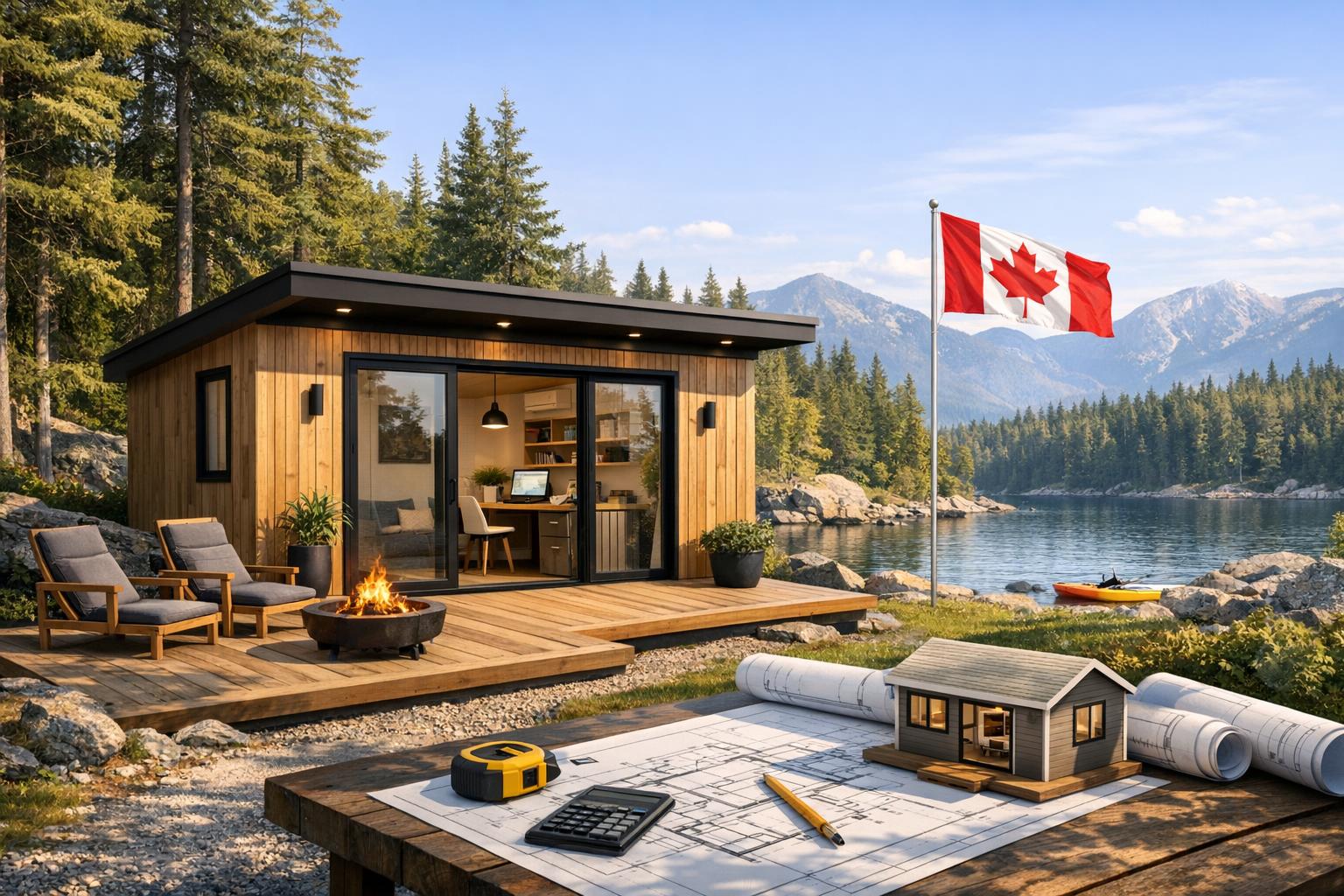
Tiny Home Studio Canada: 2026 Guide to ADUs, Maker Spaces, and Startup Workspaces
Estimated reading time: 18 minutes
Key Takeaways
- A tiny home studio Canada is a compact, permitted (where required) workspace in ~100–500 sq ft that blends living, making, and business functions.
- Pick a clear primary use—art, maker, or hybrid startup—before designing; this drives ventilation, power, and layout choices.
- Permitting and zoning vary widely; start with national guidance and then check your municipality.
- Maker fit-outs add costs for ventilation and electrical—plan those early with licensed trades.
- Use vertical storage, clear aisles, and a designated “dirty” vs “clean” zone to keep small spaces functional.
Table of contents
- Introduction
- Quick at-a-glance
- Who this is for
- Why tiny home studios are smart in 2026
- Who should consider one (personas)
- Design ideas & space planning
- Converting an ADU into a workspace
- Maker space considerations
- Regulatory landscape & permitting
- Costs, financing, and ROI
- Case studies & examples
- Practical steps to get started
- FAQs
- Checklist content
- Conclusion
A tiny home studio Canada setup is a compact, purpose-built tiny home or accessory dwelling unit (ADU) located in Canada that is designed, configured, and permitted (where required) to serve as a workspace—for artists, makers, and small startups—combining living, working, or studio functions in about 100–500 sq ft with tailored ventilation, power, and storage. A tiny home studio Canada plan can help Canadian artists and small business owners create an affordable, flexible startup workspace without signing a long commercial lease.
This guide breaks down real options and choices for 2026: examples, regulations, design ideas, costs, conversion steps, and a practical checklist you can copy into your notes.
Research note: Some synthesis in this article reflects a research-assistant summary method; always confirm rules and specs with primary sources and your municipality. See Perplexity for research tools and quick summaries.
Quick at-a-glance: what you’ll get from this article
- What a tiny home studio is (and which layout fits: art studio, maker space, or hybrid startup workspace).
- Ballpark costs (estimates) for DIY shells, prefab builds, and full maker fit-outs.
- Typical timelines: planning (2–6 weeks), permits (2–12+ weeks), build (4–12 weeks).
- Permits to expect in many places (zoning check, building, electrical, plumbing, HVAC, business licence—VERIFY locally).
- Maker space safety basics: ventilation, power planning, dust control, and storage for flammables.
- A printable checklist outline you can use for “Build Your Tiny Home Studio — Canada Checklist 2026”.
(Section sources: start with the CMHC ADU guidance for Canada-wide context.)
Who this is for (tone + audience)
This is for entrepreneurs, startup founders, indie makers, Canadian artists, small business owners, designers, and DIY builders who want a tiny home studio that is practical, safe, and easy to run. The focus is clear steps, simple options, and “what to decide next” so you can build a workspace that fits your work.
(Section sources: Funding and financing links can matter for this audience—see Canada Council funding.)
Additionally, for broader context on compact living and related posts, explore the compact-living resources at ADUstart’s tiny home living guide and related posts on home-office conversions.
Why tiny home studios are a smart choice in 2026
Commercial space remains expensive in many Canadian cities; many small businesses prefer not to sign long leases. Hybrid work is common, and more municipalities have clearer pathways for ADUs, laneway homes, and secondary suites—always VERIFY locally.
Key benefits (with simple, practical comparisons)
- Affordability vs commercial rent (ballpark—VERIFY)
Many projects find monthly costs closer to $500–$1,500/month (loan payment, yard rental + utilities) versus $1,500–$5,000+/month for small commercial spaces, depending on city and fit-out. - Flexible use
A tiny home studio can be:- a quiet art room,
- a product packing hub,
- a client meeting spot,
- a part-time teaching space.
- Lower footprint
Smaller spaces usually mean lower heating/cooling loads and fewer materials. - Clearer work-life boundary
Having a separate studio can reduce stress and help you keep “home” separate from “work.” - Tax and expense notes (not tax advice)
Some workspace costs may be deductible for a home-based business; check the Canada Revenue Agency guidance and talk to an accountant.
ADUs are a big reason this is easier than it used to be—many Canadians are using creative ADU builds via laneway housing, garden suites, and accessory dwelling units. Start with the CMHC ADU hub, then check your municipality.
Consider also ADU overview material at ADUstart’s guide.
Who should consider a tiny home studio?
Different work needs create different layouts. Below are common personas, their needs, and a fast design checklist for each.
1) Solo artists (painting, illustration, textiles)
You likely need calm, daylight, and storage that doesn’t eat the floor. Many Canadian artists want a spot to photograph work, package orders, and keep materials away from pets.
Typical needs
- North-ish light or soft, even lighting
- Tall storage for canvases and paper
- A sink (nice to have) and easy-clean floors
Budget idea (estimate—VERIFY)
DIY shell $10k–$30k, prefab $30k–$80k depending on size and finish.
3-point design checklist
- Light: big window + good task lights
- Storage: vertical racks + closed cabinets
- Clean-up: wipeable floors + a small utility sink if possible
(Section sources: arts funding context at Canada Council and ADU guides at ADUstart.)
2) Craft entrepreneurs / Etsy sellers
If you ship products, you need a smooth workflow more than a “pretty room.” The studio should reduce steps: make → label → pack → store → ship.
Typical needs
- Packing bench + label printer spot
- Inventory shelving
- Small photo corner (backdrop + lights)
Budget idea (estimate—VERIFY)
Often fits well in 160–240 sq ft with smart storage.
3-point design checklist
- Workflow: one counter for packing + one for making
- Storage: bins with labels + a returns shelf
- Shipping: dedicated desk + scale + mailer storage
(Section sources: small-business supports like Futurpreneur.)
3) Micro-manufacturers & makers (3D printing, CNC, laser, woodworking)
“Studio” becomes maker space territory. Power, ventilation, and noise control decide everything. Many makers keep “clean” tools inside and outsource heavy, dusty, or high-risk work.
Typical needs
- Dedicated circuits; sometimes 240V (VERIFY with electrician)
- Strong ventilation + filtration
- Dust and fire planning
Budget idea (estimate—VERIFY)
A safer fit-out can cost more than the shell because fans, ducting, and electrical add up.
3-point design checklist
- Air: direct exhaust + HEPA filtration
- Power: enough circuits + clear shutoffs
- Safety: fire extinguisher + safe storage for chemicals
(Section sources: safety reference at WorkSafeBC and maker-space directory makerspaces.io.)
4) Remote-first startups & consultants
A tiny studio can be a small “HQ” for calls, focus work, and client meetings. The goal is a clean background, good sound, and a simple space that feels professional.
Typical needs
- Acoustic control for video calls
- A small meeting table (2–4 seats)
- Reliable internet plan (site-dependent)
3-point design checklist
- Sound: soft finishes + door seals
- Layout: desk faces a clean wall or tidy shelf
- Lighting: front-facing key light + window control
(Section sources: financing overview at the Canada Small Business Financing Program.)
5) Educators & workshop hosts
If people will visit, rules can change (occupancy, exits, washroom access, parking, business licensing—VERIFY). You may need more open floor, flexible seating, and clear safety signage.
Typical needs
- Open space + folding tables
- Easy exits and clear aisles
- A plan for accessibility where required
3-point design checklist
- Flow: 36″ minimum main aisles (best practice)
- Safety: posted rules + first-aid kit
- Seating: stackable chairs + fold tables
(Section sources: CMHC ADU guidance at CMHC and municipal licensing pages.)
Tiny home studio design ideas & space planning
A tiny home studio works best when you pick your “main job” first. These are the three most common workspace types:
Workspace type 1: Quiet art studio
Priorities: daylight, clean storage, calm surfaces, safe materials storage.
Workspace type 2: Noisy maker space
Priorities: power, ventilation, dust control, noise control, fire safety.
Workspace type 3: Hybrid studio-office (startup workspace)
Priorities: meeting corner, video-call sound, modular furniture.
Floorplan sketch #1: 8×20 tiny studio (160 sq ft)
Best for: solo art, crafts, packaging, light fabrication.
Suggested layout
- Work zone on one long wall: foldaway table or 24–30″ deep bench
- Storage wall opposite: pegboard + 12–18″ deep shelves
- Mini-split head high on a short wall
- Clear centre area for moving projects
Power & mechanical (general—VERIFY code)
Multiple 120V circuits for tools + lighting; dedicated circuits for printer/heat pump as needed.
Clearances: Keep main paths at least 36″ where possible.
(Section sources: CSA Group for safety standards at CSA Group.)
Floorplan sketch #2: 10×24 tiny home (240 sq ft)
Best for: artists who want a sink, small kitchenette, or bathroom/support zone.
Suggested layout
- Front: main studio with big window and a photo corner
- Mid: storage + tall closet for inventory/materials
- Back: compact kitchenette and/or bathroom, or a “messy” wash-up area
- Optional loft: overflow storage or rest zone (VERIFY egress rules if sleeping)
Furniture ideas: Murphy-style table, rolling drawer units under benches.
(Section sources: CMHC ADU guidance at CMHC and ADUstart content.)
Floorplan sketch #3: 12×28 ADU-like tiny home (336 sq ft)
Best for: hybrid maker + admin, or a small startup workspace with light making.
Suggested layout
- Shop zone near exterior door: bench + tool wall + direct exhaust
- Office corner: desk, whiteboard wall, lockable file storage
- Meeting table for 2–4 people
- Optional small utility sink
Noise strategy: Separate shop and office with a partition wall for loud tools.
(Section sources: municipal ADU/laneway pages—Vancouver, Toronto, Calgary, Montréal—see local links below.)
Storage & organization that actually works in 100–500 sq ft
- Vertical storage first: pegboards, tall cabinets anchored to studs, wall-mounted racks.
- Right-size shelves: 12–18″ deep shelves for art supplies and small bins.
- Bench dimensions: many benches 24–30″ deep; bench height ~34–36″ (adjustable).
(Section sources: CSA Group at CSA Group.)
Natural light, glazing, and ventilation (rule-of-thumb—VERIFY)
- Art studios often prefer north-facing windows for even light.
- Rule-of-thumb: 10–15% window area vs floor area (verify energy & code rules).
- Maker work needs early ventilation planning: local exhaust to exterior + HEPA filtration for fine dust.
(Section sources: safety planning at WorkSafeBC.)
Dust control & soundproofing (small space, big impact)
Dust control basics
- Shop vac with HEPA filter
- Cyclone pre-separator to protect filters
- Portable dust collector for heavier woodworking (size varies)
Sound control basics
- Door seals + weatherstripping
- Acoustic panels for video-call zones
- Mass-loaded vinyl or double-layer drywall for partitions (space/cost trade-offs)
(Section sources: WorkSafeBC at WorkSafeBC.)
Converting a creative ADU into a workspace
A creative ADU is an accessory dwelling unit adapted or designed to support creative work: production, client meetings, micro-galleries, or small-scale maker use.
Common creative ADU use cases
- Artist live-work (where allowed)
- Micro-gallery with appointment viewing
- Teaching space for small groups (rules may change—VERIFY)
- Consultation hub or startup workspace for remote teams
(Section sources: CMHC ADU guidance at CMHC.)
Permit and livability tweaks to plan for (VERIFY locally)
- Egress doors/windows: If anyone sleeps there or it’s classed as a dwelling, egress rules apply—verify with your municipality.
- Insulation & cold-climate performance: Aim to meet or exceed provincial code; continuous insulation helps in cold climates.
- Plumbing & electrical: Plan venting, backflow protection, and dedicated circuits; use licensed trades.
- Smoke/CO alarms & ventilation: Mixed-use spaces need clear life-safety planning.
Adaptive reuse examples (simple checklists)
Garage-to-studio conversion checklist
- Structural and moisture check (slab, framing, roof)
- Insulation upgrade + air sealing
- Add natural light (window or skylight—VERIFY permits)
- Decide: studio-only vs studio + bathroom
- Confirm permit path (building + electrical + plumbing)
Laneway/garden suite conversion notes
- Confirm site access and setbacks
- Check municipal laneway or garden suite rules
- Plan delivery/craning access for prefab units
(Section sources: municipal examples—Vancouver, Toronto, Calgary, Montréal—see local pages.)
Maker space considerations inside a tiny home studio
If your tiny home studio includes making, treat air, fire, and power as core structure elements—not add-ons.
Equipment triage: what fits vs what to outsource
Usually workable inside a tiny maker space
- 3D printers
- Desktop laser cutters (with proper ventilation—VERIFY)
- Benchtop CNC
- Small mitre saw / compact table saw (with dust planning)
- Compact drill press
Often better to outsource
- Large CNC routers
- Industrial presses
- Full-size metalworking lathes
- Large kilns
A smart approach is “clean work inside, heavy work at a partner maker space.” (Find local shops via makerspaces.io.)
Power and ventilation (high-level—VERIFY)
- Use dedicated circuits for high-load equipment.
- Some tools require 240V—plan early with a licensed electrician.
- For fumes, use ducted exhaust to exterior (not into attics).
- Strong exhaust may require a make-up air plan—consult an HVAC pro.
(Section sources: CSA Group, WorkSafeBC.)
Safety and fire basics (VERIFY with local fire/building authority)
- Store flammables in approved cabinets
- Keep compressed gas outside living areas where allowed
- Fire extinguisher: Class ABC general use; Class D for combustible metals when relevant
- Install smoke + CO alarms for mixed-use buildings
(Section sources: WorkSafeBC.)
Partnering with local maker spaces (simple outreach prompts)
When you email a maker space, be clear:
- “Here’s what I make, and which tools I need 2–4 times per month.”
- “I can take your safety orientation and follow your shop rules.”
- “I’m looking for access to [tool/process] plus advice on safe ventilation for my tiny home studio.”
- “I can trade skills: teach a class or help with shop photos.”
(Section sources: makerspaces.io.)
Regulatory landscape and permitting (Canada-focused)
Rules vary by province and municipality. Always VERIFY zoning, building code pathway, and business licensing before spending on drawings or units.
Start here, then go local:
- CMHC ADU guidance (national starting point)
- Your city’s ADU/laneway/secondary suite pages (see examples below)
- Your local building permit office
(Section sources: CMHC and city examples.)
What usually varies (and can change your design)
- Zoning and land-use: lot size, height, setbacks, parking, servicing
- Building code path: foundation build vs tiny home on wheels
- Business licensing: classes, retail sales, signage, visitors, hours
- Short-term rental rules: separate rules may apply
Practical permit checklist (common items—VERIFY locally)
- Zoning / land-use verification
- Building permit
- Electrical permit
- Plumbing permit
- HVAC permit
- Septic/wastewater/utility approvals
- Business licence & occupancy classification
- Fire safety inspection
- Insurance confirmation (home-based business + equipment)
Tips for working with permitting offices
- Bring a one-page project summary: what it is, size, use, site notes.
- Bring a simple site plan and floorplan.
- Ask about pre-application reviews.
- Be clear if it’s studio-only, live/work, or client-facing maker space.
(Section sources: municipal pages for Vancouver, Toronto, Calgary, Montréal—see local links: Vancouver laneway housing, Toronto laneway housing, Calgary ADUs, Montréal.)
Costs, financing, and ROI
Costs depend on size, site work, and how “industrial” your studio is—ventilation and electrical can be major line items. Use these as starting ranges only.
Ballpark budgets (estimates—VERIFY locally)
- DIY shell (trailer or foundation): $10,000–$40,000
- Prefab tiny home / turnkey shell: $35,000–$120,000
- Full custom build + maker fit-out: $75,000–$250,000
- Annual operating costs: $500–$3,000+/year (utilities, maintenance, insurance)
(Section sources: financing info at the Canada Small Business Financing Program.)
Financing options (Canada)
- Personal savings / personal loan / HELOC
- Canada Small Business Financing Program
- Arts funding: Canada Council, provincial arts councils (Ontario Arts Council, BC Arts Council, CALQ)
- Community Futures (rural) at Community Futures
- Crowdfunding for product makers
Simple ROI scenarios (illustrative—VERIFY your numbers)
- Startup workspace rent savings: Avoiding $2,500/month commercial rent for 36 months = $90,000 saved; if tiny studio cost $75,000, payback could be ~3 years (varies).
- Classes/workshops: 2 classes/week × 6 students × $60 = $720/week → $28,800/year (40 weeks).
- Artist sales: $50,000 build cost ÷ $200 average sale → 250 sales to recoup gross (excludes costs).
Case studies & examples (Canada-specific formats you can copy)
Real case studies need permissions, photos, and verified costs. Use these profile formats to guide your own plan.
Example profile 1: Vancouver-area consultant builds a backyard startup workspace
- Location: Metro Vancouver (verify municipality)
- Persona: Remote consultant / startup founder
- Size: ~240–336 sq ft
- Budget: Estimate $80k–$140k
- Uses: Calls, proposals, client meetings, light prototyping
(Section sources: Vancouver laneway housing.)
Example profile 2: Toronto maker uses a hybrid home studio + local maker space
- Location: Toronto
- Persona: Product maker (3D printing + light assembly)
- Size: ~160–240 sq ft studio + off-site heavy tools
- Budget: Estimate $50k–$120k
- Uses: Printing, packaging, admin; heavy cutting outsourced
(Section sources: Toronto laneway housing, makerspaces.io.)
Example profile 3: Calgary artist builds a clean, bright tiny home studio
- Location: Calgary
- Persona: Painter/illustrator
- Size: ~160–240 sq ft
- Budget: Estimate $35k–$90k
- Uses: Painting, framing, order packing, photo corner
(Section sources: Calgary ADU overview.)
For additional Canada-specific profiles and regulatory context, see ADUstart’s Ontario ADU zoning guide and the Canadian ADU regulations guide.
Practical steps to get started (actionable checklist)
Use this step-by-step path for a tiny home studio Canada project. Add dates beside each step.
- Site selection (1–7 days)
- Check orientation for light, neighbour impacts, and access.
- Confirm setbacks, servicing, and delivery/craning access (if prefab).
- Do a zoning pre-check with your municipality (VERIFY).
- Budgeting and cost estimate (3–10 days)
- Get 2–3 quotes for trades you won’t DIY.
- Add 15–25% contingency.
- Confirm tax/accounting approach for a home-based business.
- Choose: prefab vs custom vs conversion (2–7 days)
- Prefabs: faster, predictable.
- Custom: best for odd lots and special equipment.
- Conversions: can save on structure but watch moisture/insulation.
- Concept and floorplan (2–14 days)
- Make a program list: tools, storage, shipping, meeting area, sink/bath needs.
- Sketch layout, keep main aisles near 36″.
- Decide dirty vs clean zones.
- Permits and pre-application (2–12+ weeks)
- Book a pre-consultation if offered.
- Bring a site plan + floorplan + description of use.
- Hire or contract (1–4 weeks)
- Decide who designs, builds, and pulls permits.
- Use licensed trades for electrical and plumbing.
- Utilities and mechanicals (1–3 weeks planning)
- Electrical service: ensure it matches your equipment needs.
- Ventilation: design duct routes early.
- Heating: mini-split heat pumps are common (VERIFY site/climate).
- Build and fit-out (4–12 weeks)
- Install benches, secure storage, dust control, and tool zones.
- Add labelling for shutoffs and safety rules.
- Insurance and licensing (1–3 weeks)
- Confirm business liability and contents/equipment coverage.
- Apply for a business licence if required (VERIFY).
- Launch and operations setup (1–4 weeks)
- Test workflow: make → pack → store → ship.
- Join local maker networks for skills and tool access.
Timeline example (typical ranges): Planning & design 2–6 weeks; Permitting 2–12+ weeks; Build & fit-out 4–12 weeks; Operations setup 1–4 weeks.
Resources & partners (Canada): CMHC ADU guidance, Canada Council, Canada Small Business Financing Program, provincial arts councils, makerspaces.io, Futurpreneur, Community Futures.
FAQs
Can I live and work in a tiny home in Canada?
Often yes, but it depends on zoning, building code pathway, and classification. Start with the CMHC ADU guidance and your city’s ADU/laneway rules.
What about winter heating in a tiny home studio?
Good insulation, air sealing, and an efficient heat source (often a mini-split heat pump) are key. Check local energy rules and climate specifics.
Do I need a business licence to sell from a tiny home studio?
If customers visit, you teach classes, or you sell on-site, a business licence may be required—check your municipality (example: Montréal licensing pages).
How do I handle waste and water?
Common options: municipal water/sewer connections or septic (where allowed). Off-grid systems often require extra approvals—VERIFY with local authorities and CMHC guidance.
What permits are typically required?
Often: zoning/land-use verification, building, electrical, plumbing, HVAC, and sometimes business licensing and fire inspection. Requirements change by city and use—start at the CMHC ADU hub.
Can I use a tiny home on wheels as a permanent studio?
Maybe. Tiny homes on wheels are often treated differently from foundation builds—zoning, servicing, inspections, and insurance vary. Confirm with your municipality before buying.
Where can I find tool access if my studio is too small?
Partner with a local maker space for heavy tools, training, and safety processes—find options via makerspaces.io.
Checklist content (for “Build Your Tiny Home Studio — Canada Checklist 2026”)
Below is a compact checklist you can copy into a printable page. Use checkboxes and short notes.
- ☐ Site selection questions — Light direction, neighbour distance, access for delivery, snow/rain drainage.
- ☐ Zoning & permit pre-check — Confirm ADU/tiny structure rules, setbacks, servicing, and home-business limits.
- ☐ Budget template + contingency — Include electrical, ventilation, insulation, and 15–25% contingency.
- ☐ Tools & equipment triage — Decide what stays in-studio vs what moves to a maker space partner.
- ☐ Ventilation & electrical must-haves — Dedicated circuits, safe shutoffs, ducted exhaust to exterior.
- ☐ Insulation & heating — Air sealing plan, cold-bridge mitigation, heating approach (VERIFY code).
- ☐ Insurance & business licensing — Liability + equipment coverage; check licensing if clients visit.
- ☐ Launch checklist — Workflow test, storage labels, safety signage, cleaning plan.
(Section sources: CMHC ADU guidance, WorkSafeBC, CSA Group, makerspaces.io.)
Conclusion
A tiny home studio Canada project can be a strong move in 2026 if you want lower fixed costs, a clearer work-life boundary, and a space designed around your exact craft or service. The best results come from matching your layout to your workflow (art, maker space, or hybrid startup workspace), planning permits, ventilation, and power early—and verifying every local rule before you build.
(Section sources: start with the CMHC ADU guidance and confirm with municipal pages for Vancouver, Toronto, Calgary, and Montréal.)
Leave a Reply