

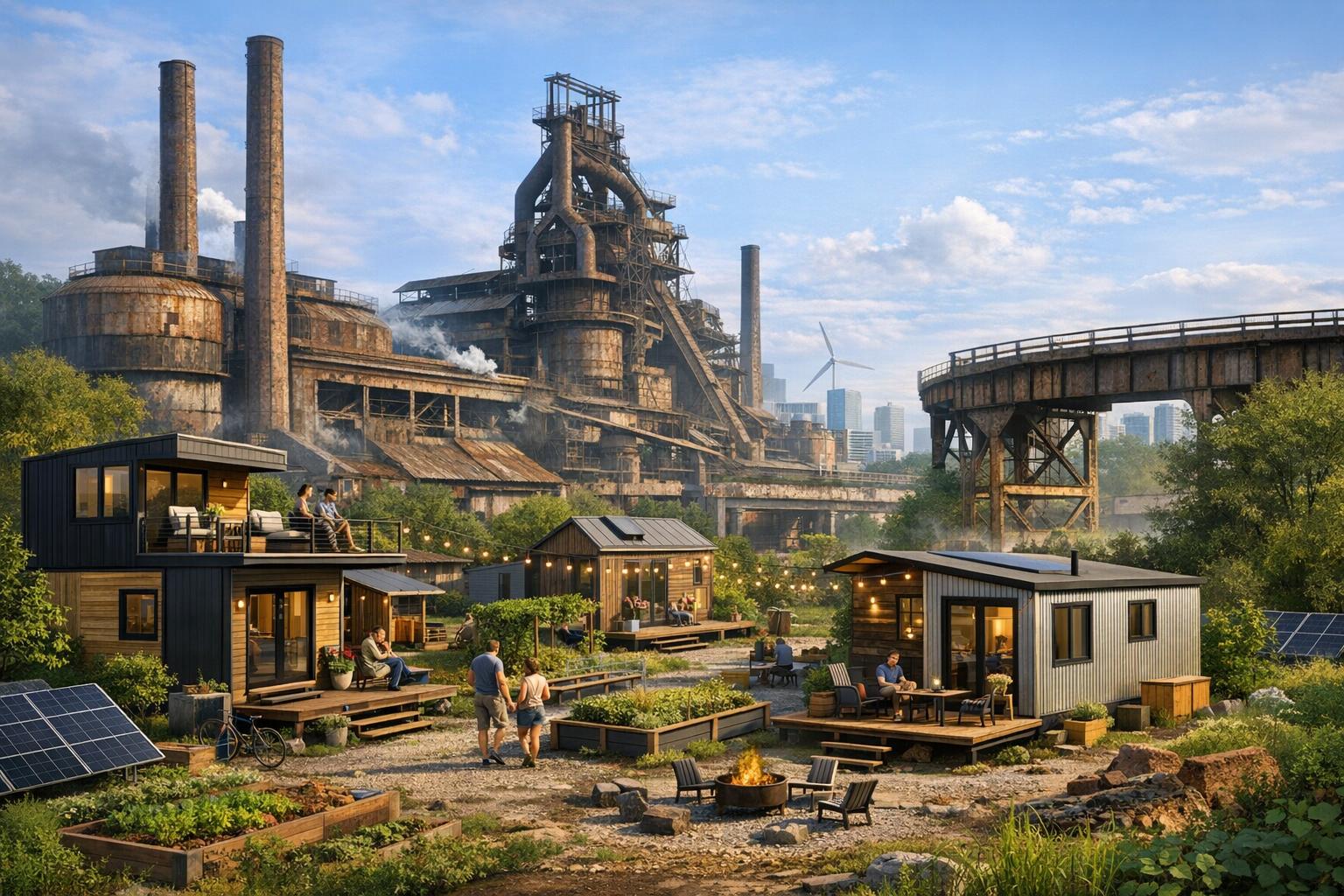
Tiny homes industrial sites: Scalable industrial revitalization & urban renewal in Canada (2026)
Estimated reading time: 14 minutes
Key Takeaways
- Tiny homes industrial sites convert underused industrial land into affordable tiny home and ADU communities, accelerating industrial revitalization and urban renewal.
- Build pilots with proven modular manufacturers such as MMRH and learn from the Tinybox Arctic pilot for cold-climate, repeatable delivery.
- Key success factors: strict due diligence (Phase I/II ESAs), clear ADU/zoning pathways, conservative remediation budgets, and a realistic operations budget.
- Design choices (clustered communities vs scattered ADUs) determine infrastructure needs, ownership models, and permitting complexity.
- Use a phased pilot approach (6–15 units) to prove operations, refine costs, and unlock funding including remediation grants and tax-increment tools.
Table of contents
- Introduction
- Why convert industrial land
- Market & policy context (Canada 2026)
- Site types suited to conversion
- Design approaches & housing models
- Case studies (Canadian + international)
- Financing & delivery
- Regulatory & permitting checklist
- Community engagement
- Implementation roadmap & pilot blueprint
- Toolkits & templates
- Risks & mitigation
- Visual and asset plan
- SEO & on-page keyword placement plan
- Metrics and success criteria for the post
- Conclusion
Introduction
Tiny homes industrial sites are underused, surplus or abandoned industrial parcels (brownfields, vacant warehouses, rail yards, surface lots) repurposed to host clustered tiny home communities and/or accessory dwelling units (ADUs) through modular/prefab, container, trailer-mounted or permanent foundation models.
To keep terms clear:
- Tiny home: usually 65–400 sq ft. It can be trailer-mounted (mobile) or built on a foundation. In Canada, a common cost range is $65,000–$235,000 CAD per unit, depending on size, finish, location, and build method.
- ADU (Accessory Dwelling Unit): a second home on the same lot as a main building. It must meet local rules (zoning + building code). In some places, a tiny home can count as an ADU if it meets the bylaw and permit rules.
Why this matters in 2026: tiny home communities placed on the right industrial parcels can speed up industrial revitalization and urban renewal across Canada, especially when paired with modular builds and strong local partnerships.
Key references: pricing and build-cost context from Constructem, product examples from MMRH, and cold‑climate learnings from the Tinybox Arctic pilot.
For broader context, see Launching Tiny Home Community Startups in Canada.
Why convert industrial land
Reusing industrial land reduces sprawl, returns underused parcels to the tax base, and stimulates local economic activity.
Land-use benefits (infill that’s faster to deliver)
Converting vacant factories, brownfields, and surplus yards can unlock housing without pushing outward into farmland or forests.
Key land-use wins:
- Infill on brownfields and vacant factories instead of greenfields
- Shorter build timelines using prefab/modular or adaptive reuse
- Better use of existing roads and services (where available)
- A clearer “before/after” story for industrial revitalization in older districts
Modular and prefab producers can help shorten schedules because much of the work happens in a factory setting. See MMRH for product examples.
Social benefits (more affordable options that can fit many needs)
Tiny homes can fill real gaps: seniors downsizing, workers near industrial jobs, people exiting homelessness, and people priced out of rentals.
Practical social outcomes:
- Affordability: $65,000–$235,000 CAD per tiny home is often far below new conventional housing costs.
- Flexible tenure: rent, rent-to-own, co-op, or community land trust models.
- Workforce housing near employment zones; the Tinybox Arctic approach shows how fast, small builds can reduce cost and crew size (Tinybox Arctic).
Important: affordability does not happen automatically. It needs the right land deal, servicing plan, and governance. Additional cost context: Constructem and market guidance like The Good Trade.
Environmental benefits (cleanup + better performance)
Industrial sites can carry pollution and stormwater problems. A tiny-home conversion can fix both if it starts with the right testing and design.
Environmental upsides:
- Brownfield remediation can make land safe for people again.
- Lower material use per home because units are smaller.
- Energy efficiency opportunities like high-performance insulation, heat pumps, and solar-ready designs.
- Better stormwater design (permeable paving, rain gardens) to reduce runoff from old paved yards.
Cold-climate innovation is especially relevant for Canada; see the Tinybox Arctic pilot for lessons on design and logistics (source) and regional practice in Nova Scotia (Green Building Canada).
Market & policy context (Canada 2026)
In 2026, housing pressure remains high; tiny homes on industrial parcels are attractive because they can deliver housing faster and at lower capital cost than conventional projects.
Housing pressure (including northern cost extremes)
In northern communities, costs can be extreme. Example: in Kuujjuaq (QC) conventional housing has been reported at up to $1 million per home, which drives interest in small, repeatable builds and local training models (Tinybox Arctic).
Cost and market variability across provinces
Costs vary by province and spec. Example ranges used for 2026 planning:
- Ontario: about $70,000–$180,000 CAD
- BC: about $80,000–$200,000 CAD
- Higher-spec modular models: $145,000–$235,000 CAD
These ranges should ground your pro forma assumptions. See pricing context from Constructem and manufacturer examples such as MMRH.
Zoning and ADU policy updates (a practical model)
A clear Canadian example: Squamish, BC permits tiny homes as ADUs in all single-unit zones (with rules). Policy lessons:
- Write clear definitions for tiny homes as ADUs
- Set rules for size, services, parking, and occupancy
- Align permitting steps so staff and applicants know what to do
2026 funding streams to check
Typical buckets for pilots:
- Affordable housing grants (municipal/provincial/federal)
- Brownfield remediation support
- Tax increment financing
- Land leases or land swaps as a non-cash contribution
Micro-pilot and manufacturer-led models can show results quickly. Useful references include the Tinybox Arctic pilot and MMRH.
Permitting expectations (cost + brownfield steps)
For brownfields expect environmental due diligence: Phase I and Phase II Environmental Site Assessments (ESAs) when required. Soft cost placeholders often cited:
- Engineering and permit costs: often cited around $1,500–$5,000 (varies by scope)
- Utility reviews and connection permits
Budget these early; see MMRH and Constructem for planning guidance.
Site types suited to conversion
Not every industrial parcel is a good fit. Match housing type to risk, servicing, and location.
Vacant factories & warehouses (adaptive reuse upside)
These sites often have existing road access and sometimes oversized utilities, and can support mixed-use setups: tiny homes in yards while buildings become maker space or services. See MMRH.
Brownfields & lightly contaminated lots (remediation-first)
Typical approach:
- Phase I ESA (paper review + site walk)
- If needed, Phase II ESA (testing)
- Choose remedy (remove, cap, treat, manage risk)
Remediation cost bands can range widely; use conservative numbers. Reference: Constructem.
Rail yards / underused yard space / large surface parking (transit-adjacent)
Old yard space is often flat and easy to lay out, near transit and job centres, and suited to phased rollout—start small, expand later. For ADU strategies see Squamish guidance.
Waterfront industrial strips & peri-urban peri-industrial lots (mixed-use pilots)
These can drive strong renewal but require extra checks: flood risk, shoreline rules, and stormwater. Cold-climate design and green infrastructure are essential; see the Tinybox Arctic pilot (source) and regional examples such as Green Building Canada.
Note: Indigenous-led Tiny Home Communities provide culturally grounded approaches — see ADU Start Indigenous-led guidance.
Design approaches & housing models
Two main strategies: clustered tiny home communities on a dedicated parcel, or scattered ADU infill across industrial-edge lots. Each has different infrastructure and governance implications.
Clustered tiny home communities (one site, one operating plan)
Good for clear management, shared amenities, and faster infrastructure planning.
Design rules of thumb:
- Typical unit size: 200–400 sq ft
- Typical density: 8–12 units per acre (rule-of-thumb)
Core infrastructure needs: water + sewer tie-ins (or approved alternatives), stormwater management, electrical sizing for heat pumps and winter loads, EV charging rough-ins, and fire access routes.
Shared amenities: community kitchen, laundry, tool/maker space, and a heated community building (important in Canada). For additional site and cost guidance, see HomeSmartLiving and Constructem.
Scattered ADU infill strategies (many lots, more coordination)
Good for gradual growth and lower political risk. This needs very clear zoning language and building rules — Squamish is a practical model (Squamish).
Construction typologies (modular, prefab, container, mobile)
Common options:
- Prefab/modular: factory-built quality and speed; some manufacturers reference CSA A277 for factory-built certification — higher-spec models often sit in the $145,000–$235,000 CAD band.
- Container conversions: strong structure but need careful insulation and moisture control.
- Trailer-mounted mobile units: highway compliance and clear rules for year-round occupancy are essential.
Factory-built approaches reduce site exposure on brownfields, but site works and safe servicing remain non-negotiable. Manufacturer examples: MMRH and marketplace summaries like The Good Trade.
Mixed-use models (industrial work + small homes)
Example concept: convert a warehouse with ground-floor maker-labs and an adjacent yard of tiny units. Accessibility matters: step-free entries, ramps, 32–36 inch doorways, and at least some units with grab bars and turning space.
Site design metrics (clear specs to hand to a designer)
Starting template:
- 1-acre scheme: 10 ADUs + 25% communal open space + 1 community building
- Circulation: 2-way lanes: 6–8 m width; pedestrian paths that stay lit and plowed in winter; bike parking: 1.5 spaces per unit
- Stormwater best practice: permeable paving, rain gardens, and separating clean roof runoff from suspect ground areas where possible
See regional practice: Green Building Canada.
Case studies (Canadian + international)
Each example below focuses on verified details and transferable lessons for tiny homes industrial sites.
Tinybox Arctic Pilot, Kuujjuaq, QC — 2026 (Canada)
Project overview
A Canadian startup advanced a cold-climate tiny home pilot in Kuujjuaq to address very high housing costs. The pilot showed how a small crew and a repeatable design can cut build cost and time in hard conditions.
Site profile
Remote northern conditions with limited infrastructure capacity; constraints mirror those on some underused industrial lands (logistics, servicing limits, climate).
Development steps & outcomes
- Pilot build with a two-person crew
- Reported pilot cost ~$90,000 vs up to $1M for conventional housing in the region
- Skills development and job training were integral
Lessons: standard designs lower cost when repeated; local training reduces schedule risk; cold-climate performance must be designed in. Source: Peter Gilgan Foundation / Tinybox Arctic.
MMRH tiny home models + lot concept (near Ottawa, ON)
Project overview
MMRH offers modular tiny homes with factory-built documentation and published pricing ranges useful for 2026 pilots.
Development steps & lessons
- Select a CSA/quality pathway (e.g., CSA A277)
- Match home type to local code and occupancy requirements
- Factory-built documentation helps lenders and insurers
Pricing references and certification can improve underwriting and timelines — see MMRH.
Squamish tiny homes as ADUs — zoning model
Project overview
Squamish publishes rules allowing tiny homes as ADUs in single-unit zones. This is a practical policy model for other municipalities.
Lessons: publish plain-language guides, align planning/building/inspection expectations, and clarify distinctions between tiny homes and RVs. See Squamish tiny homes guidance.
International comparator
International markets show a wide range of unit types (prefab, DIY, on-wheels). Transferable lessons: transport, setup, and servicing can be as important as unit price; on-wheels units are not automatically legal for year-round occupancy. Context: The Good Trade.
Financing & delivery
Repeatable pilots mix: (1) a workable land deal, (2) a build method with predictable pricing, and (3) an operating model that keeps homes affordable over time.
Common delivery pathways
- Public-Private Partnership (P3): municipality provides land lease or fee waivers; developer builds; community org manages operations. Tinybox illustrates an MVP partnership approach (source).
- Community Land Trust (CLT) / Co-op: CLT holds land for long-term affordability; operator runs homes; resale controls keep prices stable.
Grants + remediation support
When planning brownfields, cite remediation grants and tax increment financing in staff reports — they often make the difference between pilot approval and rejection. See cost guidance at Constructem.
Sample pro forma (15-unit pilot — illustrative)
Assumptions
- 15-unit pilot
- Average unit cost: $100,000
- Land remediation: $150,000
- Site servicing: $200,000
- Soft costs: 15% of hard costs
Example totals (illustrative)
Hard costs: (15 × $100,000) + $150,000 + $200,000 = $1,850,000
Soft costs (15%): $277,500
Example total development cost: $2,127,500
All-in per-unit: ~$141,800/unit
Sources to ground assumptions: MMRH and Constructem.
Simple annual ops budget template (starter)
- Site management: 10% of gross rents
- Utilities: $500–$1,000 per unit per year (estimate)
- Insurance: project-specific — get quotes early
- Maintenance reserve: 5% of revenue
- Snow removal, waste, landscaping: priced per contract
Operational realism is critical—reference regional operating cost studies such as Green Building Canada.
Regulatory & permitting checklist
Use this step-by-step checklist for tiny homes industrial sites in Canada. Adjust for your province and municipality.
1) Pre-development due diligence (before design)
- Phase I ESA (environmental screening)
- Title search (ownership, liens)
- Servitude/easement review (utility corridors, access rights)
- Archaeological screen if waterfront or sensitive area
- Early servicing concept (water, sewer, power, stormwater)
Reference: Constructem.
2) Zoning pathways (pick the simplest legal route)
- Check current industrial zoning for caretaker units, mixed-use overlays, or temporary uses
- For ADUs: draft an ADU amendment pathway to qualify tiny homes
- Consider temporary use permits for a pilot village (time-limited, measurable outcomes)
- Use variances only when necessary
Squamish’s ADU guidance is a useful template: Squamish.
3) Building code and unit classification
- Decide early: trailer-mounted vs foundation
- Confirm applicable code and inspections
- Factory-built standards like CSA A277 can simplify approvals
- Watch size thresholds: above ~400 sq ft complexity can increase
References: MMRH and Constructem.
4) Environmental remediation permitting (brownfields)
- Phase II ESA triggers: evidence of contamination risk, past industrial uses, visible staining/odours, or lender/municipal requirements
- Define acceptable risk levels for residential reuse (jurisdiction-specific)
- Common mitigations: cap & cover, removal, soil replacement, vapour barriers
- Apply early for remediation support; add contingency
Reference: Constructem.
5) Utilities, health, and occupancy permits
- Sewer/septic approvals
- Water supply certification (if not municipal)
- Electrical inspections and service upgrades
- Fire access review
- Occupancy licensing and final inspections
Budget placeholders: engineering/permits often quoted between $1,500–$5,000. See MMRH and Constructem.
6) Policy changes that speed pilots
- Temporary exemption from minimum dwelling size on designated revitalization parcels
- Expedited pilot permit pathway with a standard checklist
- Tax incentives tied to verified remediation outcomes
Reference policy examples and Canada-wide context: Canada Federal Housing Policy 2025 and Squamish guidance (Squamish).
Community engagement
Social integration is as important as physical remediation. Early, transparent engagement reduces opposition and shapes workable pilots.
Stakeholder mapping (who must be in the room)
- Nearby residents (renters + owners)
- Local businesses and BIAs
- Indigenous communities and rights holders
- Industrial landowners and tenants
- Utility companies, social service providers, municipal staff
Sample outreach timeline
Monthly touchpoints during planning: notification letter + project webpage; info sessions; co-design workshops; feedback loop; public hearing (if required); move-in and ongoing check-ins.
2-hour workshop agenda (script-ready)
- 0:00–0:10: welcome + goals
- 0:10–0:25: “What we heard” and site constraints
- 0:25–1:05: design charrette
- 1:05–1:25: affordability & management options
- 1:25–1:45: safety, noise, parking, operations rules
- 1:45–2:00: Q&A + next steps
NIMBY concerns: respectful, clear answers
Common concerns and responses:
- Safety: show lighting, site lines, addresses, and onsite management plan.
- Property values: focus on removing blight and improving the site, plus maintenance commitments.
- Noise & parking: publish quiet hours, guest policies, and parking/bike plans.
- Temporary becomes permanent: set a pilot term with KPIs and public reporting.
Governance models
- Resident council + operator + municipal oversight
- Community land trust governance with a clear operating partner
Social services integration
Plan for onsite or linked supports: case management referrals, employment services, and transit support. The Tinybox Arctic pilot highlights value in training and local capacity building (source).
Indigenous-led approaches: ADU Start Indigenous-led Tiny Home Communities.
Implementation roadmap & pilot blueprint
This roadmap targets a 12-month pilot delivery in 2026 with phased milestones and clear deliverables.
Phase 0: Project initiation (weeks 0–4)
- Project lead named
- Partner list (municipality + builder + operator)
- High-level funding commitment
- Shortlist 3–5 candidate parcels
Phase 1: Feasibility & site selection (1–2 months)
Criteria: transit adjacency, parcel shape, contamination risk, servicing access, clean ownership. Due diligence: Phase I ESA, title search, servicing concept, rough pro forma. Reference: Constructem.
Phase 2: Remediation & zoning (3–4 months)
- Phase II ESA if required
- Remediation plan, budget, schedule
- Apply for zoning amendment or temporary use permit
- Secure remediation grants where available
References: Constructem and the Tinybox Arctic pilot for remediation and logistics lessons.
Phase 3: Permitting & prefab fabrication (2 months)
- Building permits and servicing approvals
- Place prefab order and confirm lead times
- Design utility tie-ins and construction management plan
See manufacturer examples: MMRH and municipal ADU guidance like Squamish.
Phase 4: Build & commissioning (1–3 months)
- Site works and pads complete
- Units installed and inspected
- Occupancy approvals obtained
- Resident onboarding + community rules in place
Launch KPIs to track: occupancy target 90% within 6 months; unit cost reduction target 20% vs conventional (define baseline); contamination reduction metrics; local hires target.
12-month Gantt (quarterly): Q1 site selection and Phase I; Q2 Phase II and remediation plan; Q3 permits and prefab fabrication; Q4 install and occupancy.
Toolkits & templates
Core assets to prepare:
- Site checklist titled: tiny homes industrial sites site checklist Canada
- Sample site plans (1, 2, 5 acres) with unit mix, lane widths, setbacks, amenities, and stormwater measures
- Sample pro forma spreadsheet template (unit cost, remediation, servicing, soft cost %, grant inputs)
- Permitting checklist PDF + sample zoning language (plain-language tiny home/ADU definitions)
- Funding matrix (municipal, provincial brownfield grants, CMHC, private impact investors)
Visual assets: site selection heatmap, phased timeline diagram, remediation decision tree. References for templates and guidance include MMRH, Constructem, the Tinybox Arctic write-up, Squamish guidance (Squamish), and regional examples like Green Building Canada.
Risks & mitigation
Call out risks early and budget conservatively.
Risk register (high level)
1) Environmental remediation cost overruns
Mitigation: secure remediation grants/insurance; stage remediation; add 20–30% contingency. See Constructem.
2) Zoning/permitting delays
Mitigation: early meetings with staff; use temporary pilot permits; adapt Squamish model (Squamish).
3) Market absorption risk
Mitigation: phase rollout (6–10 units), mixed-income mix, workforce housing agreements with local employers. Tinybox offers an example of demand-side partnerships (Tinybox Arctic).
4) Long-term maintenance & governance
Mitigation: CLT or managed co-op, maintenance reserve funding, clear onsite rules.
Insurance and warranty
Prefer units with manufacturer documentation and warranties; modular builders often offer clearer coverage—see MMRH.
Adaptive monitoring plan
- 6 months: occupancy, resident satisfaction, operational issues
- 12 months: maintenance costs, incident rates, local hires
- 24 months: long-term affordability, site condition, contamination monitoring
Visual and asset plan
Use visuals that explain industrial revitalization quickly to the public and to council.
Hero image
Description: repurposed industrial site with clustered tiny homes and green infrastructure
Alt text example: “Tiny home communities on a repurposed industrial site — industrial revitalization and urban renewal in Canada, 2026.”
Additional images and captions
- Before/after site photo — Caption: “Brownfield to tiny home community — tiny homes industrial sites and industrial revitalization”
- Case study panels — Caption: “(Project name) — tiny homes industrial sites”
- Diagrams: phased timeline, remediation decision tree, site selection heatmap — Alt text must include: tiny homes industrial sites, industrial revitalization, Canada, 2026
Image credit fields (publishing workflow)
Record source URL, photographer/owner, license status, date accessed, restrictions.
SEO & on-page keyword placement plan
Primary keyword: tiny homes industrial sites. Keep supporting keywords prominent: industrial revitalization, tiny home communities, urban renewal, Canada, ADU, 2026.
Link out to primary sources for numbers and rules. Examples to use as anchors: “ADU policy”, “brownfield remediation grants”, and “modular tiny home manufacturers”. See Squamish (Squamish) and MMRH (MMRH).
Metrics and success criteria for the post
Track practical impact, not just traffic.
Business & editorial KPIs
- Time on page: > 6 minutes
- Toolkit downloads: > 200 within 3 months
- Backlinks from municipal planning pages or 3+ partners within 6 months
- Inbound partnership inquiries: ≥ 5 within 3 months
- Ranking targets (Google Canada): Top 5 for “tiny homes industrial sites” in 3 months
Reporting cadence: weekly for first month; monthly for next five months.
Conclusion
Tiny homes industrial sites can turn idle industrial land into safe, well-run tiny home communities and ADUs that support industrial revitalization and urban renewal across Canada in 2026. The strongest projects start with strict site due diligence, plain-language zoning, and financing that covers servicing, remediation, and long-term operations.
Done well, pilots can deliver faster housing, cleaner land, and a clear path from underused industrial parcels to healthy neighbourhoods. Further reading: Tinybox Arctic pilot and Launching Tiny Home Community Startups in Canada.
FAQ
Q: What is the typical cost range for a tiny home in Canada in 2026?
A: Unit costs commonly range from $65,000–$235,000 CAD depending on size, finish, certification, and location. Higher-spec modular models often sit between $145,000–$235,000. See pricing context from Constructem and manufacturer examples such as MMRH.
Q: Can tiny homes be used as ADUs on industrial-edge lots?
A: Yes — where local bylaws allow. Squamish’s ADU guidance is a practical example of drafting clear rules so tiny homes qualify as ADUs: Squamish.
Q: What environmental steps are required on brownfields?
A: Begin with a Phase I ESA; if risks are flagged, proceed to Phase II testing. Mitigation options include removal, cap & cover, vapour barriers, or soil replacement. Budget conservatively and pursue remediation grants — see Constructem for cost guidance.
Q: Which builders are suitable for pilot projects?
A: Use manufacturers with factory documentation and clear warranties. Examples referenced here include MMRH and other modular providers; also study the Tinybox Arctic pilot for cold-climate delivery lessons (Tinybox Arctic).
Q: How should a municipality reduce permitting time for pilots?
A: Consider temporary use permits, expedited pilot checklists, and temporary exemptions from minimum dwelling sizes on designated revitalization parcels. Use clear, plain-language submission lists and staff‑led pre-application meetings to reduce back-and-forth.
Previous blog posts include a related piece on tiny home living and other resources at ADU Start — Tiny Home Living.
Leave a Reply