
Community Solar and Shared Power for Tiny Home Neighborhoods: A Canadian Guide
Estimated reading time: 10 minutes
Key Takeaways
- Community solar enables shared renewable energy that benefits tiny home neighborhoods without the need for individual rooftop installations.
- Shared power distributes credits or dividends from a centralized solar array, making clean energy accessible and affordable.
- Canadian community solar projects demonstrate how scalable, sustainably designed projects support both environmental goals and local economies.
- Successful models rely on careful site assessment, legal due diligence, community engagement, and innovative funding strategies.
Table of contents
- Introduction: Community Solar, Shared Power, and Sustainable Living for Tiny Home Energy
- Understanding Community Solar and Shared Power
- Tiny Home Energy Needs and Sustainable Living Integration
- Planning a Community Solar Project for Tiny Home Neighbourhoods
- Funding and Financial Incentives
- Benefits to Developers, Homeowners, and Communities
- Case Studies: Successful Canadian Models
- Conclusion: Steps Toward Accessible, Sustainable Energy
- Frequently Asked Questions
Introduction: Community Solar, Shared Power, and Sustainable Living for Tiny Home Energy
Community solar is a shared renewable energy model that lets multiple participants subscribe to or co-own a central solar array. This means you can receive credits on your utility bill for the electricity produced, even if you don’t have solar panels on your own roof. Instead, you buy, lease, or subscribe to a share of a larger “solar garden” set up nearby or within your region. You benefit from clean energy without property limitations, complicated installations, or big up-front costs. More on community solar | EcosmartSun explanation | National Observer news
Shared power describes how energy from one centralized solar project is distributed. Your share of the solar array’s generation is allocated through your utility, either as bill credits (subscription model) or financial dividends (co-op model). This mechanism makes solar benefits available to more people, especially in places like tiny home neighbourhoods where installing rooftop panels can be tough due to space or shading. Definition of shared power | Hillsvale example
This approach is particularly well-suited for tiny home energy needs. Tiny homes use much less electricity compared to typical houses; pairing this low demand with scalable solar subscriptions helps neighbourhoods meet their energy needs efficiently and supports the larger goal of sustainable living—minimizing individual and collective environmental impacts through smart design and renewable power. Tiny home energy and solar
Canadian models are putting these ideas into action. From Nova Scotia to Alberta, Ontario, and British Columbia, provincially-backed community solar projects show real-world success in equitably distributing renewable energy options and reaching Canada’s ambitious clean energy goals. Canadian Models explainer | AIRE community projects
This guide will deliver practical steps for developers, homeowners, and community groups to plan, finance, and benefit from community solar and shared power in the context of Canadian tiny home neighbourhoods.
Understanding Community Solar and Shared Power
What is Community Solar?
Community solar refers to a central photovoltaic (PV) “solar garden” that anyone—homeowner, renter, or tiny home dweller—can access. It’s different from utility-scale solar because you’re directly tied to the performance of a specific, often community-run, installation. Community solar in detail
Common structures include:
- Subscription Model: You “rent” a share of the solar array and get credits on your utility bill.
- Cooperative Ownership (Co-op): You become part-owner and receive dividends or credits, often with community governance or voting rights.
- Virtual Net Metering: Credits are calculated for your share, even if you don’t live next to the solar garden.
How community solar works | Canadian solar differences
How Does Shared Power Work?
Shared power is the critical process that distributes generated solar energy benefits across multiple users.
- Subscription Credits: The utility allocates a portion of total output to you, reducing your electricity bill.
- Co-op Dividends: As a co-owner, you may receive a portion of revenue from power sales or discounted energy rates.
- Equitable Sharing: All participants, regardless of housing type, can access solar benefits—ideal for renters, condo owners, or those in tiny home communities.
Tiny home application of shared power
Why Community Solar and Shared Power Fit Tiny Home Neighbourhoods
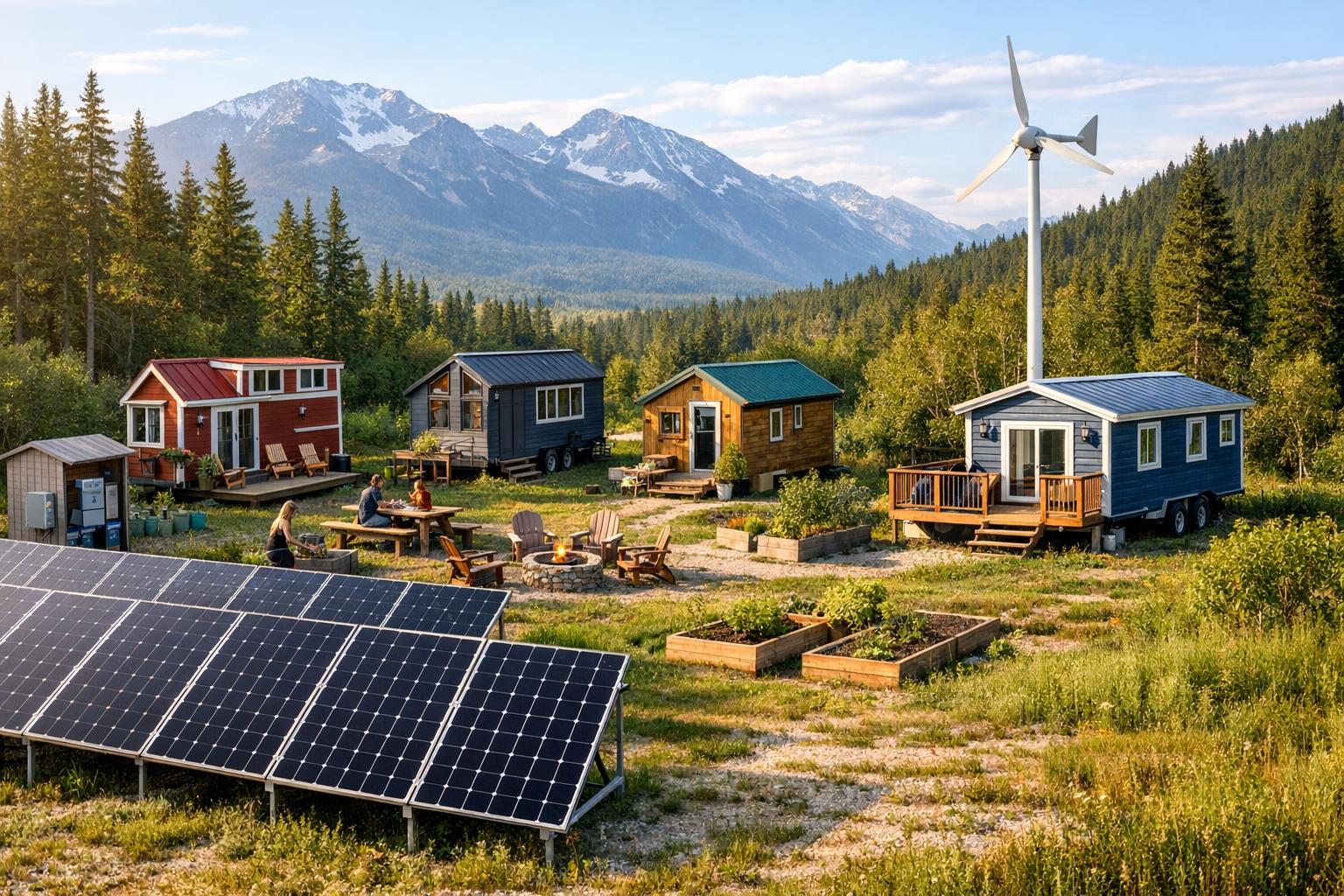
Tiny homes often don’t have the roof area or structural strength for standard solar arrays. Placing solar panels on individual homes is technically challenging and sometimes not allowed by park or strata rules. By pooling resources in a ground-mounted, community solar array, a neighbourhood can collectively “own” enough clean energy capacity to supply everyone reliably.
- Flexibility in location: Solar gardens can be positioned on optimal land with maximum sunshine.
- Cost savings: For example, Nova Scotia community solar programs provide a $0.02 per kWh credit to subscribers.
- Energy independence: Reduces reliance on fossil-fuel-powered grids.
- Lower emissions: Shifting neighbourhood energy use to solar supports cleaner air and aligns with Canada’s emissions targets.
Tiny Home Energy Needs and Sustainable Living Integration
Tiny Home Energy: How Much and How to Supply It
Tiny homes typically consume only 5–10 kWh per day. This covers:
- Efficient LED lighting
- Small refrigerators and kitchen appliances
- Induction cooktops
- Water pumps and hot water heaters (often heat-pump based)
- Mini-split heating and cooling systems
This low consumption rate means one community solar project can cover the needs of many tiny homes with a relatively small array. For example, a 100 kW solar garden could power up to 15–20 tiny houses, even in less sunny regions. Learn more about sizing and energy use
Scalable Community Solar for Tiny Home Neighbourhoods
Community solar projects can be scaled by matching the total subscription size to the neighbourhood’s aggregated energy needs:
- Right-sized subscriptions: Residents buy only as much output as they require.
- Adaptable projects: Solar arrays can be as small as 10 kW or as large as needed.
- Flexible participation: Homes can join or adjust their share as needs change.
Scalable neighbourhood projects | Program example in NS
Sustainable Living: Maximizing Impact
Sustainable living means minimizing energy waste and using clean sources to reduce ecological footprint:
- Efficient home design: Tiny homes cut emissions with less material and energy usage.
- Clean power: Community solar ensures nearly all household use is renewable.
- Collective resilience: Local generation helps neighborhoods weather grid outages or price spikes.
Together, energy-efficient tiny homes and shared solar can lower combined utility bills, help Canada hit net-zero by 2050 targets, and prove practical for diverse development settings. Sustainable living impacts | More about net-zero goals | For additional insights on sustainable living in tiny homes, see Tiny Home Living: Your Complete Guide to Micro Homes, Sustainability, and Lifestyle Freedom.
Planning a Community Solar Project for Tiny Home Neighbourhoods
Step 1: Site Assessment for Community Solar
Start by evaluating locations for the solar array:
- Sun exposure: Choose open ground or rooftops with clear southern exposure for maximum sunlight.
- Space: Size the plot to meet collective needs—ground-mount installations work well near the tiny home cluster.
- Grid proximity: Access to existing electrical infrastructure simplifies tie-in and reduces costs.
- Land protection: Avoid ecologically sensitive areas or prime farmland.
How to assess a site | Hillsvale example
Step 2: Legal and Regulatory Considerations in Canada
Canadian community solar projects must navigate legal and regulatory steps:
- Permits: Apply through local government and provincial utility (e.g., Nova Scotia Power for net metering).
- Zoning: Ensure land use aligns with municipal rules; tiny home villages may require rezoning.
- Indigenous engagement: Respectfully consult if on or near First Nations land.
- Utility interface: Many provinces offer net metering or “virtual” metering options.
Permitting details | AIRE guide | More from Sweb Energy
Step 3: Scalable System Design for Tiny Homes
- System Size: Design modularly—start small and scale as more homes join.
- Technology: Use high-efficiency PV panels and modern hardware.
- Energy Storage: Integrate lithium battery banks or other storage to support usage during low sunlight.
- Expansion: Adapt systems as community needs change.
More on scalable design | Tech and sizing details
Step 4: Community Engagement and Buy-In
Securing local support is key for project longevity:
- Workshops and town halls: Explain benefits, costs, and participation opportunities.
- Co-op meetings: Establish governance models that give every household a voice.
- Transparent communication: Make plans, financials, and impact data open to the public.
Canadian models like Nova Scotia’s show this successfully: community non-profits and municipalities lead planning with broad participation. Best practices from Nova Scotia | More engagement strategies
Funding and Financial Incentives
Provincial Investments
Certain provinces, notably Nova Scotia, make direct investments into community solar:
- Nova Scotia funds over $5 million in capital costs for solar gardens to help non-profits and municipalities with upfront expenses.
- Additional provincial support may be available for First Nations, rural areas, or low-income housing.
Grants, Rebates, and Power Purchase Agreements
- Grants: Access funding for design, permitting, and equipment costs.
- Rebates: Some utilities and provinces offer cash-back for solar installations.
- Power Purchase Agreements (PPAs): Secure long-term energy pricing and credits through agreements with utilities.
AIRE funding options | Sweb program funding
Tax Incentives
- Federal investment tax credit: Receive up to 30% rebate for renewable installations.
- Provincial programs: Additional rebates or write-offs may be available in Ontario, Alberta, and BC.
Innovative Funding Methods
- Crowdfunding: Raise funds from community members or external supporters.
- Co-op ownership: Share purchase models distribute risks and rewards democratically.
- Bulk subscriptions: Group negotiations for volume discounts on solar shares.
- Low-income tiers: Sliding scales or grants to reduce costs for lower-income residents.
Benefits to Developers, Homeowners, and Communities
Energy Cost Savings and ROI
- Long-term savings through utility bill credits or co-op dividends over the installation’s lifespan.
- Predictable energy costs protect neighborhoods from market volatility.
Cost benefit analysis | Sweb ROI
Environmental Sustainability and Resilience
- Lower emissions: Every kilowatt-hour of solar energy avoids fossil fuel generation.
- Grid stability: Local generation reduces stress on the larger grid.
Environmental sustainability impacts | National Observer coverage
Property Value and Market Appeal
Solar-ready communities attract buyers and renters by offering lower utility bills and sustainable, eco-friendly living, which in turn boosts property resale and rental value. Market appeal and value
Social Benefits and Job Creation
- Fosters local ownership: Communities take pride in contributing to climate solutions.
- Education: Workshops on solar energy and conservation empower local residents.
- Economic boost: Installation and maintenance create local jobs.
Case Studies: Successful Canadian Models of Community Solar and Shared Power
Nova Scotia Community Solar Program (2024 Launch)
- The province is funding up to 100 MW of community solar gardens managed by non-profit organizations and local governments.
- Subscriber incentive: Bill credits at $0.02/kWh help make solar accessible for those without rooftop options.
- Challenges: Regulatory processes, site permitting, and utility negotiations.
- Lessons for tiny homes: Shared arrays can be positioned within or near tiny home developments for individual or group subscriptions.
NS program overview | Case study details | Hillsvale pilot
Nelson Hydro Community Solar Garden (British Columbia)
A utility-led array designed to serve homeowners and renters alike, demonstrating the appeal of shared power, especially for mobile or modular tiny home communities. Local utility partnerships were key for streamlined credits.
Coopérative solaire Montréal (Quebec)
This non-profit co-ownership model utilizes virtual metering for energy accounting, perfect for urban areas with limited rooftop space, including co-housing clusters that may incorporate tiny homes.
Note: While direct tiny home case studies are limited, these adaptable models offer valuable insights for low-consumption neighbourhoods.
Conclusion: Steps Toward Accessible, Sustainable Energy in Canadian Tiny Home Communities
Adopting community solar and shared power can dramatically improve energy affordability, sustainability, and resilience in tiny home neighbourhoods. By sharing the cost and output of a central solar array, communities unlock:
- Lower utility bills and improved financial predictability
- Near-zero local emissions and progress toward net-zero goals
- Enhanced market appeal for eco-friendly housing
- Stronger community bonds and opportunities for local job creation
To get started, developers, homeowners, and community groups should:
- Assess total energy needs and identify optimal sites for solar arrays.
- Host community workshops to educate and build support.
- Engage utilities and municipal authorities early for smoother permitting.
- Explore financial programs including grants, rebates, and tax incentives.
- Review Canadian models like Nova Scotia and Nelson Hydro for guidance.
For actionable next steps, visit provincial energy sites such as energy.novascotia.ca, connect with organizations like Solenery or Pembina, and pilot a community solar garden tailored to tiny home living. Further reading | More on planning | AIRE project hub | Hillsvale project
By following these proven steps and tapping into Canadian innovation, your tiny home neighbourhood can thrive with affordable, clean, and resilient community solar power.
Frequently Asked Questions
Q1: What is community solar and how does it work for tiny homes?
A: Community solar allows multiple households to subscribe to a central solar array. The energy generated is then shared via credits or dividends, making it accessible even for those without the capacity for rooftop installations.
Q2: How can tiny home communities benefit from shared power models?
A: Shared power distributes energy benefits equitably among participants, reducing reliance on traditional grids. This setup is perfect for tiny homes with limited space and low energy consumption, delivering cost savings and a cleaner environment.
Q3: What funding options are available for community solar projects in Canada?
A: Funding can include provincial investments, grants, rebates, power purchase agreements, federal tax incentives, innovative crowdfunding methods, and co-op ownership models.
Q4: How do Canadian regulatory frameworks affect the implementation of these projects?
A: Canadian projects must navigate permits, zoning, indigenous engagement, and utility interfacing. Early and transparent community engagement, along with adherence to legal guidelines, ensures smoother project implementation.
Leave a Reply