

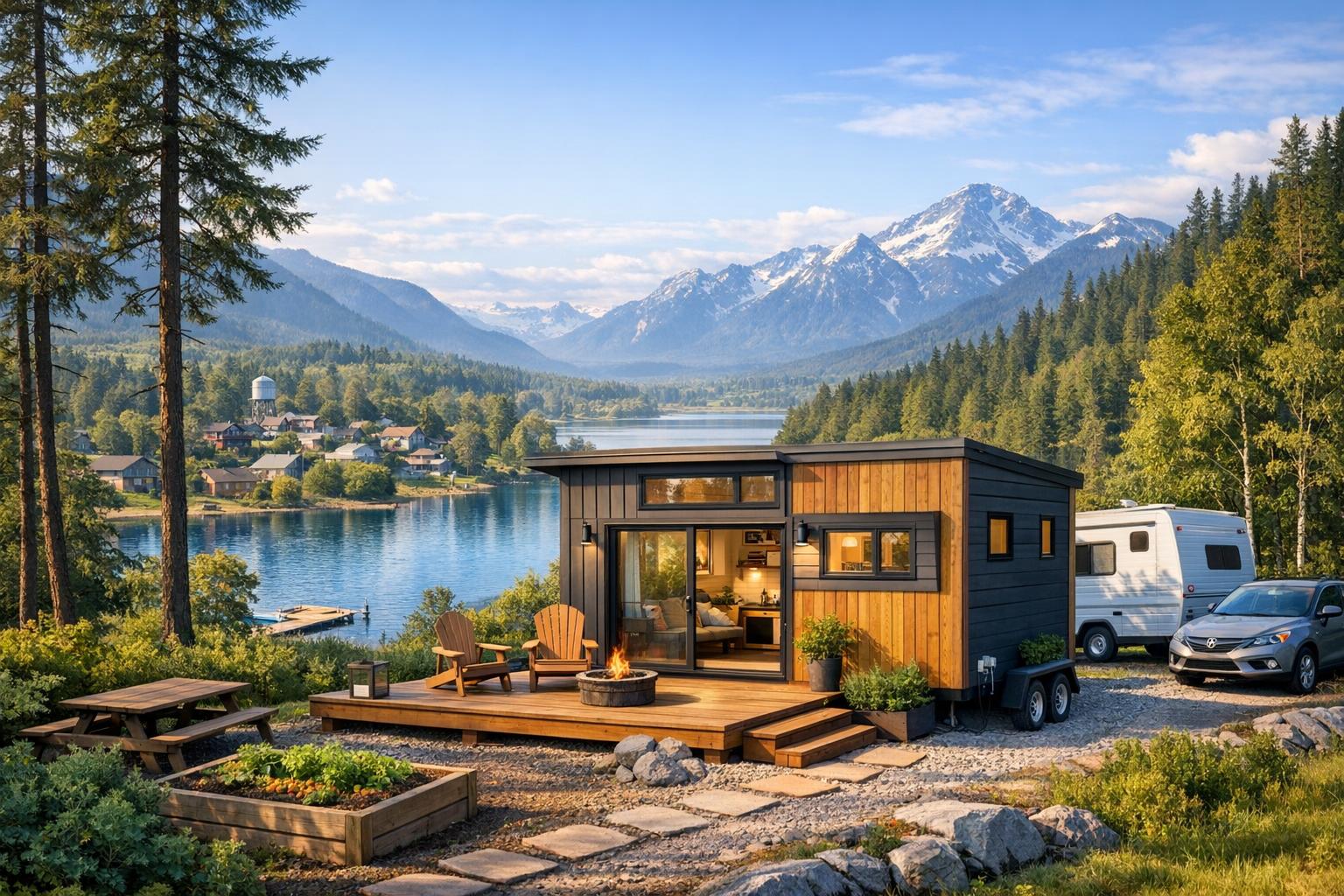
Tiny home friendly municipalities in Canada: Canadian zoning 2026 — Where to build and what to check
Estimated reading time: 18 minutes
Key Takeaways
- Canadian zoning 2026 is a patchwork of federal goals, provincial policy changes, and municipal bylaw updates that together are making room for more small homes and ADUs.
- More municipalities are allowing a wider range of ADU regulations (garden suites, laneway homes, basement suites), often with smaller lot thresholds, lower parking rules, and simpler permit pathways.
- Check local bylaws carefully: owner-occupancy, short-term rental rules, hookup vs off-grid requirements, and whether wheeled tiny homes are treated as dwellings or RVs can make or break a project.
- Use a scorecard approach to compare places—zoning permissiveness, permit speed, lot availability, incentives, utilities, climate, community support, and legal clarity are all critical.
- Start research with reliable summaries (for example, Tiny House Canada — Ontario ADU-friendly) and confirm everything on the municipal site before signing anything.
Table of contents
- Introduction
- National overview: Canadian zoning 2026
- Quick primer: What is an ADU
- What to understand about ADU regulations before you build
- Criteria for assessing tiny home friendly municipalities
- Up-and-coming municipalities to watch in 2026
- Comparative resources (table)
- How to choose the best places to build
- Financing, insurance, and legal practicalities
- Case studies and local voices
- Step-by-step action plan / checklist
- Frequently asked questions (FAQ)
Introduction
In 2026, tiny home friendly municipalities across Canada are moving quickly to update rules under Canadian zoning 2026 reforms, making it easier to build small homes legally. The biggest shift is that more cities and towns are adjusting ADU regulations (rules for secondary units like garden suites and laneway homes) to add housing faster.
This matters now because housing costs keep rising, provinces are pushing for gentler density, and municipalities are testing pilot zones for tiny house locations—from backyard suites in cities to small clusters in rural areas.
This guide gives you, as of 2026, a practical list of places to watch, what to look for in bylaws, how to compare rules, and a step-by-step checklist to reduce permit surprises while finding the best places to build.
Sources: Tiny House Canada (Ontario ADU summary) | Centris — Tiny houses overview
National overview: Canadian zoning 2026 — what changed and why it matters
Canadian zoning 2026 is not one single law. It’s the real-world mix of federal goals, provincial housing policies, and municipal bylaw changes that, together, are making room for more small homes and ADUs.
A few big drivers in 2026 include:
- Ontario-style housing supply pushes that encourage ADUs like garden suites and laneway homes.
- Quebec municipalities approving or mapping tiny home neighbourhood concepts in specific areas.
- Alberta and BC communities exploring micro-villages and clustered small homes as part of affordable housing planning.
Across Canada, you’ll see similar patterns in new or updated bylaws:
- More ADUs allowed (garden suites, coach houses, basement suites, laneway homes)
- Smaller minimum lot sizes in some zones
- Lower parking requirements (sometimes 0–1 extra space)
- Setback relaxations (easier to place a small unit in a backyard)
- Simpler permitting pathways (clearer forms, faster reviews for “standard” designs)
The impact is simple: more legal pathways to create tiny house locations—not only in dense cities (backyards and laneways), but also in smaller towns (tiny clusters, rural parcels, and eco-focused developments).
Key sources: Tiny House Canada | Centris | Tiny Home Industry Association | RenoQuotes (permits) | Tiny House Alliance (news roundup)
Quick primer: What is an ADU and why it matters
An Accessory Dwelling Unit (ADU) is a self-contained secondary home on the same property as a main home. It usually has its own kitchen, bathroom, and sleeping space.
Common ADU examples:
- Laneway homes
- Garden suites (backyard suites)
- Coach houses (over a garage)
- Basement apartments
Key legal terms you’ll run into in ADU regulations:
- Owner-occupancy: the owner may need to live in either the main home or the ADU.
- Short-term rental limits: many places restrict Airbnb-style renting.
- Hookup vs. off-grid: rules often differ if you connect to municipal water/sewer vs. septic/well.
- Wheeled vs. permanent: a tiny home on wheels may be treated like an RV, not a legal dwelling, unless a bylaw clearly says otherwise.
Typical thresholds you may see in 2026 (always verify locally):
- Max size: often around ~60 m² (about 645 ft²)
- Height: often single-storey or roughly ~4.5–6 m
- Setbacks: often ~1–3 m from property lines
- Parking: often 0–1 space, depending on area and transit
More reading: Tiny House Canada | Centris | RenoQuotes
What to understand about ADU regulations before you build
Before you buy land or order a build, use this checklist to pressure-test local ADU regulations. Each item can block your project if you assume instead of confirm.
Allowed unit types
- Garden suite / backyard suite
- Coach house
- Basement secondary suite
- Laneway home
- Tiny home on wheels (sometimes not treated as a dwelling)
Practical tip: if the bylaw does not clearly allow a wheeled tiny home as a dwelling, it may be treated as an RV and limited to temporary use.
Overview resource: Accessory Dwelling Units Guide
Size limits
Many places set a max around ~60 m², but it can be smaller, larger, or based on a percent of the main house size. How to verify: find the zoning bylaw definition and look for “gross floor area”.
Height & stories
Common pattern: single-storey backyard units, or height capped around ~4.5–6 m. Check “maximum building height” and whether it differs for accessory buildings vs. ADUs.
Setbacks & lot coverage
Setbacks commonly land around ~1–3 m. Remember to calculate lot coverage: footprint of all buildings divided by lot area—this can block an ADU even if it “fits”.
Parking requirements
Parking can be make-or-break. In 2026 many municipalities require 0–1 extra spaces, or waive extra parking near transit. Search the bylaw for “parking” + “accessory dwelling” + your zone.
Owner-occupancy & rental restrictions
Some places require the owner to live on-site. Others allow long-term renting but restrict short-term rentals—confirm owner-occupancy, short-term rental rules, and licence needs.
Utilities and septic/water
Urban builds often need full municipal hookups; rural builds may require septic capacity checks. Ask planning/building: “Do I need a septic review or capacity confirmation for an ADU?”
Building code & foundation
Classification matters: a permanent foundation ADU usually needs to meet provincial building code. A tiny home on wheels may be an RV unless explicitly permitted as a dwelling. Foundation choice changes your legal path.
Provincial/regional differences
- Ontario: stronger focus on laneways, garden suites, and standard ADU pathways.
- Quebec: mapped or pilot tiny home areas in some municipalities.
- Prairies: experimentation with primary dwelling tiny homes and clusters.
- BC / Alberta: micro-village and supportive housing pilots in some areas.
Sources: Tiny House Canada | Centris | RenoQuotes
Criteria for assessing tiny home friendly municipalities
Use this quick scorecard to compare tiny home friendly municipalities. Give each category a score from 0 to 5 (5 is best). Add them up to compare places.
1) Zoning permissiveness (0–5)
Check: does the bylaw clearly allow ADUs? Does it define unit types and where they are allowed?
2) Permit speed & cost (0–5)
Benchmark: under 3 months and under $3,000 (permits and basic reviews). Email building departments for typical approval times.
3) Lot availability & price (0–5)
Check if lots meet setbacks/lot coverage and whether neighbourhoods have deeper backyards.
4) Incentives (0–5)
Look for grants, fee rebates, tax programs, and affordable housing incentives on municipal housing pages.
5) Utilities & service access (0–5)
Check water/sewer capacity, septic rules, snow clearing, road access, and proximity to services.
6) Climate & seasonal access (0–5)
Winter road access, heating costs, and exposure matters—ask locals about winter access.
7) Local support/community (0–5)
Look for tiny-home groups, co-ops, municipal pilots, and builders with local ADU experience.
8) Legal clarity (0–5)
Does the bylaw explicitly mention tiny homes or provide a clear ADU path? Ask planning: “Is a tiny home on wheels permitted as a dwelling in any zone?”
Sources and starting points: Tiny House Canada | Tiny Home Industry Association
Up-and-coming municipalities to watch in 2026 — core list
These are lesser-known or evolving tiny home friendly municipalities to watch under Canadian zoning 2026. Verify official municipal pages for any decisions listed below.
Kitchener, Ontario
Profile: mid-sized Ontario city with a track record for gentle density—one of the stronger places for backyard ADUs.
2026 zoning changes (verify): streamlined ADU pathways aligned with Ontario housing reforms; tiny homes positioned as secondary units on qualifying lots.
Typical ADU summary (verify): max ADU size ~60 m²; minimal setbacks depending on zone; often no extra parking required; owner-occupancy varies.
Estimated permit timeline & fees: 2–4 months, $1,000–$3,000 (estimate).
Research start point: Tiny House Canada (Ontario ADU-friendly)
Innisfil, Ontario
Profile: lakeside town near Lake Simcoe with rural and suburban lots—practical for garden-suite style builds.
Estimated permit timeline & fees: 1–3 months, $800–$2,500 (estimate).
Research start point: Tiny House Canada (Ontario ADU-friendly)
Tay Valley Township, Ontario
Profile: rural township exploring primary tiny dwellings and clustered concepts.
Estimated permit timeline & fees: ~3 months, $500–$1,500 (estimate).
Research start point: Tiny Home Industry Association
Sainte-Luce, Quebec
Profile: coastal community in Bas-Saint-Laurent with mapped or planned tiny neighbourhood concepts in discussion.
Research start points: Centris | RenoQuotes
Saint‑Nicéphore (Centre-du-Québec)
Profile: secondary reporting links it to an eco-project and a planned 30-unit tiny house concept—verify developer and municipal approvals.
Research start point: RenoQuotes
Clearwater (AB/BC border area — exploratory)
Profile: news reports describe micro-village exploration—watch for pilot approvals and clustered-lot concepts.
Research start point: Tiny Home Industry Association
Greater Sudbury, Ontario
Profile: large northern municipality where alternative housing and incentives have been discussed—monitor municipal housing pages for updates.
Research start point: Tiny House Alliance (news roundup)
Comparative resources (table)
Use this simple comparison as a starting point—if a cell says “varies,” confirm with planning staff and the bylaw PDF.
| Municipality | ADU Allowed | Max ADU Size | Parking Requirement | Permit Fee Range | Approval Time | Source link |
|---|---|---|---|---|---|---|
| Kitchener, ON | Y (backyard ADU pathway) | ~60 m² (typical; verify) | Often 0 extra (varies) | $1,000–$3,000 (est.) | 2–4 months (est.) | Tiny House Canada |
| Innisfil, ON | Y (garden suites mentioned) | Varies | Minimal (verify 0–1) | $800–$2,500 (est.) | 1–3 months (est.) | Tiny House Canada |
| Tay Valley Township, ON | Y (primary tiny dwelling movement; verify) | Varies | Low (varies) | $500–$1,500 (est.) | ~3 months (est.) | Tiny Home Industry Association |
| Sainte-Luce, QC | Y (tiny neighbourhood concept; verify) | Flexible (verify) | Low/none (verify) | $600–$2,000 (est.) | ~2 months (est.) | Centris / RenoQuotes |
| Saint‑Nicéphore, QC | Y (eco-project context; verify) | ~50 m² (reported; verify) | Low/none (verify) | $700–$1,800 (est.) | Varies (“quick” reported; verify) | RenoQuotes |
| Clearwater (AB/BC border area) | Y (micro-village exploration; verify) | Small/varies | Low (verify) | ~$1,000 (est.) | 2–4 months (est.) | Tiny Home Industry Association |
| Greater Sudbury, ON | Varies (verify by zone) | Varies | Varies | Varies | Varies | Tiny House Alliance (news) |
How to read “Max ADU Size”: some bylaws measure total living area inside walls, others limit footprint or cap ADU size as a percent of the main home—confirm which measurement applies.
Sources: Tiny House Canada | Centris | RenoQuotes | Tiny Home Industry Association | Tiny House Alliance
Interactive map idea (embed)
An interactive map helps you spot tiny house locations faster by showing which municipalities are actively changing rules under Canadian zoning 2026.
Suggested map features:
- Clickable pins for each municipality in this guide
- Pop-up snapshot cards with a short paragraph + key ADU stats
- Links to official zoning bylaws, planning/building contact pages, and known tiny home developments
Suggested data sources to build the dataset: provincial summaries and municipal bylaw PDFs. Example starting points: Centris, Tiny House Canada, RenoQuotes.
How to choose the best places to build your tiny house
The best places to build depend on your goal—use this decision flow.
1) Purpose
- Full-time home — you live in it
- Long-term rental — tenant lives in it
- Guest suite — family visits
Why it matters: some ADU regulations limit rentals or require owner-occupancy.
2) Lot type
- Backyard/laneway — pros: services nearby; cons: neighbours and access limits
- Rural parcel — pros: space and privacy; cons: septic, road maintenance
- Co-op lease / land-lease — pros: shared infrastructure; cons: extra rules
- Micro-village plot — pros: shared servicing; cons: limited supply and pilot rules
3) Build approach
- Self-build — lower cash cost, higher time and permitting risk
- Prefab — faster, clearer specs (still needs permits)
- Builder kit — middle ground; confirm code compliance early
4) Utilities
Hookups often fit city ADU pathways. Off-grid is possible, but confirm septic/water approvals and year-round access plans.
5) Financing
Options include construction loans, HELOCs, private lenders, and developer financing. Ask lenders how they appraise ADUs and whether the ADU adds assessed value immediately or after occupancy.
6) Insurance
Wheeled tiny homes may need RV/tiny-home insurance. Foundation ADUs often fit homeowner policies—get written confirmation before signing a contract.
Quick scenarios: Backyard ADU with city services — Kitchener. Lakeside garden suite — Innisfil. Rural primary tiny home path — Tay Valley Township. Cluster/eco-village model — Saint‑Nicéphore. Mapped tiny neighbourhoods — Sainte-Luce.
Further Ontario reading: Ontario ADU Zoning guide | ADU Permitting in Ontario guide
Financing, insurance, and legal practicalities
Financing
Common options: bank construction loans (if treated as a dwelling), HELOC, private lenders, developer financing, and grants where offered. For Ontario-specific guidance see the ADU Financing Canada guide.
Insurance
Tiny home on wheels: often insured like an RV. Permanent ADU: often part of homeowner coverage. Get written confirmation from insurers early; see ADU Insurance Canada guide for starting points.
Taxation & assessment
An ADU can raise assessed value and property taxes—call the municipal tax office and ask how ADUs are typically assessed locally.
Legal checklist
- Confirm title issues: liens, easements, rights-of-way.
- Confirm driveway and fire access requirements.
- Confirm building code path and required inspections.
- Confirm utility easements and connection permissions.
Practical sources: Tiny House Canada | RenoQuotes
Case studies and local voices (mini examples)
These snapshots are based on secondary reporting—use them to form questions for municipal staff, not as guaranteed outcomes.
Case 1: Kitchener backyard ADU (streamlined review example)
Key takeaways: a complete application (site plan, floor plan, servicing notes) can dramatically shorten review time. Most delays come from missing site details.
“Once we labelled every setback and utility detail clearly, the review stopped bouncing back.”
Source: Tiny House Canada
Case 2: Saint‑Nicéphore eco-village concept
Developer-led models can solve servicing and siting questions up front, but they often impose design standards and have limited availability.
“Shared planning lowered uncertainty, but it also meant shared standards.”
Source: RenoQuotes
Case 3: Tay Valley Township (primary tiny dwelling direction)
Rural approvals hinge on health and safety requirements—off-grid is not “no rules.”
“The goal is clarity: small homes can meet code if the basics are designed right.”
Source: Tiny Home Industry Association
Step-by-step action plan / checklist for readers
Use this 12-step plan to shortlist municipalities, confirm ADU regulations, and find reliable tiny house locations.
- Build a shortlist (3–5 places). Use summaries and municipal planning pages to start. (Tiny House Canada, Centris)
- Download the zoning bylaw PDF and search key terms: “secondary suite,” “accessory dwelling unit,” “garden suite,” “coach house.” Save URLs and check dates.
- Confirm lot eligibility. Check minimum lot size, lot coverage, and setbacks.
- Confirm utility rules. Ask about municipal hookup vs septic/well capacity.
- Confirm the ADU classification. Ask: “Is this treated as an ADU? What if it’s on wheels?”
- Request a pre-application meeting. A short call can reveal fatal assumptions early.
- Get fee and timeline estimates in writing. Ask planning/building for permit fee ranges and typical approval times.
- Secure financing and insurance pre-approval. Confirm how lenders and insurers classify the unit.
- Do site prep planning early. Grading, driveway, utility trench routes, and septic design often cause delays.
- Submit a complete permit package. Site plan with setbacks, floor plans with m², foundation details, and servicing plan are minimums.
- Plan inspections and occupancy steps. Ask for the full inspection list and timing for occupancy.
- Monitor rules every year. Bylaws change—keep a folder of what you relied on and re-check annually.
Ready-to-send email templates
Subject: ADU / garden suite zoning questions (as of 2026) — [Your address]
Body:
Hello,
I’m planning a small ADU/garden suite at [address or general area]. Can you confirm, as of 2026:
1) Whether an ADU is permitted in this zone, and allowed unit types
2) Max size (m²), height, and required setbacks
3) Parking requirement and owner-occupancy rules
Thank you, [Name]
Subject: Permit timeline and fee estimate for ADU (complete application)
Body:
Hello,
If I submit a complete ADU application (site plan, floor plans, foundation, and servicing), what is the typical approval time and permit fee range this year?
Thank you, [Name]
Frequently asked questions (FAQ)
Which Canadian towns have the most permissive ADU regulations?
As of 2026 (based on the secondary sources used here), places often discussed for more flexible ADU regulations include Sainte‑Luce, Kitchener, Innisfil, Tay Valley Township, and Saint‑Nicéphore. The reason is not just “friendly vibes”—these places are linked to clearer ADU pathways, pilots, or mapped tiny home areas in secondary reporting. Always verify with the official bylaw and planning department before buying or building.
Where are the best places to build a tiny house in Canada in 2026?
The best places depend on your goal:
- Backyard ADU with city services: Kitchener
- Garden suite near the lake with space: Innisfil
- Rural primary tiny home direction: Tay Valley Township
- Eco-village / clustered models: Saint‑Nicéphore
- Mapped tiny neighbourhood concepts: Sainte-Luce
Sources: Tiny House Canada, Tiny Home Industry Association, RenoQuotes, Centris
How can I find tiny house locations near me?
Start with:
- Provincial and municipal planning pages and bylaw PDFs (search for “accessory dwelling unit”, “garden suite”, “secondary suite”).
- Quebec mapping leads tied to MQMM discussions and municipal maps (if applicable).
- Ontario ADU-friendly summaries—then confirm on the official municipal site: Tiny House Canada.
- Local builders, tiny-home groups, and planning pre-application meetings to confirm practical constraints.
Where can I read more resources and guides?
Key resources used as starting points for this guide (verify all details on official pages):
- Tiny House Canada — Ontario ADU-friendly
- Centris — Tiny houses overview
- RenoQuotes — Permits & regulations
- Tiny Home Industry Association — policy & pilot news
- Tiny House Alliance — news roundup
- Placement & site selection guide
Legal caution: regulations change quickly. This guide is informational—verify everything with municipal planning departments before purchasing or building.
Information verified as of February 26, 2026.
Leave a Reply