

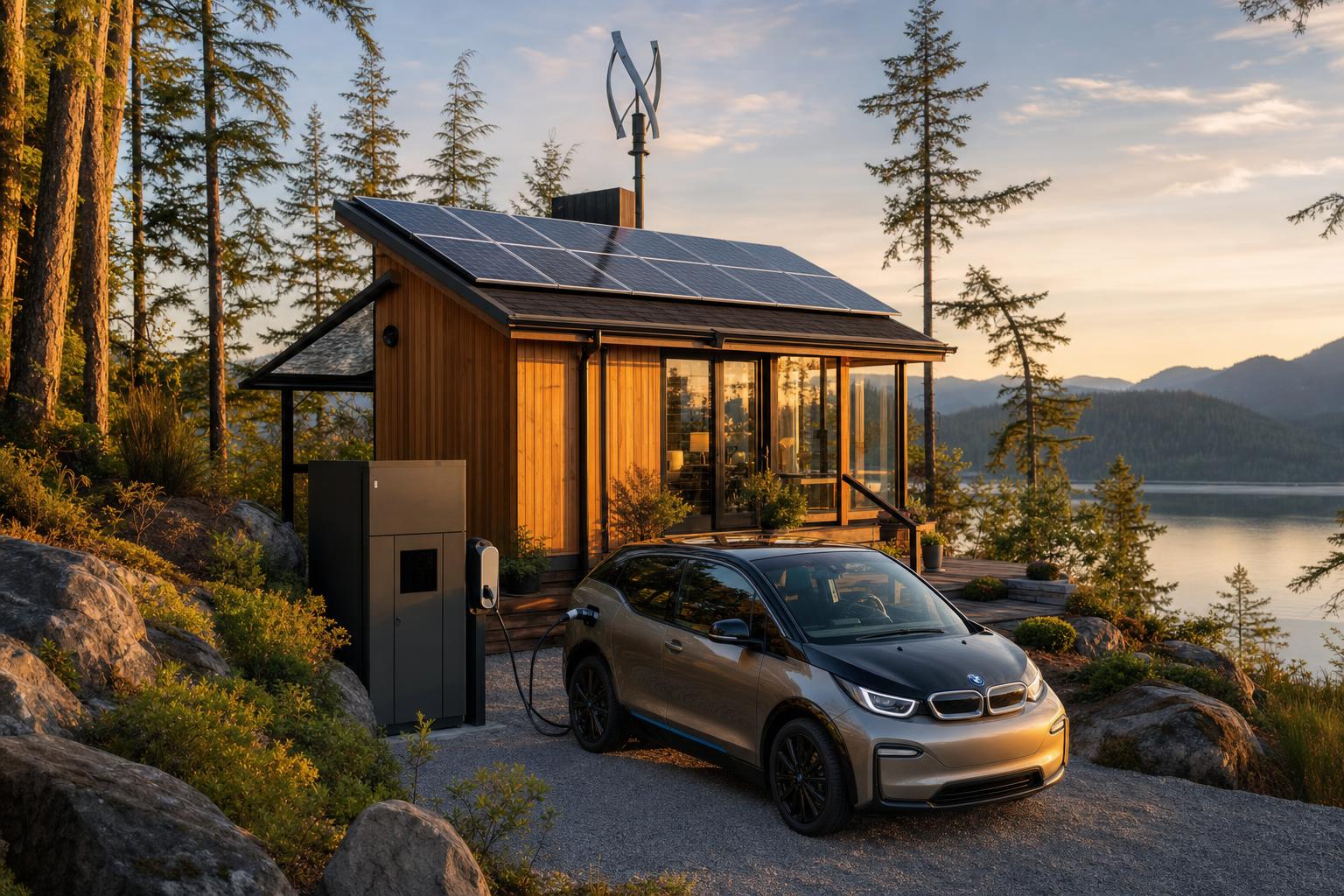
Off-Grid Tiny Home EV Charging in Canada: What Actually Works in 2026
Estimated reading time: 14 minutes
Key Takeaways
- Off-grid EV charging in Canada is possible, but it must be designed around daily energy use, winter solar limits, battery storage, and inverter capacity.
- An EV can easily consume as much energy as, or more than, an entire off-grid tiny home in a day.
- For most households, the best strategy is controlled top-up charging, not trying to recharge a large EV battery from empty at home.
- Level 1 and current-limited Level 2 charging are usually the most practical options for Canadian off-grid tiny homes.
- Battery sizing, winter solar design, generator backup, and smart load management matter more than simply buying a charger.
- Canadian cold weather changes everything: solar production drops, battery charging needs protection, and EV consumption rises.
Table of contents
- Reality check: how much energy an off-grid tiny home and an EV actually use
- What makes 2025 electric vehicles different for off-grid charging
- EV charging options for an off-grid tiny home
- Core system architecture: how to design an off-grid tiny home for EV charging
- Smart charging strategies to reduce cost, waste, and battery stress
- Three example off-grid tiny home system builds for Canadians
- Product categories and brand examples available in Canada
- Canadian regulations, code, climate, and incentives
- Safety and installation checklist
- Cost ranges, ROI logic, and decision-making
- Realistic Canadian mini case studies
- Future-proofing for 2026 and beyond
- Tools, calculators, and resources to use
- Final recommendations and next-step checklist
- Frequently Asked Questions
Off-grid tiny home EV charging can work in Canada, but only if the system is designed around real numbers. An off-grid tiny home has limited roof space, limited inverter power, limited battery reserve, and long winter stretches with short solar days. At the same time, 2025 electric vehicles often have larger batteries and can use a lot of energy, even for short daily trips. For people combining Canadian small living with remote or semi-remote life, that creates a real design challenge. For context on this lifestyle setup, see off-grid living and Canadian tiny homes.
This guide explains how to make EV charging practical in a Canadian off-grid tiny home. It covers daily energy use, charging levels, energy storage, solar sizing, backup generation, product categories, costs, and Canadian rules. The core idea is simple: for most Canadians, successful off-grid tiny home EV charging is not about filling an EV from empty to full at home. It is about designing the house first, then adding controlled EV top-ups through smart energy storage and load management, much like the broader planning needed for tiny home utilities in Canada.
Reality check: how much energy an off-grid tiny home and an EV actually use
Typical daily electricity use for an off-grid tiny home in Canada
Tiny does not always mean low energy use. In Canadian small living, the biggest drivers are appliance choices, heating method, water source, and how many people live there. This is why energy efficiency in tiny homes matters so much before EV charging is even considered.
Practical off-grid tiny home ranges often look like this:
- Low-use off-grid tiny home: 3–5 kWh/day
- LED lights
- Laptop and phone charging
- Efficient fridge
- Small water pump
- No electric resistance heat
- Medium-use off-grid tiny home: 6–10 kWh/day
- Efficient fridge
- Lighting
- Electronics
- HRV or ERV
- Some induction cooking
- Occasional microwave use
- Well pump
- Higher-use off-grid tiny home: 10–15 kWh/day
- Family occupancy
- More cooking
- Extra appliances
- Freezer
- Summer cooling
In Canada, electric space heating usually makes off-grid living much harder. Many off-grid homes use wood, propane, pellet, or another non-electric heat source instead. That tradeoff is closely related to decisions around a heat pump for a tiny home.
Winter also changes the math:
- Lighting use usually goes up
- Fans, pumps, and ventilation may run longer
- Snow and storms can cut renewable generation
- Household demand can rise at the same time
How much energy 2025 electric vehicles typically use
For planning, use simple EV efficiency numbers:
- Efficient sedans and compact crossovers: about 15–22 kWh/100 km
- Larger SUVs and electric trucks: about 22–30+ kWh/100 km
- Winter in Canada often pushes the numbers higher
A simple formula helps:
Daily EV energy use (kWh) = kilometres driven per day × kWh per kilometre
Examples:
- 20 km/day at 0.18 kWh/km = 3.6 kWh/day
- 50 km/day at 0.25 kWh/km = 12.5 kWh/day
- 80 km/day at 0.25 kWh/km = 20 kWh/day
Winter matters for 2025 electric vehicles because:
- Cold weather lowers efficiency
- Cabin heat uses extra power
- Battery conditioning takes energy
- Winter tires add drag
- Snow and slush increase rolling resistance
The core design implication
Even modest driving can match or beat a tiny home’s daily electrical use.
Example:
- Medium-use tiny home = 8 kWh/day
- Electric truck commute, 50 km/day = 12.5 kWh/day
- Combined total = 20.5 kWh/day
That means the EV is often the biggest flexible load in an off-grid tiny home.
This is why energy storage and charging control matter more than simply buying a charger.
For a deeper look at this design issue, see maximizing tiny home energy storage in Canada.
What makes 2025 electric vehicles different for off-grid charging
Many 2025 electric vehicles have larger battery packs than older EVs:
- Compact EVs: around 55–70 kWh
- Crossovers: around 70–85 kWh
- Electric pickups and large SUVs: often 100+ kWh
That is great for range. It is less great if you assume your off-grid tiny home can refill a near-empty battery quickly.
In most cases, it cannot.
The practical target for off-grid tiny home EV charging is usually:
- Daily top-ups
- Supplemental charging
- Careful charging during good solar windows
Not:
- Frequent full refills from empty
- High-power charging every night
- Fast “gas station style” refuelling at home
Some newer EVs also offer export features:
- V2L: vehicle-to-load
- V2H: vehicle-to-home
- V2G: vehicle-to-grid
These features can help in emergencies. But they are not a full replacement for fixed energy storage. Vehicle support, inverter support, charger support, and code compliance all matter. For more on this overlap, review tiny home EV charging in Canada.
EV charging options for an off-grid tiny home
Level 1 EV charging (120V)
Level 1 means standard household-style EV charging, usually around 1.2–1.4 kW.
Pros
- Lowest power demand
- Easier on smaller inverter systems
- Easier on smaller battery banks
- Good for very short daily driving
Cons
- Slow
- Adds only a modest amount of range each hour
- May need to run for many hours
- Night charging usually pulls from the house battery bank, not directly from solar
Best fit
- Minimalist off-grid tiny home setups
- Drivers doing roughly 10–20 km/day
Level 2 EV charging (240V)
Level 2 uses 240V and is the standard most Canadians think of for home EV charging. In off-grid systems, practical charging rates are often in the 3.3–7.7 kW range, with many setups current-limited to the lower end, consistent with typical Canadian home EV charger installation guidance.
Why it is often the best balance:
- Faster than Level 1
- Easier to schedule for midday solar production
- Better for moderate daily driving
- More realistic for households with one regular commuter
The challenge is that Level 2 needs enough inverter capacity and enough energy storage to prevent low-voltage events or deep battery depletion.
Best practice is to use an adjustable-current charger. That lets you limit charging to 16A or 24A instead of always charging at maximum power. Level 2 charging is commonly recommended for Canadian home setups and is often the most practical home charging standard.
DC fast charging
DC fast charging uses very high power, usually tens or hundreds of kilowatts.
For a single off-grid tiny home, this is usually unrealistic because:
- The power demand is far above what most home battery systems can deliver
- The inverter and wiring requirements become extreme
- The generation needed becomes commercial in scale
Possible exceptions:
- A remote lodge
- A community charging hub
- A large shared micro-grid
For most Canadians, DC fast charging belongs off-site, not in a normal off-grid tiny home design.
Bidirectional charging, V2H, V2G, and V2L
Here is the simple version:
- V2L: the vehicle powers tools or appliances directly
- V2H: the vehicle can support home loads through proper hardware
- V2G: the vehicle sends power to a utility grid
For off-grid tiny home EV charging, the most useful ideas are V2L and sometimes V2H.
Possible value:
- Backup power during outages
- Help during cloudy stretches
- Less generator use in some cases
Limits:
- Not every EV supports it
- Not every charger or inverter supports it
- Extra cycling can affect battery wear
- Warranty rules may differ
- Proper switching and approved integration are required
Treat bidirectional support as a backup feature, not your main energy storage plan. More context is available in this article on solar and smart-grid integration.
Onboard export features on certain vehicles
Some vehicles offer onboard export or AC outlet power. Examples include:
- Ford F-150 Lightning with Pro Power-style export
- Hyundai and Kia models with V2L-style export
- Other EVs with onboard AC outlets
These can help with:
- Emergency backup
- Small tools
- Critical circuits
- Short-term support
But never backfeed a panel directly. Safe use needs proper transfer equipment and licensed electrical work, which aligns with broader tiny home safety requirements in Canada.
Core system architecture: how to design an off-grid tiny home for EV charging
Why battery chemistry matters
For most serious off-grid systems, LiFePO4, also called LFP, is usually the best battery type.
Why LFP is preferred:
- Long cycle life
- High usable depth of discharge
- Good efficiency
- Low maintenance
Lead-acid still has a lower upfront cost, but it usually gives:
- Less usable capacity
- Shorter life
- More maintenance
- Lower efficiency
Canadian caution: LFP batteries usually should not be charged below freezing unless they have heaters or are kept in a controlled-temperature space. This is especially important in cold-climate tiny home construction.
For long-term off-grid tiny home EV charging, LFP is usually the strongest choice.
How to size battery energy storage
Use this formula:
Total daily kWh = home daily kWh + EV daily kWh
Then size the battery bank with:
Battery bank size (kWh) = (daily kWh × autonomy days) ÷ usable depth of discharge
Terms:
- Autonomy days: how long the system can run through poor weather
- Usable depth of discharge: how much battery capacity you can normally use
Worked examples:
Minimal example
- Home = 5 kWh/day
- EV = 4 kWh/day
- Total = 9 kWh/day
- 2 autonomy days
- 80% usable DoD
Required battery:
(9 × 2) ÷ 0.8 = 22.5 kWh
Moderate example
- Home = 8 kWh/day
- EV = 12.5 kWh/day
- Total = 20.5 kWh/day
- 2 autonomy days
- 80% usable DoD
Required battery:
(20.5 × 2) ÷ 0.8 = 51.25 kWh
These are house battery-bank sizes, not EV battery sizes. For related planning, see tiny home energy storage in Canada.
How to size the inverter
The inverter changes battery DC power into usable AC power for the house and EV charging.
It must cover:
- Normal home loads
- EV charging loads
- Short startup surges
Key terms:
- Continuous power: steady output
- Surge power: short burst output
Example:
- House peak load = 3 kW
- EV charger = 3.3 kW
- Practical inverter target = 6–7 kW continuous, plus surge margin
Useful inverter features:
- Pure sine wave
- 120/240V split-phase if needed
- Generator input and charger integration
- Battery monitoring support
- Load control compatibility
Solar PV sizing in Canada
A tiny roof is often the limiting factor. Winter solar in Canada is also much weaker than summer solar. This is one of the biggest lessons from winter solar power basics.
Use this planning formula:
PV array size (kW) ≈ daily kWh ÷ (winter sun hours × system efficiency)
System efficiency is a planning factor, often around 0.7–0.75, to allow for real-world losses.
Example:
- Daily load = 20.5 kWh
- Winter sun hours = 2.5
- Efficiency = 0.75
Required PV:
20.5 ÷ (2.5 × 0.75) = 10.9 kW
That is often more than a tiny home roof can hold.
So many Canadian systems need:
- Ground-mounted solar
- Steeper winter tilt
- Snow clearing access
- Backup generation
Cold air can help panel efficiency, but short days, snow cover, and shading still reduce output. Roof limits versus real demand are also discussed in how much solar a small dwelling may need.
Other generation sources
Wind
- Can help in prairie, coastal, or exposed sites
- Needs proper site assessment
Micro-hydro
- Excellent where there is year-round flowing water and enough head
- Site-specific but powerful if available
Generator backup
- In many parts of Canada, this is normal, not optional
- It improves winter resilience
Charge controllers, BMS, and cold-weather battery protection
An MPPT charge controller helps solar panels send the best possible power into the battery bank. For serious off-grid design, MPPT is the standard choice.
A BMS, or battery management system, protects battery cells from:
- Over-voltage
- Under-voltage
- Over-current
- Unsafe temperature conditions
Cold-weather planning should include:
- Battery heaters
- Insulated battery space
- Indoor or semi-conditioned placement where suitable
- Protection from condensation
- Protection from freeze-thaw cycles
Smart charging strategies to reduce cost, waste, and battery stress
Charge when surplus energy is available
Midday charging is usually better than night charging. If solar is producing well, the EV can use live generation instead of draining the house battery bank.
In smaller systems, charging at night makes the battery bank do double duty:
- Run the home
- Charge the EV
That often means a bigger, more expensive battery system.
Use current limiting and scheduling
Current limiting means charging more slowly on purpose so the system stays within safe limits.
That helps by:
- Preventing overloads
- Protecting inverter capacity
- Reducing battery stress
- Keeping enough power for house loads
Smart chargers with adjustable current, app control, and scheduling are especially useful in off-grid or power-limited setups, as seen in many Canadian home EV charger products and installations.
Prioritize house loads over EV charging
The home should always come first.
Sample automation rules:
- If battery state of charge is above 80% and solar output is above house load, enable EV charging at 16A
- If battery state of charge drops below 60%, pause EV charging
This kind of logic can run through an EMS, inverter platform, or monitoring system. For related control ideas, see smart home technology for small dwellings.
Use the EV as a buffer only when it adds real value
Good use cases:
- Several cloudy days in a row
- Temporary overload risk
- Emergency backup
Drawbacks:
- Conversion losses
- More cycling wear
- More hardware complexity
The EV can support your energy storage strategy, but fixed stationary batteries should still be the main system.
Three example off-grid tiny home system builds for Canadians
Minimal system for light driving
Profile:
- One person
- 200–300 sq ft off-grid tiny home
- About 20 km/day driving
Assumptions:
- Home load = about 5 kWh/day
- EV load = about 3.6–4 kWh/day
- Total = about 9 kWh/day
Example system:
- 20–25 kWh LFP battery bank
- 4–5 kW solar array
- 3–5 kW inverter
- Level 1 or limited-current Level 2 EV charging
- Small backup generator
Expected result:
- Strong summer performance
- Winter generator use likely during poor solar periods
Best fit:
- Minimalist Canadian small living
- Short daily trips
- Strong energy discipline
That mindset matches many of the priorities behind tiny home living benefits.
Moderate system for a commuter tiny home
Profile:
- One or two adults
- 300–400 sq ft tiny home
- Around 50 km/day driving
Assumptions:
- Home = about 8 kWh/day
- EV = about 10–13 kWh/day
- Total = about 18–21 kWh/day
Example system:
- 45–55 kWh battery bank
- 8–12 kW PV, likely ground-mounted
- 7–8 kW inverter/charger
- Adjustable Level 2 charger, usually 16–24A
- 5–8 kW propane or diesel generator
This is the range that fits many practical off-grid tiny home EV charging goals.
Typical home EV charger hardware in Canada often falls around $800–$1,200, though installation adds more. Some provinces and utilities also offer charger rebates, but the rules vary and may be aimed at grid-tied homes. See both Canadian charger installation cost guidance and Canadian charging station incentives.
High-capacity system for heavier driving or larger EVs
Profile:
- Work-from-home couple or family
- Larger tiny home
- 60–80 km/day combined driving
- Possibly larger 2025 electric vehicles
Assumptions:
- Home = 10–12 kWh/day
- EV(s) = 15–20+ kWh/day
- Total = 25–32+ kWh/day
Example system:
- 60–80+ kWh battery bank
- 12–16+ kW PV
- 10–12 kW inverter system
- Smart Level 2 charger
- Large backup generator
- Optional wind or micro-hydro if suitable
This is getting close to a small micro-grid. It is not casual plug-and-play territory.
Professional design is strongly recommended.
That becomes even clearer in larger off-grid dwelling builds.
Product categories and brand examples available in Canada
These are example categories and commonly considered brands in Canada, not universal endorsements. Always verify certification, compatibility, cold-weather suitability, and installer support.
Smart Level 2 EV chargers
For an off-grid tiny home, the most useful charger features are:
- Adjustable amperage
- Scheduling
- App control
- Cold-weather reliability
- Certification for Canadian installation
Common examples include:
- Enel X / JuiceBox
- Wallbox
- ChargePoint Home Flex
Adjustable-current and smart-control features are common selling points in Canadian home EV charging products.
Inverter/charger systems
Examples often considered for off-grid use:
- Victron MultiPlus or Quattro
- OutBack Radian and related lines
Why they matter:
- Inverter and charging functions in one platform
- Monitoring support
- Generator coordination
- Off-grid system integration
Battery energy storage products
Common categories:
- Rack-mounted LFP systems
- Wall-mounted systems
- 48V modular banks
- Drop-in LFP batteries
Examples often discussed:
- Battle Born
- BYD
- Pylontech
- SimpliPhi
- Tesla Powerwall, with off-grid compatibility confirmed first
Product choice depends on:
- BMS compatibility
- Inverter integration
- Cold-weather design
- Service support in Canada
MPPT charge controllers
Examples:
- Victron SmartSolar
- Morningstar
What matters:
- Correct voltage and current sizing
- Future expansion options
- Proven support
Backup generators
Examples:
- Honda
- Yamaha
- Generac standby options
- Other propane or diesel units sized for the system
Matching logic:
- Small generator for a minimal setup
- Larger auto-start unit for moderate or high-use systems
Monitoring and EMS
Examples:
- Victron VRM and Cerbo
- SolarEdge where relevant
- Home Assistant for advanced users
Monitoring is what makes controlled EV charging and load-priority rules practical. Related operational thinking appears in smart home maintenance for tiny homes.
Installation support
For Canadian small living projects, look for:
- Licensed Canadian electricians
- Off-grid designers
- Installers who understand local permits and inspections
Canadian regulations, code, climate, and incentives
Electrical permits and code compliance
Rules vary by province, territory, municipality, and site type. Even in an off-grid tiny home, electrical permits are often required.
Why inspection matters:
- Safety
- Legal compliance
- Insurance
- Resale confidence
In Canada, the main framework is the Canadian Electrical Code (CEC), applied through local authorities and licensed professionals.
Tiny-home-specific practical issues
Not all tiny homes are treated the same.
Possible categories include:
- Trailer-mounted tiny homes
- Park models
- Fixed-foundation tiny homes
These can face different rules for:
- Site servicing
- Setbacks
- Land use
- Occupancy
- Permanent utility systems
Cold-climate system design
Canadian winters must shape the design.
Important items:
- Battery heating or conditioned battery space
- Inverter placement away from condensation and freezing drafts
- Steeper solar tilt for snow shedding
- Outdoor-rated conduit and wiring
- EV range loss planning in winter
Solar production often drops in winter. Battery performance can fall without temperature control. EV consumption also rises.
Remote logistics and maintenance
Remote locations add cost and risk.
Common issues:
- High freight costs for batteries, racking, chargers, and inverters
- Slower replacement parts
- Harder service calls
- Need for spare breakers, fuses, and critical parts
- Importance of remote monitoring
Incentives and rebates in 2026
Programs change often, so they must be verified before buying.
Common categories include:
- EV purchase incentives
- Home charger rebates
- Provincial or utility clean energy support
BC and Quebec are common examples of provinces with charger incentive information or programs. Canada’s iZEV program has also been a key federal source for zero-emission vehicle incentive information. Residential EV charger rebates vary by province and utility, and some may assume a grid-tied property.
Readers should verify current 2026 offers with provincial energy ministries, local utilities, Natural Resources Canada, and Transport Canada. Helpful starting points include charger rebate guidance in Canada and Canada-wide charging incentive listings.
Safety and installation checklist
A safe off-grid tiny home EV charging setup needs more than a charger.
Use this checklist:
- Correct wire sizing for AC and DC runs
- Proper breakers and fuses
- Surge protection on solar and AC sides where needed
- Ground-fault and EV-specific protection as required
- Weatherproof enclosures, conduit, glands, and outdoor fittings
- Voltage-drop planning for long cable runs to the parking area
- Safe transfer switching for generator or bidirectional EV integration
- Battery placement with temperature protection and proper clearances
- Smoke alarms
- Carbon monoxide alarms if combustion backup is used
- Fire extinguishers in practical locations
- Generator ventilation and fuel storage rules
- Quarterly visual inspections
- Annual terminal checks and firmware updates
- Charging-control testing before winter
Cost ranges, ROI logic, and decision-making
Ballpark Canadian cost ranges
Broad 2026 CAD ranges for an off-grid tiny home with EV charging are often:
- Minimal system: about $20,000–$40,000
- Moderate system: about $45,000–$80,000
- High-capacity system: $80,000+
- In remote areas, costs can easily push into six figures
Main cost drivers:
- Battery bank size
- Ground-mounted solar
- Inverter class
- Electrical labour
- Generator integration
- Freight to remote sites
Cost-saving strategies
Ways to lower the total cost:
- Build for house loads first
- Add stronger EV charging later
- Use staged upgrades
- Consider tested used panels
- Consider second-life batteries only with expert integration and strong BMS protection
- Explore shared or community charging setups
When staying connected to the grid may still be better
If grid service is available at a reasonable cost, it may be the better choice.
Benefits of staying connected:
- Smaller battery system
- Smaller generator
- More flexible EV charging
- Less maintenance burden
- Easier winter operation
Compare:
- Grid extension cost plus monthly fees
against
- Large off-grid capital cost
- Battery replacement risk
- Generator fuel and servicing
- More hands-on system management
Realistic Canadian mini case studies
Coastal BC single-person setup
Profile:
- 250 sq ft tiny home
- 20–30 km/day
- Compact crossover, such as a 2025 Tesla Model Y example
System:
- 6 kW PV
- 25 kWh LFP bank
- 5 kW inverter
- Level 2 charger limited to 16A
- Small backup generator
Lesson:
- Works best with top-up charging
- Winter may still need generator support
- Good match for disciplined Canadian small living
Weather resilience is a major factor in coastal sites, as discussed in coastal tiny homes in Canada.
Alberta family with a larger EV
Profile:
- 400 sq ft tiny home
- 40–50 km/day
- Ford F-150 Lightning-type use case
System:
- 12 kW ground-mounted PV
- 60 kWh battery bank
- 8 kW inverter
- Smart charging controls
- Occasional bidirectional emergency support
Lesson:
- Larger 2025 electric vehicles can fit an off-grid design
- The system becomes substantial
- Professional planning matters
Accessibility, long-term livability, and bigger vehicle use often intersect in projects similar to accessible tiny homes for aging in place.
Shared micro-grid for two tiny homes
Profile:
- Two households on one rural property
System:
- 20 kW PV
- 80 kWh battery bank
- 12 kW inverter cluster
- Shared Level 2 charging
Lesson:
- Shared energy storage can reduce cost per home
- Shared EV charging infrastructure is often more efficient than two undersized systems
This approach can align well with shared backyard and multi-dwelling property planning.
Future-proofing for 2026 and beyond
A dead-end system gets expensive fast. Build for expansion where possible.
Smart future-proofing steps:
- Choose modular battery systems
- Leave room for more PV input
- Pick inverter platforms that can stack or parallel
- Run conduit for a second charger
- Plan for a second EV if that may happen later
- Allow room for more stationary energy storage
Connector ecosystems and bidirectional standards are still changing. Before buying, verify compatibility between the exact charger and the exact vehicle.
This matters because:
- 2025 electric vehicles already have large batteries
- Future EVs may be even larger
- Households may add a second EV
- Export functions may become more common
Tools, calculators, and resources to use
Useful planning tools for off-grid tiny home EV charging include:
- Home load calculator
- Appliance watts × hours/day = kWh/day
- EV energy estimator
- km/day × kWh/km
- Solar sizing calculator
- Daily kWh
- Region
- Winter sun hours
- Efficiency factor
- Battery sizing worksheet
- Daily kWh
- Autonomy days
- Battery chemistry
- Usable DoD
- Roof capacity comparison
- Available roof area vs required PV size
Helpful resources include:
- Provincial permit portals
- Natural Resources Canada
- EV model spec pages
- Provincial rebate pages
- Incentive databases
Final recommendations and next-step checklist
If you want off-grid tiny home EV charging to work well, follow a practical order.
Checklist:
- Measure actual home electrical loads for at least one week
- Estimate daily driving in kWh, not just kilometres
- Decide whether Level 1 or limited-current Level 2 EV charging is realistic
- Choose battery chemistry, usually LFP
- Calculate required energy storage
- Size solar for winter, not summer
- Decide if generator backup is required
- Plan for battery heating and snow management
- Verify permits, code compliance, and insurance rules
- Compare product compatibility before buying
- Consult a licensed electrician and an off-grid designer before installation
The best off-grid tiny home EV charging systems are not the most powerful.
They are the ones that match real driving, real winter conditions, and real daily energy habits in a Canadian small living setup.
Frequently Asked Questions
Can I fully charge an EV from an off-grid tiny home in Canada?
Yes, technically you can, but for most setups it is not practical to regularly charge a large EV from near-empty to full at home. Most successful systems focus on daily top-ups and supplemental charging.
Is Level 1 or Level 2 better for an off-grid tiny home?
It depends on your driving. Level 1 is often enough for very light daily use. Current-limited Level 2 is usually the best balance for moderate commuting because it can be timed around midday solar production.
How much battery storage do I need?
Add your home’s daily kWh use and your EV’s daily kWh use, then size the battery bank based on autonomy days and usable depth of discharge. In many real Canadian setups, that quickly lands in the 20–55+ kWh range for the house battery bank alone.
Can a tiny home roof hold enough solar for EV charging?
Often not, especially if you are designing for winter in Canada. Many practical systems need ground-mounted solar to support both home loads and EV charging.
Do I need a generator?
In many Canadian off-grid systems, yes. A generator is often the difference between a resilient winter setup and a frustrating one, especially when snow, storms, and short daylight hours reduce solar output.
Can I use my EV as backup power for the tiny home?
Sometimes. If your vehicle supports V2L or V2H and the rest of the electrical system is designed correctly, it can help in emergencies. But it should not replace a properly sized stationary battery system.
Are there Canadian rebates for off-grid EV charging systems?
Sometimes, but many charger rebates are designed for grid-tied homes. Always verify current provincial, utility, and federal programs before purchasing equipment.
Leave a Reply