

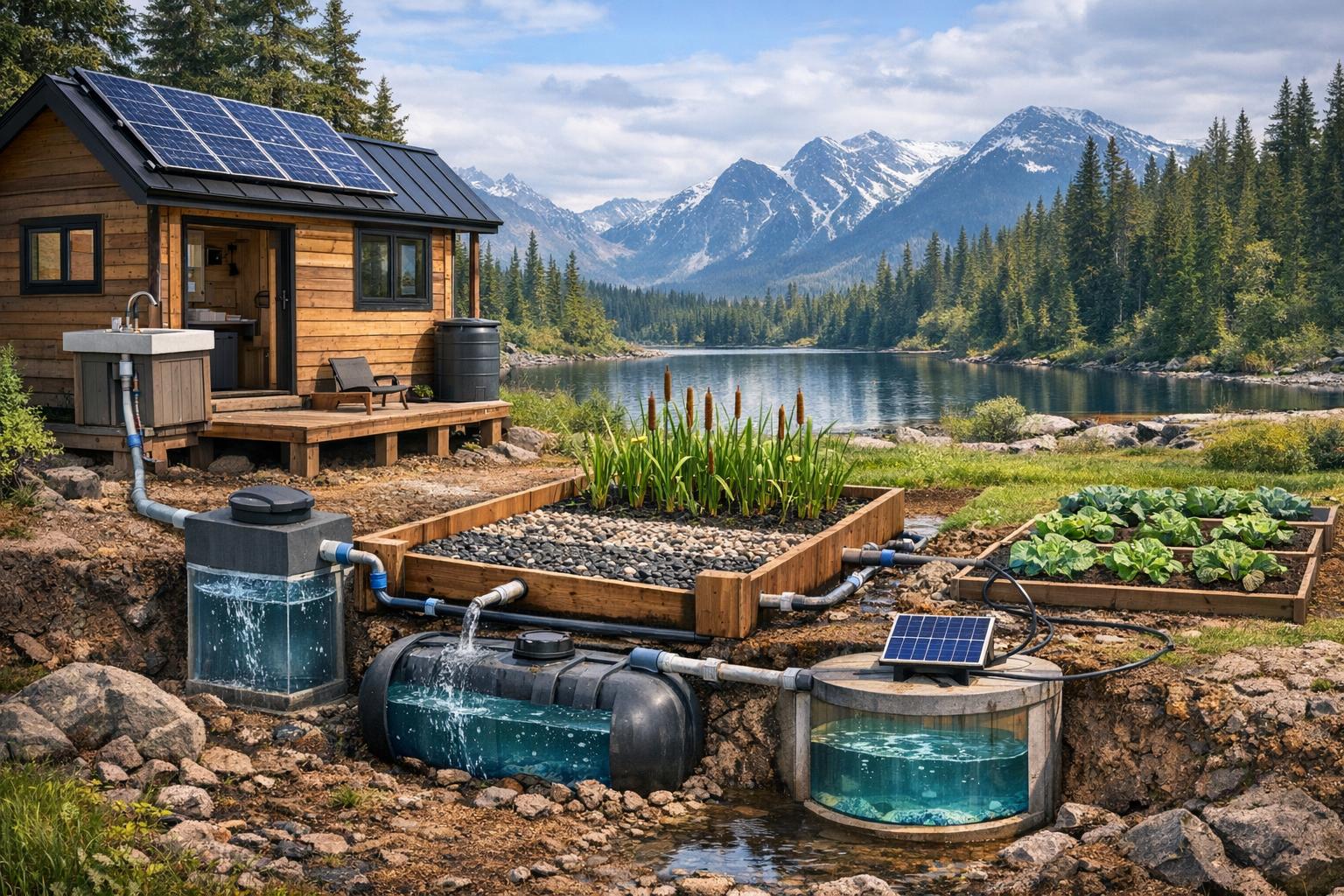
Greywater solutions for tiny homes in Canada — 2026 guide
Last updated: 2026
Estimated reading time: 8 minutes
Key Takeaways
- Greywater reuse can reduce freshwater demand by 50%+ in tiny-home setups when used for toilet flushing and irrigation.
- Canadian designs emphasize freeze-proof parts, compact footprints under 1 m², and solar-ready low-power pumps for off-grid sites.
- Choose between passive (mulch/drip) systems for seasonal, low-cost sites and compact mechanical recyclers for year-round indoor reuse.
- Proper sizing, winterization, and maintenance are critical — even small clogs or freeze events can stop a system in a tiny home.
Table of contents
- Why greywater matters for tiny homes and off-grid living
- Overview of greywater system types for tiny homes
- Canadian-made greywater systems & innovations (2026)
- Sizing & designing a tiny-home greywater system
- Installation for off-grid and remote sites
- Operation, maintenance & troubleshooting
- Cost, ROI & incentives
- Case studies: Canadian tiny-home greywater installs
- Regulatory, health & safety checklist
- DIY vs commercial: which greywater solution is right for you?
- Resources, suppliers & next steps
- Frequently Asked Questions
Why greywater matters for tiny homes and off-grid living
“Define greywater as wastewater from sinks, showers, baths and laundry; distinguish it from blackwater (toilet waste with higher pathogen loads).”
In tiny homes, every litre and every square inch matters. In off-grid living, water may be trucked in, pumped from a small well, or stored in limited tanks. That’s why greywater reuse can be a big part of water conservation.
Benefits (and why they matter off-grid)
- Cuts freshwater demand. Diverting and reusing greywater can cut freshwater demand by 50%+, depending on reuse (see Greywater Recycling ADU Guide).
- Reduces septic loading. Less water into septic extends system life.
- Less hauling and fewer supply trips. A single laundry cycle ≈ 150 L; showers ≈ 9–20 L/min. Reuse reduces refill frequency.
Challenges for tiny homes in Canada
- Space and weight limits. Tanks and equipment add mass and occupy limited areas.
- Freeze risk in cold zones. In zone 5b and colder, pipes and tanks can freeze without insulation or drain-back designs.
- Seasonal use and remote access. Systems must be easy to shut down, drain, and restart for seasonal cabins.
Greywater planning links to how tiny homes are classified and approved across provinces — a system that’s fine on private land may still need permits when used for year-round housing.
Overview of greywater system types for tiny homes
Passive (landscape) systems vs compact mechanical (onboard recyclers). Both support water conservation, but fit different tiny-home lifestyles.
Passive / low-tech greywater (mulch basins, subsurface drip, wetlands)
Common in DIY tiny homes because they can be simple and low-cost.
How a basic mulch basin works (simple steps):
- Diversion from a shower or sink with a 3‑way valve.
- Hair and lint caught in a simple screen or bucket filter.
- Water flows into a mulch-filled basin where soil and microbes break down organics.
- Plants (non-food) use the moisture.
Best uses:
- Subsurface irrigation for ornamentals and shrubs
- Seasonal sites with easy winter shutdown
Key limits in cold climates:
- Frozen ground stops infiltration
- Surface discharge can create ice, odour, and health risks
- Often need a winter bypass to a holding tank or septic
Source: Permies thread.
Compact mechanical greywater solutions (tiny-home friendly recyclers)
These systems treat water more deeply so it can be reused indoors for toilets, and sometimes laundry or safer irrigation.
Typical staged flow (mental map):
shower/sink → coarse pre-filter → bio/reactor → sand/peat polishing → membrane (UF) → UV → storage → pump + reuse loop.
Protection features to look for:
- Header tank for steady pressure
- Overflow routed to septic or sealed holding tank
- Anti-siphon and backflow prevention
- Bypass valve for winter or maintenance
Reference overview: Groundstone.
Filtration & disinfection stages (what each part does)
Coarse pre-filter (hair/lint) — first defence; mesh ~1–2 mm.
Bio / bioreactor (aerobic tank) — bacteria and oxygen break down soaps and organics; reduces odour when aerated.
Sand/peat or cartridge “polishing” — lowers turbidity so UV works better.
Membrane (UF) — pore sizes ~0.01–0.1 µm remove many bacteria; adds cost and maintenance.
UV disinfection — reduces pathogens; lamps typically replaced annually.
Source: Groundstone.
Reuse end-uses and safety (what’s OK, what’s not)
Common acceptable uses (local rules vary):
- Toilet flushing
- Subsurface irrigation
- Laundry (with stronger treatment)
- Exterior cleaning
Not allowed (typical):
- Drinking (potable use)
- Spray irrigation on edible plants without advanced treatment and approvals
Basic safety controls: colour-coded non-potable plumbing, clear “NON-POTABLE” labels, backflow preventers, and overflow management.
References: Groundstone | Metal Pro Buildings guide.
Canadian-made greywater systems & innovations (2026)
Canadian innovation focuses on cold-first, compact, and serviceable designs for remote tiny homes.
Product profiles (Canada-focused)
Canadian Off Grid Depot — retailer with portable greywater components and packaged kits for cottages and tiny homes; highlights solar‑compatible pumps and portable filtration. See: Canadian Off Grid Depot.
Tinybox Systems (Arctic-tested module concept) — Arctic housing pilots show freeze-proof valves and cold-adapted parts for modular tiny-home builds. Read: Tinybox Arctic pilot.
Groundstone-style recyclers — design archetypes for staged compact recyclers that can sit inside insulated cabinets. Reference: Groundstone.
What “Canadian innovation” looks like in real builds
- Modular units under 1 m² with insulated header tanks
- Low-energy UV and 12–24 V solar pumps (combined pump/UV budgets can target ~50 W)
- Winterization hardware: drain-back valves, heated enclosures, basic remote monitoring
Sizing & designing a tiny-home greywater system
Sizing rule of thumb: estimate greywater generation as 50–80 L/person/day. For two occupants use 150–300 L/day. Toilet flushing ≈ 6–13 L/flush.
Worked example A: toilet-flush focused
- Target reuse: ~100 L/day
- Suggested system capacity: 150–200 L/day
- Suggested storage: 200–300 L
Why oversize? Greywater comes in bursts; toilets need steady supply.
Worked example B: toilet + irrigation
- Greywater generated: 150–300 L/day
- Irrigation target: ~200 L/day
- Suggested capacity: 350–500 L/day
- Suggested storage: 500–800 L (freeze-protected)
Match capacity to your reuse goal
- Toilet flushing — steady treated output, smaller storage, float valves and overflow routing.
- Irrigation — distribution systems (subsurface), seasonal drain-down plans, safe soil infiltration.
Hybrid design: greywater + rainwater harvesting
Two non-potable sources work well: roof rainwater for laundry/cleaning and greywater for toilet flushing. Use separate tanks and clear valves. Check local plumbing rules and the National Plumbing Code for backflow prevention.
Internal links: Tiny Homes — Water Conservation.
Installation for off-grid and remote sites
Simple checklist for off-grid installs.
Power (pumps + UV)
- Example peak load: 50 W pump + 20–30 W UV ≈ 70–100 W peak
- Example daily energy: pump ~2 hours/day → 100–200 Wh/day (plus UV runtime)
Tips: prefer 12–24 V pumps to avoid inverter losses and keep wiring protected.
Internal link: off-grid solar. Supplier example: Canadian Off Grid Depot.
Freeze protection & winterization (Canada-first design)
- Insulate tanks and pipes
- Use heat tape/trace with safe controls
- Provide a heated enclosure for filters and UV
- Prefer drain-back designs and bypass valves for winter shut-off
Lessons from Arctic builds: protect valves, simplify service access, design for local repair.
References: Tinybox Arctic pilot | Permies.
Placement & plumbing routing
- Keep runs from fixtures to pre-filter short
- Common locations: under‑chassis (insulated box) or utility cabinet inside the thermal envelope
- For trailer homes: manage weight distribution and secure tanks for vibration
Safety basics: label non-potable lines, add backflow protection, and route overflow to sealed holding or septic (not the ground surface).
References: Metal Pro Buildings guide | Groundstone.
Access & servicing
Plan for a service door for pre-filter cleaning, space to remove cartridges, UV lamp access, and a safe drain method.
Sources: Groundstone | Canadian Off Grid Depot.
Operation, maintenance & troubleshooting
Regular maintenance is essential — especially off-grid where a small clog can stop the system.
Maintenance schedule (paste into your checklist)
Daily/weekly
- Visual inspection of pre-filter; clear hair/lint weekly.
- Check pump operation and system alarms during active use.
Monthly
- Clean polishing/cartridge filters; check UV lamp indicator; check tank sensors and float switches.
Every 6–12 months
- Replace UV lamp annually (typical life ~9,000–12,000 hours); change polishing cartridges; replace membrane elements per manufacturer (typical cost: $200–$500).
Annual
- Full system flush and inspection; check heat tape and antifreeze systems before freeze season.
Troubleshooting (common problems, simple fixes)
- Clogs / slow flow: clean pre-filter; backflush if design allows.
- Odours: ensure aeration and recirculation; avoid long stagnant holds.
- Pump failure: check battery voltage/fuses; test with known power source.
- Sensor faults: clean float switches; replace unreliable sensors.
Typical running costs (ballpark)
- Filter cartridges: $30–150
- UV lamp: $50–200
- Membrane replacements: $200–500
- Annual servicing parts: $100–300
- Electricity: planning $50–150/year (often solar offsets this)
Source: Groundstone.
Cost, ROI & incentives
Systems range from DIY mulch basins to compact mechanical recyclers with UF and UV.
Upfront cost ranges (Canada, typical)
- DIY (mulch-basin/basic filter): $500–$2,000
- Small commercial / compact onboard systems: $3,000–$10,000
References: Metal Pro Buildings guide | Canadian Off Grid Depot.
Simple ROI example (illustrative)
Illustrative math — verify local water costs before planning:
- 2 occupants saving 2,000–4,000 L/month → 24,000–48,000 L/year
- If avoided cost ≈ $0.10/L, annual savings ≈ $2,400–$4,800
- Payback on a mid-range system: ~1–3 years (highly variable)
Incentives and rebates (2026 guidance)
Rebates change frequently. In 2026 check provincial energy programs that support off-grid or efficient equipment, and municipal water conservation grants.
Context: Metal Pro Buildings guide.
Case studies: Canadian tiny-home greywater installs
Short examples showing different system fits by climate and budget.
Case study 1: DIY retrofit, zone 5b tiny home
A tiny-home owner used an above-ground mulch basin and basic filter for irrigation. Portable and easy to drain before freeze season; water savings ≈ 40%. Lesson: simple systems work for seasonal use but year‑round irrigation requires winter design. Source: Permies thread.
Case study 2: Tinybox Arctic install, Kuujjuaq (2026)
Tinybox’s Arctic modules paired with freeze-proof components reduced failures in extreme cold; reported a 60% reduction in septic load for workforce housing. Lesson: winterization must be primary design focus. Read: Tinybox Arctic pilot.
Case study 3: B.C. off-grid cabin (Groundstone-style recycler)
A compact recycler supported toilet flushing and partial laundry reuse, saving ~200 L/day and reducing septic impact in poor soils. Lesson: small systems can materially ease off-grid life. Reference: Groundstone.
Regulatory, health & safety checklist
“Health & safety bottom line: greywater is non-potable and must not be used for drinking; acceptable uses are restricted to toilet flushing, subsurface irrigation, laundry (depending on treatment) and exterior cleaning. Avoid contact with edible crops unless advanced treatment and approvals.”
Greywater can carry germs and chemicals — provinces and local health authorities often impose restrictions.
Step-by-step approval checklist (Canada)
- Research provincial codes: B.C. — check Sewerage Regulation and local health authority; Ontario — Ontario Building Code (Part 8); Nova Scotia — on-site sewage guidance. See context in the Metal Pro Buildings guide.
- Prepare a permit packet: schematic, treatment specs, overflow routing, winter shutdown plan.
- Install safety controls: label non-potable pipes, add cross-connection protection, schedule inspections if required.
- Keep an O&M log: inspectors may request maintenance records for filters, UV lamps, and tanks.
Disallowed or risky practices (common red flags)
- Surface discharge to streams, lakes, or ditches
- Spraying greywater over edible plants without advanced treatment and approvals
- Any connection that risks backflow into potable plumbing
Sources: Groundstone | Metal Pro Buildings guide.
DIY vs commercial: which greywater solution is right for you?
Decision factors: risk tolerance, winter exposure, intended uses, and permits.
Quick decision checklist
- Skills & time: Comfortable with plumbing/electrical and servicing? Yes → DIY; No → commercial.
- Compliance: If permits/inspections required → prefer commercial documented systems.
- Budget: Under $2,000 → DIY; Over $3,000 → commercial recommended.
- Cold/remote: Need freeze-proofing and remote monitoring → commercial vendor support helpful.
Pros and cons (simple)
DIY pros: lower upfront cost, customizable, portable. DIY cons: more maintenance, harder to prove compliance, higher freeze risk.
Commercial pros: warranty, documentation, vendor support, better freeze-proofing. Commercial cons: higher cost and shipping complexity.
When to use a professional installer
- Year-round use in freezing climates
- Connections near potable plumbing
- More than 2–3 occupants
- Builds requiring permits and inspections
Sources: Groundstone | Tinybox Arctic pilot.
Resources, suppliers & next steps
Supplier directory (Canada-focused)
- Canadian Off Grid Depot — portable greywater components and packaged systems for off-grid use.
- Tinybox Systems / Arctic innovation article — cold-climate modular housing context.
- Groundstone — system stages and greywater primer.
- Permies forum thread — DIY examples and tiny-home workarounds.
Assets for production (captions + alt text)
Technical diagram
Diagram title: “Tiny-Home Greywater Flow: Filtration → Storage → Reuse Loop”
Alt text: “Tiny-home greywater solutions loop for off-grid water conservation (Canadian innovation).”
Infographic
Caption: “Water conservation impact: litres saved per occupant with greywater reuse (data source: Groundstone, 2026).”
Source: Groundstone.
Suggested photo gallery list (with keyword captions)
- Tinybox module components (freeze-proof) — “Tinybox Arctic greywater module — Canadian innovation for off-grid tiny homes.”
- Canadian Off Grid filtration kit/product shot — “Portable greywater solutions kit for off-grid tiny homes (solar-ready components).”
- Insulated header tank with heat tape — “Insulated greywater header tank with heat tape for winterization in remote cabins.” (context: Groundstone | Permies)
- Pre-filter access panel close-up — “Greywater pre-filter access panel — simple maintenance for tiny homes.”
- Compact recycler under chassis — “Under-chassis greywater solutions install for off-grid water conservation in tiny homes.”
- UV unit in a service cabinet — “UV disinfection stage for greywater reuse — off-grid tiny home safety.”
Frequently Asked Questions
- Will I save water?
Yes. Reusing greywater can cut freshwater demand by 50%+ in many setups. Source: Groundstone. - Can I drink greywater?
No. Greywater is non-potable and not safe for drinking. Sources: Groundstone | Metal Pro Buildings guide. - Is greywater safe in cold climates?
Yes, if designed for winter: insulation, heat systems, or drain-back shutdowns. Sources: Tinybox Arctic pilot | Permies. - Do I need a permit?
Often yes — it depends on province, municipality, and how the tiny home is classified. Source: Metal Pro Buildings guide. - Can greywater go on my vegetable garden?
Avoid edible crops unless you have advanced treatment and approvals; subsurface irrigation for non-food plants is more common. Source: Groundstone. - What’s the biggest cause of system failure?
Clogging and poor maintenance (especially pre-filters), plus freeze damage in winter. Source: Groundstone.
Further reading and suppliers: Canadian Off Grid Depot | Tinybox Arctic pilot | Groundstone | Permies.
Leave a Reply