

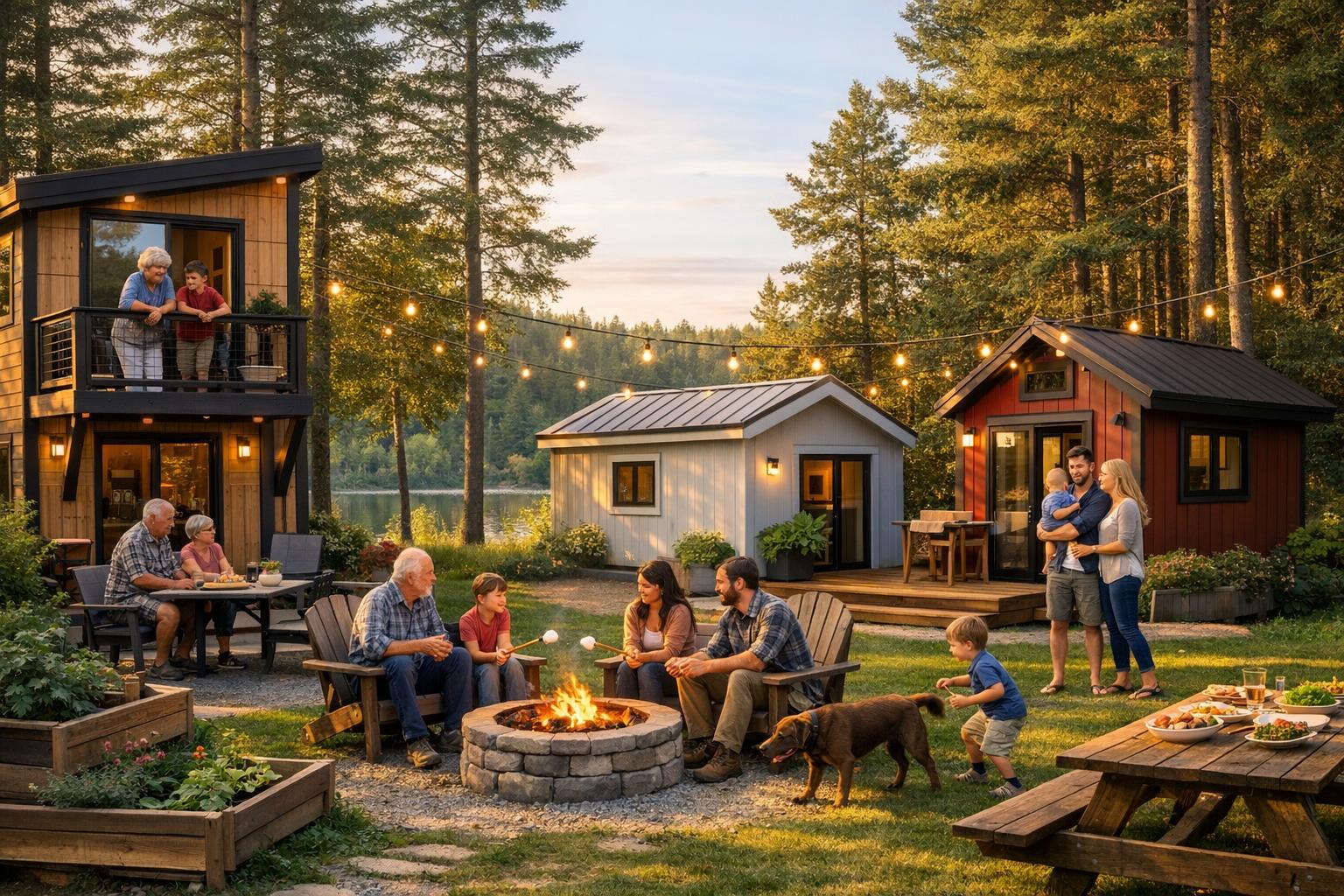
Multi-Generational Living in Tiny Home Compounds: A Guide for Canadian Families in 2026
Estimated reading time: 8 minutes
Key Takeaways
- Innovative Housing Trends: Canadian families are embracing tiny home compounds to support multi-generational living.
- Shared Resources and Privacy: Pooling resources reduces costs while maintaining individual privacy.
- Legal and Zoning Challenges: Robust legal structures and understanding local bylaws are essential.
- Community and Sustainability: The design fosters both connectivity and eco-friendly living.
Table of contents
- Understanding Multi-Generational Living in Canada
- What Is a Tiny Home Compound? Multi-Generational Living by Design
- Shared Resources: Boosting Efficiency and Family Closeness in Tiny Home Compounds
- Legal Structures and Regulatory Considerations
- Maintaining Privacy in Multi-Generational Living Tiny Home Compounds
- Steps to Create Your Own Multi-Generational Tiny Home Compound
- Conclusion
- Frequently Asked Questions
Multi-generational living is reshaping how Canadian families think about home. Traditionally, this means more than two generations—like grandparents, parents, and children—living under a shared roof. In 2026, Canadian families are redefining this arrangement through innovative tiny home compounds: a group of small, independent dwellings grouped on one property.
This model brings families close while allowing privacy. By pooling shared resources (utilities, spaces, chores), these compounds help cut costs and deepen bonds. To succeed, families must also set up sound legal structures to meet local zoning laws and ensure fairness. With housing affordability at a crisis point, it’s no surprise this trend is exploding: as of 2021, 2.4 million Canadians (6.5% of the population) lived in multigenerational households—up 21.2% since 2011 (StatCan, Vanier Institute).
For a deeper dive into the broader movement around tiny, sustainable homes and the lifestyles they enable, see: this guide.
Understanding Multi-Generational Living in Canada
Multi-generational living among Canadian families is now among the fastest-growing household types. This surge highlights how families are dealing with today’s economic realities and cultural shifts:
– Between 2011 and 2021, multi-generational households grew by 21.2%, almost twice the rate of all Canadian households (StatCan).
– Regional variations are significant:
• Nunavut: 24.9% of people live in multi-generational homes.
• Vancouver: 17.5%, Toronto: 11.6%
• Quebec: Only 3.1% (StatCan).
What’s driving this growth?
– Rising housing costs: Homes are less affordable than in the past 30 years. In 2024, the gap between incomes and housing prices is the worst among G7 nations (MediaCoop).
– Stagnant wages and inflation: Families feel squeezed by flat incomes and higher expenses.
– Cultural factors and family structure:
• Indigenous, immigrant, and young single-parent families are most likely to live in multi-generational households.
• Over half (52.7%) of these households are people of colour; 40.5% were born outside of Canada.
• 85.7% of teenage one-parent families live in these homes (Vanier Institute, StatCan, CORE Alberta).
But it’s not only about necessity—this lifestyle fosters connection, support, and resilience.
For insights on legal and zoning challenges impacting multi-generational living with ADUs, check: this resource.
References:
StatCan |
Vanier Institute |
MediaCoop
What Is a Tiny Home Compound? Multi-Generational Living by Design
A tiny home compound describes a collection of compact, independent housing units located together on a shared piece of land. Each family unit gets its own small home, but everyone benefits from joint facilities and outdoor spaces.
For design inspiration and understanding compact living principles, visit: this page.
Key aspects:
– Private Units: Every generation or family subgroup has its own small home with essential amenities.
– Shared Spaces: Central gardens, kitchens, laundry rooms, and gathering areas encourage interaction.
– Separation Structures: Individual entrances and soundproofing ensure privacy.
– Communal Utility Areas: Shared storage, workshops, or recreational facilities are centrally managed.
How is it different from a duplex or shared house?
Traditional multi-family homes often share bathrooms and kitchens. In a tiny home compound, each unit is self-contained while allowing for intentional communal interaction.
Example Layout for a Canadian Context:
• Three or four tiny homes arranged in a semi-circle.
• A central screened pavilion for communal dining and gatherings.
• Shared vegetable garden and storage shed.
• Buffer zones with trees and shrubs for privacy.
Architectural Innovations:
• Modular, energy-efficient units with super-insulated walls.
• Use of sound-dampening building materials.
• Strategic landscaping with hedges and berms.
• Shared solar panels and rainwater collection (learn more).
Shared Resources: Boosting Efficiency and Family Closeness in Tiny Home Compounds
“Shared resources” are the lifeblood of a successful multi-generational living setup—especially in a tiny home compound. Pooling resources cuts costs and builds shared memories.
Learn more about smart storage and resource management in small homes at: this link.
What are shared resources in this context?
– Communal utilities: Electricity, water, and internet costs are split among families.
– Shared spaces: Kitchens, laundry rooms, living rooms, gardens, and storage sheds serve everyone.
– Vehicles: Sharing a car or electric bike reduces transportation costs.
– Large appliances: Items such as washing machines or deep freezers are used jointly.
– Maintenance tools: A communal tool library helps manage schedules (learn more).
Balancing communal sharing with privacy:
– Use sign-up sheets or booking apps for scheduling communal areas.
– Ensure private storage areas are clearly labeled.
– Maintain responsibility charts to rotate chores.
– Design common spaces away from primary private entrances.
Benefits for Canadian families:
• Reduced expenses through shared bills.
• Enhanced emotional connection and family cohesion (Broadview).
• Less clutter and waste via shared purchasing.
Legal Structures and Regulatory Considerations for Multi-Generational Living
Building and maintaining a tiny home compound requires robust legal structures to protect each family’s interests and comply with local regulations.
For guidance on co-ownership and legal frameworks, visit: this resource.
Zoning and Local Bylaws:
– Zoning restrictions: Many cities limit multiple dwellings on one lot or restrict secondary suites (MediaCoop).
– Permits: Each unit must meet building codes, occupancy, and safety standards.
– Tax implications: Adding homes can affect property assessment and taxes.
Ownership and Management Models:
– Co-ownership agreements: Define rights, payments, and conflict resolution.
– Trust structures: Manage property for benefit of all families.
– Cooperative housing: Form a legal cooperative, common in BC and Ontario.
Professional Guidance:
Always consult a lawyer experienced in property and family law, architects familiar with local zoning (learn more here), and urban planners.
Maintaining Privacy in Multi-Generational Living Tiny Home Compounds
A balanced multi-generational setup ensures privacy—physical, visual, and acoustic.
Learn more about noise reduction and soundproofing strategies at:
Noise Reduction Techniques and
Soundproofing Strategies.
Design strategies for privacy:
– Architectural separation: Private entrances and strategic window orientation.
– Soundproofing: High-quality insulation and staggered layouts minimize noise.
– Buffer zones: Decks, patios, and gardens with fencing or tall shrubs enhance privacy.
For landscaping ideas that support both privacy and community, see: this guide.
Social agreements:
– Draft simple guidelines for noise, guest policies, and usage of shared areas.
– Hold regular meetings to review expectations.
Steps to Create Your Own Multi-Generational Tiny Home Compound
Building a multi-generational living arrangement is a rewarding journey. Follow these steps to create your tiny home compound:
1. Planning Phase: Family Needs and Site Selection
– Assess family requirements: number of homes, privacy needs, shared space priorities.
– Research sites near work, schools, and transit while checking local zoning laws.
– Plan your budget, factoring in shared utility savings.
For ideas on designing remote workspaces in tiny homes, review: this guide.
2. Design and Build Phase: Architects and Sustainable Construction
– Collaborate with architects and builders experienced in small, modular designs (learn more).
– Prioritize private entrances, soundproofing, and effective communal area design.
– Use sustainable practices like solar panels and rainwater capture (read more).
3. Navigating Legal Permits and Ownership Agreements
– Secure required permits for land use and occupancy.
– Draft clear co-ownership, trust, or cooperative agreements to outline responsibilities.
– Consult real estate lawyers and zoning experts (MediaCoop).
4. Implement Shared Resources and Privacy Measures
– Establish calendars or digital apps for shared chores and facility schedules.
– Install landscaping and soundproofing measures to balance privacy and community.
5. Ongoing Management and Conflict Resolution
– Hold regular family meetings to address budgets, chores, and legal matters.
– Set up conflict resolution protocols and maintain accurate records.
For further community-building ideas and shared amenities, explore:
Communal Kitchens |
Shared Workshops
Conclusion: Why Multi-Generational Living in Tiny Home Compounds Makes Sense for Canadian Families
Multi-generational living through tiny home compounds is a practical, cost-effective, and emotionally rewarding solution for 2026 and beyond.
– Financial Security and Improved Relationships: Shared utilities and communal areas reduce expenses while promoting family cohesion.
– Adaptability and Resilience: Sound legal structures and thoughtful design foster both independence and connection.
– Addressing Housing Challenges: As housing becomes more unaffordable, this model provides a much-needed solution.
Before starting, ensure you understand local zoning, invest in proven shared resource systems, and set clear privacy and conflict resolution guidelines.
Consult experienced architects, real estate lawyers, or urban planners for the most up-to-date guidance.
Further resources:
– Statistics Canada: Multigenerational Households
– Vanier Institute: Families Count 2024
– MediaCoop: Canada’s Housing Crisis
– Broadview: The Rise of Multigenerational Households
Frequently Asked Questions
Q1: What defines multi-generational living in a tiny home compound?
A: It is the practice of multiple generations living in separate but clustered home units with shared resources and communal spaces to save on costs and promote family bonding.
Q2: How do legal structures affect the setup?
A: Proper legal frameworks—such as co-ownership agreements, trusts, or cooperative models—ensure clarity in responsibilities, payments, and conflict resolution while meeting zoning and safety regulations.
Q3: What are the key benefits of shared resources in this model?
A: Shared utilities, communal spaces, and resource pooling help reduce individual expenses, foster community, and minimize waste.
Q4: How is privacy maintained in a compact environment?
A: Through strategic architectural design such as private entrances, soundproofing, designated buffer zones, and well-planned landscaping that separates private areas from communal ones.
Leave a Reply