

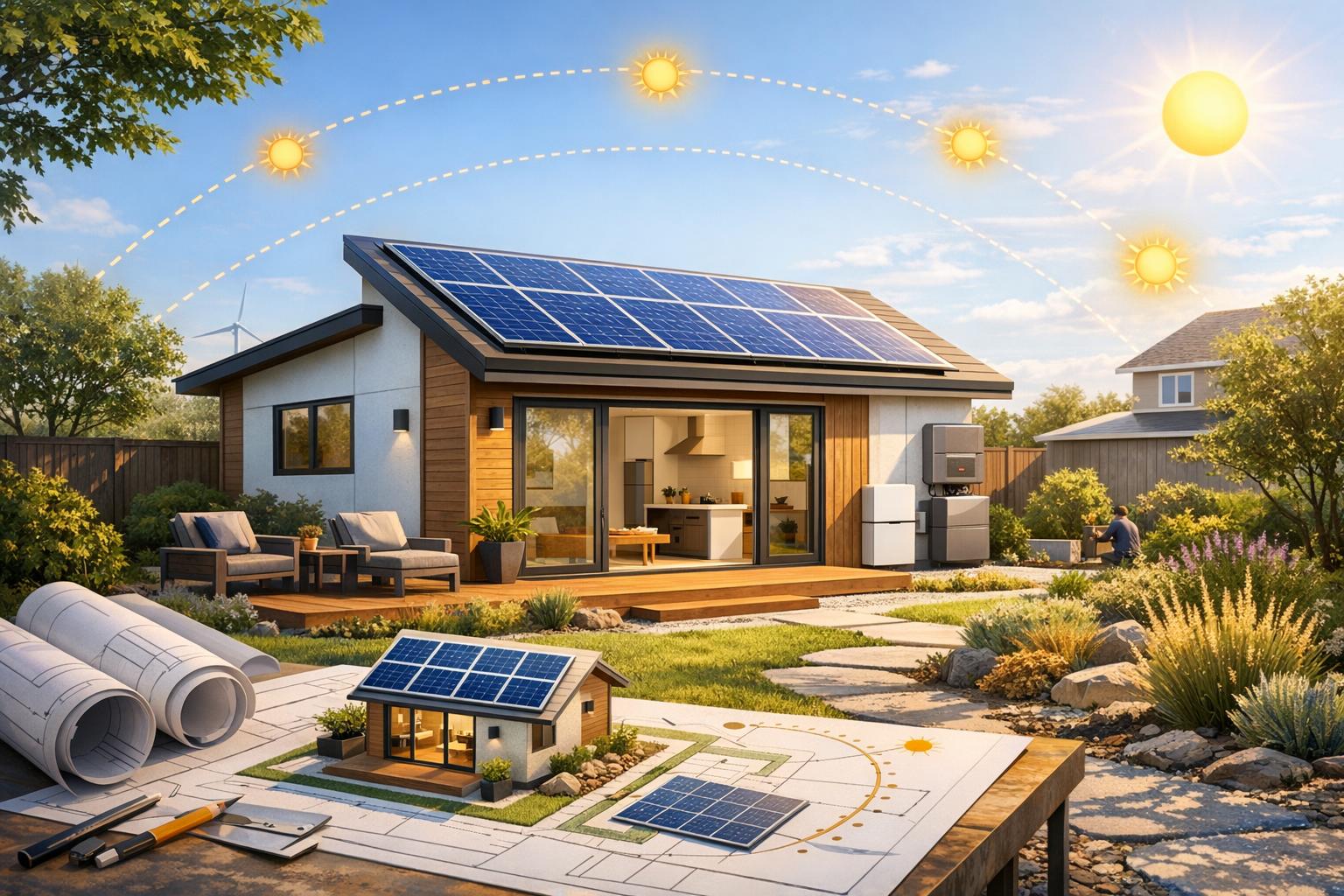
Solar-ready ADUs in Canada: A practical guide to rooftop PV & battery-ready accessory dwelling units
Estimated reading time: 12 minutes
Key Takeaways
- Plan early: making an ADU solar-ready during design is usually far cheaper and less disruptive than retrofitting later.
- Four readiness buckets: reserved roof area, structural reinforcement, electrical conduit/panel capacity, and permitting documentation.
- Canada specifics: heating-dominant homes change sizing and storage needs — use ~1,000–1,400 kWh/kW/yr as a planning sanity check.
- Battery readiness: plan space, clearances and thermal management for reliable winter performance.
Table of contents
- Why design a solar-ready ADU?
- What is a solar-ready ADU?
- Pre-design checklist: site, code & incentives
- ADU design details for a solar-ready roof and exterior
- Electrical planning: panel sizing, conduit & inverter space
- Battery-ready ADU: storage, backup & independence
- Build now or future-proof? Step-by-step options
- Maintenance & monitoring for long-term performance
- Resources, tools & downloads
- Real-world examples: Canadian solar-ready ADUs
- Next steps
- Frequently Asked Questions
Why design a solar-ready ADU?
Designing solar-ready early is usually cheaper than fixing things later. It also tends to make an ADU easier to rent, easier to sell, and more comfortable to live in.
Key benefits for Canadian homeowners include:
- Lower long-term energy costs — you buy less power from the grid.
- Higher property value — buyers like lower bills and modern upgrades.
- More resilience during outages — with a battery and critical loads setup.
- Faster future upgrades — less roof and drywall rework.
- Better sustainable planning — fits Canada’s push toward net-zero.
Canada-specific reasons matter too. Many Canadian homes are heating-dominant, meaning heating can be 50–70% of annual energy use. If your ADU is all-electric, heating choices (heat pump vs electric resistance) can change your solar and battery plan a lot.
One helpful planning number: In Canada, aim for ~1,000–1,400 kWh generated per kW of installed PV annually (site dependent). Use this to sanity-check your design and your installer’s model.
Benefit callout: Cost savings, resilience, property value uplift and support for electrification and net-zero planning.
Sources:
What is a solar-ready ADU?
Definition: an ADU designed at the planning or construction stage with reserved roof area, structural reinforcement, conduit paths, electrical panel capacity and permitting documentation so a rooftop PV + battery system can be installed later with minimal roof, framing or interior rework.
A strong solar-ready ADU plan covers four buckets:
1) Physical roof basics (make solar easy later)
- Unshaded roof area set aside for panels.
- Good roof pitch and orientation (often south-facing is best).
- Safe access for install and future maintenance.
- Roof anchors and flashing-friendly roofing so mounts don’t cause leaks.
For real-world roof planning examples, see the Estrada House case study.
2) Structural readiness (make sure the roof can carry it)
Solar panels and racking add weight and change wind forces. In Canada, roofs also need to handle local snow loads. Your drawings should show where PV loads go and how they are supported.
See the Estrada House case study for complex roof planning and load paths.
3) Electrical readiness (so you’re not opening walls later)
- Reserved breaker spaces and labelled knockouts.
- Conduit routes from roof to electrical room.
- Space for inverter and (if planned) battery equipment.
For sizing guidance and electrical planning, see How Much Solar Does an ADU Need?
4) Permitting documentation (so approvals are smoother)
If your plans already show “solar-ready” details, you can often avoid redesign when you add PV later.
A practical permitting roadmap is outlined in Navigating ADU Permits in Canadian Cities.
Build now vs future-proof (simple comparison):
- Build now: install PV + inverter + battery during construction — Pros: faster path to energy independence; Cons: higher upfront cost.
- Future-proof: reserve space, loads, conduit, and panel capacity — Pros: lower cost during construction and less disruption later; Cons: you still need to buy and install the solar system later.
Sources:
Pre-design checklist: site, code & incentives
This ordered checklist saves the most time later. Treat it as a pre-drawings verification list.
Solar-ready pre-design checklist (copy-ready)
- Site & shading analysis
- Action: Run LiDAR/shade analysis in Aurora Solar, PVWatts, or Google Sun Study.
- Target: 1,000–1,400 kWh/kW/year (Canada, site-dependent).
- Measurement: Identify contiguous unshaded roof area (example: 200–400 ft² supports a 5–10 kW system depending on panel wattage).
- Roof orientation & pitch
- Target: prioritize south-facing planes.
- Pitch: ideal 30°–40° (acceptable 15°–45°).
- Structural capacity (engineer check)
- Action: Ask an engineer to verify truss/rafter capacity for local ground snow load and additional PV load allowance (use +1.1 kPa as a design cue).
- Attic/ceiling access for wiring
- Action: Plan a minimum 3 ft clear access/working space where conduit and wiring will pass.
- Zoning & ADU rules
- Action: Check municipal rules for ADU size, height, and setbacks.
- Note: Many municipalities commonly cap ADUs around 600–1,000 sq ft (confirm locally).
- Incentives & net-metering
- Action: Mark programs as [VERIFY 2026 PROGRAM] and confirm with your province and utility.
- Tip: Ask your utility about net-metering or net-billing and interconnection limits.
Sources:
ADU design details for a solar-ready roof and exterior
Good ADU design for solar is mostly about layout discipline: keep a clean roof plane, keep loads predictable, and keep wiring paths simple.
Roof plane sizing (reserve enough clear area)
Reserve 200–400 ft² of clear, unshaded roof for a typical 5–10 kW PV array. Best practice: write the exact reserved square footage directly on the roof plan.
Guidance and reserved area references are informed by resources like NRCan’s solar-ready guidelines and case studies such as the Estrada House.
Orientation & pitch (set the geometry early)
- Prioritize south-facing roof planes where possible.
- Pitch guidance: 30°–45° is often ideal; in snow climates consider 40°+ to encourage snow shedding.
For snow-load considerations in design, see Canadian Snow Load Requirements.
Roof penetrations & placements
- Keep vents, skylights, plumbing stacks and flues out of the reserved PV zone.
- Consolidate exhausts on a different plane or cluster them away from the solar field.
- Place a roof hatch or safe access route near the planned conduit entry point.
Structural framing & reinforcement
Put clear notes in the structural set so future installers don’t guess. Example notes:
“Verify truss uplift and snow-load capacity for PV installation. PV design load: +1.1 kPa wind/snow allowance plus local snow load (specify value).”
Also specify attachment zones, rafter/truss spacing compatibility, and special notes for metal roofs (for example, clamp-style systems such as S-5! on standing seam where relevant).
Exterior placement for electrical equipment
- Plan inverter and meter location near the main panel to reduce cable runs.
- Reserve battery-ready space that can support about 1,000 lb and maintain 3 ft clearance.
- Keep gear out of tight closets where heat can build up.
Sources:
Aesthetics & livability
- Use low-profile racking and align panel edges with rooflines for a clean look.
- Plan safe access for maintenance and follow fall-protection rules.
Source: MaxableSpace
Electrical planning: panel sizing, conduit & inverter space
Electrical planning is where “solar-ready” succeeds or fails. Get service capacity, conduit and equipment space right and future solar is fast and clean.
Service capacity & panel space
Recommendation: plan 200 A service or higher for an ADU that may add solar, batteries, and EV charging. Reserve 20–40% extra breaker spaces and label them for “Solar/Battery”.
Source: SolarBuilder — Estrada House
Subpanel footprint & stubbing
Reserve wall space for a future 100 A solar subpanel or another arrangement your electrician prefers. Include a dedicated knockout or stub for future inverter tie-in so panel swaps can be avoided.
Conduit runs (size them for real life)
- Specify conduit from roof entry point to electrical room: typically 2″–3″ PVC.
- Run two parallel conduits if possible to separate DC and AC paths and include pull boxes where runs change direction.
Source: NRCan — Solar-ready guidelines
Labeling & documentation
Label conduits, pull boxes and panel knockouts: “Solar Reserved — Do Not Block.” Include an as-built electrical drawing in the handover package.
Inverter/battery space & ventilation
Reserve a ventilated, fire-rated area for inverter(s) and batteries with 3 ft clearance. In cold regions, note that batteries may need thermal management for -30°C conditions (insulated utility area, approved enclosure, or manufacturer-approved heating).
Sources:
EV readiness & smart load management
- Include a 50 A EV-capable branch circuit if EV charging is a possibility.
- Consider a smart panel or energy management stub to shift loads and improve independence (useful for heat-pump loads).
For EV charging guidance specific to Canadian tiny homes and ADUs, see EV charging for tiny homes.
Battery-ready ADU: storage, backup & independence
Battery-ready planning turns solar into real independence during outages and winter peaks.
Battery types (simple overview)
- LFP (Lithium Iron Phosphate): durable, stable, long cycle life; often preferred for home storage.
- Lead-acid and others: older options; usually bigger and less efficient for most modern homes.
Physical design & thermal needs
Reserve space for a battery cabinet that can support about 1,000 lb for a typical 10–20 kWh setup. Plan for temperature: batteries lose performance in deep cold, so consider an insulated utility area or approved thermal management for -30°C climates.
Sources:
Backup strategy
Explain backup strategy early so wiring is clean:
- AC-coupled systems: easier to retrofit and modular for later battery adds.
- DC-coupled systems: more efficient in some cases but benefit from early planning.
- Critical loads panel: plan a separate panel for fridge, lights, internet/router, heat pump controls, and a few plugs.
Sizing guidance (rule-of-thumb)
- Small heated ADU (600–800 ft²) with heat-pump heating: ~5–10 kWh/day.
- Electric-resistance heating: daily use can be ~20–30 kWh/day.
- Battery target: plan 1–2 days of autonomy for critical loads (roughly 10–40 kWh depending on needs).
Source: MaxableSpace
Pair PV sizing with storage
Practical rule: consider PV sized at ~1.2× annual ADU kWh demand then refine with a production model. Use smart controls (heat-pump scheduling, smart thermostats) to raise self-consumption and improve independence.
Guidance: The Ultimate Guide to Solar-Powered ADUs
Build now or future-proof? Step-by-step options
Both paths can work; choose based on budget, timeline and desired time-to-independence.
Option A: Build now (solar-integrated)
- Finalize array size with a solar installer during ADU design; select racking for the roof type.
- Coordinate structural attachments and roof flashing during framing.
- Install PV modules, rails, rapid shutdown devices, inverter(s), and battery(s) during finishing.
- Apply for interconnection, pass inspection and commission the system.
Source: MaxableSpace
Option B: Future-proof (solar-ready)
- Reserve roof area and structural reinforcement points in the truss plan.
- Run 2″–3″ conduits from roof to electrical room and install labelled pull-boxes.
- Reserve breaker spaces, knockouts, subpanel footprint; add roof hatch or safe access plan.
- When ready, installer adds mounts, wiring and commissions with minimal disruption.
Source: NRCan — Solar-ready guidelines
Typical timeline & cost delta (ballparks for 2026)
- Future-proofing during ADU construction: $2,000–$7,000 (conduit, structural details, documentation).
- Typical 5 kW PV system (2026 ballpark): $15,000–$25,000 installed.
- Battery systems (LFP) 10–20 kWh: $6,000–$15,000 installed depending on brand and integration.
ROI example: at $0.15/kWh, a 5 kW system could plausibly pay back in 7–10 years — verify locally for rates and incentives.
Sources:
Incentive types to look for
Programs change often — mark everything [VERIFY 2026 PROGRAM]. Common buckets include federal programs, provincial rebates, utility net-metering/net-billing, municipal pilots and demand-response incentives.
Start verification at Natural Resources Canada.
Maintenance & monitoring for long-term performance
Solar is low-maintenance but not zero-maintenance — especially in snow climates.
Annual maintenance checklist
- Inspect mounts and flashings after winter for loose hardware or seal issues.
- Manage snow safely with roof-safe tools; avoid stepping on panels.
- Check inverter health every 3–5 years and apply firmware updates when available.
- Clean panels when dust/pollen buildup reduces output; frequency depends on location.
Monitoring & smart controls
- Use the installer’s monitoring app to track daily kWh and spot production drops.
- Use smart thermostats and schedules to run key loads when solar is high, improving self-consumption.
- If you have backup, decide in advance what “critical loads” means for ADU occupants.
Resources, tools & downloads
Downloadable assets to document “solar-ready” clearly for homeowners and design teams:
- Printable solar-ready ADU checklist (PDF): roof orientation & area, truss specs, conduit run map, inverter/battery location checklist, permit & inspection checklist, plus a contract clause template.
- Decision flowchart (PDF): Build now → Future-proof → Retrofit, with cost ranges.
- ADU load sizing worksheet (Google Sheet/Excel): inputs for heating type and area; outputs for recommended PV kW and battery kWh.
Reference links (useful in the same package):
Real-world examples: Canadian solar-ready ADUs
Case study 1: Estrada House (Vancouver)
- System: 25 kW bifacial PV on a multi-plane roof.
- Output: ~26,000 kWh/year.
- Key lesson: microinverters + software modeling helped manage shading and roof complexity.
- Result: reported ~$4,500/year grid bill reduction.
How it applies to ADU design: model partial shading early and plan equipment locations and wiring paths before the roof is finalized.
Source: SolarBuilder — Estrada House
Case study 2: Alberta backyard ADU (trend-based)
Example: 600 ft² detached unit where reinforced trusses, clear roof zone and labelled conduit reduced retrofit cost from ~$20K to ~$12K when PV was later added.
Sources:
Case study 3: Townhouse ADU (shared-roof constraints)
Where roof control is limited, plan alternate PV placement (garage/shed) and focus on electrical and battery planning to get resilience and reduced disruption.
Source: Bernardi Building Supply
Suggested image assets list (with captions and alt text)
- Roof orientation diagram — Caption: “Reserved PV roof zone with ideal pitch and vent-free area.” Alt: “solar-ready ADU roof diagram — south-facing panel zone and vent-free reserved area”.
- Roof plane layout — Caption: “Keep vents and skylights out of the solar field.” Alt: “ADU design roof plan showing reserved solar-ready roof area and relocated vents”.
- Conduit/wiring path diagram — Caption: “Plan conduit early to avoid opening finished walls later.” Alt: “solar-ready conduit path diagram from rooftop PV entry to electrical panel in ADU”.
- Structural reinforcement sketch — Caption: “Example of roof structure notes for added PV load allowance plus local snow load.” Alt: “solar-ready ADU structural sketch showing truss reinforcement notes for PV load and snow load”.
- Battery cabinet placement sketch — Caption: “Battery-ready space with clearance and floor load capacity.” Alt: “battery-ready ADU layout showing 3-foot clearance and reinforced floor area”.
- Mini-layouts: townhouse vs detached backyard ADU — Caption: “Different sites need different solar-ready plans.” Alt: “Canadian homeowners ADU design comparison: townhouse solar constraints vs detached backyard solar-ready roof”.
Sources: NRCan, SGH, SolarBuilder.
Next steps: start your solar-ready ADU project
Designing a solar-ready ADU saves money, reduces future disruption, supports sustainable planning and positions your property for energy independence. The cleanest path for Canadian homeowners is to lock the roof zone, structural notes, and electrical conduit/panel space into the first ADU design set — then confirm [VERIFY 2026 PROGRAM] incentives and net-metering rules before choosing final system size.
Broader context on ADU design and solar-ready strategies: ADUs: The Ultimate Guide to ADUs for Canadian Property Investment.
Permitting resources (examples): ADU Permits — Canadian Cities, ADU permitting — Ontario guide, ADU permitting — British Columbia guide.
If you need tailored anchor-text placements or a version edited to match a specific voice, this guide can be adjusted to your preferred wording.
Frequently Asked Questions
Is it worth making my ADU solar-ready?
Short answer: Usually yes — the modest up-front cost during construction avoids far higher retrofit costs and tenant disruption later, and it improves resale and rental appeal.
How much extra will future-proofing add to my ADU build?
Typical future-proofing costs range from $2,000–$7,000 (conduit, structural notes, panel capacity and documentation). Full PV + battery installation is extra and varies by system size.
Do I need a structural engineer?
Yes — ask an engineer to verify truss/rafter capacity for local snow loads and PV attachment. Include clear notes in the structural drawings.
Can batteries work reliably in Canadian winters?
Yes, with proper planning: choose appropriate battery chemistry (LFP is common), reserve insulated or heated space, and follow manufacturer guidance for cold-weather operation.
Where do I check incentives and interconnection rules?
Start with Natural Resources Canada, then check provincial programs and your local utility (mark items [VERIFY 2026 PROGRAM]).
If you want, I can convert this guide into a one-page printable checklist or a roof-plan overlay with the exact reserved square footage annotated for your project.
Leave a Reply