
Youth empowerment ADUs, Canadian tiny homes & co‑living: Transitional housing + skills training — 2026 guide
Estimated reading time: 18 minutes
Key Takeaways
- ADU support, Canadian tiny homes, and co‑living are complementary pathways to deliver rapid, small‑scale transitional housing for youth.
- Skills training tied to housing improves employment outcomes and reduces return to homelessness.
- Municipal policy levers — fee waivers, expedited permitting, and land overlays — can make small project delivery feasible and fast.
- Use clear operational rules, trauma‑informed design, and measurable KPIs to reduce risk and show funders impact.
- Confirm local zoning and permitting requirements early — see the Canadian ADU regulations guide for background on ADU policy options.
Table of contents
- Why ADUs, Tiny Homes and Co‑Living Are Effective
- The 2026 Landscape: Policy, Funding and Skills Programs
- Case Studies: Templates and What It Takes
- How to Build a Youth‑Focused ADU / Tiny Home Program — Step‑by‑Step
- Roles, Partnerships and Funding
- Policy Recommendations
- Design & Safety Considerations
- Measuring Impact
- Resources & Toolkits
- Frequently Asked Questions
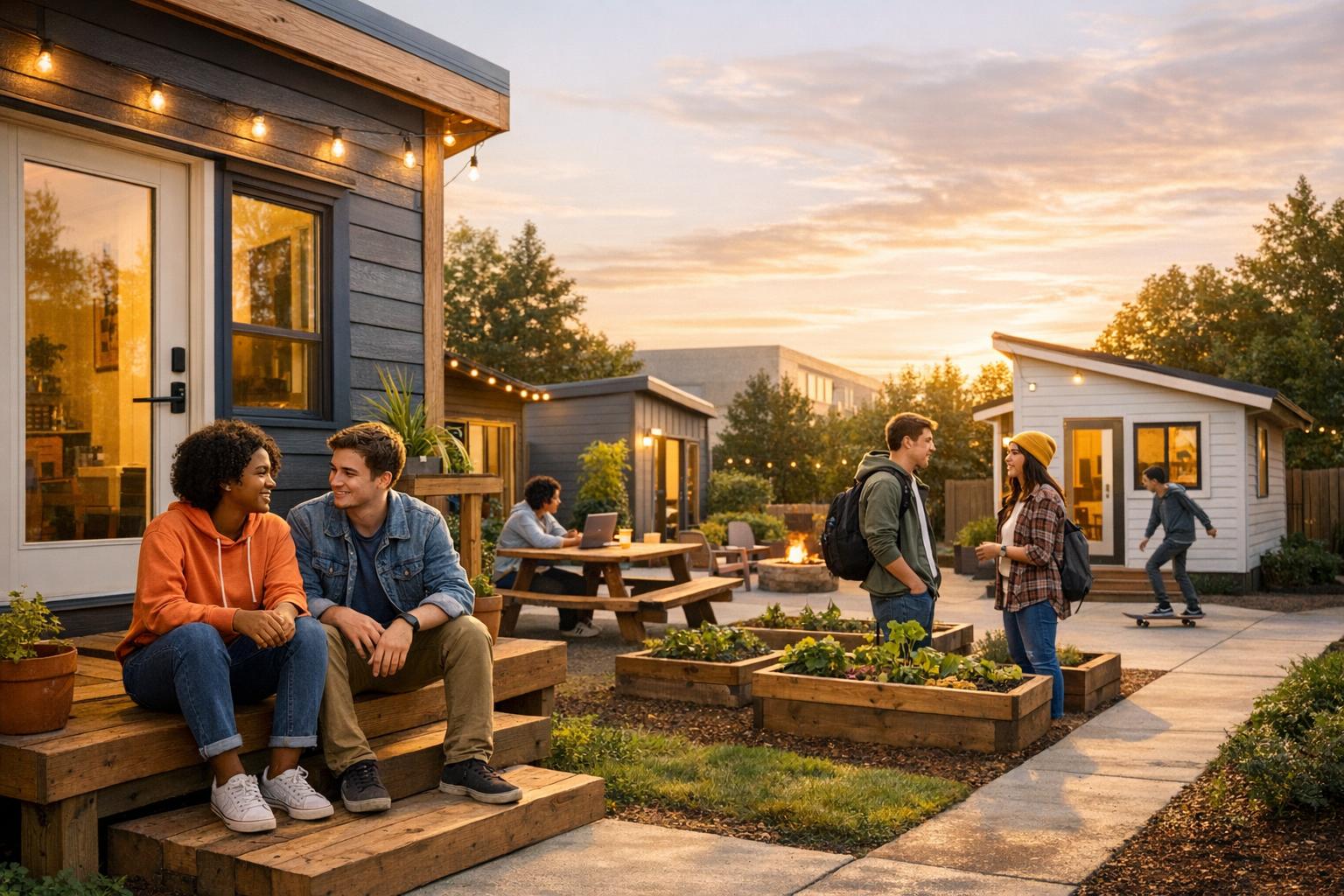
Youth empowerment ADUs are emerging as a practical, scalable approach to transitional housing that pairs ADU support with Canadian tiny homes, co‑living models, and integrated skills training to help young people move from instability to independence in 2026.
Why ADUs, Tiny Homes and Co‑Living Are Effective for Youth Empowerment
An ADU (Accessory Dwelling Unit) is a secondary housing unit on a single‑family lot—detached, attached, or internal—used to provide independent living space while remaining on the same property.
Tiny homes are compact, fully self‑contained dwellings (typically 100–400 sq ft) that can be permanent or semi‑permanent. Co‑living clusters private rooms with shared common areas and services.
Why these models fit youth empowerment goals
- Stability: a consistent address helps keep school, work and health care intact.
- Autonomy: private space for practising daily routines — cooking, cleaning, budgeting.
- Community: peer support reduces isolation and supports goal retention.
- Safety: trauma‑informed supervision, clear rules, and secure design reduce harm.
- Pathways to independence: link housing to jobs, education and mentors via skills training.
Practical program combos:
- Homeowner offers an ADU at reduced rent + nonprofit provides case management and subsidy.
- Small site hosts Canadian tiny homes with on‑site staff and weekly training.
- Co‑living building runs group life‑skills sessions and peer circles in shared kitchens/lounges.
For background on ADU options and investment, see the Accessory Dwelling Units guide.
The 2026 Landscape: Policy, Funding and Skills Programs in Canada
By 2026 many municipalities are updating zoning to allow more small homes on existing lots: detached/internal ADUs, and faster builds using modular/prefab methods. At the same time, federal skills funding provides an opportunity to weave employment pathways into housing supports.
Two federal programs to consider
- Youth Employment and Skills Strategy (YESS): a horizontal initiative that supports youth through work experience, training and wraparound supports. Align housing program training streams to wage subsidies and placements where eligible — see the YESS overview for program components.
- Agriculture and Agri‑Food Canada Youth Employment and Skills Program (YESP): targeted funds that prioritize Indigenous, disabled, and rural youth — useful for rural tiny‑home sites near employers. See the Agri‑Canada announcement here.
Important gap: there is no consolidated national inventory of youth‑focused ADU or tiny home projects — plan a local scan of municipal rules, land options and providers.
Case Studies: ADU support programs, Canadian tiny homes, co‑living and skills partnerships (templates)
These vignettes are ready‑to‑verify templates. Replace placeholders during research with verified Canadian examples, metrics and consented quotes.
Youth ADU Host Partnership (Template) — City/Region — 2026 launch (example)
Model: municipal encouragement or legalization of ADUs + nonprofit matches youth with host homeowners and provides ongoing supports.
Typical pathway
- Youth referral from shelters, outreach, schools.
- Nonprofit intake, eligibility and safety plan.
- Host screening and ADU safety checks.
- Matching with clear expectations (quiet hours, privacy).
- Program stipend/subsidy to homeowner; youth pay small portion when able.
Illustrative cost model (estimates): retrofit/grant $10k–$25k per ADU; monthly subsidy $300–$600; case management $6k–$12k per resident/year (validate locally).
Snapshot (template): partners: municipality, nonprofit, host homeowners; model type: ADU support + case management; average stay: 6–18 months; services: case management, tenancy skills, mediation, training links.
Canadian Tiny Homes Transitional Housing Site (Template) — City/Region — 2026 launch (example)
Model: small “village” of tiny homes on serviced land (municipal or nonprofit). Useful when multiple beds are needed quickly and servicing & operations are secured.
Design & operations highlights
- Procure modular/prefab tiny homes; phase installs to open beds earlier.
- Shared spaces for programming (laundry, classroom, lounge).
- Trauma‑informed features: insulation, daylight, lockable doors, secure storage.
- Operations: on‑site staff core hours, weekly case management, daily light check‑ins for new residents.
For background on tiny‑home options in Canada, see Tiny Home Living in Canada.
Co‑Living Transitional Housing Home (Template) — City/Region — 2026 launch (example)
Model: private sleeping rooms plus shared kitchens and lounges, with structured supports and resident governance.
Governance: resident council, peer roles (kitchen lead, welcome buddy), conflict resolution ladder, confidentiality rules.
Operational notes: staffing ratio sample 1 caseworker per 15–25 residents; average stay typical 6–18 months (confirm locally).
Skills Training + Employer Partnership (Template)
Model: link transitional housing with training that leads to paid work — in‑house or with colleges, unions and employers.
- Initial weeks: job readiness (attendance, resumes, interviews).
- Short credentials: first aid, WHMIS, food safety, etc. (confirm local availability).
- Pathways: pre‑apprenticeship, paid internships, employer placements with trauma‑informed supervision.
Consider aligning wage subsidies and placements with the YESS program where eligibility allows.
How to Build a Youth‑Focused ADU or Tiny Home Transitional Housing Program — Step‑by‑Step
Use these steps as a practical checklist. This is informational only — confirm permitting and legal details with local authorities.
Step 1: Needs Assessment
- Define target age (common: 16–24 or 18–30).
- Identify risk groups: system‑involved, LGBTQ2S+, Indigenous, exiting foster care, newcomers.
- Data sources: local homelessness counts, shelter intakes, school outreach.
Step 2: Choosing the Right Model
Use a simple matrix: site availability, time to deploy, capital cost, permanency, zoning complexity, privacy, operational intensity.
Basic guidance: ADUs for small placements; tiny homes for phased site scale; co‑living for larger cohorts and efficient staffing.
Step 3: Trauma‑Informed Design and Safety
- Private, lockable rooms; natural light; durable finishes; clear sightlines balanced with privacy.
- Operational policies: visitor rules, confidentiality, on‑call protocols, resident governance, de‑escalation training.
Step 4: Permitting, Zoning and ADU Support
Treat permitting as a core workstream. Confirm local ADU rules (detached/attached/internal), setbacks, fire & life safety, parking rules.
Municipal supports to request: fee waivers, expedited permits, technical assistance, retrofit grants, low‑interest loans. See the Ontario resources below for permit examples: Ontario ADU zoning guide and ADU permitting Ontario.
Step 5: Funding and Capital Stack
Mix municipal grants, provincial/federal sources, philanthropy, social loans and community land trusts. Allocate capital for site acquisition, construction/retrofit, utilities, furniture and 12 months operations plus contingency (10–15%).
Estimate ranges: tiny home capital $30k–$100k/unit; ADU retrofit $15k–$80k (validate locally).
Step 6: Operations and Services
Intake: referral → eligibility → risk plan → onboarding. Case management targets based on acuity; example check‑in: weekly for first month, then biweekly. Rent models: sliding scale, earned contributions, clear arrears rules.
Step 7: Integrating Skills Training
- Curriculum options: job readiness, trades pre‑apprenticeship, life skills, digital micro‑credentials.
- Delivery: on‑site workshops, partner college courses, paid internships.
- Operational notes: use stipends when possible, prefer paid placements, align schedules with appointments and transit.
Step 8: Monitoring and Evaluation
Core KPIs: exits to permanent housing, employment/education placement, length of stay, recidivism, resident satisfaction. Use intake databases, case management software, and quarterly dashboards.
Roles, Partnerships and Funding Roles
- Municipal governments: ADU support, zoning flexibility, seed funding, land access.
- Nonprofits: intake, case management, hosting coordination, training links.
- Employers/colleges: apprenticeships, credentials, supervisor training.
- Community/hosts: home inspection, hosting agreements, stipend administration.
- Funders: grants, social loans, outcome‑based contracts.
Policy Recommendations: Scaling Youth Empowerment ADUs
Start with 1–2 levers: fee waivers/grants for youth‑serving ADUs; expedited permit reviews; flexible land overlays for tiny home villages; tax incentives or light registration for host homeowners; small‑project capital funds.
Sample ordinance language (starting point):
“A Youth‑Serving ADU is an accessory dwelling unit that is leased or licensed through a registered nonprofit provider for transitional housing for youth. Youth‑Serving ADUs are eligible for: (a) development fee waiver; (b) expedited permit review; and (c) parking requirement waiver where transit access is within [X] metres.”
Design and Safety Considerations for Youth‑Focused Housing
Good design reduces incidents and helps youth stay housed. Checklist highlights:
- Private lockable bedrooms/units; secure entrances; soundproofing.
- Daylight, accessibility features, lockable storage, communal kitchen + quiet rooms.
- Operational: consistent routines, confidentiality, voluntary services, cultural safety training.
Challenges, Pitfalls and How to Avoid Them
- NIMBYism: mitigate with early engagement, neighbour FAQ, safety plans and outcome data.
- Funding sustainability: diversify capital stack, secure multi‑year ops funding and consider blended finance.
- Regulatory barriers: use pilot permits, temporary use permits and targeted advocacy.
- Staff burnout: manage caseloads, provide clinical supervision and staff wellness policies.
Measuring Impact: A 12‑ and 24‑Month Dashboard
Dashboard fields to track monthly/quarterly: # residents served, median length of stay, % exits to permanent housing (6/12/24 months), % employed/enrolled (at exit and follow‑up), average wage change, resident satisfaction, cost per successful exit.
Example targets (adapt locally): 60% exits to permanent housing at 12 months; 50% employed or in education within 6 months (example targets).
Resources, Toolkits and Templates to Download
Assets to develop and attach to publications:
- Checklist: “Starting a Youth ADU/Tiny Home Program” (site selection, budget template, permitting steps).
- Sample budget + capital stack template.
- Floor plan examples and design briefs (1‑bed ADU; 2‑bed co‑living; tiny home accessibility notes).
- One‑page advocacy letter template to municipal council.
- Core links:
Visuals and Formatting Suggestions
Recommended: hero image; comparative ADU vs Tiny Home vs Co‑living infographic after the “Why” section; capital flowchart in Step 5; case study pullouts with photos and quotes; dashboard visual in the Measuring Impact section.
SEO & On‑Page Content Plan
Primary keyword: youth empowerment ADUs (used in intro). Meta description suggestion: “How youth empowerment ADUs and Canadian tiny homes are being used in 2026 to deliver transitional housing and skills training—real case studies & how‑to.” Suggested URL slug: /youth-empowerment-adus-tiny-homes-transitional-housing-2026
Editorial plan & next steps (2026 build schedule)
Research priorities:
- Verify 3–4 Canadian case studies and collect project URLs, contacts and outcomes (2 weeks).
- Pull updated youth homelessness stats from Statistics Canada or the Canadian Observatory on Homelessness (1 week).
- Gather municipal ADU policy examples (Vancouver, Toronto, Calgary prioritized) (2 weeks).
- Collect consented quotes from program leads and residents (3 weeks).
Frequently Asked Questions
Q: What is the difference between an ADU and a tiny home for youth programs?
A: ADUs are accessory units on existing residential lots (detached, attached or internal) that can be used for one or two placements and generally integrate into neighbourhoods faster. Tiny homes are standalone compact units often used to build a small site or “village” — useful when multiple beds are needed quickly but require land and servicing.
Q: Can federal skills funding be used with housing subsidies?
A: Federal programs like YESS can be a fit for training and work placements aligned to housing programs, but confirm eligibility and regional contacts during planning.
Q: How do municipalities typically support youth‑serving ADUs?
A: Common supports include fee waivers, expedited permitting, technical assistance, retrofit grants and small capital funds. Use sample ordinance language in the Policy Recommendations section as a starting point.
Q: What are realistic cost ranges?
A: Estimates (validate locally): tiny home capital $30k–$100k per unit; ADU retrofit $15k–$80k; case management $6k–$12k per resident/year. Local labour, servicing and code requirements will modify these ranges.
Q: Where can I find municipal ADU policy examples?
A: Municipal ADU pages and formal municipal pilot program links should be collected during your local research phase. For Ontario permitting examples see the Ontario ADU zoning guide and ADU permitting Ontario.
Leave a Reply