
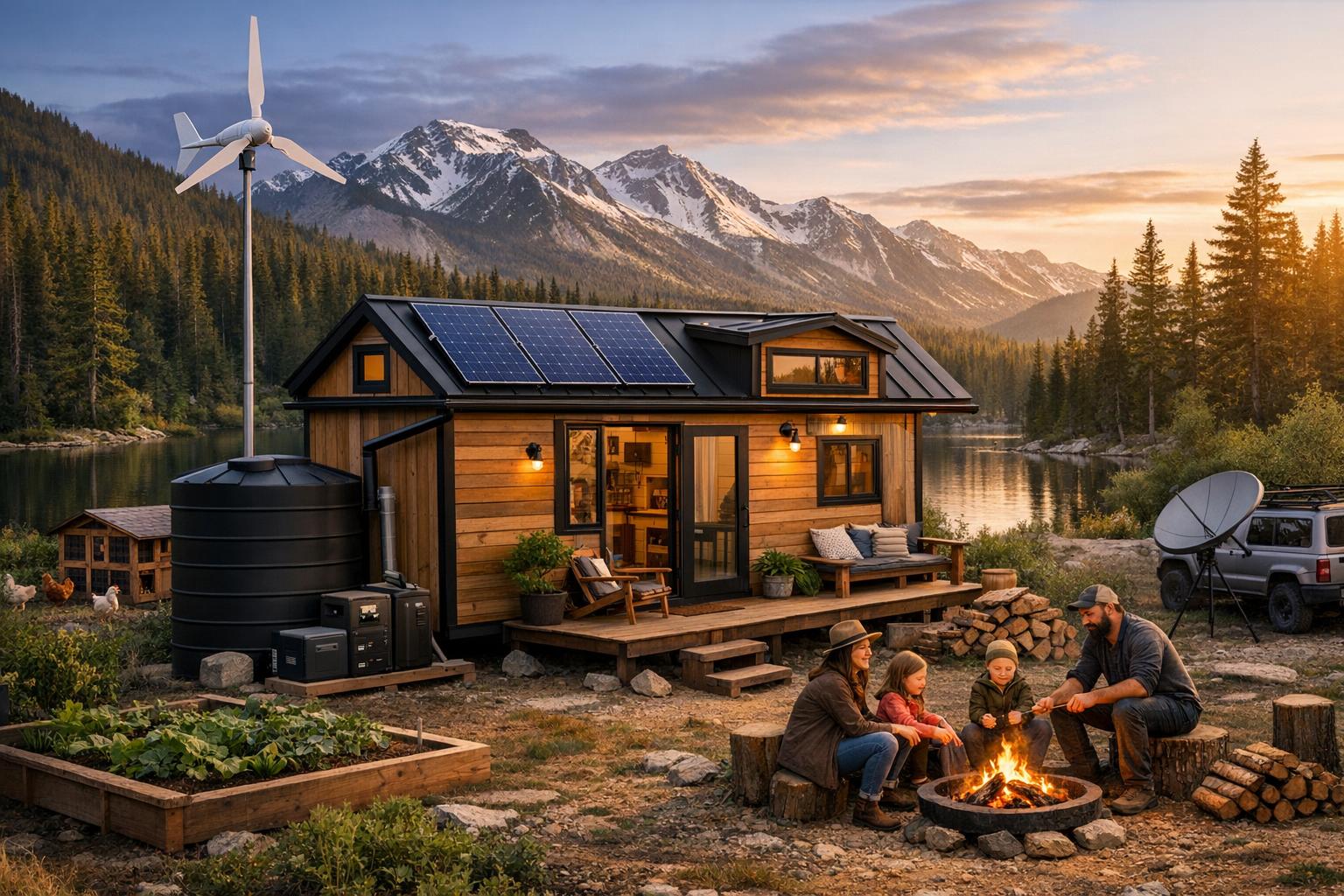
An off-grid family tiny home: affordable, resilient family living in Canada (2026)
Estimated reading time: 12 minutes
Key Takeaways
- Off-grid family tiny homes let Canadian families reduce housing cost and increase resilience while keeping comfort and safety.
- Plan site selection, bylaws, insulation, solar & battery sizing, water strategy and safety systems early — these choices shape cost and livability.
- Hybrid systems (grid or generator backup) are a pragmatic first step for many families; full off-grid requires larger storage and redundancy.
- Design for kids: safe sleeping zones, storage, ergonomic remote-learning spaces and simple escape routes make tiny living family-ready.
Table of contents
- Quick decision checklist
- Off-grid vs ADU for families
- Site selection and orientation
- Sustainable design strategies
- Heating, cooling & ventilation
- Designing for family living and space planning
- Remote learning in an off-grid tiny home
- Safety systems
- Operations & maintenance
- Budgeting, timelines & funding
- Professionals & permits
- Mini case example
- FAQ
Quick decision checklist (scan this first)
Use this list to quickly see if an off-grid family tiny home plan is realistic for your household.
- List your occupants and needs
- How many people, ages, and any mobility needs?
- Target size: 20–40 m² often fits 2–4 people (plan bigger or an ADU/expandable option for 5+).
- Set a clear budget range
- Typical 2026 range: $100,000–$250,000 CAD for a 20–40 m² tiny home (size, finishes, systems vary). See the cost guide from Constructem for context.
- Confirm your bylaw path before design
- Ask whether tiny homes on wheels vs on foundation or an ADU are permitted; get permit conditions in writing. See Canadian tiny-home news at the Tiny Home Industry Association.
- Check your climate zone and exposure
- Find winter lows, snow loads, and wind exposure to size insulation and solar. Practical off-grid planning resources: OffGridSolarSystem.
- Decide your self-sufficiency level
- Full off-grid, or hybrid (grid/generator backup)? Write your target: “24/7 off-grid” or “off-grid most days + backup.”
- Plan schooling early
- Remote learning affects power and internet choices — research connectivity options and provincial rules (see BC and Ontario portals below).
- Confirm emergency access
- Aim for 30–60 minutes to emergency care year-round; verify winter road passability.
- Plan water and storage
- Well, rainwater catchment, or municipal? If rainwater, target 5,000 L minimum backup storage. See rainwater guidance at Rainwater Harvesting for Tiny Homes.
- Map the build timeline in phases
- Planning: 1–3 months; Shell: 3–6 months; Systems: 2–4 months; Interior: 1–2 months. See cost & timeline notes at Constructem.
Off-grid vs ADU for families (what changes in real life)
An off-grid family tiny home is a compact dwelling—often under 40 m²—designed to run without municipal utilities. An ADU (accessory dwelling unit) is a second unit on an existing lot and is usually connected to services unless local rules allow otherwise. For background on regulatory trends, see the off-grid planning guide and industry news at the Tiny Home Industry Association.
Side-by-side: family pros and cons
- Zoning & permits
- Off-grid: often easier in rural areas; trickier in towns/cities unless bylaws are clear.
- ADU: often easier in cities supporting missing-middle housing; permits/resale advantages apply.
- Utilities
- Off-grid: design for independence (solar + batteries, rainwater/well, composting/septic) — higher upfront system costs. See practical system planning at OffGridSolarSystem.
- ADU: simpler hookups, ongoing bills, potentially lower short-term complexity.
- Taxes & resale
- Off-grid: niche resale market for buyers seeking self-sufficiency; tax treatment varies locally.
- ADU: stronger resale appeal in urban areas where extra units are valuable.
Site selection and orientation (Canada-specific)
Select a site that balances solar access, water, emergency proximity, and legal compliance—your floorplan cannot fix a poor site.
Step-by-step: check solar and microclimate
- Stand where the panels would go (roof or ground rack).
- Use solar path tools or calculators (PVGIS, other apps).
- Aim for south exposure with minimal shade, roughly ±20°.
- Plan storage and backup for low winter production. Source: OffGridSolarSystem.
Wind & snow — on the Prairies wind increases heat loss; use windbreaks and confirm local snow-load requirements. For legal and bylaw context, consult industry updates at Tiny Home Industry Association.
Water access: decide early
- Well: year-round supply but drilling costs vary.
- Rainwater catchment: works if sized and treated—plan 5,000 L for family backup; see Rainwater Harvesting for Tiny Homes.
- Municipal: simplest if available; consider hybrid hookups for reliability.
Practical legal checklist for the land
Bring these questions to the municipality: lot coverage limits, septic permit rules, driveway and emergency access standards, floodplain restrictions, and rules for wheeled units. Get permit conditions in writing. See regulatory context at the Tiny Home Industry Association.
Sustainable design strategies (the systems that make off-grid easier)
Design to use less energy and water so your solar and storage systems can be smaller and more affordable.
Passive design targets
- Insulation: walls ~R-40; roof/ceiling R-50+; floor R-20+.
- Airtightness: aim for < 1.0 ACH50.
- Windows: prefer triple-glazed units and optimize south glass for winter sun.
Two small choices that help a lot: exterior shading for summer and some indoor thermal mass.
Renewable energy: solar PV + batteries (family sizing basics)
Start with an honest energy budget—include internet, laundry, cooking and remote learning gear. Typical references and planning tips are available from OffGridSolarSystem.
- Example family baseline: 5–8 kWh/day.
- Typical system ranges: PV 5–10 kW; batteries 20–40 kWh usable for 1–3 days autonomy.
- Inverter sized to peak loads; consider a hybrid inverter/charger for future grid/generator integration.
Microinverters vs string vs hybrid: microinverters help with partial shading; string inverters are simpler on clear sites; hybrid best when batteries are used. Always use certified equipment and qualified installers for Canadian inspections.
Water systems (safe, sized, realistic)
- Rainwater catchment: storage target 5,000 L minimum; treatment stack: first-flush, sediment prefilter, 0.2–0.5 µm filter, and UV.
- Well: plan for pump, pressure tank and testing.
- Greywater: laundry-to-landscape can reduce usage — check local rules first.
For composting vs septic comparisons see the composting toilets guide at Composting Toilets: The Ultimate Waste Management Solution.
Heating, cooling & ventilation for Canadian climates
Efficient heat with redundancy and proper ventilation for moisture control are priorities in small family homes.
Heating options that work off-grid
- Wood stove (high-efficiency): many tiny homes use an EPA-certified 8–12 kW unit—follow clearance and chimney rules; use CO alarms.
- Cold-climate mini-split heat pump: choose models rated toward -25°C to -30°C and plan backup heat for extreme cold.
- Radiant floor heat: very comfortable, especially for infants; pair with a good envelope.
Ventilation (HRV/ERV)
HRV/ERV brings fresh air while saving heat. Typical flows: 30–60 L/s depending on occupancy. Plan filter maintenance every 6–12 months.
Freeze protection and safety
Keep plumbing inside the heated envelope; insulate runs; use heat tape where necessary and design waste lines to avoid freeze risk.
Designing for family living and space planning
Balance flexibility, privacy, storage and child safety to reduce daily friction in small spaces.
Multi-functional zones
- Kitchen + dining + learning: keep at least 90 cm clear paths; consider induction cooking if power allows.
- Lofts vs ground sleeping: lofts save floor area but require safe stairs/rails; ground bedrooms better for kids and elders.
- Storage & safety: locked, high storage for chemicals and meds; anchor tall furniture; install cabinet locks and stair gates.
Design sample floorplans: couple + 1–2 children (~28 m²) or multi-gen ADU (~35 m²) with ground bedroom for elders and a loft office/learning nook. For design inspiration see the tiny-home living guide at Tiny Home Living: Your Complete Guide.
Remote learning in an off-grid tiny home
Reliable internet and an ergonomic study space are as critical as plumbing for families doing remote learning.
Internet options
- Starlink (LEO satellite): commonly reported ~50–200 Mbps (varies by location).
- Fixed wireless ISP: stable when available.
- Cellular LTE/5G: workable with external antenna and data plan.
- Point-to-point links: possible where a clear path to a tower exists.
Reference: technical planning overview at OffGridSolarSystem.
Redundancy & speed targets
- Aim for two methods: primary (Starlink/fixed wireless) + backup (LTE hotspot).
- Minimum for 1–2 video calls: 25 Mbps / 5 Mbps; multiple streams: 50 Mbps+; latency <100 ms preferred.
Learning space tips
- Desk matched to child height, side natural light, rug and soft panel for acoustics.
- Stock: headset, webcam, extra chargers, paper planner for offline days.
- Check provincial schooling portals early: BC education and Ontario education.
Safety systems (family-ready, code-ready)
Install code-compliant detection, safe storage and escape planning before move-in.
Fire safety
- Interconnected photoelectric smoke alarms near sleeping areas.
- Minimum two fire extinguishers: kitchen and near wood stove/exit (rating ~2A:10B:C).
- Escape plan with two ways out from sleeping zones; practise loft escape drills.
CO, gas & electrical safety
- CO alarms near sleeping areas and propane detectors if used.
- Use CSA-certified equipment; proper grounding, labelled AC/DC panels, transfer switch for generators, GFCI where required.
- High-voltage or grid-tied work: hire a certified electrician. See safety and cost context at Constructem.
Childproofing & remote site security
- Cabinet locks, tamper-resistant outlets, stair gates, stove guards, anchored storage.
- Battery-backed alarm panel, motion lighting, strong deadbolts, and a neighbour check-in plan.
- Maintain a written emergency plan and a 72-hour kit (water, food, meds, blankets, tools).
Operations & maintenance (keep the home stable all year)
Routines prevent small issues from becoming system failures.
Monthly
- Log battery SOC trends, check inverter alarms, test detectors, check propane levels, visual PV check after storms.
Quarterly
- Clean panels if needed, test generator under load (30 minutes), check HRV/ERV and rainwater filters.
Annual
- Electrical inspection by certified electrician, septic or compost servicing, roof & snow checks, reseal openings as needed.
Train for first aid/CPR and basic battery-system awareness. Keep a maintenance log with date, item, findings, corrective action and next due date. Reference: OffGridSolarSystem.
Budgeting, timelines & funding (2026 planning numbers)
Cost varies most with shell quality, insulation, and off-grid systems.
Cost ranges (2026 CAD)
- Common estimates: $120–$200 per sq ft; many builds around $150,000–$300,000 CAD. See cost context at Constructem.
Typical cost breakdown
- Shell: $60K–$100K
- Systems (PV, batteries, water, waste, HVAC): $40K–$80K
- Interior: $20K–$50K
- Planning & permits: $10K–$20K
Phased build approach
- Phase 1: Planning & permitting (1–3 months) — site plan, energy budget, permit package
- Phase 2: Shell & envelope (3–6 months) — weather-tight structure
- Phase 3: Systems (2–4 months) — PV, batteries, water, waste, inspections
- Phase 4: Interior & move-in (1–2 months) — occupancy/compliance sign-off
Funding & incentives
Programs change—start with federal resources: CMHC and Natural Resources Canada at NRCan Energy Efficiency. Verify 2026 program details on the provider sites.
Professionals & permits (who you need and what to ask)
A strong team saves time and rework—especially on systems and inspections.
Recommended team
- Tiny home/ADU designer or architect
- Structural engineer (snow/wind loads)
- Certified electrician with off-grid experience
- Solar installer, plumber/septic installer, municipal liaison, commissioning inspector
Common permits
- Building, electrical, plumbing, septic (if applicable), occupancy or compliance certificate. Ask your building department for the written list of required inspections and timelines. Industry resources: Tiny Home Industry Association.
Mini case example (Canada)
An Edmonton-area example shows municipal bylaw changes can open clearer paths for small secondary units; the lesson is to confirm written permission before committing to a site or foundation/trailer approach. See coverage at the Tiny Home Industry Association.
FAQ
1) How much does an off-grid family tiny home cost in 2026?
Many Canadian builds fall in the $150,000–$300,000 CAD range depending on size, insulation and systems. Per-square-foot estimates commonly cited are $120–$200/sq ft. For detailed budgeting and phased approaches see Constructem.
2) What schooling options and supports are best for remote learning in remote areas?
Families typically mix provincial online school, homeschooling, or blended approaches. Reliable internet (Starlink/fixed wireless) plus an LTE backup are common. Confirm provincial reporting and enrolment rules via the official portals: BC education and Ontario education. See technical planning notes at OffGridSolarSystem.
3) Can my family live off-grid in winter in Canada?
Yes, with careful design: high insulation, airtightness, reliable heating with redundancy (e.g., heat pump + wood stove), plumbing freeze protection and snow management. See winter and off-grid planning resources at OffGridSolarSystem and regulatory notes at the Tiny Home Industry Association.
4) What safety systems must I install before moving in?
Install smoke alarms (interconnected photoelectric), CO alarms, fire extinguishers, clear escape routes, code-compliant grounding and labelled electrical panels. Use certified installers for high-voltage or gas work. Cost and safety guidance: Constructem.
5) Are off-grid family tiny homes legal where I live?
It depends on municipality and whether the unit is wheeled or on foundation. Provinces adopt the National Building Code with local amendments; cities control zoning. Always ask your planning/building department for written direction before buying land or ordering drawings. See provincial/municipal context examples at Ecohome (BC guide) and industry updates at Tiny Home Industry Association.
6) ADU vs off-grid tiny home — which is right for my family?
An ADU is often better where services, schools and healthcare are nearby and permitting is clearer. An off-grid tiny home suits families seeking independence in rural settings. The right choice depends on zoning, site, and how much maintenance you want. See regulatory and design resources at Tiny Home Industry Association and the off-grid planning guide at OffGridSolarSystem.
Practical resources (Canada)
- Tiny home costs and 2026 budgeting — Constructem
- Off-grid technical planning (solar, water, winter realities) — OffGridSolarSystem
- Canadian tiny-home news & bylaw context — Tiny Home Industry Association
- Additional tiny-home legal/news context — Tiny House Alliance
- BC tiny homes on wheels legal guide — Ecohome
- CMHC — federal housing information
- NRCan — energy efficiency programs
- The Ultimate Guide to Solar-Powered ADUs for Canadian Homes — ADUStart
- Rainwater Harvesting for Tiny Homes in Canada — ADUStart
Actionable planning checklists, phased timelines and system specs above are designed to help you plan a safe, sustainable and education-ready off-grid family tiny home in 2026. Always confirm bylaws and permitting locally before you build.
Leave a Reply