

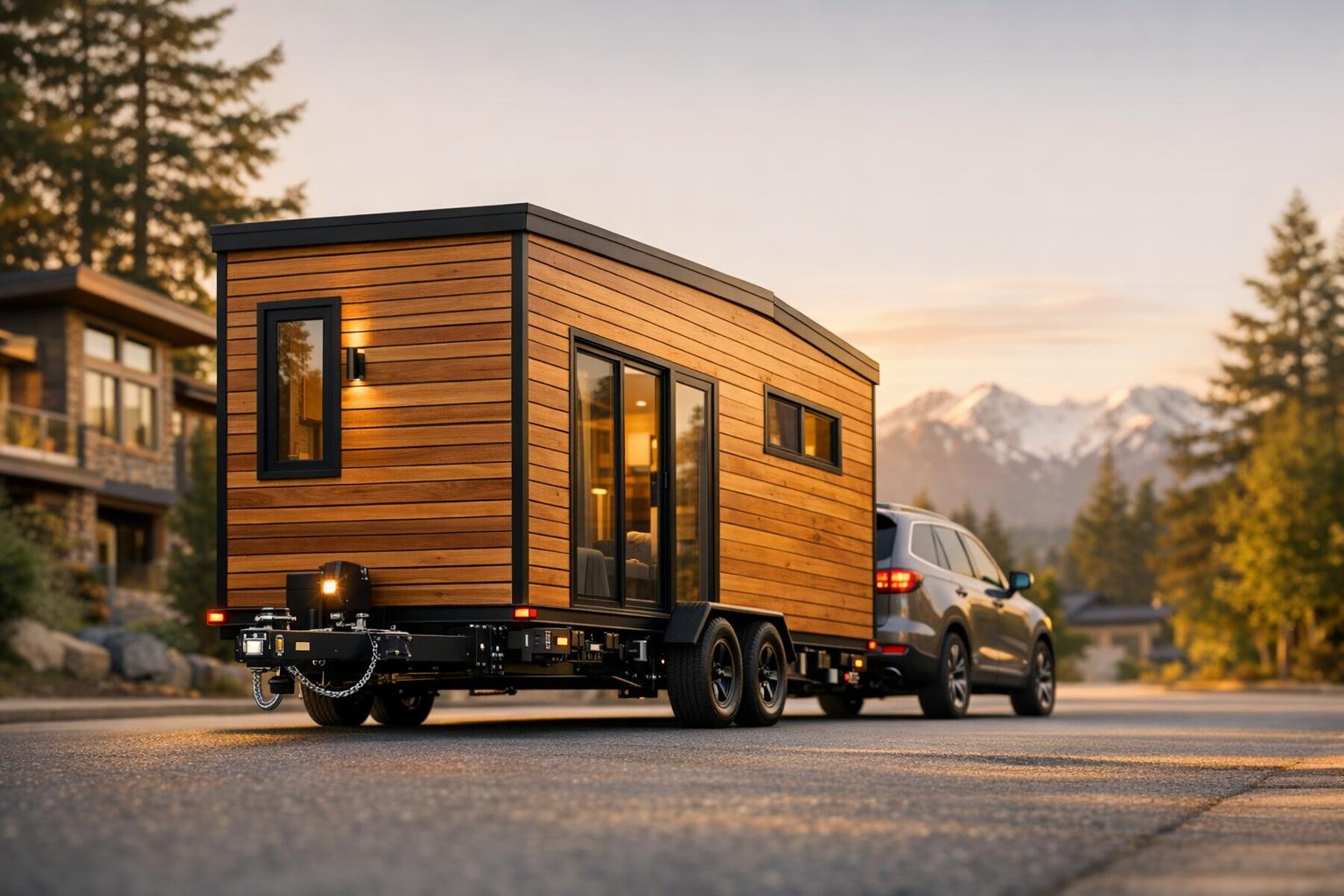
Estimated reading time: 12 minutes
Key Takeaways
- Tiny home mobility in Canada now means managing the entire system: chassis, tow vehicle, brakes, route tools, certification, and permits.
- Moveable homes 2025 often relied on fixed frames and basic towing setups, while 2026 brings modular chassis, smarter braking, and better terrain-aware navigation.
- Canadian builders like Minimaliste and Teacup Tiny Homes reflect the growing demand for mobile, 4-season designs.
- A transportable ADU may be treated one way during towing and another way after installation, so provincial and municipal rules must both be checked.
- For safer transport, prioritize braking upgrades, payload matching, route planning, and certification before focusing on convenience features.
Table of contents
- Tiny Home Mobility in Canada 2026
- Quick recap — Moveable Homes 2025: wins, limits, and lessons
- What’s new in 2026 for tiny home mobility
- Moveable homes 2025 vs 2026: what changed
- Modular chassis deep dive — how 2026 designs improve moveability
- Towing technology upgrades in 2026
- Smart navigation and route planning for Canada
- Transportable ADU rules, certification, and permitting in Canada
- Safety, testing, and standards that matter in 2026
- Choosing the right tow vehicle and drivetrain
- Canadian case studies and scenarios
- Costs, retrofit budget, ROI, and resale
- Step-by-step checklist for moving a transportable ADU across provinces
- Visuals and assets to include in the published article
- Frequently Asked Questions
Tiny Home Mobility in Canada 2026
Tiny home mobility is the ability to move a tiny home or transportable dwelling safely, legally, and efficiently between sites without compromising structure, systems, or road safety.
In 2026, this is changing fast in Canada. New modular chassis designs, improved towing systems, and smarter route-planning tools are making transport easier than it was for moveable homes 2025.
That matters because Canada adds real complexity to every move: long distances, steep grades, ferry crossings, winter roads, provincial permit differences, and insurance or certification hurdles.
This article explains what changed since 2025, what is new in chassis design, which towing upgrades matter most, how navigation tools now better fit Canadian geography, and what a buyer or owner of a transportable ADU should check before crossing provincial lines.
It is written for owners, builders, regulators, tow-vehicle operators, and buyers researching mobile, 4-season homes in Canada, including examples from Minimaliste and Teacup Tiny Homes. For broader purchasing context, the Canada-focused guide from Home Smart Living is also useful.
Quick recap — Moveable Homes 2025: wins, limits, and lessons
Before looking at 2026, it helps to remember what moveable homes 2025 looked like in Canada.
In 2025, many homes still used fixed steel trailer frames rather than a true modular chassis. Towing systems were often basic as well, with standard electric brakes, simple hitch setups, and limited trailer-to-vehicle communication. For navigation, many owners still depended on consumer GPS apps that were not designed for bridge heights, ferry timing, winter hazards, or dead-signal regions.
There were real wins:
- More 4-season tiny homes became available in Canada
- Wheeled tiny homes became more common in urban and rural contexts
- Park-model and portable-shelter options expanded buyer choice
- Many practical units stayed under 400 square feet
But the limits were clear:
- Rigid frames transferred road shock into the structure
- Leveling was often slow and manual
- Sway control and braking could be weak
- Route planning tools missed key hazards
- Uncertified units often ran into insurance and permit trouble
The biggest lessons from 2025 were simple:
- Certification matters for permits and insurance
- Tiny home mobility depends on the whole system, not just the trailer
- Buyers often underestimated route limits and tow-vehicle matching
Builders such as Teacup Tiny Homes and Minimaliste helped move the Canadian market forward, while broader industry coverage from Tiny Tiny Homes and guidance on tiny home certification in Canada made one point very clear: uncertified units can become expensive problems very quickly. Buyers should also review legal requirements in Canada before assuming a mobile home will be easy to place.
What’s new in 2026 for tiny home mobility
The headline for 2026 is this: tiny home mobility is improving at the system level, not just the product level.
That means:
- chassis are more modular
- towing is more sensor-driven
- route planning is more terrain-aware
- winter and remote-region performance are being designed with Canada in mind
The three biggest changes are:
- Structural innovation: modular chassis
More homes now use adaptable frame systems instead of one fixed trailer design. - Movement and safety innovation: towing technology
Braking, sway control, steering help, sensors, and trailer communication are more advanced than they were for 2025. - Operational innovation: smart navigation and telematics
Route tools now account for grades, low bridges, weather, ferry needs, and poor connectivity.
These upgrades matter even more in Canada, where the environment is rarely forgiving. Rocky Mountain grades, coastal roads, ferry ramps, northern dead zones, and freeze-thaw damage all create extra stress on trailers, homes, and tow vehicles.
In short, 2026 is not just a better trailer year. It is a better mobility year.
Plug-and-play chassis options, active steering support, and AI-assisted route tools are beginning to shape how Canadian moveable homes travel and get placed. This shift is visible across manufacturer examples like Minimaliste, consumer-focused builder pages such as Teacup Tiny Homes, and broader trend discussions tied to remote work and tiny home utilities in Canada.
Moveable homes 2025 vs 2026: what changed
| Feature | moveable homes 2025 | 2026 |
|---|---|---|
| modular chassis | Fixed steel frames | Interchangeable hydraulic modules |
| Leveling | Manual leveling | Auto-leveling options |
| Braking and sway systems | Basic electric brakes | ABS-related EOH brake integration and active sway aids |
| Steering assistance | Little or none | Active trailer steering support |
| Route planning and navigation | Consumer GPS only | Terrain-aware tools, ferry and winter routing, satellite/mesh support |
| Winter readiness | Limited route intelligence and mixed cold-weather prep | Better winter-focused planning and system protection |
| Certification and permit awareness | Often handled late | More attention to compliance earlier in the process |
This table captures the core shift: 2025 often treated transport as a trailer problem, while 2026 treats it as a full mobility system.
For Canadian buyers comparing options, resources from tiny home on wheels comparisons, along with manufacturer examples from Minimaliste and Teacup Tiny Homes, help show how quickly that shift is happening.
Modular chassis deep dive — how 2026 designs improve moveability
A modular chassis is a frame or trailer system built with interchangeable or configurable parts. These can include axle sets, support modules, mounting points, leveling gear, and utility-routing paths.
Unlike a fixed trailer, a modular chassis is built to adapt to different loads, road conditions, and service needs. That makes it a major part of better mobility in 2026, especially for a transportable ADU moving between provinces.
Key 2026 modular chassis features include:
- Bolt-on hydraulic leveling systems
- Pivot mounts that reduce stress on uneven ground
- Integrated electrical harness routing
- Axle modules better matched to weight distribution
- Easier service access
- Better shell compatibility for some transportable ADU designs
The practical benefits are clear:
- Improved stability on rough roads
- Faster setup after transport
- Better leveling on site
- Smarter weight management
- Less structural stress on the shell
Some 2026 research examples place common ranges around:
- GVWR: roughly 10,000 to 15,000 lbs
- Axle ratings: up to 7,000 lbs each
- Shell compatibility: up to around 28 feet in some examples
Still, there is one important caution: modular does not mean universal.
You still need to check:
- shell dimensions
- utility hookup layout
- GVWR
- axle rating
- legal width and height
- service support in Canada
Buyer and retrofit checklist for a modular chassis
- Confirm shell compatibility
- Verify axle ratings
- Inspect harness routing
- Ask about auto-leveling
- Confirm replacement parts and service support in Canada
Canadian manufacturers like Minimaliste and Teacup Tiny Homes are useful examples, but buyers should always verify exact specs for each model. It is also worth reviewing steel-framed small home guidance and checking how certification affects any chassis retrofit through resources like this certification guide.
Towing technology upgrades in 2026
Towing technology means the entire towing system: hitches, couplers, braking, sway control, steering assistance, wiring, sensors, and communication between trailer and tow vehicle.
This is one of the biggest areas where 2026 moves beyond 2025.
Braking
A major upgrade is electric-over-hydraulic (EOH) braking. The trailer gets an electric signal but applies hydraulic force, which usually gives stronger and more controlled braking than simpler electric-only setups.
In 2026, ABS-related integration is also a major improvement. On wet roads, icy roads, and long downhill grades, that matters a lot in Canada.
Hitches and weight distribution
Tongue weight is the downward force the trailer applies to the hitch. A common working guide is roughly 10% to 15% of GVWR.
If tongue weight is too light, sway gets worse. If it is too heavy, steering and braking can suffer. Proper hitch setup is not optional.
Sway control
Active sway control uses sensors and brake response to keep the trailer steadier. This is especially valuable on open prairies, windy coastlines, mountain descents, and during sudden lane changes.
Active trailer steering
Active trailer steering helps the trailer track better in tight or awkward spaces. That can be useful on ferry ramps, small urban lots, narrow driveways, and placement sites with limited turning room.
Wiring and sensors
Modern 2026 towing systems may include:
- CAN-bus wiring integration
- LED lighting
- backup cameras
- 360-degree sensors
- emergency disconnect systems
Best-practice payload matching
For safety, many setups should stay under about 80% of real tow and payload capacity. That buffer matters even more in Canada because hills, snow, and distance amplify towing stress.
Retrofit priorities
- Braking upgrade first
- Lighting and camera upgrade second
- Emergency disconnects and wiring integrity next
- Sway and steering aids after that, if budget allows
Research summarized by Home Smart Living points to EOH brakes with ABS-related integration as one of the strongest gains for highway stopping and stability. Buyers interested in greener logistics can also review zero-emission tiny home transport, while financial planning around upgrades may connect with broader ownership costs such as tiny home financing in Canada.
Smart navigation and route planning for Canada
Route planning is now part of safe tiny home mobility. It is no longer something to do the night before a move.
A modern route-planning stack may include:
- low-clearance alerts
- road weight-limit data
- steep-grade forecasting
- winter hazard rerouting
- ferry schedule integration
- remote connectivity through satellite or mesh tools
Canadian route challenges by region
BC and Atlantic coastal routes
Expect ferry bookings, narrow lanes, wind exposure, and tricky loading angles.
Ontario and Quebec corridors
These often involve bridge heights, dense traffic, local restrictions, and more routing complexity after arrival.
Prairies
Strong winds, long distances, and freeze-thaw pavement changes are common.
Rockies
Steep grades create brake heat, transmission strain, and higher consequences for poor tow setup.
Northern territories and remote roads
Poor signal, seasonal access, and rough resource roads make backup planning essential.
What predictive grade assist means
Predictive grade assist means the navigation system can identify major climbs and descents ahead, helping the driver manage speed, braking, cooling, and stop points before the hardest section begins.
Winter planning must include the home too
For a transportable ADU or tiny home, route planning should consider more than roads. It should also cover the home’s systems during travel and after placement.
- antifreeze-compatible HVAC
- heated tanks
- insulation suited to freeze-thaw travel and use
In 2026, telematics can flag low bridges, weight-limited roads, and winter hazards. Some tools also support satellite or mesh connectivity and ferry pre-booking, which is especially useful in BC. Related connectivity planning can be explored further through universal Wi-Fi for tiny homes in Canada and remote sensing basics.
Transportable ADU rules, certification, and permitting in Canada
A transportable ADU is a secondary dwelling built to be moved or delivered to a site. But its legal treatment may change depending on when, where, and how it is being used.
During transport, a unit may be treated more like an RV or trailer. Once placed on land, it may be reviewed under local zoning and building rules as an ADU.
Sizing and classification
Many market examples remain under 400 square feet. But size alone does not determine legal status. The same unit may be road-legal for towing and still require separate local approval after placement.
Certification
Certification affects both insurance and permitting. The cited research references CSA Z240 as one trailer-related example, but buyers should always confirm current requirements before transport or installation.
Provincial differences
- BC and Alberta may treat some units more like RVs during towing
- Ontario and Quebec may review the unit more clearly as an ADU once stationary
- In one cited Alberta example, 8.5-foot width may be allowed without a pilot in that context
- In one cited Quebec example, axle certifications are required
Insurance
Insurers usually want clear answers to these questions:
- Is the unit road-legal?
- Is it certified?
- Is it mainly mobile or mainly stationary?
- Does actual use match declared use?
Why modularity helps, and what it does not do
A modular chassis can support safer transport and quicker setup, but it does not replace zoning approval, permit review, or local building compliance.
Do not assume one province’s rules apply in another. Always check municipal zoning as well as provincial transport rules. Helpful starting points include the Canadian ADU regulations guide, the BC ADU permitting guide, and the Ontario ADU permitting guide.
Safety, testing, and standards that matter in 2026
Safe tiny home mobility depends on compliance, test data, and component compatibility.
Transport dimensions and combination limits
Research for 2026 includes examples such as:
- maximum height around 12 feet 6 inches
- maximum combination length around 53 feet
These are examples, not universal guarantees. Current federal and provincial rules should always be confirmed before moving.
Trailer and braking standards
The research also references standards such as:
- CSA A123 for roofs
- ISO 11406 for braking
Again, these should be treated as cited examples that must be verified against current 2026 rules and product documents.
Winterization and real-world safety
Winter testing matters more in Canada because cold, wet, and icy roads change braking distance, sway risk, and tire behavior. A stronger chassis and better brakes can perform very differently from older equipment once temperatures drop.
Why 2026 is safer than moveable homes 2025
Compared with 2025, 2026 setups can be safer because they combine:
- better brakes
- better sway control
- stronger chassis adaptability
- better route intelligence
The cited research reports winter tests where EOH brakes cut sway incidence by 50%, with real-world stability gains around 30% versus older setups. Those numbers matter because mobility upgrades are not just convenience upgrades; they are risk-reduction upgrades.
Related safety planning may also involve reviewing tiny home fire safety in Canada and confirming compliance through resources like this certification guide.
Choosing the right tow vehicle and drivetrain
This part is about matching the tow vehicle to the real gross combined load, terrain, and climate.
Important terms:
- GCWR: the combined weight of loaded vehicle and loaded trailer
- Payload: how much weight the truck can carry
- Tongue weight: the force from the trailer pressing down on the hitch
- Gearing: the axle ratio that affects pulling power
Practical guidance by load range
Under 12,000 lbs
Some heavier light-duty trucks may work, but buyers still need to check payload, hitch rating, and real conditions.
12,000 to 20,000 lbs
This is where many Canadian tiny home and transportable ADU setups fit better with a 3/4-ton truck or stronger. Auxiliary cooling, stronger brakes, and proper gearing matter more here.
Drivetrain features that help in Canada
- AWD or 4WD for slippery access roads and winter conditions
- Transmission cooler for mountain towing
- Diesel torque or strong gas output for steep grades
- 3.73 or higher gearing for better pulling power
- 400+ hp examples for higher GCWR applications in the research
Common mismatch mistakes
- Looking only at max tow rating
- Ignoring payload limits
- Forgetting passengers, tools, batteries, water, cargo, or winter gear
- Underestimating hills, snow, or gravel access roads
The 2026 research strongly supports AWD or 4WD 3/4-ton trucks with transmission cooling and suitable gearing for Canadian grades and GCWR near 20,000 lbs. Buyers exploring future transport trends may also find zero-emission transport worth watching.
Canadian case studies and scenarios
Real examples make technical points easier to apply.
BC coastal ferry route
A transportable ADU on a modular chassis faces ferry lane alignment, ramp angles, crosswinds, and booking timing. In a 2026-style setup, telematics can help with ferry planning, while sway control and better hitch setup improve movement on windy coastal roads.
Lesson: On coastal routes, route planning and towing technology matter as much as the trailer itself.
For readers planning these routes, useful references include tiny home permits in British Columbia and BC permit guidance.
Yukon or northern remote haul
A remote winter move needs strong braking, emergency readiness, remote connectivity, and careful speed control. EOH brakes and conservative loading are especially important on cold, rough roads with limited support.
Lesson: In the north, safety margins should be bigger than the minimum.
For more context, see tiny homes in northern Canada.
Ontario urban deployment
A move into an Ontario corridor may involve bridge clearances, dense traffic, and local routing limits. After placement, the unit may also shift from transport use to transportable ADU review under local rules.
Lesson: Urban moves need both smart routing and legal planning after arrival.
Relevant planning resources include the Ontario ADU permitting guide and broader urban infill guidance.
Costs, retrofit budget, ROI, and resale
In 2026, the cost of better tiny home mobility usually falls into a few buckets.
Typical upgrade ranges
- modular chassis: about $15,000 to $25,000
- towing technology upgrades: about $5,000 to $10,000
- navigation and telematics: about $2,000 to $4,000
- total upgrade path: about $25,000 to $40,000
What drives cost
- hydraulic leveling
- higher axle capacity
- braking upgrades
- cameras, sensors, and wiring
- route-planning tools or subscriptions
- labour
- certification work
What drives value
Better mobility can:
- widen where and how the home can be used
- reduce transport risk
- speed up setup at destination
- improve resale appeal for certified homes
- help operators who move units more often
The cited research notes resale uplift around 15%, installation timelines of roughly 4 to 6 weeks, and rental ROI examples around 8% to 12% per year.
Still, ROI is never automatic. It depends on zoning, insurance, route frequency, and whether the home actually moves often enough to justify the upgrades. For investment-minded buyers, it may help to compare with ADU investment guidance in Canada and ADU resale and property value considerations.
Step-by-step checklist for moving a transportable ADU across provinces
This checklist turns tiny home mobility into a practical process.
- Verify the legal identity of the unit
Confirm whether the unit is being moved as a trailer, RV-type unit, tiny home, or transportable ADU. Check the destination municipality too. - Check certifications and inspections
Review axle stamps, chassis documents, brake and lighting compliance, and insurance paperwork. - Confirm dimensions and weights
Measure height, width, length, GVWR, axle loads, and tongue weight. - Secure permits
Check provincial oversize rules, escort requirements, and ferry bookings where needed. In the cited BC example, oversize conditions can begin above 8 feet 6 inches. - Prepare the home systems
Drain or secure water systems if needed. Winterize with heated tanks or antifreeze-compatible systems. Secure interior and exterior items. - Prepare the tow setup
Inspect the hitch, test the brake controller, check lights and cameras, and verify the emergency disconnect. - Build the route plan
Check bridge clearances, weight-restricted roads, steep grades, fuel stops, service access, and remote connectivity backup. - Conduct a pre-departure inspection
Check tires, wheel torque, brake response, chains, mirrors, and signage. - Inspect after the move and set up
Recheck the chassis, shell, seals, roof, utilities, and leveling system after arrival.
This kind of repeatable process reduces surprises and makes cross-province transport safer. Additional moving guidance can be found in moving a tiny home across provinces and province-by-province moving considerations.
Visuals and assets to include in the published article
Strong visuals help explain tiny home mobility clearly.
Useful assets include:
- annotated modular chassis diagram
- comparison table for moveable homes 2025 vs 2026
- route-planning map screenshots for Canadian constraints
- winter towing prep infographic
- optional short video or GIF showing active steering or sway control
Suggested alt text examples:
- “2026 modular chassis diagram for tiny home mobility in Canada”
- “Towing technology comparison for moveable homes 2025 vs 2026”
- “Transportable ADU route planning map for Canada”
These visuals align well with Canadian examples shown by Minimaliste, Teacup Tiny Homes, and the broader research compiled by Home Smart Living. Design inspiration for the presentation layer can also be supported by guides such as tiny home design in Canada.
Frequently Asked Questions
What is the biggest tiny home mobility upgrade in 2026?
The biggest change is the rise of the modular chassis, especially systems with auto-leveling, better utility integration, and better compatibility with modern towing sensors and control systems. See examples from Minimaliste and additional prefab context at prefab house modern housing.
How is a transportable ADU treated in different Canadian provinces?
A transportable ADU may be treated more like an RV or trailer during transport, then reviewed under ADU or zoning rules after placement. In the cited research, BC and Alberta can be more transport-focused in some contexts, while Ontario and Quebec may treat the unit more clearly as a stationary ADU once installed. Start with the Canadian ADU regulations guide, then review the BC guide or Ontario guide as needed.
What’s the best towing technology for winter towing in Canada?
ABS-related EOH brakes are one of the strongest upgrades for winter towing. Add sway control, a properly matched tow vehicle, and conservative loading for the best results. Winter preparation resources such as winter-proof tiny homes in Canada and the Canadian winterization checklist can help.
How different is 2026 from moveable homes 2025?
Moveable homes 2025 often relied on fixed frames, basic electric brakes, and standard GPS. In 2026, systems are more modular, braking and steering aids are smarter, and route planning is built around terrain, weather, and permits. For a broader comparison, see moving a tiny home in Canada and examples from Teacup Tiny Homes.
Can I retrofit an older tiny home for better mobility?
Yes, in many cases. Start with braking, then improve lighting and cameras, check hitch and weight distribution, and review chassis compatibility before moving into deeper modular upgrades. Also confirm certification implications using this tiny home certification guide. If the unit includes water systems or off-grid upgrades, related infrastructure topics like greywater recycling may also affect retrofit planning.
Resources and next steps: Helpful references include the Canada-focused overview from Home Smart Living, manufacturer examples from Teacup Tiny Homes and Minimaliste, plus practical guidance on moving a tiny home in Canada, moving between provinces, and legal requirements.
In 2026, successful tiny home mobility in Canada depends on matching the right chassis, the right towing technology, and the right route and permit strategy to real Canadian conditions. The safest path is to treat mobility as a full system: structure, brakes, tow vehicle, navigation, certification, and local rules all need to work together.
Leave a Reply