

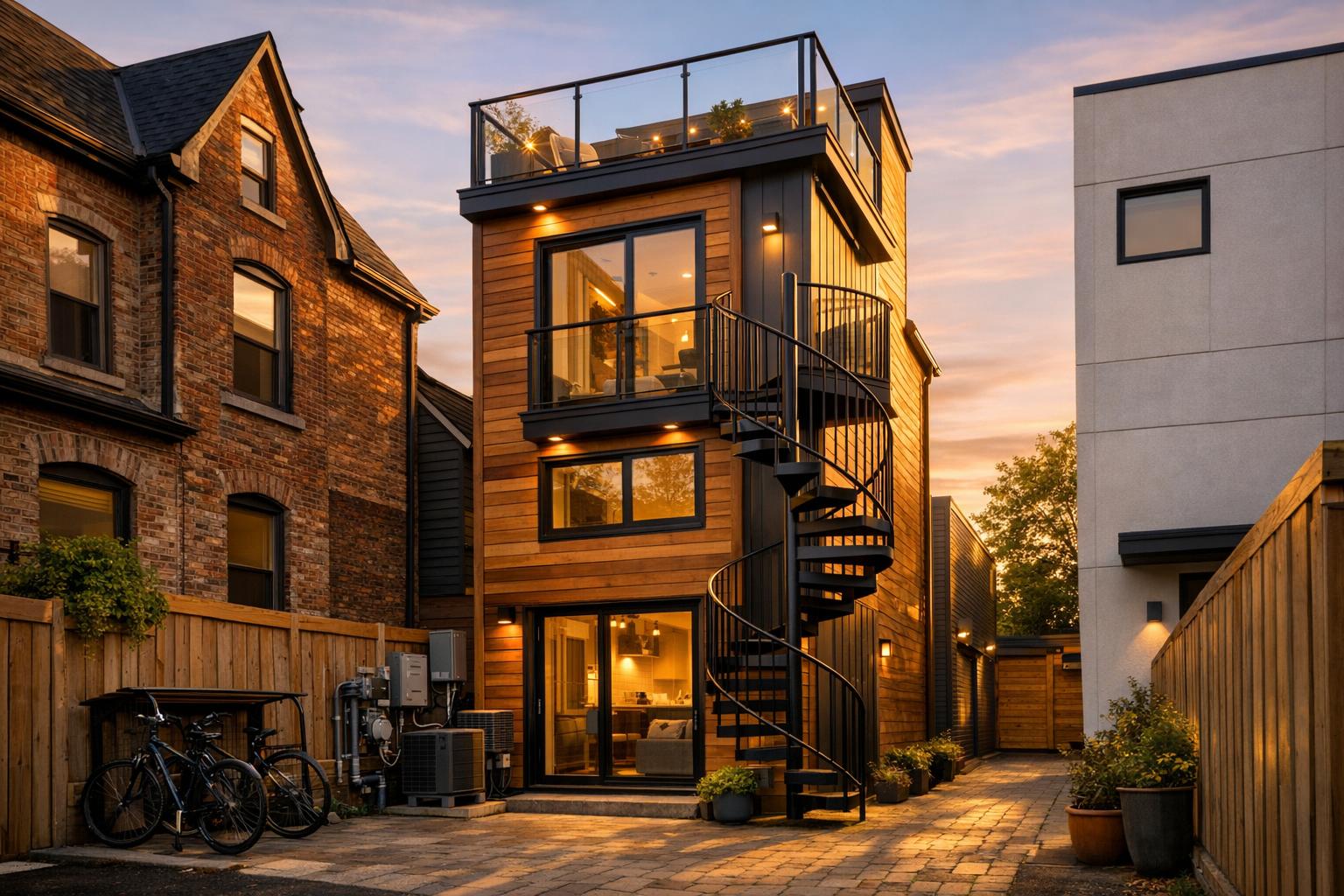
Vertical Tiny Homes and Multi-Story ADUs in Canadian Cities: Smart Small-Lot Housing for 2026
Estimated reading time: 12 minutes
Key Takeaways
- Vertical tiny homes are becoming a practical response to 2026 housing pressure in Canadian cities where land is limited and lot sizes are tight.
- A multi-story ADU can add meaningful living area on a small footprint while supporting rental income, family housing, or downsizing in place.
- Urban infill and the multi-story ADU model are gaining attention because they increase housing choice without pushing development farther outward.
- Success depends on balancing design, code, cost, and comfort, not just fitting rooms into a narrow structure.
- Permitting rules vary by province and city, so early zoning and code review is essential in places such as Toronto, Vancouver, Calgary, and beyond.
Table of contents
- What Are Vertical Tiny Homes and Why Are They Growing in Canadian Cities?
- Design Principles for Vertical Tiny Homes That Actually Work
- Multi-Story ADU Design Options for Narrow Urban Lots
- How Vertical Tiny Homes Support Urban Infill on Small Lots
- Building Code and Permitting for Vertical Tiny Homes in Canadian Cities
- Best Materials and Construction Methods for Vertical Tiny Homes
- Sustainability and Long-Term Livability in Compact Living
- 3 Examples of Vertical Tiny Homes and Multi-Story ADU Projects in Canadian Cities
- Free Planning Tools for Your Vertical Tiny Home or Multi-Story ADU
- Design and Regulatory Checklist Before You Build
- FAQ: Vertical Tiny Homes and Multi-Story ADUs in 2026
Vertical tiny homes are becoming a practical answer to a hard 2026 housing problem. In many Canadian cities, lot sizes are tight, land costs are high, and neighbourhoods are under pressure to add more homes without spreading farther out.
When a site cannot grow wider, the smart move is often to build upward.
That is exactly why urban infill and the multi-story ADU model matter right now. These homes help owners add useful floor area on small lots while staying focused on zoning, code, cost, and day-to-day comfort.
They are also getting serious attention as a strong form of compact living because they stack rooms over a small footprint instead of taking over more yard space. In built-up neighbourhoods, that can make every square foot count.
And the need is not abstract. It is visible in Canadian cities such as Toronto, Vancouver, and Calgary, where housing pressure is pushing owners, designers, and small builders to explore new infill options. Recent context from Canadian tiny house and housing trend reporting, prefab regulation guidance in Canada, municipal tiny home policy examples like Squamish, and the Ontario building code requirements for tiny homes all show why this topic is so relevant in 2026.
What Are Vertical Tiny Homes and Why Are They Growing in Canadian Cities?
Vertical tiny homes are small multi-level homes, often under 800 square feet, that gain space by stacking rooms instead of spreading across a larger lot. They are designed for compact living on narrow or constrained sites.
A multi-story ADU is a second home on the same lot as a main house. It may be detached or attached, and it often rises two or three storeys. In Canadian cities, this can appear as a laneway suite, garden suite, rental home, or family living space. See more on types of ADUs in Canada and how backyard homes can add value.
Urban infill means adding new homes inside existing neighbourhoods instead of building outward onto undeveloped land. That makes vertical tiny homes especially useful because they increase density without greatly increasing footprint.
These formats are growing because of three major forces:
- Population growth
- Policy changes that allow more gentle density
- Energy and land-use goals that favour efficient housing forms
Ontario’s Bill 23 and zoning shifts in places such as Edmonton have helped make more small-footprint housing possible. Wider context from Canadian prefab and housing regulation updates, local tiny home policy examples, housing trend reporting, legal conversion guidance for tiny home structures, and 2026 tiny home cost reporting shows why this style is increasingly relevant.
“Gentle density works best when homes fit existing neighbourhoods without demanding a large footprint.”
Design Principles for Vertical Tiny Homes That Actually Work
Good vertical tiny homes are not just small homes piled on top of each other. They are carefully planned so each level feels bright, safe, and easy to use.
In many Canadian cities, these homes aim for roughly 400 to 600 square feet over two or three levels, often on lots only 10 to 15 feet wide.
The core design goal is simple: fit more usable area into a tight footprint without making the home feel dark, awkward, or cramped.
Start with light and air
Natural light is one of the biggest challenges in narrow stacked homes. Smart openings matter, especially in the middle of the plan. Strategies from tiny home light design guidance can make a major difference.
Useful approaches include:
- Clerestory windows near the top of walls
- Skylights above stairs or lofts
- Tall glazing on one main façade
- Open riser stairs where code allows
- Interior openings that borrow light between levels
Ventilation matters just as much. Warm air rises, so upper operable windows can pull stale air out while lower openings bring fresh air in. This stack-effect approach is a simple way to improve indoor comfort in compact homes, as explained in guidance on air quality in tiny homes.
Zone each floor by use
A good vertical layout gives every level a clear job.
A common arrangement looks like this:
- Ground level
- Entry
- Utility room
- Laundry
- Bike storage
- Coat storage
- Small flex room or bath
- Middle level
- Kitchen
- Dining
- Main living area
- Upper level
- Sleeping
- Wardrobe
- Private storage
This usually works well because the middle level often gets the best daylight for everyday use, while the upper floor feels more private. If you plan a loft or mezzanine, review multifunctional loft design considerations, especially where open mezzanine area may be limited.
Respect code-sensitive dimensions
Small homes still need proper headroom, circulation, and access. In many cases:
- Key living areas should have ceiling heights around 2,100 to 2,300 mm
- Bedrooms generally need 2,100 mm headroom over at least 50% of required floor area
- Hallways and stairs need to support safe movement
A width like 860 mm is often a useful guide for circulation. That is one reason full stairs are usually better than ladders. Guidance on tiny home accessibility in Canada and curbless entry design shows why safe access should be built in early.
Build storage into the structure
Compact living only works if clutter has somewhere to go.
- Drawers under stairs
- Bench seating with hidden storage
- Fold-down desks
- Murphy beds
- Sofa-stair hybrids
- Full-height cabinets on structural walls
Stack services and stabilize the frame
Because vertical tiny homes are narrow and tall, they need careful structural planning. Light-frame wood is common, though metal-framed or hybrid systems may help with wind, shear, or seismic needs in some regions.
Mechanical, electrical, plumbing, and ventilation systems usually work best when stacked in a central chase. This saves space and reduces labour, as outlined in this tiny home utilities guide.
In colder Canadian climates, strong insulation is essential. Guidance on energy efficiency in tiny homes and soundproofing tiny homes also shows why thermal and acoustic performance matter in stacked layouts.
A useful scale example: a 12 x 20 foot base can create around 500 square feet of livable area when stacked vertically, depending on design and code compliance. Broader reference points appear in prefab home regulation guidance and the Ontario code requirements for tiny homes.
Multi-Story ADU Design Options for Narrow Urban Lots
A multi-story ADU gives owners more flexibility than a single-level backyard suite. Instead of consuming more yard area, it adds room by stacking spaces vertically.
That makes it a strong fit for small urban sites where rear-yard space is limited.
These homes are often used for:
- Rental income
- Housing for parents or adult children
- Downsizing on the same property
- Care-related living
- Flexible guest space
Depending on local rules, many are two or three storeys tall. Some areas may allow heights of about 10 to 12 metres, though backyard forms are often capped lower.
Common layout types
A 2-storey ADU often places support functions below and living functions above.
Typical 2-storey setup:
- Ground floor
- Entry
- Storage
- Mechanical room
- Bathroom
- Mudroom
- Upper floor
- Kitchenette
- Sitting area
- Sleeping zone or bed platform
A 3-storey micro-home offers better separation between functions.
Typical 3-storey setup:
- Lower level
- Entry
- Utilities
- Storage
- Middle level
- Kitchen
- Living area
- Upper level
- Sleeping loft or bedroom
- Storage
- Possible roof terrace above
Two floorplan concepts
Sketch example 1: 2-level ADU
- Approximate footprint: 200 square feet
- Ground level
- Mudroom
- Storage
- Mechanical
- Compact bath
- Upper level
- Kitchenette
- Sitting area
- Sleeping platform
- Exterior stair
- Egress window
Sketch example 2: 3-level micro-home
- Base level: 80 square feet for entry and utilities
- Middle level: 120 square feet for kitchen and living
- Top level: 100 square feet for sleeping
- Roof deck above
- Central MEP chase
- Skylights for top-down light
This type of layout suits owners who want very small-footprint housing with strong compact living features. More on sizing can be found in this guide to the sweet spot for ADU size in Canada.
Access, safety, and envelope basics
Most multi-story ADUs work best with an internal stair for privacy and weather protection. Exterior stairs can still be useful on some sites, especially where fire separation or lot configuration makes them practical.
On Toronto-related sites, an access path of about 1 metre is often a key issue to review, as noted in the Ontario ADU permitting guide.
Fire and life safety can include:
- Rated wall or floor assemblies of about 45 to 60 minutes where required
- Type X gypsum in tested assemblies
- Smoke alarms on every floor
- Bedroom egress windows with openings of at least 0.35 square metres
For thermal performance, baseline wall insulation examples around RSI 3.08 or R-20 may appear in research, though local energy rules can require more. See guidance on tiny home fire safety in Canada and accessible tiny home design.
Cities such as Edmonton are making this format easier through evolving suite and infill rules, supported by broader examples from housing trend reports and local municipal policy.
How Vertical Tiny Homes Support Urban Infill on Small Lots
Urban infill means adding homes within existing neighbourhoods instead of consuming new land at the edge of a city. Vertical tiny homes support this because they increase housing yield while keeping the footprint small.
That matters on sites where yard area, access, and servicing are already tight. Instead of a wide addition or a sprawling backyard suite, a narrow stacked home can deliver more living area with less ground coverage.
Example: a 3-storey vertical tiny home using about 250 square feet of ground area can create roughly 600 square feet of living space.
Site planning points that matter
Orientation
South-facing glazing can help capture solar gain in colder climates. Upper openings should also be placed to avoid direct overlook. See the solar-ready ADU design guide.
Setbacks
Side and rear setbacks may be around 1 to 1.5 metres in some contexts, but local rules control. More on this appears in the Ontario ADU zoning guide.
Shadowing
Height should be shaped carefully so neighbours do not lose too much winter sunlight. Stepped upper levels and roof shaping can help reduce impact. Climate-sensitive strategies are discussed in this guide to climate-resilient ADUs in Canada.
Privacy
- Frosted glazing
- Clerestory windows
- Offset window placement
- Privacy screens
- Fencing
- Landscaping
Streetscape fit
Even modern vertical tiny homes should relate to the street. Matching roof pitch, cladding rhythm, or window scale can help them feel part of the block. See Canadian ADU architectural design guidance.
Parking, access, and neighbours
Some Canadian cities now reduce or waive parking near transit, which makes urban infill easier on tight lots. See this guide on whether an ADU requires parking.
Early neighbour communication also helps. Simple elevations or a small 3D sketch can answer concerns before they become formal objections. Guidance on neighbour relations for tiny home projects can be especially helpful.
Vancouver’s laneway and garden suite context, Calgary’s infill demand, and Edmonton’s zoning flexibility all help explain why this approach keeps growing. Broader context also appears in Canadian housing trend reports and legal tiny home conversion guidance.
Building Code and Permitting for Vertical Tiny Homes in Canadian Cities
Building code for vertical tiny homes in Canadian cities works in layers. The National Building Code of Canada sets a broad framework. Provinces adapt or enforce through their own systems, such as the Ontario Building Code or BC Building Code. Municipalities then apply zoning bylaws, permit rules, and site-specific controls. A useful starting point is this guide to Canadian ADU regulations.
In 2026, this matters even more because rules for ADUs and gentle density are changing quickly.
A design that works in one city may not work in another, even on a similar lot.
Common rules to review first
- Maximum height
- Lot coverage
- Rear-yard placement
- Unit size caps
- Bedroom or occupant limits
- Minimum access path
- Tree protection
- Drainage and stormwater
- Water and sewer servicing
- Parking rules or waivers
City examples to understand the pattern
Toronto
Ontario’s Bill 23 supports up to three units on many residential lots. Toronto examples often note detached garden suite controls and the need for an access path of about 1 metre. Current wording should always be confirmed through local review and the Ontario ADU permitting guide.
Vancouver
Garden suites and reduced parking near transit are major themes. See the British Columbia ADU permitting guide.
Montreal
Rules can vary by borough, so local review is essential. Fire separation and local form controls may strongly affect design.
Calgary
Calgary has added flexibility for secondary suites and infill housing in several residential settings. More on this appears in the Alberta ADU permitting guide.
Ottawa
Rear-yard ADU examples are often discussed in policy summaries, but current bylaw text should always be confirmed through local sources and the Ontario guide.
Key code points in plain English
Egress
Bedrooms need safe emergency escape. A common reference point is an egress window opening of at least 0.35 square metres.
Fire separation
Attached units usually need rated assemblies and smoke separation. Detached units still need proper alarms, clearances, and compliant openings. See tiny home fire safety guidance.
Stairs
In a legal dwelling, stairs are usually expected as the main route between floors. Ladders may be accepted only in limited loft cases. See Canadian tiny home accessibility guidance.
Accessibility
Barrier-free rules depend on building type, size, and local triggers. For more, see the accessible tiny home guide.
Typical permit workflow
- Pre-application review or zoning check
- Site survey and early concept drawings
- Site plan or planning review
- Building permit submission
- Structural and energy documents
- Inspections for foundation, framing, insulation, and final
- Occupancy or final sign-off
Typical rough timing may include:
- 2 to 4 weeks for site review
- 8 to 12 weeks for permit review
- 4 to 6 months total for many projects
Delays can happen if a site has servicing issues, tree reviews, neighbour objections, or variance needs. See solutions for ADU construction delays in Canada.
Practical permit advice
- Work with a local professional who understands local ADU rules. See why to hire an architect for your ADU.
- Ask early if a minor variance is needed for height, massing, or access.
- If using prefab, bring code-compliance documents such as CSA-A277 related prefab compliance guidance.
- Watch policy examples from places such as Kitchener and Edmonton, where evolving rules have helped support this housing type, as discussed in futureproofing tiny homes in Canada.
For vertical tiny homes, good design is only half the job. The other half is fitting that design into the permit and code path from the beginning.
Additional context can be found in prefab home regulation guidance, the Ontario code requirements, legal conversion guidance, and Canadian tiny house reporting.
Best Materials and Construction Methods for Vertical Tiny Homes
For most vertical tiny homes, light-frame wood remains the most cost-effective and code-familiar system. Builders know it well, materials are widely available, and it suits many small urban infill projects.
Steel or hybrid systems can also make sense, especially in seismic regions or on very narrow sites where thinner structural parts protect interior space. See steel-framed small homes in Canada.
Why prefab can work well
Prefabrication is often a smart choice on constrained urban infill sites. Off-site construction can reduce neighbourhood disruption, shorten site time, and improve quality control. More on this appears in the comparison of prefab ADUs vs custom builds.
Prefab benefits include:
- Better factory quality control
- Less weather exposure during construction
- Faster installation
- More consistent energy-performance detailing
But prefab also has limits:
- Transport width and height constraints
- Crane access challenges on tight lots
- Less design flexibility once production begins
What vertical tiny homes cost in 2026
Research points to a broad range of about $250 to $400 per square foot. That means a 600 square foot vertical tiny home may land around $150,000 to $300,000, depending on city, finishes, and site conditions. See 2026 tiny home cost reporting.
Typical budget shares may look like this:
- Foundation: about 15%
- Framing and structure: about 25%
- Mechanical, electrical, plumbing: about 20%
- Finishes: about 20%
Other major cost drivers include:
- Servicing connections
- Permits
- Consultant fees
- Landscaping
- Site access limitations
- Excavation needs
Value-engineering tips
- Stack plumbing fixtures vertically
- Use a simple building shape
- Choose standard window sizes
- Limit cantilevers
- Consider SIPs or panelized systems for stronger thermal performance
- Avoid deep excavation where a slab or pier system works
Financing may come through a HELOC, a construction loan, or selected rebate and incentive paths. Broader context can be found in Canadian prefab regulation guidance, tiny home buying guidance for Canada in 2026, cost reporting, and legal conversion information.
Sustainability and Long-Term Livability in Compact Living
Compact living works best when the home is efficient and comfortable over the long term. Small homes can use less energy, but only if insulation, ventilation, and moisture control are handled properly. See net-zero ADU and sustainable community guidance.
For vertical tiny homes in Canadian cities, a strong envelope is the base of performance. That means:
- High insulation levels
- Airtight construction
- Controlled ventilation
- Good windows
- Smart solar orientation
Research suggests high-performance walls such as R-40 assemblies and triple glazing can reduce heating demand significantly in some cases.
Systems that suit small homes
- Mini-split heat pumps
- HRV or ERV ventilation
- Radiant floor heat where budget allows
Water and roof choices can also improve performance:
- Low-flow toilets around 4.8 L per flush
- Solar-ready roof layouts
- Small PV arrays in the 5 to 10 kW range where feasible
- Green roofs or rooftop decks where structure and bylaws allow
Make compact living feel good
Long-term livability is not just about energy bills. It is also about how the space feels. See these wellness design ideas.
- Natural wood and calm finishes
- Plants and framed views for biophilic design
- Double-height spaces or borrowed light for visual openness
- Flexible work or guest zones
- Good acoustic separation between floors
- Enough storage to keep surfaces clear
Small does not have to feel restrictive. With the right design, it can feel intentional, calm, and highly livable.
Additional perspective appears in prefab regulation guidance, 2026 cost reporting, and tiny home buying guidance.
3 Examples of Vertical Tiny Homes and Multi-Story ADU Projects in Canadian Cities
Real projects show how vertical tiny homes and multi-story ADU designs can solve small-lot challenges in Canadian cities.
1. Edmonton vertical tiny home garden suite
One Edmonton-style example shows a 2-storey vertical tiny home of about 450 square feet used as a garden suite. The project cost was about $180,000 and moved through a local zoning and council path. More regional context appears in the Alberta ADU permitting guide.
Design lesson: Use height to preserve yard space.
Code lesson: Early zoning review is key.
Best for: Owners adding a rental or family suite in a gentle-density setting.
2. Kitchener multi-story ADU in a backyard
A Kitchener example reflects updated permissions for extra units on residential lots. This multi-story ADU was about 600 square feet, placed at the rear of an urban lot, and cost about $220,000. The permit timeline was roughly three months. See the Ontario ADU permitting guide.
It also shows how urban infill can support family housing or rental use without major changes to the main house. Related guidance on multigenerational living with ADUs adds useful perspective.
Design lesson: Rear-yard placement can work if access and servicing are planned early.
Code lesson: Extra unit permissions do not remove the need for full compliance.
Best for: Owners seeking income or family space on an existing lot. For financial context, see the ADU investment guide for Canada.
3. Squamish modular prefab pilot
A Squamish-type prefab model shows how a 3-storey vertical tiny home or multi-story ADU can fit constrained sites. This example was about 550 square feet, CSA-certified, and cost about $250,000. See the local policy context in Squamish tiny home guidance.
Prefab methods also reduced on-site disruption, which is valuable in built-up neighbourhoods. See prefab ADU vs custom build comparisons.
Design lesson: Modular construction can suit narrow or hard-to-build sites.
Code lesson: Certification and local siting rules still matter.
Best for: Owners or builders seeking faster installation and strong quality control.
Across all three examples, the pattern is clear: stack space carefully, plan services early, and match the design to local permit rules. More broader context appears in Canadian housing trend reporting and municipal tiny home examples.
Free Planning Tools for Your Vertical Tiny Home or Multi-Story ADU
Useful planning tools can make a vertical tiny home or multi-story ADU project much easier to understand in the early stages.
Helpful assets include:
- Permit checklist for multi-story ADU projects in Canadian cities
- Sample 2-storey and 3-storey floorplans
- Cost-estimate spreadsheet
- Annotated section drawing showing egress, structural stack, and MEP chase
Each tool supports a different part of planning:
- Permit checklist: helps with zoning and code preparation
- Floorplans: help you understand room fit and circulation
- Cost sheet: helps with early budgeting
- Section diagram: helps explain the design to consultants and builders
Design and Regulatory Checklist Before You Build
Before planning vertical tiny homes or a multi-story ADU for urban infill in Canadian cities, review the following:
- Confirm zoning allows a detached or attached multi-story ADU
- Confirm setbacks, lot coverage, height, and rear-yard rules
- Confirm whether laneway access or a 1 m access path is required
- Check servicing capacity for water, sewer, stormwater, and electrical
- Confirm fire separation requirements
- Confirm bedroom egress window sizes
- Confirm stair geometry and whether ladders are not allowed for primary access
- Confirm ceiling heights and mezzanine limits
- Prepare a site plan, elevations, structural drawings, and energy documents
- Prepare consultant stamps if required
- If prefab, gather factory certification and transport or install details
- Prepare a neighbour communication package to help smooth approvals
This checklist helps reduce redesigns, permit delays, and code surprises. Supporting references include the Ontario tiny home building code requirements, prefab home regulation guidance, and Squamish tiny home policy.
In 2026, vertical tiny homes and the multi-story ADU model are practical ways to add housing choice in Canadian cities. They support urban infill, create more usable space on small lots, and expand housing options for owners, renters, and families. They can also support long-term value, as explored in the ADU investment guide for Canada.
Their value comes from getting three things right at once: design, code, and site planning.
With the right layout, these homes can support rental income, family housing, or downsizing in place. With the right envelope and systems, they can also become a more sustainable housing type. See multigenerational ADU living and net-zero ADU sustainability guidance.
The strongest vertical tiny homes do not just stack rooms. They solve real land, cost, and livability challenges in a way that fits how Canadian cities are changing. Broader context remains available through Canadian housing trend reporting and prefab housing regulation guidance.
FAQ: Vertical Tiny Homes and Multi-Story ADUs in 2026
Can I build a multi-story ADU on my lot?
Usually, it depends on zoning, lot size, setbacks, servicing, and whether detached secondary suites are allowed. Lots around 30 x 100 feet are often workable examples, but local bylaws vary. See legal tiny home conversion guidance.
How tall can vertical tiny homes be in Canadian cities?
Many vertical tiny homes are 2 to 3 storeys. Some examples reach about 10 to 12 metres, but many municipalities set lower caps for ADUs or backyard buildings. See Canadian housing trend reporting and prefab regulation guidance.
Do I need fire separation from the main house?
Usually yes for attached conditions or close shared assemblies. Detached units still need compliant distances, openings, and smoke alarms. A 45-minute fire separation is a common example in some cases. See the Ontario building code requirements for tiny homes.
Is a ladder allowed instead of a staircase for a sleeping loft?
Sometimes in limited loft or mezzanine cases, but stairs are usually preferred and often required for primary egress and daily use. Mezzanine rules and open-area limits also apply. See the Ontario code reference.
What is the typical timeline and cost?
Research suggests about 4 to 6 months total for many projects, with costs around $250 to $400 per square foot. Complex servicing or slow permit review can push both numbers higher. See prefab regulation guidance and 2026 tiny home cost reporting.
Is parking required for urban infill ADUs?
Sometimes, but many Canadian cities now reduce or waive parking near transit. This can make urban infill easier on small lots. See guidance on legal tiny home conversion and local requirements.
Are prefab vertical tiny homes allowed?
Yes, if they meet local bylaws, code rules, and factory certification standards. CSA-A277 is an important reference point for prefab compliance. See prefab home regulations in Canada.
Are vertical tiny homes good for long-term compact living?
Yes, if they are designed with proper daylight, ventilation, stairs, storage, and sound control. Small size alone is not enough. Good design is what makes compact living work.
Leave a Reply