

Estimated reading time: 14 minutes
Key Takeaways
- A tiny home brewery can fit inside a detached ADU or modular backyard suite if local rules allow both the structure and the brewing use, with compact options discussed by modular backyard suite providers in Canada, Petite Homes, and pre-approved detached ADU programs.
- A realistic 2026 startup range is often CAD $100,000 to $200,000 once you combine the building, utility work, and microbrewery setup, based on examples from backyard suite cost guides, compact capsule-style build examples, and municipal ADU templates.
- The fastest path can be around 3 to 6 months, especially when using a modular or pre-approved ADU design instead of starting from scratch.
- The first smart step is not buying brewing gear. It is checking zoning, lot rules, and whether your property can legally support an ADU plus a possible business use under local guidance such as this Canadian ADU guide.
- Canadian homebrewing is generally allowed for personal use, but once beer is sold, the project moves into commercial licensing, tax, inspection, and compliance territory.
- The best next move is simple: verify lot zoning, utility capacity, and your provincial alcohol licensing path before you invest heavily in the building or equipment.
Table of contents
- Why build a tiny home brewery?
- Understanding scale: from homebrew to microbrewery setup
- Site planning: can your backyard ADU actually work?
- Technical essentials for a tiny home brewery microbrewery setup
- Canadian homebrewing and legal requirements
- Health, safety, and compliance in a small brewing space
- Design and aesthetics: making the space functional and brandable
- Economics: costs, revenue, and budgeting for 2026
- Step-by-step roadmap to launch
- Sustainability and best practices
- Case studies and examples
- Resources, templates, and tools
- Frequently Asked Questions
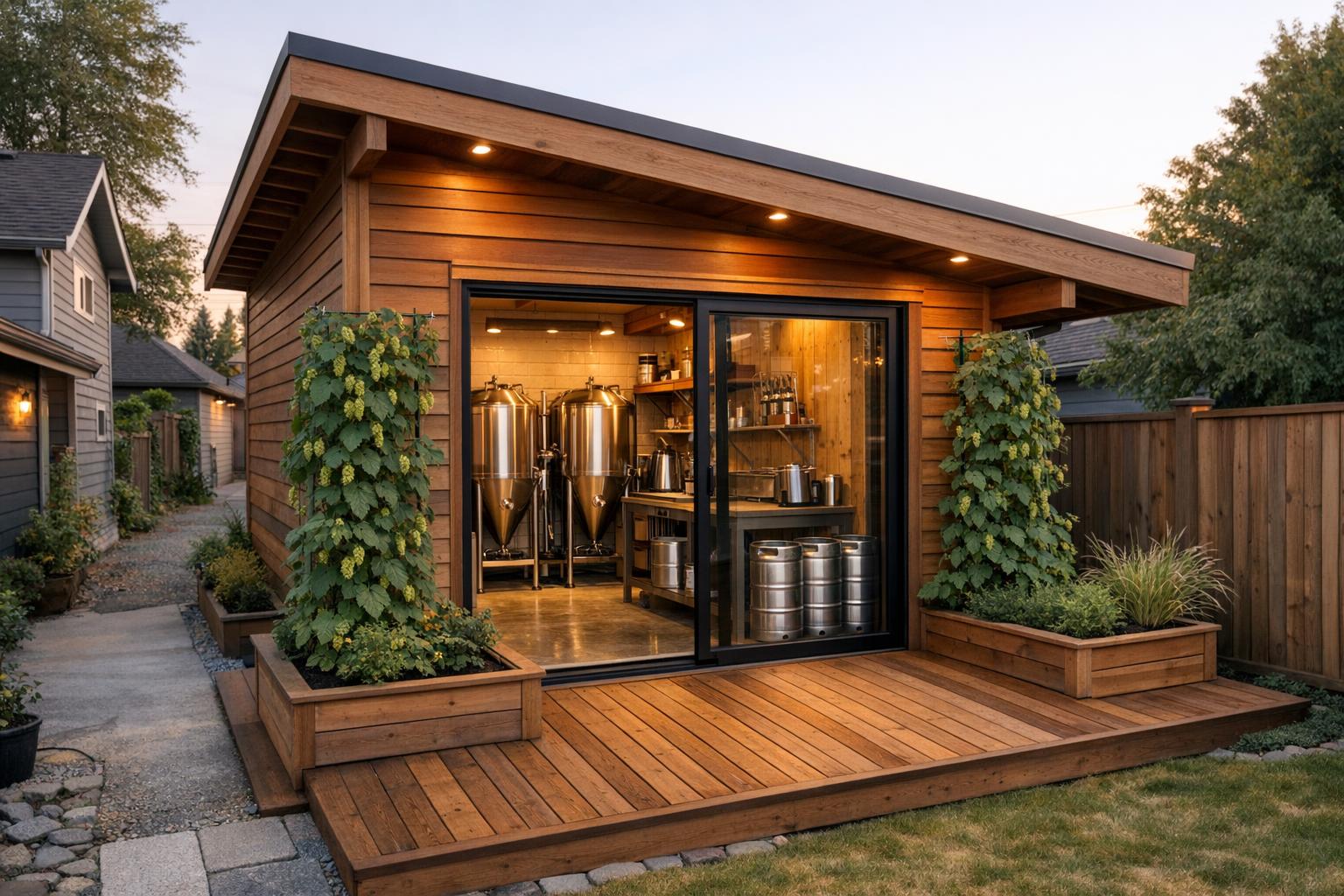
A tiny home brewery is a compact brewing operation built inside a backyard tiny home or accessory dwelling unit, often called an ADU. In 2026, this idea is more realistic than it used to be because compact detached suites are now available in footprints that can work for small-batch brewing with careful planning.
This matters for three groups in particular:
- hobby brewers ready to move beyond the kitchen
- small brand builders testing a concept before signing a commercial lease
- entrepreneurs exploring an ADU business model tied to beer production or tasting
With options like modular backyard suites in Canada, compact builds from Petite Homes, and municipal examples such as St. Catharines pre-approved detached ADUs, the shell of the building is often easier to solve than it was a few years ago.
But the real question is not “Can I fit kettles into a backyard unit?”
It is whether the site, utilities, zoning, and licensing path make the project legally and financially workable.
This guide covers feasibility, site planning, equipment, compliance, costs, and a practical launch roadmap.
Why build a tiny home brewery?
A tiny home brewery gives you a dedicated brewing space away from the family kitchen. That means better workflow, less household disruption, and a clearer bridge between hobby brewing and a real small-scale business.
Main benefits
Lower overhead than a standalone brewery
If you already own the land, you may avoid one of the biggest costs in brewing: leasing or buying a separate site. A full commercial unit often brings higher rent, more parking demands, more tenant improvements, and a heavier utility buildout.
Close to home
A backyard location makes daily brewing tasks easier, from fermentation checks to cleaning and packaging.
Flexible use
A backyard suite can work as:
- a production-only room
- a compact tasting area
- cold and dry storage
- a future flexible asset if the brewing use pauses
Property value potential
Some research on backyard suites suggests an ADU may increase value significantly, with one source noting potential gains of up to 30% in certain situations through backyard suite market analysis.
Realistic use cases
A tiny home brewery works especially well for:
- hobby brewers moving to a dedicated 10 to 50L system
- nano brands testing recipes before leasing commercial space
- small tasting concepts where local rules allow sampling
- event or farmers’ market production
Pros vs cons
Tiny home brewery / ADU
Pros:
- lower startup cost
- faster installation
- dedicated brewing space
- can feel more neighbourhood-friendly than a large site
Cons:
- limited batch size
- higher zoning sensitivity
- customer traffic can become an issue
Garage brewery
Pros:
- lower upfront cost if the garage is already usable
Cons:
- poor drainage
- weak ventilation
- more disruption to home life
Standalone microbrewery
Pros:
- more production freedom
- easier to scale
Cons:
- far higher cost
- heavier regulatory burden
For many founders, the tiny home brewery sits in the middle: more serious than a garage setup, but less risky than jumping straight into a major lease. That tradeoff becomes clearer when comparing examples from modular backyard suites, capsule-style compact housing, ADU conversion ideas, and business-focused ADU concepts.
Understanding scale: from homebrew to microbrewery setup
The right setup depends on the scale you want. This is where many projects either become manageable or become expensive too quickly.
Homebrew or hobby scale
This is beer for personal use only. It is not sold. It often uses:
- small electric all-in-one systems
- basic kettles
- a few fermenters
This is ideal for recipe testing and personal Canadian homebrewing.
Nano scale
This is often the sweet spot for a tiny home brewery. It usually means:
- 10 to 100L batches
- compact production
- limited but serious output
- space for direct sales or market testing where allowed
Micro scale
This usually means a 1 to 3 barrel system. It brings much bigger requirements for:
- water
- power
- storage
- cooling
- licensing
- packaging
A 1 to 3 bbl system may fit only in a larger detached ADU with strong utilities and a production-first design. In many cases, the most practical backyard range is still 10 to 100L, especially when working within examples like compact tiny home layouts, regional small-home references such as tiny homes in Nova Scotia, and 37 square metre pre-approved ADU models.
Why scale matters
Your scale changes everything:
- water demand
- power needs
- wastewater output
- fermentation storage
- packaging needs
- customer flow
- legal classification
Business models to pick early
Decide whether the brewery is meant for:
- personal-use brewing only
- direct-to-consumer sales
- farmers’ market and event sales
- wholesale supply
- tastings by appointment
The more commercial the plan becomes, the more the legal framework shapes the building itself.
Site planning: can your backyard ADU actually work?
Not every backyard structure can become a brewery. A legal and practical project starts with site feasibility, not equipment shopping.
Site feasibility checklist
Lot size and setbacks
Some ADU programs include lot minimums, and setback rules determine where the building can sit. Research into Canadian modular backyard suites suggests that lot thresholds and placement rules can be decisive before anything else moves forward.
Rear-yard placement and access
You need room for:
- material delivery
- utility trenching
- emergency access
- service access for repairs
Utility connections
Brewing requires steady:
- electrical service
- water supply
- drainage
- ventilation
Existing vs new ADU
A legal backyard suite is not the same thing as an old shed. A code-compliant ADU starts much closer to what you need. A non-compliant structure may require extensive upgrades or may not qualify at all.
Good floor plan basics
For a tiny home brewery, simple design wins.
Ceiling height
Aim for roughly 8 to 10 foot ceilings so fermenters, hoods, and brewing gear fit comfortably.
Functional zones
- raw ingredient storage
- hot-side brewing
- fermentation and cold-side work
- packaging and storage
- cleaning and sanitation
- optional tasting area
Drainage
Floor drains are highly desirable because brewing means repeated wet cleaning.
Ventilation
Steam must leave quickly. Without proper exhaust, you get condensation, corrosion, and mold.
Customer circulation
If tastings are planned, customers need a clear entrance and a safe path away from hot or pressurized equipment.
Layout examples
A 37 square metre Beech Model could support a compact brew zone plus a small tasting counter. A 560 square foot tiny home can also handle production and storage when the layout uses sliding doors, light finishes, and careful circulation.
Neighbourhood issues to think about
Your ADU business may affect neighbours through:
- pump and chiller noise
- boil odour
- guest traffic
- parking pressure
- delivery timing
- signage and visual impact
Before moving ahead, check whether local bylaws allow:
- home-based beverage production
- customer visits
- retail pickup
- outdoor signage
Helpful starting points include guidance on accessory dwelling units, broader context from this complete guide to ADUs in Canada, parking considerations at does an ADU require parking, and neighbour impact advice from neighbour relations for tiny homes in Canada.
Technical essentials for a tiny home brewery microbrewery setup
A good setup is part brewing plan and part building systems plan.
Brewhouse equipment
You may need:
- mash tun
- brew kettle
- hot liquor tank for multi-vessel systems
- an all-in-one electric system for space efficiency
For many beginners, an electric all-in-one system is the best fit.
Fermentation equipment
- 2 to 4 stainless fermenters
- airlocks or pressure-capable lids
- temperature control
- slim or stack-friendly shapes
Cooling
Options include:
- immersion or batch chillers for entry-level brewing
- a glycol chiller for tighter fermentation control
Transfer and packaging
Most small brewery setups also need:
- pumps
- hoses
- kegging gear
- CO2 system
- bottling or canning tools if volume justifies it
Cleaning and sanitation
Never treat this as optional. Include:
- CIP tools
- food-safe cleaning chemicals
- wash sink
- drying racks
- clean storage
Recommended setup sizes
Entry-level tiny home brewery
- 10 to 50L electric system
- 2 fermenters
Growth-ready small setup
- 50 to 100L system
- 3 to 4 fermenters
- cold storage
Utility needs
Electrical
Heating elements and chillers raise demand quickly. Some ADU projects may require or support a 200A panel depending on building and equipment load, as noted in references on suite construction planning and utility connections for Canadian ADUs.
Water
You need reliable supply, hot water, and sometimes filtration. Related background can be found in guides about rainwater harvesting for tiny homes and the broader tiny home utilities guide for Canada.
Drainage
Floor drains are ideal, and wastewater should not overload a weak septic system. Review tiny home wastewater solutions and greywater recycling guidance for ADUs.
Ventilation and exhaust
Boil steam should be removed with a hood or strong exhaust system. See guidance related to air quality in tiny homes and even noise planning from noise reduction in Canadian housing.
HVAC
Fermentation benefits from steady temperatures, and dehumidification helps control mold. Useful references include eco-friendly heating for ADUs and using a heat pump for a tiny home.
Gas
If using propane or natural gas, expect extra safety requirements and permits.
Small-space design tips
- modular racks
- wall-mounted hose reels
- vertical grain storage
- rolling carts
- fold-down worktops
Smart scaling rule: start with pilot batches, leave room for one future upgrade, and do not overbuild before demand and licensing are proven.
Canadian homebrewing and legal requirements
This is one of the most important sections of the entire project.
The difference between a hobby setup and a legal brewery is not kettle size. It is compliance.
What Canadian homebrewing means
Canadian homebrewing usually means brewing for personal, non-commercial use. That is generally allowed. But once beer is sold, offered to the public, distributed, or produced as a business, a different legal framework applies.
For broader ADU and compliance context, see the Canadian ADU guide, plus overviews of tiny home legal requirements in Canada and Canadian ADU regulations.
Legal requirements by level
Municipal
- zoning approval
- permission for home occupation or production use
- building permits
- occupancy approval
- fire review
- plumbing and mechanical sign-off
Provincial
- liquor manufacturing approval
- sales permissions
- tasting room permissions
- distribution approval
Federal
- CRA excise registration
- excise duty records
- reporting duties
Food safety and product rules
- sanitary production expectations
- packaging and label rules
- CFIA-related requirements depending on claims and presentation
ADU-specific issues
A detached backyard structure can be legal as a dwelling or accessory building and still not be legal for brewing or public visits.
That is where many projects fail.
For an ADU business, residential approval does not automatically equal beverage production approval. Tastings, pickup, and events may trigger additional reviews under local planning rules. Relevant reference points include backyard suite guidance, ADU design and policy notes, pre-approved detached ADU examples, ADU conversion insights, and ADU legal clinic guidance for 2026.
Documents and permits to ask about
- zoning compliance letter
- ADU permit or building permit file
- business licence
- fire inspection requirements
- plumbing and mechanical permits
- provincial liquor manufacturing licence
- on-site tasting endorsement if needed
- federal excise registration
- insurance certificate requirements
Best order to ask
- municipal planning office
- provincial liquor regulator
- lawyer or licensing consultant if sales are planned
Bottom line: no single process covers all of Canada. Rules vary by province and municipality.
Health, safety, and compliance in a small brewing space
A compact brewery concentrates heat, pressure, water, chemicals, and CO2 in one small place. That makes safety planning even more important than in a larger, better-ventilated space.
Sanitation
Sanitation means repeated cleaning and disinfection of all wort- and beer-contact surfaces so beer stays stable and safe. In a tiny home brewery, moisture and clutter raise contamination risk, so cleaning discipline must be tighter. Even general suite planning references like modular backyard suite guides reinforce how important moisture management is in compact buildings.
Mold and moisture control
Boil steam and washdowns create intense humidity. Use:
- active exhaust
- dehumidification
- wipe-clean finishes
- good air movement
Fire and gas safety
Install and maintain:
- extinguishers
- alarms and detectors as required by code
- gas shutoffs if gas is used
- clearances around hot equipment
Helpful reference points include municipal ADU standards and tiny home fire safety in Canada.
CO2 risk
Fermentation and kegging can build up CO2. In a sealed small ADU, that becomes a real hazard. Ventilation and monitoring are worth serious attention, with more background in tiny home safety guidance for Canada.
Wastewater
Brewery wastewater contains organic matter and cleaning chemicals. Never assume a small septic system can handle it without review. See the broader ADU infrastructure guide and greywater recycling guidance.
Records if commercial
- batch logs
- sanitation logs
- tax and excise records
- product traceability notes
- label version files
Insurance
A small brewery should review:
- product liability
- property and equipment insurance
- business interruption coverage
- liquor liability if tastings happen
A practical starting point is often $1 million or more in liability coverage depending on the operation, with useful background from tiny home insurance in Canada and ADU insurance guidance.
A beautiful backyard brewery still fails if it is unsafe, under-ventilated, or underinsured.
Design and aesthetics: making the space functional and brandable
Design in a tiny home brewery has two jobs:
- support workflow
- support the brand
Production-only layout
Best for serious brewing. Focus on:
- stainless work surfaces
- sealed floors
- easy cleaning
- simple circulation
- minimal décor
Hybrid production and tasting layout
Best when local rules allow small visits. Add:
- a compact bar ledge
- stools or a standing counter
- a separate customer entry
- visual separation between public and production areas
Good materials
- non-slip moisture-resistant floors
- washable wall panels
- steel or sealed wood counters
- acoustical insulation
- durable trim in wet zones
Style ideas
Compact modern ADUs often look better and feel bigger with:
- industrial-style details
- exposed brick accents
- sloped roof forms
- strong natural light
- clean lines
For inspiration, review compact design examples from Petite Homes, ideas in backyard suite design articles, and broader aesthetic direction in tiny home interior trends.
Neighbour-friendly design
To reduce conflict, use:
- insulated walls
- anti-vibration pads under pumps and chillers
- modest signage
- subtle exterior design
Exterior planning
If allowed, plan for:
- small patio seating
- screened service zones
- secure grain and waste storage
- a weather-protected delivery spot
A pre-approved 37 square metre model is a strong design reference because it shows how a compact shell can still support practical circulation. Noise-focused planning also benefits from Canadian housing noise reduction strategies.
Economics: costs, revenue, and budgeting for 2026
Think of this project as two linked investments:
- the ADU building
- the brewing business
Startup cost ranges
ADU or backyard build cost
Many compact or modular options in 2026 may land around CAD $85,000 to $130,000 depending on region and finish level, based on examples from modular backyard suites, affordable capsule-style tiny homes, and pre-approved municipal ADU models.
Brewing equipment
A small but serious setup may cost roughly CAD $20,000 to $50,000.
Permits and professional fees
Often around CAD $5,000 to $10,000.
Total project estimate
A planning range of CAD $110,000 to $190,000 is realistic for many projects. That is still much lower than many standalone breweries.
Main operating costs
- utilities
- malt, hops, and yeast
- packaging
- cleaning chemicals
- maintenance
- taxes and duties
- insurance
Illustrative examples suggest utilities around $500 per month, grain around $200 per batch, and a tax burden in the 10% to 15% range depending on structure and location.
Possible revenue paths
- tasting sales
- market sales
- keg supply for events
- seasonal brand releases
- alternate legal ADU business use in slower periods
Illustrative scenarios suggest:
- taproom income around $2,000 to $5,000 per month
- market sales around $1,000 per week
- breakeven in 12 to 18 months at roughly 50L per week under favourable conditions
These are examples, not guarantees.
Budget smarter
- choose a modular ADU where possible
- start with pilot-scale gear
- avoid building a large customer area before approvals are clear
- keep contingency for utility upgrades
- separate one-time asset costs from recurring brewing costs
Step-by-step roadmap to launch
Here is a practical 2026 launch plan.
1. Define your goal — 1 week
Decide whether this is:
- hobby-only
- market testing
- commercial launch
2. Check zoning and lot suitability — 1 to 2 weeks
Confirm:
- ADU rules
- lot size
- setbacks
- business-use permissions
Helpful references include backyard suite zoning considerations, tiny home friendly municipalities, and this Ontario ADU zoning guide.
3. Choose the ADU model and layout — 2 to 4 weeks
Decide:
- modular or custom
- where utilities enter
- how production will flow
4. Map your microbrewery setup — 1 to 2 weeks
Choose:
- batch size
- equipment list
- one future upgrade step
5. Consult municipality and regulator — concurrent
Talk to:
- planning office
- building department
- fire department
- provincial liquor authority
6. Apply for permits and approvals — 4 to 8 weeks
This may include:
- building
- plumbing
- electrical
- business
- provincial alcohol approvals
- federal registration if needed
Reference materials include ADU guidance, the Ecohome ADU overview, and ADU permits in Canadian cities.
7. Build or install the ADU — 4 to 6 weeks
Modular delivery can shorten the timeline, as seen in modular backyard suite examples and compact building options from Petite Homes.
8. Install equipment and utilities — about 2 weeks
Test:
- electrical loads
- drainage
- ventilation
- fermentation cooling
9. Run test batches — 2 to 4 weeks
Use pilot runs to check:
- process flow
- sanitation
- heat and moisture control
- packaging
10. Complete inspections and sign-off — around 4 weeks
Finish required inspections and licence checks.
11. Soft launch
Start with:
- invite-only tasting
- limited pilot release
- local market debut
12. Review and scale
Only add:
- more fermenters
- packaging upgrades
- customer features
…after demand is proven.
A minimum viable hobby-only project in a suitable ADU may be possible in about 3 months. A fully commercial path may take 6 months or longer, especially if approvals drag out. See ADU construction delay solutions in Canada for common bottlenecks.
Sustainability and best practices
Sustainability matters because small-batch brewing margins can be thin. In a compact brewery, wasted energy, water, and material show up quickly on the budget.
Practical ideas
- reuse water where legal and technically safe
- find compost or animal-feed uses for spent grain
- choose energy-efficient chillers
- use LED lighting
- insulate well to reduce HVAC load
- schedule batches carefully to avoid overproduction
An aspirational benchmark for efficient systems is up to 80% water recovery, but sanitation and local wastewater rules must always come first.
Sustainability can also strengthen your brand story, especially when supported by broader practices such as zero-waste design, reducing ADU construction waste, and energy-efficient tiny homes in Canada.
Case studies and examples
These examples are for inspiration only. They do not prove that every city will approve the same brewery or ADU business use.
Case study 1: Haven ADU in Atlantic Canada
A 460 square foot ADU example in Atlantic Canada linked with hospitality-style use ideas shows that modular construction can support strong branded spaces. The key lesson is that utility upgrades are often harder than the building shell.
Case study 2: Vancouver capsule-style backyard concept
This capsule-style backyard concept shows how a lower-cost structure can make testing easier, but the revenue plan still has to match legal permissions.
Case study 3: St. Catharines Beech Model
The St. Catharines Beech Model shows how municipal template designs can simplify the shell stage. The lesson is simple: pre-approved plans can speed up the building side, but brewing and business approvals still need separate review.
Common pitfalls
- underestimating drainage
- assuming residential approval means business approval
- ignoring electrical and utility upgrades
- spending too much before licensing is clear
For more cautionary planning, review hidden costs of ADU construction and the skill demands outlined in what special skills are needed to build an ADU.
Resources, templates, and tools
This is where the project moves from an idea to a real plan.
Useful planning tools include:
- permit and legal requirements checklist PDF
- startup budget spreadsheet
- sample tiny home brewery floor plan
- equipment shopping list
- launch timeline template
Helpful contact categories include:
- municipal planning department
- building department
- provincial liquor authority
- local small business centre
- brewing consultant
- liquor-law lawyer
Useful reference points include municipal and modular backyard suite guidance, ADU information, the complete Canadian ADU guide, pre-approved detached ADU designs, an ADU legal clinic resource, and this tiny home business guide for Canada.
Frequently Asked Questions
Can I legally sell beer brewed in my ADU?
Possibly, yes, but only if local zoning allows the use and you have the right provincial and federal approvals. If the setup is only personal Canadian homebrewing, then sales are not allowed.
What system size fits a tiny home brewery?
For many small ADUs, 10 to 100L is the most realistic range. Larger systems need more room and stronger utilities, as seen in compact-layout references from Petite Homes and pre-approved detached ADU designs.
What are the main legal requirements in Canada?
The main legal requirements usually include municipal zoning and building approvals, provincial alcohol licensing, and federal excise registration if the operation is commercial. Start with local planning guidance and foundational ADU resources such as backyard suite rules and ADU requirements.
How noisy is a backyard microbrewery setup?
Usually manageable, but pumps, chillers, and exhaust fans can create steady noise. Soundproofing, anti-vibration mounting, and sensible hours help a lot. See related notes from backyard suite planning, noise reduction strategies, and sound management strategies.
Can a tiny home brewery double as another ADU business?
Sometimes. It depends on zoning, sanitation separation, licensing, and how the building is classified. Dual use can be efficient, but it often complicates compliance. See multi-purpose ADU spaces and business ADU examples.
How long does setup take in 2026?
A simple project may take about 3 months. A more regulated ADU business with full approvals can take 6 months or more.
A tiny home brewery is a realistic 2026 path for people who want to move beyond kitchen brewing without taking on the cost of a full commercial lease. The concept can fit inside compact ADU footprints, but success depends on careful design, utility planning, and early attention to legal requirements.
For many people interested in Canadian homebrewing, the smartest move is not opening a giant brewery right away.
It is building a compliant, efficient tiny home brewery that proves the idea one batch at a time.
Leave a Reply