

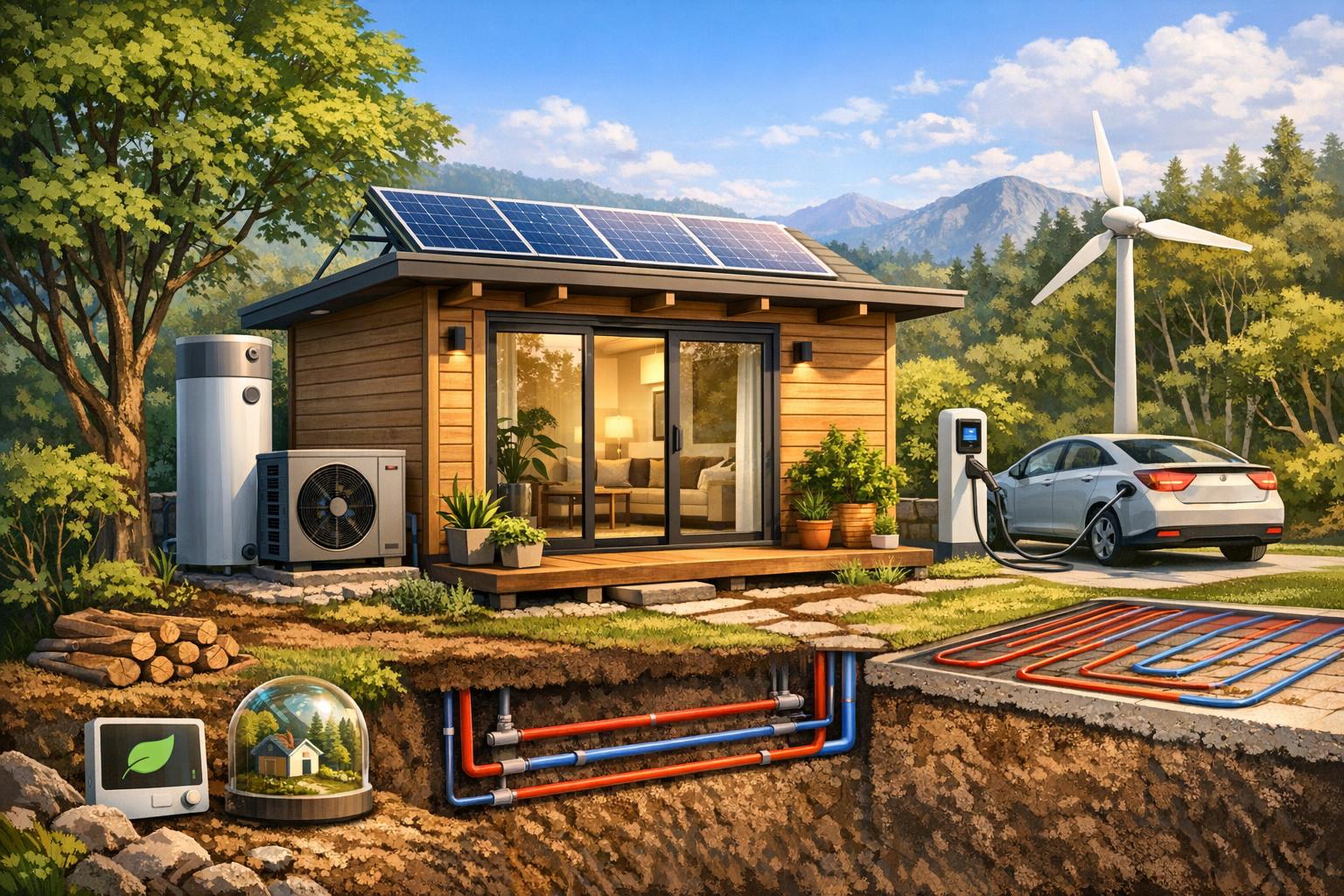
Eco-friendly heating ADU upgrades: A practical 2026 guide for Canadian ADUs
Estimated reading time: 12 minutes
Key Takeaways
- Focus on envelope first: better insulation and airtightness let you buy smaller, cheaper HVAC systems and improve comfort.
- Heat pumps are the workhorse: cold-climate air-source units and ductless mini-splits usually offer the best balance of cost and performance for ADUs.
- Ventilation matters: an HRV or ERV preserves heat in winter and manages IAQ in tight ADUs.
- Geothermal is premium: great efficiency and lifespan but high upfront cost and site constraints.
- Controls + passive design: small systems with smart controls, shading, and night purging reduce runtime and energy bills.
- Resources to check: See the ADU design and incentives guides linked throughout this post for program specifics and local rules.
Table of contents
- Why eco-heating for ADUs matters in 2026
- Key technologies explained
- Technology comparison (2026 estimates)
- Sizing, design integration & modelling
- ADU cooling strategies
- Canadian efficiency context & incentives
- Costs & lifecycle economics
- Three Canadian case studies
- Implementation checklist & decision flow
- How to pay & where to get help
- Implementation timeline
- Visuals & assets
- Data accuracy & editorial note
- Conclusion (by climate zone)
- Frequently Asked Questions
Why eco-heating for ADUs matters in 2026
Canada is pushing toward net-zero goals and provinces are tightening energy-code expectations. For ADU owners, builders, and retrofitters, eco-friendly heating ADU upgrades deliver three concrete benefits: lower bills, steady comfort, and reduced stress on the grid during extremes like frigid mornings or heat waves.
Two key facts to keep in mind:
- “Heating dominates household energy use in cold Canadian zones—often 60–70% of annual energy use—so efficient heating has outsized impact on bills and emissions.”
- “Upgrades can yield household bill reductions in the 30–50% range for well-upgraded ADUs.”
ADUs have special characteristics—small area, quick temperature swings, often tight envelopes—which makes correct equipment sizing, balanced ventilation, and humidity control especially important. For practical ADU design guidance, see the ADU energy-efficiency guide.
Eco-friendly heating ADU: key technologies explained
Heat Recovery Ventilation (HRV/ERV): what it does and why small ADUs need it
What HRV and ERV mean
- HRV moves sensible heat from exhaust air to incoming fresh air.
- ERV also transfers moisture (latent heat), helping humidity control in damp/coastal climates.
Typical performance
- Sensible heat recovery ~60–85%.
- Efficiency ratings often quoted in the 70–90% range depending on test method.
Why it matters
A tight ADU needs fresh air; opening windows in winter wastes heat. An HRV/ERV gives ventilation with much lower heat loss. In summer it can support ventilation-driven cooling but it doesn’t replace a dedicated cooling system.
Ventilation rate guidance (rule-of-thumb)
Designers often use ~0.35 ACH or an ASHRAE 62.2-equivalent flow scaled to ADU size. Example: 50 m² × 2.4 m ceiling ≈ 120 m³; 0.35 ACH → ~42 m³/hr continuous.
Maintenance
- Filters: every 3–12 months.
- Core cleaning: about once per year.
- Keep intake/exhaust hoods clear of snow and leaves.
Pros/Cons & best use
- Pros: improved IAQ, less ventilation heat loss, humidity control.
- Cons: needs balanced ductwork, commissioning, and filter replacement.
- Best: all climates; ERV often preferred in humid/coastal areas.
For incentive options and program searches, see the Green Building Canada Incentive Finder and the ADU design guide at MyOwnCottage.
Geothermal (ground-source) heat pumps
How it works (plain language)
Buried loops exchange heat with the ground, which stays relatively stable (~5–15°C), so performance remains strong even in deep cold.
Key metric: COP
Typical geothermal COP: 3.5–5.0 (many models around COP 4.0). COP = heat output ÷ electricity input.
Loop types
- Closed-loop horizontal: less drilling, needs yard space.
- Closed-loop vertical: more drilling, smaller footprint but higher cost.
- Open-loop (well water): efficient but site- and permit-dependent.
Site & lifespan notes
- Drilling/site work often adds $10k+.
- Loops: 25+ years typical; equipment 20+ years depending on maintenance.
Pros/Cons & best climates
- Pros: very high efficiency, stable output, quiet outdoor operation.
- Cons: high capital cost, site limitations (urban lots may not qualify).
- Best: Ontario and Prairie regions when land and budget allow.
See rebate and incentive discussions at Breaking Bank and the Incentive Finder.
Cold‑climate air‑source heat pumps & mini‑splits
What they are
Inverter-driven variable-speed heat pumps exchange heat between indoors and outdoors; ductless mini-splits are common in ADUs because they avoid bulky ducts and provide easy zoning.
Performance
- Many modern cold‑climate units maintain COP > 2.0 at around −25°C (model dependent).
- High-efficiency cooling SEER: often 18–22+.
Ductless vs ducted
- Ductless: easiest install, good zoning for ADUs.
- Ducted: cleaner aesthetics for multiple rooms but costlier and bulkier.
Backup strategies
At extreme temperatures you may need backup heat (electric resistance or hybrid strategies where gas exists). Avoid large oversizing: it causes short‑cycling and poorer humidity control.
Sizing guidance
Typical ADU ranges: 6,000–18,000 BTU (1.8–5.3 kW). Use Manual J-equivalent calculations; modest safety factors (~1.2×) are common—don’t double-size.
For ADU design reference see ADU design guidance and practical system selection notes at PACD Homes. Market and rebate overviews are tracked on Breaking Bank.
Advanced insulation & high‑performance windows
Start with the envelope
Smaller heating loads let you buy smaller equipment, reduce peak draw, and improve comfort.
High-performance targets (adapt to local code)
- Walls: R‑40
- Roofs/ceilings: R‑60
- Floors: R‑20
Windows
- Triple-pane, U‑value target ≈ 0.15 W/m²K, Low‑E with argon/krypton fills.
- SHGC: higher for cold climates (capture winter sun), lower for hot summer control.
Air sealing
Blower-door target: < 1.0 ACH50 for high-performance ADUs (tighter homes need mechanical ventilation like HRV/ERV).
Practical tactics
- Continuous exterior insulation to reduce thermal bridging.
- Taped air/vapour control layers and appropriate cavity insulation.
See ADU envelope guidance at MyOwnCottage and retrofit incentive notes at RE/MAX Millennium’s rebates guide.
Passive design strategies
Use building orientation, shading, and materials to reduce HVAC loads.
Core tactics
- Orientation: favour south-facing glazing where site allows.
- Fixed overhangs: block high summer sun, admit low winter sun.
- Thermal mass: smooth day/night swings with heavy floors.
- Cross-ventilation and night purging where climate permits.
Typical benefit
Passive design can cut HVAC loads by ~20–40% when paired with a good envelope.
ADU passive tips and siting guidance are summarized in the ADU guide at MyOwnCottage.
Green HVAC controls & smart thermostats
Why controls matter in a small ADU
Small errors (ventilating too much, heating empty rooms) represent a bigger share of total consumption in ADUs. Controls provide zoning, scheduling, and efficiency coordination.
Capabilities
- Zoning and variable-speed coordination.
- Scheduling, demand-response readiness, and integration between heat pumps and HRV/ERV.
Savings
Well-configured controls typically deliver ~5–15% operational savings. Check for rebate availability—some thermostats have modest rebates via utility programs; search the Incentive Finder.
Technology comparison table (ADU-scale, 2026 estimates)
Caption: Eco-heating and green HVAC options for Canadian energy efficiency (ADU scale).
| Technology | Typical Installed CapEx (ADU-scale) | Typical Opex Savings vs. Electric Resistance | Typical COP / metric | Best Canadian climates | Lifespan |
|---|---|---|---|---|---|
| HRV / ERV | $5k–8k | Indirect (less heat loss + IAQ) | Recovery 70–90% | All climates | 10–15 yrs (core) |
| Mini‑split heat pump | $6k–11k | Saves ~$500–$1k/yr (site dependent) | COP 2.5–3.5 @ −15°C; SEER 18–22+ | BC / ON (also elsewhere with planning) | 15–20 yrs |
| Geothermal | $30k–50k | Best long-term savings | COP 3.5–5.0 | ON / Prairies (space helps) | 25+ yrs |
| Insulation & windows upgrade | $8k–17k | Load cut ~40% (varies) | — | Critical for extreme cold | Decades (materials dependent) |
For incentive lookups see the Incentive Finder, ADU design notes at MyOwnCottage, and rebate roundups at Breaking Bank.
Sizing, design integration, and modelling
Accurate sizing prevents oversizing, short‑cycling, and humidity issues. Use Manual J (or equivalent) and whole‑building energy modelling tools (e.g., HOT2000 for Canada) to guide equipment selection.
Key inputs
- Floor area, orientation, window area + U‑values/SHGC
- Infiltration (ACH50), internal gains, and local design temps
How envelope upgrades help
Every 10–20% improvement in envelope performance can reduce heating load by ~10–20% and allow equipment sizing reductions of 20–30%.
Example workflow (50 m² ADU, Ottawa)
- Run Manual J with accurate inputs.
- Pick a heat pump sized to calculated peak load + modest safety factor (~1.2×).
- Decide on auxiliary heat if the heat pump’s low‑temp capacity is insufficient.
- Commission: confirm airflow, refrigerant charge, and control settings.
Tools and references: ADU energy-efficiency guide and modelling guidance like Ecohome’s ADU guide.
ADU cooling strategies (passive + efficient mini‑splits)
ADUs overheat faster due to high glazing-to-floor ratios and small volumes. The best approach: reduce heat gain first, then add efficient cooling where necessary.
Passive cooling tactics
- Exterior shading / fixed overhangs (block before heat enters).
- Night purging when outdoor nights are cool and dry.
- Reflective roofing and light-colour finishes.
- Exterior blinds/screens for west glass and cross-vent routes.
Active cooling
- Efficient mini‑splits sized with Manual J (avoid oversizing).
- Heat pump cooling eliminates need for separate AC in many ADUs.
- HRV/ERV can assist with tempered ventilation but watch humidity in summer.
If your location has >10 days/yr above 28°C or frequent >25°C days, plan for active cooling and ensure electrical capacity and outdoor unit siting are considered. See passive and ADU cooling notes at MyOwnCottage and technical selection at PACD Homes.
Canadian energy efficiency context & regulations (2026)
Programs and code requirements change—verify current 2026 program rules before applying. Key tools:
Code direction (high level): higher R‑values, tighter envelopes with mechanical ventilation, and increased adoption of heat pumps and efficient mechanicals. Always confirm local ADU permit and zoning requirements before you build.
Costs for eco-friendly heating ADU upgrades: breakdowns & lifecycle economics
All numbers below are conservative 2026 estimates. Site factors (electrical upgrades, access, permitting) strongly influence final quotes.
Typical installed cost ranges (CAD, ADU‑scale)
| Upgrade | Cost range (installed) | Notes |
|---|---|---|
| HRV/ERV total installed | $5,000–8,000 | Equipment $3k–5k; install $1k–2k; controls/permits $500–1k |
| Mini‑split heat pump total installed | $6,000–11,000 | Equipment $4k–8k; install $1k–2k; controls $500–1k |
| Geothermal total installed | $30,000–50,000 | Equipment $15k–25k; drilling $10k–20k; controls/permits $1k–2k |
| Insulation & windows upgrade | $8,000–17,000 | Materials $5k–12k; install $2k–4k |
Operating costs & payback
Heat pumps typically save $500–$1,000/year vs electric resistance (site/rate dependent). Annual maintenance rule-of-thumb: $100–300/year. Lifespans: mini-splits 15–20 yrs; geothermal 25+ yrs; HRV cores 10–15 yrs.
Simple payback (example)
Mini‑split example: electricity $0.15/kWh; annual savings 3,500 kWh → $525/yr. Net installed cost $6,000 → payback ≈ 11.4 years pre-incentives. Rebates shorten payback; use the Incentive Finder and rebate guides like RE/MAX Millennium for local programs.
Three case studies (mini‑reports)
Case Study A: Coastal BC ADU — mini‑split + HRV + shading
Summary: 37 m² detached ADU, humidity-aware ventilation and passive shading, mini‑split heat pump plus HRV.
- Before: 8,000 kWh/yr → After: 4,500 kWh/yr (−44%, 3,500 kWh saved)
- Gross cost: $9,000; rebate example: $2,000 (utility-level, verify); net: $7,000
- Sample payback: $7,000 ÷ ($525/yr) ≈ 13.3 yrs (at $0.15/kWh)
Lessons: shading reduces overheating; carefully consider ERV vs HRV for humidity. See practical ADU design notes at MyOwnCottage and incentive lookups at Green Building Canada.
Case Study B: Southern Ontario ADU — cold‑climate heat pump + HRV
Summary: Garage conversion, heavy envelope work (R‑45), cold‑climate heat pump, HRV.
- Size: 46 m². Before: 12,000 kWh/yr → After: 6,000 kWh/yr (−50%).
- Gross cost: $12,000; rebate example: $5,000 (program dependent); net: $7,000.
- Sample payback: $7,000 ÷ ($900/yr) ≈ 7.8 yrs (at $0.15/kWh).
Lessons: envelope-first strategy lets the heat pump run efficiently; HRV is essential in tight conversions. See incentive finder at Green Building Canada.
Case Study C: Prairie / Interior cold ADU (Saskatchewan)
Summary: Superinsulated, very airtight ADU with cold‑climate heat pump and explicit backup plan.
- Size: 32.5 m². Before: 15,000 kWh/yr → After: 7,500 kWh/yr (−50%).
- Gross cost: $14,000; incentives applied (varies); net: $10,000.
- Sample payback: $10,000 ÷ ($1,125/yr) ≈ 8.9 yrs (at $0.15/kWh).
Lessons: backup heat planning is essential below −35°C; commissioning and monitoring are critical in very airtight builds. See ADU envelope resources at MyOwnCottage and rebate tracking at Breaking Bank.
Case study summary table
| Case | Climate | Size | Before kWh/yr | After kWh/yr | Net Installed Cost | Payback yrs |
|---|---|---|---|---|---|---|
| A (BC) | Mild coastal | 400 / 37 | 8,000 | 4,500 | $7,000 | 13.3 |
| B (ON) | Mixed | 500 / 46 | 12,000 | 6,000 | $7,000 | 7.8 |
| C (SK) | Severe cold | 350 / 32.5 | 15,000 | 7,500 | $10,000 | 8.9 |
Implementation checklist & decision flow
Decision flow (text version)
- Climate zone? (Mild BC / Mixed / Severe Prairie)
- Budget & site constraints? High budget + land → geothermal. Moderate budget → cold‑climate heat pump + HRV/ERV. Tight budget/site → mini‑split + targeted envelope work.
- Cooling needed? If >25°C days frequent → include mini‑split cooling plan.
- Airtightness target? If ACH50 ≤ 1.0 → HRV typically recommended.
Pre-install checklist
- Energy model + Manual J (deliverables: load calc PDF + equipment summary).
- Blower-door test and thermographic inspection.
- Site assessment (drilling access for geothermal, shading/orientation review for passive design).
- Confirm electrical capacity (panel, breaker space, disconnects).
- Confirm permits & zoning.
- Choose qualified contractor (ask about HRAI or equivalent, references, warranty).
- Require commissioning: airflow balance, startup verification, and control tuning.
Use the Incentive Finder and ADU planning guide at MyOwnCottage while preparing bids.
How to pay and where to get help
Programs & tools to check
Financing options
- Low-interest retrofit loans.
- On-bill financing (where available).
- PACE-style programs (where available in your province).
Finding qualified contractors
- Ask for proof of load calculations (Manual J or equivalent).
- Ask for low-temperature capacity charts and sample commissioning reports.
- Use the homeowner script: “What is the COP at −15°C? At −25°C? When would you recommend backup heat?”
Implementation timeline & project management
Typical phases (weeks):
- Pre-assessment & modelling — 1–2 weeks.
- Permits & contractor procurement — 2–4 weeks.
- Envelope work — 1–3 weeks.
- Mechanical install: mini‑split/HRV 1–3 days; geothermal drilling 3–10 days + commissioning.
- Commissioning & testing — 1 week.
Typical ADU projects: 4–10 weeks. Geothermal projects often take longer due to drilling schedules.
Visuals, assets, and suggested creatives
Suggested diagrams: HRV vs ERV airflow; geothermal loop types; passive sun/shade examples for Toronto, Vancouver, Calgary. Suggested charts: lifecycle cost & payback timeline and before/after energy bars for the three cases. Include photo captions with alt text using keywords like eco-friendly heating ADU and ADU cooling.
Data accuracy & editorial note
Important: All cost ranges and incentives are conservative estimates for 2026. Verify:
- Local building codes and permit requirements.
- Manufacturer specs for low-temperature COP and SEER.
- Current program eligibility and rebate amounts.
Conclusion (by climate zone)
Coastal BC (mild, damp)
Best fit: mini‑split heat pump + HRV/ERV for humidity control. Prioritize passive shading to prevent overheating.
Southern Ontario (mixed)
Best fit: cold‑climate air‑source heat pump + HRV. Prioritize higher R‑values and airtightness so equipment can be smaller and quieter.
Prairies / Interior severe cold
Best fit: cold‑climate heat pump + clear backup heat plan. Prioritize superinsulation, air sealing, and commissioning; consider geothermal only when site & budget allow.
SEO & on‑page guidance
Primary keyword: eco-friendly heating ADU. Secondary terms used: eco-heating, ADU cooling, Canadian energy efficiency, green HVAC, passive design. Suggested internal resources to link on your site (replace with your real pages):
- ADU regulations guide
- Insulation & passive ADU guide
- Heat pump buying guide
- Ontario ADU zoning guide
- EcoHome ADU overview
Frequently Asked Questions
What is the best eco‑heating option for a small ADU in Vancouver?
A mini‑split heat pump plus a properly sized HRV/ERV and strong passive shading is a common best fit for Vancouver—covering heating and ADU cooling in a small footprint. See ADU design guidance at MyOwnCottage and system selection notes at PACD Homes.
How much does geothermal cost for an ADU in Canada?
Typical ADU‑scale geothermal installed cost: $30,000–$50,000. Much of this is drilling and site work—get multiple quotes and verify permits. See market summaries at Breaking Bank and incentive options via the Incentive Finder.
Do I need a backup heater with a cold‑climate heat pump?
In severe cold (near or below −30°C) a backup heater is often recommended to cover capacity limits, defrost cycles, and extreme events. Design the backup strategy (electric resistance or hybrid) with your load calc and local climate in mind. For selection help see ADU design notes.
Leave a Reply