
Co-building Tiny Home Developments in Canada: A Practical Guide to Co-ownership, Permits, Financing, Design, and Governance
Estimated reading time: 18 minutes
Key Takeaways
- Co-building turns one underused lot into several homes through pooled land, capital, and shared site services.
- Shared development can cut per-unit cost by roughly 20–50% when land and site works are shared and prefab/modular is used (cost context from Constructem).
- Federal and modular momentum can speed delivery; see the Build Canada Homes initiative for policy context.
- Pick a clear legal model early (TIC, bare‑land condo, co‑op, CLT, JV) and document governance, exits, and buyout formulas.
- Expect permitting timelines of roughly 6–18 months in many Canadian cities; plan contingency and community outreach.
Table of contents
- TL;DR / Quick overview
- Introduction / Why you should keep reading
- Definitions and context
- Why now? Urban development drivers in 2026
- Benefits and trade-offs
- Partnership models and legal structures
- Financial approaches and financing hurdles
- Design & site planning
- Municipal / regulatory pathway in Canada
- Governance, agreements & management
- Sample project roadmap & timeline
- Case studies & examples (Canada)
- Practical checklists & templates
- Risks, red flags & mitigation
- FAQs
- Next steps
TL;DR / Quick overview
Co-building tiny home developments lets neighbours, families, or small groups pool land and capital to create clustered multi-unit tiny homes or ADUs on underused urban lots across Canada. It suits:
- Urban homeowners adding backyard suites or laneway houses
- Housing co-ops and community groups
- Small developer-activists testing gentle density
- Municipal planners piloting infill and modular approaches
Numbers & context:
- Lower per-unit cost by about 20–50% when sharing land, services, and bulk-ordering prefab (see Constructem).
- Prefabrication can be ~50% faster and ~20% cheaper in some pilots; federal momentum is captured in the Build Canada Homes release.
- Examples of modular units ~$90,000 exist in pilot contexts (see modular pilot coverage via the Peter Gilgan Foundation).
Starter 90-day plan (simple):
- Form the group and record goals + money commitments.
- Check zoning and lot feasibility (units, setbacks, parking, servicing).
- Book a municipal pre-consult and bring a one-page brief.
For governance templates and Canada-focused case studies, see Tiny Home Co-Ownership 2026.
Introduction / Why you should keep reading
Co-building tiny home developments can work — but only if you treat it like a real urban development project. That means:
- Clear partnership models
- Written co-ownership rules
- A permit plan that fits your city
Below are practical tools you can copy: checklists, agreement clauses, budget scenarios, and scripts for planners and neighbours. For governance templates and deeper case studies, consult Tiny Home Co-Ownership 2026.
Definitions and context
Co-ownership
Co-ownership is a legal arrangement where two or more people hold undivided interests in the same property (commonly tenancy in common in Canada). Key points:
- Requires written rules for payments, decisions, exits.
- Inheritance treatment differs between tenancy in common (TIC) and joint tenancy.
- Real-world learning appears in the community example: Big Calm video.
Multi-unit tiny homes
Clusters of compact dwellings (often under ~600 sq ft) — ADU clusters, laneway houses, backyard suites, stacked micro-units, rows of prefab modules. For size and cost context see Constructem.
ADU (Accessory Dwelling Unit)
Secondary homes on a residential lot: laneway houses, backyard suites, detached garden suites. Product examples: Teacup Tiny Homes.
Why now? Urban development drivers in 2026
- Affordability pressure: federal focus on housing and new supply strategies — see Build Canada Homes.
- Federal modular momentum: public programs are emphasizing factory-built solutions (Build Canada Homes).
- Prefab advantages: modular pilots and Arctic examples (see Peter Gilgan Foundation coverage).
- Municipal policy loosening: ADU rules are changing in several cities; check local pages and resources like Constructem.
- Sustainability goals: tiny clusters can support reduced per-person footprints and shared efficiency measures — see community benefits in Homesmart Living.
Benefits and trade-offs
Benefits
- Affordability: share land/site costs and bulk-buy prefab (cost resources: Constructem).
- Land-use efficiency: 4–15 units on some lots with careful planning (examples: Big Calm video, Homesmart Living).
- Shared amenities: laundry, workshops, gardens reduce private unit size needs.
- Speed with prefab: federal push for modular in Build Canada Homes.
- Community & resilience: shared systems and care (see: Big Calm video).
Trade-offs
- Governance complexity: requires formal agreements and dispute processes.
- Financing headaches: TIC can be lender-unfriendly; condos are easier for mortgages (Constructem).
- Permitting timelines: often 6–18 months depending on variances and rezoning.
- Resale/equity complications: differ by model — condo vs co-op vs TIC vs CLT.
Partnership models and legal structures
Your model decides who owns title, who borrows, who decides, and how exits work. Below are common Canadian models — use as a starting point and consult a lawyer for your province.
Tip: “Nice people” is not a legal structure — paperwork protects friendships.
Tenancy in Common (TIC) / Co-ownership
Good for: 2–6 friends/family who want direct ownership.
- Pros: flexible ownership shares and simpler to set up than a full condo.
- Cons: some lenders resist TIC; risk of partition disputes.
- Include clauses: capital contribution table, maintenance cost-share, voting thresholds, buyout formula, mediation→arbitration.
- Context: community planning lessons appear in the Big Calm video and finance context in Constructem.
Cooperative housing (non‑profit co‑op)
Democratically governed, members hold occupancy rights rather than title. Public funding and modular pilots may align with federal programs such as Build Canada Homes.
Bare‑land condominium
Each owner has title to their lot; common elements managed by a condo corporation. Bank-friendly; better resale than TIC but requires surveys and condo administration. Useful cost/permit context: Constructem.
Condominium with common elements
Classic condo model — clear ownership, bank-friendly, but condo fees and admin work are ongoing.
Joint venture (JV)
Contractual JV for profit-sharing — flexible but requires careful negotiation of capital calls, waterfalls, guarantees, and dissolution triggers (Build Canada Homes context for public/private intersections).
Incorporated non-profit / corporation
Good for groups seeking grants and liability shelter — board governance, filings, and administrative burden apply. Federal program alignment: Build Canada Homes.
Land trust / Community Land Trust (CLT)
Non-profit owns land; residents own buildings or hold long leases; preserves affordability long-term. Public funding links: Build Canada Homes.
Quick selection guide
- 2–6 friends/family → TIC + lawyer-drafted agreement
- 6–20+ households, democratic control → co‑op or bare‑land condo
- Developer profit model → JV or condo
- Long-term affordability → CLT or incorporated non-profit
Financial approaches and financing hurdles
1) Group mortgage (single mortgage)
One mortgage on the whole site; all signatories are mortgagors. Pros: cleaner property-level handling. Cons: joint exposure if someone defaults. Draft default remedies and exit triggers into your co-ownership agreement.
2) Multiple individual mortgages
Each owner finances their share. Pros: individual control; cons: complex title encumbrances and lender coordination.
3) Construction loan → conversion mortgage
Typical: construction financing converts to long-term mortgage after completion. Lenders often need cost schedules, fixed-price contracts, and contingencies. Federal modular programs may influence lender comfort (Build Canada Homes).
4) Developer financing / private equity
Brings capital and management but may require giving up control — document profit-sharing and decision rights carefully.
5) Personal equity pooling
Informal loans inside the group are risky — always use written promissory notes with terms, interest, and collateral if needed.
6) Grants and programs
Look for federal programs and public-land initiatives (Build Canada Homes), CMHC resources (CMHC), and provincial/city ADU pilots.
Insurance, property tax & mortgageability (quick)
- Insurance: site-level policy for buildings + personal contents/liability per household.
- Taxes: condos often assessed per unit; TIC may be assessed as one property and allocated by agreement.
- Mortgageability: condos / bare‑land condos usually bank-friendlier than TIC (see Constructem).
Example 2026 planning costs (high-level)
- Shared land prep + utilities: $50,000–$100,000 (shared)
- Prefab tiny unit: $90,000–$250,000 each (pilot unit context: Peter Gilgan Foundation).
- Permits/fees: $10,000–$30,000
- 6-unit cluster example total: $800K–$1.5M (~$130K–$250K/unit). Plan 15–20% contingency.
Sources: Build Canada Homes | Constructem | Peter Gilgan Foundation | CMHC.
Design & site planning for multi-unit tiny homes
Cluster/site layout principles
- Privacy: stagger units, planting screens, aim for 1.5–3.0 m setbacks (confirm local rules).
- Sunlight: orient living windows to the south where possible.
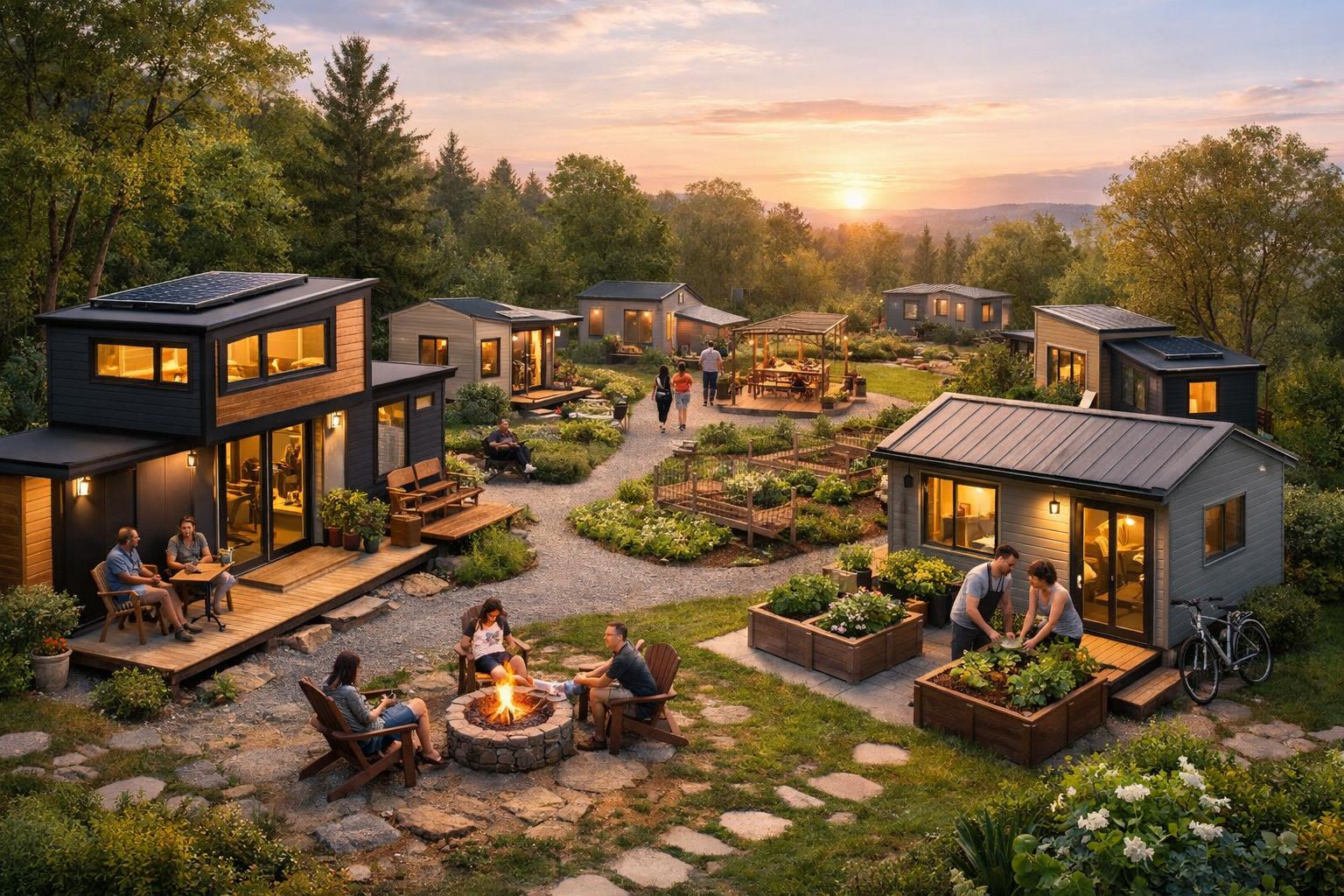
- Shared space: central common green or linear courtyard with amenity core (laundry, tool shed, bike storage).
- Stormwater: permeable paving, rain gardens.
- Parking: typical planning 0–1.5 spaces/unit (transit-dependent).
- Utilities: cluster hookups, consider shared mechanical room/module for heat pumps.
- Fire access: confirm local fire width requirements (often ~3.0–4.5 m).
Community planning examples: Big Calm video.
Common design types
- ADU clusters / backyard pods (300–600 sq ft)
- Laneway houses (alley access)
- Stacked micro-units (two-storey modules)
- Row / courtyard clusters
- Prefabricated modules (plan crane access and delivery logistics)
Prefab / remote logistics example: Peter Gilgan Foundation; ADU product examples: Teacup Tiny Homes.
Accessibility & sustainability basics
- Doors & corridors: ~36 inches (925 mm) recommended
- Ramp slope: 1:12 standard where used
- Heat pumps, strong insulation (target high R-values in cold climates), LED lighting
- Solar-ready roofs and low-flow fixtures; greywater and composting need municipal approvals
Shared amenity sizes (ideas)
- Tool shed: 12–20 m²
- Community kitchen: 20–40 m²
- Optional guest unit to reduce pressure on private units
Village design and shared amenity benefits: Homesmart Living.
Municipal / regulatory pathway in Canada
Step-by-step process
- Pre-application zoning check (0–2 weeks): one-page brief + site sketch; check ADU/laneway permission.
- Pre-consultation with planning (1–3 weeks to schedule): bring site sketch, massing, servicing concept. Ask the six planner questions in your script.
- Concept review / community consultation (1–3 months): neighbour session, fact sheet, record feedback.
- Rezoning/variance if needed: formal application, public notice, possible hearings.
- Building permit submission (3–6 months): site plan, structural drawings, MEP plans, energy compliance, engineering letters, geotech as needed.
- Inspections & occupancy: prefab reduces site time but inspections remain essential.
Typical national timeline for small clusters: 6–18 months from first check to occupancy; complex cases can be longer (see Constructem).
Working with neighbours (simple approach)
Start outreach within ~50 m (two properties each way). Sample meeting agenda (45–60 min):
- Intro and project scope
- Impacts + mitigations (privacy, parking, shadowing)
- Q&A and feedback capture
Common mitigations: screening, parking plan, construction staging.
Red flags to check early
- Heritage overlays
- Tree protection / conservation
- Floodplain maps
- Steep slopes / unstable soils
Governance, agreements, and day-to-day management
Essential legal documents
- Co-ownership agreement (TIC): ownership shares, capital ledger, operating fee formula, emergency capital calls, insurance, buyout formula, right of first refusal, dispute resolution.
- Operating agreement (condo/co-op/JV): day-to-day decision authority, budget schedule, major repair thresholds, reserve fund policy.
- Covenant/declaration for shared spaces: permitted uses, access rights, hours, guest policy.
- Maintenance reserve: start with 10–20% of annual operating budget or $500–$1,000/unit/year depending on shared scope.
Governance models
- Consensus: best for 2–6 people (slow but inclusive)
- Elected board: best for 6+ (clear roles and speed)
- Management company: useful when owners are mixed or remote
Minimum roles: Treasurer, Chair/President, Facilities Lead, Secretary, Communications Lead.
Financial controls
- One project bank account
- Two-signature payments
- Quarterly reporting + annual budget vote
- Independent review every 2–3 years
Maintenance schedule (examples)
- Quarterly: gutters, paths, lighting, leak checks
- Seasonal: snow plan, irrigation start/stop
- Annual: roof review, exterior sealing, HVAC servicing
Tools: QuickBooks for accounting; property platforms for management; community lessons from Big Calm.
Sample project roadmap & timeline
- Group formation & alignment (Weeks 1–8): mission, commitments, deposit rules, conflict baseline, lead contact.
- Site selection & feasibility (Weeks 4–12): site checklist, zoning read, rough budget.
- Concept design & cost estimate (Months 3–6): schematic site plan, unit list, prefab/contractor estimates.
- Legal setup (Months 4–7): pick model, draft core agreements, incorporate if needed.
- Financing & grants (Months 6–12): lender pre-approval, grant applications, investor term sheets.
- Permitting & engagement (Months 8–18): pre-consult notes, consultations, rezoning/variance as required, building permit package.
- Construction & commissioning (Months 12–24): signed builder/prefab contracts, schedule, inspections.
- Occupancy & handover (Months 18–30): occupancy certificates, governance launch (AGM), reserve fund live.
Typical national timeline: 18–36 months end-to-end; modular 6-unit backyard clusters can be closer to 12–18 months with smooth permitting (see Build Canada Homes, Constructem).
Case studies and examples (Canada-focused)
Big Calm (Kootenays, BC)
Permaculture-guided tiny homestead with phased growth, shared stewardship and path to co-ownership. Lesson: start small, build governance early, phase the build. Source: Big Calm video.
Tinybox Arctic modular pilot
Modular innovation example with ~$90K unit figures in a northern pilot. Lesson: prefab can cut costs/time but logistics (transport, craning, weather) are critical. Coverage via the Peter Gilgan Foundation.
Hypothetical Toronto ADU cluster
Six neighbours use a bare-land condominium for mortgage-friendly titles; lesson: title structure affects financing and resale (timelines/costs: Constructem).
Hypothetical Edmonton co-op with Build Canada Homes funding
Non-profit builds 10 modular units on public land with cooperative governance; lesson: public funding speeds delivery but adds reporting and procurement commitments (Build Canada Homes).
Practical checklists & templates
Site selection checklist
- Zoning status (ADU/laneway allowed?)
- Lot size & shape
- Setbacks & height limits
- Servicing location
- Tree protection, heritage overlays, floodplain, slope
- Transit access & parking reality
- Solar access & neighbour receptivity
Feasibility checklist
- Rough capital budget
- Financing options explored
- Prefab vendor quotes
- Partnership model options
- Insurance quotes
- Permit timeline estimate
- Contingency 15–20%
- Team roles committed
What to ask a municipal planner (script)
- ADU limits and definitions
- Maximum units per lot
- Parking requirements & reductions
- Required technical reports
- Variance/rezoning process and fees
- Timeline and inspections
Co‑ownership agreement checklist
- Ownership percentages
- Capital contributions (dates)
- Monthly fees and coverage
- Reserve fund rules
- Maintenance allocation
- Insurance obligations
- Dispute & exit rules
Start your financing and program research with: CMHC and local ADU pages; cost/permitting context: Constructem.
Risks, red flags and mitigation
- Unclear governance → Mitigate: lawyer-reviewed agreement before major financial commitments; set voting thresholds.
- Undercapitalization → Mitigate: minimum deposits, 15–20% contingency, financing pre-approval.
- Restrictive bylaws / heritage → Mitigate: early mapping + pre-consult with planning.
- Insurance gaps → Mitigate: site-level policy + individual contents/liability policies; name project entity as insured.
- Lender refusal for TIC → Mitigate: explore bare‑land condo, strong agreements, co-signers or developer financing.
Permit timeline and delay risk are commonly flagged in practical build discussions (see Constructem).
FAQs
Q: Who can apply for permits?
A: Usually the land title holder or an incorporated entity. Co-ownership groups typically choose one lead applicant to manage the permit file (see the Municipal pathway section).
Q: Can I mortgage a tiny home unit?
A: Yes — but mortgageability depends on ownership model. Condos and bare‑land condos are often more straightforward than TIC; lenders may require negotiation for co-ownership shares (financing context: Constructem).
Q: What happens on resale?
A: Depends on the model: condo units sell like common real estate; co-ops and land trusts restrict resale to protect affordability; TIC requires a clear buyout strategy (see Partnership models).
Q: Are there grants or incentives?
A: Sometimes. Federal programs and pilots may apply (Build Canada Homes). Start with CMHC and provincial/municipal ADU pages.
Q: How long will permitting take?
A: A common range is 6–18 months, longer if rezoning or complex servicing is required (timing context: Constructem).
Next steps
- Form a group meeting: write down goals, money limits, and decision rules.
- Book a planner pre-consultation and bring your one-page project brief and the planner script.
- Download and complete the co-ownership checklist to spot gaps before spending money.
For a practical governance blueprint and example roadmaps, see Tiny Home Co-Ownership 2026.
Leave a Reply