

Estimated reading time: 11 minutes
Key Takeaways
- Winter solar in Canada can work well for tiny homes and ADUs, but only when the system is designed for short days, low sun angles, snow, and freezing temperatures.
- Reliable performance usually depends on three linked choices: maximizing panel output, sizing and protecting battery storage, and cutting demand through energy efficiency.
- Winter solar performance improves with steeper tilt, careful snow management, and realistic sizing for the worst month, not the annual average.
- Battery strategy matters just as much as panel count, especially because LiFePO4 batteries need protection from sub-freezing charging conditions.
- The most affordable winter-ready setup is often the one that first reduces loads through energy efficiency, then sizes solar and storage around that lower demand.
Table of contents
- Why winter matters for solar power in Canada
- Assessing site and winter solar potential for Canadian tiny homes
- Best solar panels and mounting choices for winter performance
- How to manage snow on solar panels safely
- Inverters and electrical design for partial snow and variable winter light
- Battery storage and thermal management for Canadian winter
- Energy efficiency strategies that make winter solar systems smaller and cheaper
- Smart load management for winter solar power
- 3 winter-ready solar power setups for Canadian tiny homes and ADUs
- Winter maintenance checklist for solar panels, batteries, and controls
- What winter-ready solar power costs in Canada in 2026
- FAQs: solar power for Canadian tiny homes in winter
- Next steps for a winter-ready solar power system
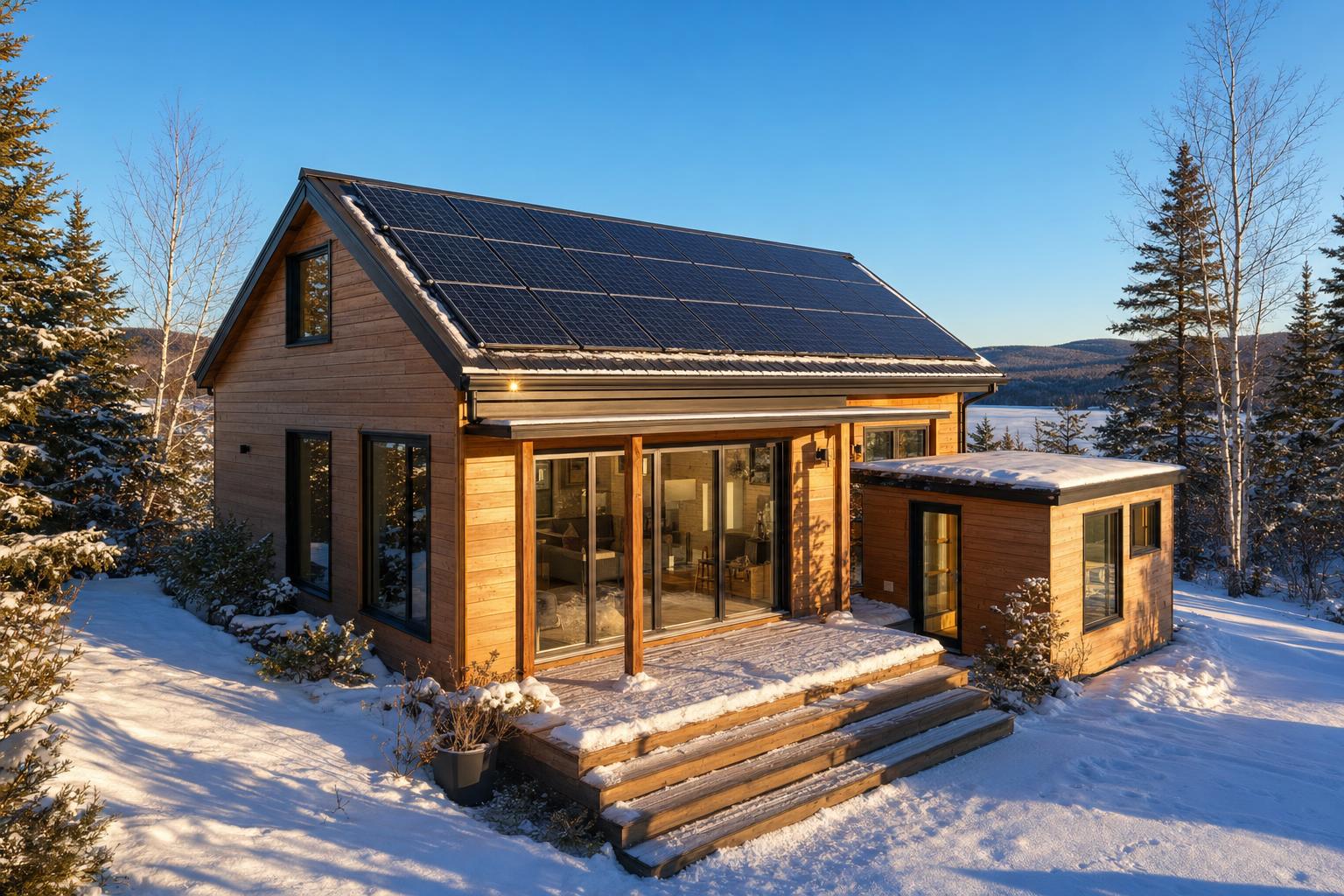
Solar power in winter can still work well for Canadian tiny homes, but only if the system is built for real cold-weather conditions. Short days, low sun angles, snow cover, and freezing temperatures all reduce how much solar panels can produce and add stress to battery storage. That is why winter design matters so much more than annual averages.
For Canadian tiny homes and ADUs, reliable solar power usually comes down to three linked choices:
- maximizing output from solar panels
- sizing and protecting battery storage properly
- cutting demand through energy efficiency
This guide is for tiny home owners, ADU owners, DIYers, builders, and installers across Canada. By the end, you will know how to assess a site for winter solar potential, improve winter generation, choose a battery strategy, reduce demand, compare simple 2026 system designs, and follow a seasonal maintenance checklist.
The key point is simple: winter solar is not just about adding more panels. It is about making the whole system work together.
Useful background on planning and pricing can be found through resources on solar installation cost, off-grid solar for cabins in Canada, and this off-grid solar Canada DIY guide.
Why winter matters for solar power in Canada
Winter changes solar power performance in a few important ways.
First, there is less daylight. In some parts of Canada, usable winter daylight can drop below 8 hours. That means solar panels simply have fewer hours to generate electricity.
Second, the sun sits lower in the sky. When sunlight hits panels at a lower angle, less energy reaches the cells unless the tilt is adjusted for winter.
Third, cold weather can help panel efficiency a little. Solar panels often work slightly better when the cells stay cool because lower temperatures reduce electrical resistance. But that does not mean winter produces more power overall. In most Canadian locations, shorter days and weaker sunlight reduce total output far more than cold improves efficiency.
Snow is another major factor.
- A full snow cover can sharply cut production.
- Even partial snow on one panel can reduce output across a full string system.
- At the same time, bright snow on the ground can reflect extra light back onto exposed panels.
- Bifacial modules can sometimes benefit the most from this reflected light.
The main planning lesson is clear: a winter-ready solar power system needs balance. More solar panels alone will not fix poor battery sizing or high daily use. For Canadian winter, you need enough generation, enough storage, and low enough loads to avoid blackouts during dark stretches.
For a practical overview of improving off-grid solar panel winter performance, it helps to think in terms of system coordination rather than single-product upgrades.
Assessing site and winter solar potential for Canadian tiny homes
Before buying equipment, design for the worst month, not the annual average.
For Canadian tiny homes, site assessment means estimating how much winter solar power your solar panels can really produce at your exact location. This step helps stop undersized systems and surprise winter shortages.
Useful tools include:
- PVWatts: a free online calculator that estimates production from location, system size, tilt, direction, and losses.
- NREL SAM: a more advanced tool for deeper simulations.
- Canadian solar resource maps or local installer software: useful for location-specific checks.
A good winter assessment should include shading. Look south and check for:
- trees
- nearby homes
- sheds
- chimneys
- hills
- utility poles
Do not ignore bare branches. In winter, the lower sun can make small shadows much more important, especially in the morning and late afternoon.
Orientation and tilt matter too. South-facing solar panels are usually best for winter in Canada. Winter tilt is often steeper than all-season tilt because it catches low-angle sunlight better and helps snow slide off. A common winter target is about latitude +10° to +15°. In southern Ontario, that often means roughly 50–60°.
Mount type also changes performance.
- Roof mount: saves space and works well on mobile tiny homes.
- Ground mount: often better in winter because it allows easy tilt adjustment and safer snow clearing.
For many Canadian tiny homes, a ground mount can improve real winter output even if the roof seems simpler at first.
If you are comparing small-home layouts, guides on how much solar an ADU may need and cold-climate tiny home construction can help connect energy modeling to the building itself.
Best solar panels and mounting choices for winter performance
The best solar panels for winter are not always the cheapest ones. In Canadian tiny homes, roof space is often tight, so every panel needs to work hard.
Monocrystalline solar panels are usually the best fit because they offer:
- high efficiency
- strong performance in limited space
- good low-light output
It also helps to choose panels with a low temperature coefficient. This means output drops less when cell temperatures rise. In winter, that supports better production during bright cold days.
Snow and wind ratings matter just as much as efficiency. In Canada, choose modules and racking built for local snow load and wind load conditions. Warranties are also important. Reputable manufacturers often offer 25–30 year performance coverage, with product coverage depending on brand and model.
Mounting choices affect winter performance too.
- Steeper tilt helps solar panels shed snow.
- Steeper tilt also improves capture of lower winter sun.
- Strong racking helps the system handle snow and wind safely.
- Bifacial modules can perform well when there is good ground reflection and enough clearance under the panels.
For Canadian tiny homes, there are some special limits. A trailer-based or mobile unit may not have room for a large fixed roof array. Transport height, roof shape, and weight all matter. In those cases, the answer may not be more panel area. It may be stronger energy savings, a ground array, or a mix of both.
In short, winter-ready solar power starts with efficient panels, strong mounting, and a layout matched to the space you actually have.
Related reading on solar-ready ADU design, steel-framed small homes in Canada, and energy efficiency for tiny homes can help shape that layout early.
How to manage snow on solar panels safely
Snow management should start with passive design.
A steeper panel tilt helps snow slide off more easily. Dark-framed modules may absorb a bit more heat and help melting. Some slick coatings may also help, but results vary, and any treatment should be checked against the panel warranty first.
Active snow removal should always put safety first.
Safer methods include:
- using a roof rake from the ground
- using a soft brush if the system can be reached safely
- clearing the lower edge first, if the manufacturer allows it
Important rules:
- never walk on solar panels
- never use metal scrapers or harsh tools
- never scrape seals, glass, or coatings
- avoid climbing on icy roofs
Heated cables are usually not a good routine solution. They add cost, use electricity, and increase system complexity. In many cases, better tilt and safe manual clearing work better.
If the roof is steep, icy, or hard to reach, professional help is the safer choice. Snow removal should always follow manufacturer instructions so the work does not damage the system or affect warranty coverage.
For additional context, see this guide to Canadian snow load requirements and this tiny home winterization checklist.
Inverters and electrical design for partial snow and variable winter light
Winter creates uneven solar conditions. One panel may be clear, another partly buried in snow, and a third in shade. That mismatch can reduce solar power output fast.
String inverters are simple and often cost less, but they have a weakness in winter: one weak panel can pull down the output of the whole string.
Microinverters and power optimizers help solve that problem. They let each panel work more independently, so partial snow coverage on one module causes less loss across the array. This can be very useful where snow drifts or patchy shading are common.
Charge control matters too. MPPT charge controllers are usually better than PWM in winter because they track the panel’s best operating voltage as light levels change. If an array has mixed orientations or different shading patterns, multiple MPPT inputs can improve performance further.
For cold-weather design, also check:
- inverter low-temperature operating ratings
- protected placement for electronics
- insulated or heated enclosures where allowed
- remote monitoring and alerts
- rapid shutdown where code requires it
Monitoring is especially useful in winter. A sudden drop in output may mean snow cover, a fault, or a battery temperature problem. Good alerts help owners act before a small issue becomes a power shortage.
If you are planning a more connected setup, this article on tiny home monitoring and maintenance is a useful next step.
Battery storage and thermal management for Canadian winter
Battery storage is often the hardest part of winter solar power design. In winter, batteries must cover longer nights, more cloudy days, and fewer charging hours.
For many Canadian tiny homes, LiFePO4 is often the preferred battery chemistry. It offers:
- long cycle life
- strong safety profile
- good fit for small residential and off-grid systems
But it has one key limit: LiFePO4 batteries generally should not be charged below 0°C unless they include a battery management system with controlled heating or preheat.
Lead-acid batteries still exist in some systems, but they usually have more downsides in winter:
- less usable depth of discharge
- poorer cold-weather performance
- more bulk for the same usable energy
- shorter cycle life in many use cases
Other lithium chemistries can also work, but they may involve different safety and thermal trade-offs.
To size storage for winter, start with your actual daily winter load in kWh. Then multiply by the number of autonomy days you want. After that, divide by usable depth of discharge, round-trip efficiency, and your reserve factor.
Nominal battery kWh = (daily winter load × autonomy days) / (DoD × round-trip efficiency × reserve factor)
If you want to keep 20% reserve, the reserve factor is 0.8.
Example:
- daily winter load = 10 kWh
- autonomy = 2 days
- DoD = 0.9
- round-trip efficiency = 0.95
- reserve factor = 0.8
Calculation:
- 10 × 2 = 20
- 0.9 × 0.95 × 0.8 = 0.684
- 20 / 0.684 ≈ 29 kWh nominal
That is roughly 28–29 kWh nominal, or about 23 kWh usable, depending on the exact battery setup.
Thermal management is just as important as battery size.
Best options often include:
- placing batteries inside the conditioned space, where code and manufacturer rules allow
- using an insulated battery box outdoors
- adding thermostatically controlled heaters
- weatherproofing the enclosure
- using BMS-controlled preheating before charging
Below-frost-line battery placement can be used in some special designs, but only where it is practical and code-compliant.
The core lesson is simple: better energy efficiency reduces winter load, and lower winter load makes battery sizing much easier and cheaper.
More detailed battery planning resources include this guide to maximizing tiny home energy storage in Canada and this overview of off-grid living in Canadian tiny homes.
Energy efficiency strategies that make winter solar systems smaller and cheaper
The cheapest winter kilowatt-hour is the one you never need to generate or store.
For Canadian tiny homes, energy efficiency is often the biggest factor in whether a winter solar power system is practical. If heat loss is high, the system gets larger, costlier, and harder to maintain.
Start with the building shell:
- high R-value insulation in walls, roof, and floor
- careful air sealing to stop drafts
- triple-pane windows
- insulated skirting and underfloor protection for homes above grade or on trailers
Heating choice matters even more. A cold-climate mini-split heat pump can often deliver a COP of about 2–3 near -15°C. That means it can provide 2–3 units of heat for each unit of electricity. Electric resistance heat has a COP of about 1, so it uses much more power for the same warmth.
That is why many owners combine:
- a cold-climate heat pump for most heating
- propane or wood backup for extreme cold or long cloudy periods
Ventilation and appliances also affect winter loads.
Useful upgrades include:
- HRV or ERV ventilation
- LED lighting
- induction cooking
- smart thermostats
- timers
- thermal curtains
- good passive solar gain through windows
These measures lower total use and help shift demand to better times. Run heavier loads around midday when solar power is strongest. That may include laundry, water heating support, or charging devices.
For Canadian tiny homes, energy efficiency is not a side issue. It is often the difference between a manageable winter system and an oversized, expensive one.
For broader context, compare the economics of solar sizing with installation cost considerations and this piece on winter-ready tiny homes in Canada.
Smart load management for winter solar power
Energy efficiency cuts total electricity use. Load management changes when that electricity is used.
That matters in winter because solar power is limited and arrives in a shorter daily window.
Useful load management strategies include:
- using timers to run heavy loads at midday
- using an energy management system to automate load timing
- charging batteries first, then running optional loads
- preheating thermal mass during sunny periods if the system is designed for it
- using diversion loads only after battery targets are met
For off-grid systems, generator backup is still a smart part of winter design. Long storms and dark stretches happen. A backup generator can protect the batteries and keep critical loads running.
For grid-connected setups, hybrid inverters can keep key circuits powered during outages. This is often useful for lights, internet, fridge loads, water pumps, and heating controls.
Good controls do not replace a strong design, but they make a winter system much more reliable and efficient.
If you want to layer in automation, see smart home technology for ADUs and this guide to tiny home utilities in Canada.
3 winter-ready solar power setups for Canadian tiny homes and ADUs
These are simplified 2026 examples, not final engineering designs. Actual sizing depends on location, shading, tilt, heating type, and code requirements.
| Scenario | Daily winter load (kWh) | PV size (kW) | Usable battery (kWh) | Inverter size (kW) | Estimated cost in CAD | Best fit / notes |
|---|---|---|---|---|---|---|
| Grid-tied tiny home with propane/wood heating | 5–8 | 1.5–2.5 | 3–5 | 2 | $8K–$15K | Lower electric heating load, resilience, bill savings |
| Mostly-electric tiny home with cold-climate heat pump | 10–15 | 2–4 | 10–20 | 3–5 | $20K–$35K | Strong energy efficiency needed, battery heating important |
| Off-grid ADU in remote location | 8–12 | 3–5 | 20–40 | 4–6 | $30K–$50K | Sized for autonomy, generator backup recommended |
Scenario A: Grid-tied tiny home with propane or wood heating
This setup fits owners who want backup power and lower bills, but not full electric winter heating. Because the heating load stays lower, the system can stay small. In areas with net metering, economics can be better, and payback may land around 5–8 years where local utility rules are favourable.
Scenario B: Mostly-electric tiny home with heat pump
This is for owners aiming for higher winter solar coverage. It depends on strong energy efficiency, smart load shifting, and careful battery thermal management. It is more realistic with a cold-climate heat pump than with resistance heating alone. In some locations, payback may fall in the 7–10 year range, depending on site and incentives.
Scenario C: Off-grid ADU in a remote location
This setup focuses on independence and reliability more than fast payback. PV is often oversized for the worst month, and the battery bank is much larger to cover several dark days. Generator backup is still wise, even with aggressive energy efficiency.
A useful rule of thumb is to oversize solar panels by about 20–50% for winter compared with annual-average thinking. But always confirm with PVWatts or SAM before final sizing.
Additional sizing references include solar-powered ADUs in Canada and remote solar design examples for cabins.
Winter maintenance checklist for solar panels, batteries, and controls
Winter upkeep helps solar power systems stay reliable in Canadian tiny homes.
Pre-winter
- inspect mounts, rails, and visible wiring
- tighten hardware if required by the installer or manufacturer schedule
- confirm inverter firmware and monitoring apps are current
- adjust tilt if the array is seasonally adjustable
- check battery enclosure insulation, heaters, and sensors
- prepare snow rakes or soft brushes
Mid-winter
- monitor output trends in the app or portal
- watch battery temperature and charging behaviour
- safely clear snow from solar panels when needed
- set alerts for abnormal drops in production
- check for unusual inverter or battery warnings
Post-winter
- clean panels if salt, dirt, or residue remains
- inspect for ice damage, water ingress, loose wiring, or flashing issues
- review system data and note what to improve before next winter
Safety matters. Roof access in icy weather is risky. For steep roofs or hard-to-reach systems, professional service is usually the safer option. Always follow warranty terms and manufacturer guidance when cleaning or inspecting equipment.
For broader upkeep planning, this ADU maintenance checklist for Canada is also useful.
What winter-ready solar power costs in Canada in 2026
In 2026, the cost of a winter-ready solar power system for Canadian tiny homes depends on the system type, battery size, and mounting details.
Main cost buckets include:
- solar panels
- inverter, charge controller, and electrical balance of system
- batteries
- snow- and wind-rated racking
- labour
- permits and inspections
- site prep for ground mounts, if needed
High-level ranges are often:
- solar panels: about CAD $0.5–$1 per watt
- batteries: about CAD $300–$500 per kWh
- total installed systems: roughly CAD $10K to $50K+, depending on complexity
ROI depends on the project goal.
- Grid-tied systems may pay back through lower bills and outage support.
- Off-grid systems are often justified more by resilience and independence.
- Better energy efficiency improves ROI because it cuts required panel and battery size.
Incentives and permits can change often, so verify current 2026 programs before making decisions. Check federal, provincial, utility, and municipal options. Also confirm local ADU and tiny home rules, especially for permanent installations, service connections, and battery placement.
Grid-tied systems with storage may need utility interconnection approval plus electrical inspections. Off-grid systems may still need permits, depending on the province, municipality, and structure type.
For budgeting context, review current guidance on how much solar power installation really costs, along with Canadian ADU planning resources such as how much an ADU costs to build in Canada and this ADU financing guide.
FAQs: solar power for Canadian tiny homes in winter
Do solar panels work in winter in Canada?
Yes. Cold weather can improve panel efficiency a little, but winter usually reduces total output because days are shorter, the sun is lower, and snow or shading can block light. Good design and maintenance are what make the difference. For more, see this overview of cold-climate tiny home construction.
How much should I oversize solar power for winter?
Often by about 20–50%, but the right number depends on location, shading, tilt, and winter loads. Use winter solar modeling guidance and site tools like PVWatts or SAM to model the worst month instead of guessing.
Will snow permanently damage solar panels?
Usually no, if the solar panels are rated for local snow load and installed correctly. In many cases, snow slides off or melts from tilted dark surfaces. Local snow design standards still matter, so review Canadian snow load requirements.
What battery chemistry is best for cold climates?
LiFePO4 is often the best fit for small residential and off-grid systems because of safety and long cycle life. But it should not usually be charged below freezing unless it has controlled preheating. This guide on tiny home energy storage goes deeper.
Can I heat my tiny home with solar and batteries in winter?
Yes, but it is much more realistic with strong energy efficiency upgrades and a cold-climate heat pump than with electric resistance heating alone. A useful starting point is this guide to a heat pump for a tiny home.
How do I safely remove snow from panels?
Use a roof rake from the ground where possible, avoid climbing onto icy roofs, and never walk on the panels. This practical advice aligns with these winter performance tips for off-grid solar panels.
Next steps for a winter-ready solar power system
For Canadian tiny homes, reliable solar power in winter depends on planning for the worst month, choosing the right tilt and electronics, protecting batteries from freezing, and improving energy efficiency so the system does not need to do more work than necessary.
The practical next steps are simple:
- run a PVWatts or SAM estimate
- list winter loads in kWh per day
- compare battery autonomy options
- check local code, permitting, and 2026 incentives
- get a site-specific review from a licensed cold-climate installer or electrician
This is generalized 2026 guidance. Final system design, code compliance, and permitting should always be confirmed through site-specific modeling and qualified professionals.
Leave a Reply