

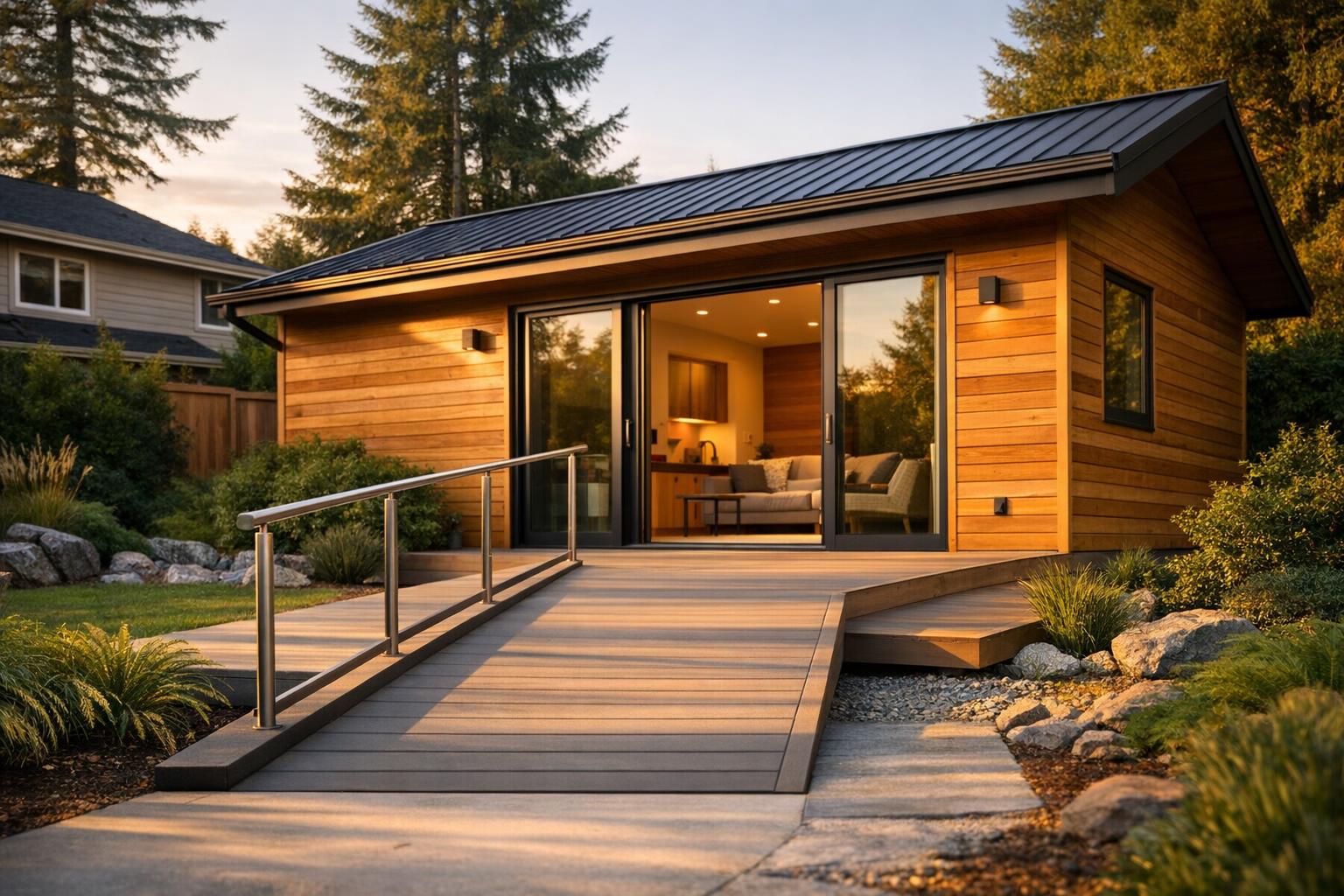
Estimated reading time: 12 minutes
Key Takeaways
- Universal design is becoming a core part of Canadian small-space planning, especially for an accessible tiny home or ADU.
- The biggest 2025 trends pushed the market toward flexibility, aging in place, and smart accessibility in 2026.
- Features like zero-step entry, curbless showers, wider doors, grab bar-ready walls, and reachable storage can make compact homes safer and easier to use long term.
- In a small footprint, a few inches matter. Layout decisions often matter more than finishes.
- Canadian homeowners should confirm local zoning, bylaws, code requirements, grants, and financing options before finalizing plans.
- Choosing experienced Canada builders is critical if you want universal design features integrated properly from day one.
Table of contents
- Why universal design matters now in Canadian tiny homes and ADUs
- The 2025 trends that reshaped universal design in 2026
- Core universal design principles for an accessible tiny home or ADU
- Must-have features for an accessible tiny home in 2026
- Flexible layouts and multi-functional design strategies
- Aging in place solutions tailored to tiny homes and ADUs
- Canadian regulations, incentives, and market shifts to know in 2026
- How to choose and vet Canada builders for universal design projects
- Real-world examples and mini case studies
- Costs, timelines, and value trade-offs
- Practical universal design checklist for a tiny home or ADU
- Recommended resources and further reading
- Final thoughts
- Frequently Asked Questions
Universal design is changing how Canadians think about small-space living. In simple terms, it means designing homes so they are usable, safe, and comfortable for people of different ages, mobility levels, and abilities without needing major changes later.
That matters even more in an accessible tiny home or ADU, where every inch has to work harder. This 2026 update reflects how accessible home design trends for 2025, 2025 tiny home trends, and current guidance from accessible tiny homes for aging in place and the accessible tiny home guide for Canada are influencing homeowners, multigenerational families, designers, and builders.
You’ll find practical takeaways on features, planning measurements, likely costs, rules, and the smartest questions to ask before you build.
Why universal design matters now in Canadian tiny homes and ADUs
Canada is getting older. At the same time, more families are exploring backyard suites, laneway homes, and secondary dwellings for parents, adult children, or caregivers.
That means tiny homes and ADUs are no longer just about lower cost or visual appeal. They increasingly need to support long-term independence.
A home that works at age 40 should still work after an injury, during illness, or later in life.
This is where universal design helps. It is one of the clearest ways to future-proof a home now rather than paying for expensive changes later.
The benefits are straightforward:
- Safety: fewer trip risks, easier bathing, easier movement throughout the home
- Financial value: lower retrofit costs later and broader appeal to future buyers
- Lifestyle flexibility: better for seniors, guests, parents with strollers, and people recovering from injury
Accessibility is no longer a niche issue. Practical features such as wider doors, level entries, and barrier-free layouts help many people, not only wheelchair users. That broader appeal is one reason an accessible tiny home can stand out in a competitive market.
If you are still comparing sites or municipalities, it also helps to review an ADU zoning in Ontario guide alongside a broader Canadian ADU regulations guide before locking in a layout. For additional market perspective, resources on tiny house plans for 2025 and current video commentary on accessible compact housing can also be useful.
The 2025 trends that reshaped universal design in 2026
One of the biggest shifts from 2025 to 2026 is that the market moved away from “tiny but stylish” toward “tiny, flexible, and livable for longer.”
That shift is visible across modern prefab, modular, and custom compact housing.
Here is the quick view of what changed most:
- Modular adaptability: movable walls and expandable sections that respond to changing mobility needs
- Integrated smart accessibility tech: voice controls, app-based lighting, reminders, and telecare tools
- Curbless wet areas: bathrooms designed for safer entry and easier everyday use
- Multi-height counters: better support for seated and standing users
- Broadened doorways: more room for walkers, wheelchairs, and everyday carrying tasks
- Universal controls: lever handles and simplified hardware that reduce required grip strength
These are not isolated trends. They align with what sources covering sustainability, functionality, design, and colour trends in tiny homes and 2025 accessible home design trends have highlighted, and they also connect with broader experimentation in compact prefab housing and adaptable living.
Some builders are now pairing these ideas with newer approaches such as prefab ADU vs custom build strategies and even prefab passive house ADUs in Canada. The result is a more practical model of accessible small-space housing: efficient, attractive, and easier to live in over time.
Core universal design principles for an accessible tiny home or ADU
This is the planning foundation. Before finishes, fixtures, or furniture, the layout has to work.
Single-level living
The main daily functions should happen on one level: sleeping, bathing, cooking, entering the home, and ideally laundry too. That reduces reliance on stairs.
Clear circulation
Circulation means the pathways through the home. In small spaces, these paths need to stay open and free of tight pinch points.
Reach range
Storage, switches, outlets, and controls should be placed where people can comfortably reach them while seated or standing.
Adaptable fixtures
Choose features that can be upgraded later without tearing the home apart, such as counter sections that can be modified and walls prepared for future grab bars.
Low physical effort
Doors, taps, locks, and controls should not require twisting, force, or a strong grip.
Simple, intuitive use
Appliances, switches, and hardware should be easy to understand at a glance. Simplicity lowers daily stress.
Helpful planning benchmarks
| Feature | Planning benchmark |
|---|---|
| Door width | 32–36 inches |
| Clear paths | 36 inches |
| Turning space | 60-inch radius where possible |
| Entry threshold | Zero-step, under 1/2 inch rise |
| Reachable storage | 15–48 inches high |
These are not style rules. They are practical benchmarks that help a compact home feel easier rather than more frustrating. In a tiny floorplan, a few inches can change everything.
For more Canada-specific layout guidance, the accessible tiny home guide, information on curbless entry in Canadian tiny homes, and advice on finding the sweet spot for ADU size in Canada are especially helpful.
Must-have features for an accessible tiny home in 2026
Good universal design becomes real through specific choices. These are the features that usually matter most.
Zero-step entry
A zero-step entry removes stairs and raised thresholds. It supports mobility devices, strollers, groceries, and safer entry in wet or icy conditions.
Wider doors
Doors around 36 inches wide are far more adaptable than narrow standard openings. They also make everyday movement easier.
Curbless shower
A curbless shower has no raised lip at the entry. It improves safety, accessibility, and ease of use, especially when paired with good drainage and slip-resistant flooring.
Grab bar-ready walls
Adding wall blocking during construction is a simple step that can save major hassle later, even if grab bars are not installed right away.
Adjustable-height counters and sinks
Counters in the 28–34 inch range can better support both seated and standing users. In a tiny home, one flexible work area can do the job of several fixed zones.
Non-slip flooring
This is especially important at the entry, in the bathroom, and in the kitchen. It reduces fall risk without making the home feel clinical.
Smart lighting and voice controls
These systems can reduce night-time risk, improve comfort, and make routine tasks easier for people with limited mobility or dexterity.
Space-saving accessibility tools
Fold-down ramps, sliding doors, and modular bathroom pods are useful because they improve access without demanding more square footage.
The best part? Accessible design does not have to look institutional. With warm materials, good lighting, and clean hardware, it can feel modern and inviting.
For more ideas, see current resources on accessible design for tiny homes and the Canadian accessible tiny home guide.
Visual asset recommendation
Suggested alt text: Floorplan of 400 sq ft accessible tiny home highlighting zero-step entry, 36-inch circulation paths, turning radius, and adjustable fixtures.
Flexible layouts and multi-functional design strategies
Accessibility is not only about fixtures. It is also about how a space can change over time.
A flexible layout allows a home to serve different needs without major structural work. That matters because mobility changes are often gradual.
Useful strategies include:
- Convertible furniture: Murphy beds, fold-out desks, bench storage, and lift-top tables
- Sliding partitions instead of swing doors: better space efficiency and easier movement
- Vertical storage with accessible zones: keep daily-use items in the lower and middle reach range
- Multi-use rooms: office by day, caregiver sleep area by night
- Ground-floor primary living: even if there is a loft, core accessible functions should remain downstairs
Example 1: Single-level 400 sq ft ADU
This kind of layout can include an open turning zone near the kitchen and bath, a foldable ramp at the entrance, and a wall bed that opens space during the day.
Example 2: Multigenerational compact suite
A partitioned sleeping area can create privacy for an older parent or temporary caregiver, while sliding panels let the layout open up when needed.
Flexibility is one of the clearest lessons from recent tiny-home trends. It makes a compact dwelling work better now and remain useful later.
If you are weighing delivery methods, a prefab vs custom ADU guide and advice on a future-proof ADU for multigenerational living can help narrow your approach.
Visual asset recommendation
Suggested alt text: Infographic comparing 2025 modular and multi-functional tiny home trends with 2026 accessible adaptations for aging in place.
Aging in place solutions tailored to tiny homes and ADUs
Aging in place means being able to live safely, independently, and comfortably in your own home as needs change.
Tiny homes and ADUs can support aging in place very well, but only if those choices are built in early. Small footprints leave less room for poor planning.
Predictive design features
Predictive design means adding helpful elements now so the home is ready for future needs.
- low-threshold entries
- lever handles
- visual contrast striping on key edges
- simplified controls with clear labels
- telecare integration for alerts or monitoring
These may seem like small details, but they often make daily life easier and reduce risk.
New build vs retrofit
New build: the easiest time to add wall blocking, wider framing allowances, proper bathroom drainage, and built-in smart systems.
Retrofit: still valuable, but more constrained. Improvements may include ramps, modular bathroom pods, smart controls, and hardware swaps such as lever handles.
The goal is not to wait for a crisis. Good planning reduces future disruption and helps people stay independent longer.
For broader context, see guidance on accessible tiny homes for aging in place and retiring into an accessory dwelling unit.
Canadian regulations, incentives, and market shifts to know in 2026
Tiny home and ADU rules vary by province and municipality. Always confirm local zoning, setbacks, servicing, height limits, and code requirements before budgeting.
Current market shifts suggest a few important patterns:
- British Columbia and Ontario eased some ADU zoning pathways in 2025
- Some municipalities expanded permissions for tiny homes on residential lots
- In some areas, height caps under 4.5 metres may still apply
- Permit activity in major cities suggests stronger acceptance of ADUs
There may also be funding support in some cases. Homeowners often look into grants, municipal incentives, adaptation support, or financing programs before finalizing an accessibility budget.
Because these programs can change, treat all numbers and eligibility rules carefully. Good starting points include a Canadian ADU regulations guide, information on ADU grants and municipal incentives in Canada, and an ADU financing guide for Canada.
It is also wise to cross-check current information through:
- CMHC for housing and funding information
- Canadian Home Builders’ Association for industry standards and builder directories
- Rick Hansen Foundation for accessibility tools and guidance
How to choose and vet Canada builders for universal design projects
The best design can fail if the builder does not understand accessibility in practice.
Ask Canada builders these questions:
- Do you have experience with universal design or accessible residential projects?
- Can you show examples of an accessible tiny home or accessible ADU you have completed?
- Do you offer prefab, modular, site-built, or hybrid options?
- How do you plan for zero-step entries, curbless showers, wider doors, and wall blocking?
- Can you coordinate with an occupational therapist, accessibility consultant, or aging-in-place specialist?
- What warranty support is offered for adaptive systems such as adjustable counters or smart controls?
- How do you handle permitting and local code compliance for ADUs?
Use this vetting framework:
- review portfolio photos closely
- ask for accessibility-specific case studies
- request references
- ask whether features were planned from the start or added later
- check for CHBA membership or comparable credentials
- ask what green-building or accessibility training they can document
If you are still narrowing your shortlist, guidance on how to choose a reliable tiny home builder in Canada and how to find a contractor for a tiny home can help.
In short: choose builders who understand access as part of the original concept, not as an afterthought.
Real-world examples and mini case studies
These examples show how the ideas can work in practice. Where public project detail is limited, they are best read as industry-style examples inspired by current market activity.
Case study 1: BC modular ADU
- Project type and location: modular ADU in British Columbia
- Size and layout: 350 sq ft, single level
- Accessibility features: curbless shower, multi-height counters
- Result: supported senior aging in place
- Lesson: modular methods can shorten timelines while making accessibility easier to include from day one
Case study 2: Ontario retrofit
- Project type and location: upgraded existing ADU in Ontario
- Size and layout: compact secondary unit retrofit
- Accessibility features: zero-step entry, smart controls, lever handles
- Result: improved daily safety and reduced injury risk
- Lesson: older small homes can become more accessible without full replacement
Case study 3: Vertical prefab concept
- Project type and location: compact prefab tower concept inspired by small-footprint innovation
- Size and layout: about 4 x 4 metres, vertical arrangement
- Accessibility features: future elevator-ready shaft, adaptable circulation planning
- Result: shows that compact design can still prepare for future access
- Lesson: not every accessible home must be single-storey, but daily-use functions need careful placement
These examples reinforce one main point: universal design works best when it is integrated early.
For inspiration, some readers also explore broader collections of notable compact homes and concepts, including accessible and forward-looking designs.
Costs, timelines, and value trade-offs
Accessibility features add cost, but they are often far cheaper during initial construction than after move-in.
A simple planning framework for a 400 sq ft home looks like this:
- Baseline tiny home cost: about $80,000 to $120,000
- Accessible upgrade premium: often 10% to 20%
- Modular timeline advantage: in some cases, 4 to 6 weeks saved, with total builds around 8 to 12 weeks
That premium may seem significant at first, but it can reduce future renovation costs, improve everyday usability, and support aging in place. It may also make the property more appealing to future buyers or renters.
Sample feature comparison
| Feature | Baseline cost | Upgrade cost | Timeline impact |
|---|---|---|---|
| Curbless shower | $5,000 | +$2,000 | +1 week |
| Adjustable counters | $3,000 | +$1,500 | No modular delay |
| Smart controls | $2,000 | +$1,000 | +2 days |
Potential value trade-offs include:
- stronger resale appeal
- lower risk of future major modifications
- broader usability for different household types
- possible utility savings from smart tech over time
Before setting a final budget, it helps to compare options using an ADU cost guide for Canada and an ADU financing guide.
Practical universal design checklist for a tiny home or ADU
Use this quick checklist when reviewing plans. Not every project can include every feature, but this helps keep the essentials in focus.
- 36-inch doors and circulation paths
- 60-inch turning radius where possible
- zero-step entry
- curbless shower
- lever handles
- multi-height counters
- non-slip floors
- voice or smart controls
- reachable storage
- modular or convertible furniture
- grab bar blocking in bathroom walls
- visual contrast at key edges and transitions
This kind of checklist is especially useful when reviewing drawings with builders or comparing what is essential now versus what can be added later.
Helpful related resources include the accessible tiny home guide for Canada and broader advice on accessibility in Canadian tiny homes.
Visual asset recommendation
Suggested alt text: Before and after of a tiny home bathroom retrofit showing curbless shower and improved accessibility for aging in place.
Recommended resources and further reading
- CMHC: useful for ADU guidance, housing policy, and funding information
- Statistics Canada: helpful for demographic context that shapes aging-in-place planning
- CHBA: a good source for builder directories and industry standards for Canada builders
- Rick Hansen Foundation: offers accessibility tools and inclusive design guidance
- Related reading: zoning guides, prefab vs site-built comparisons, and aging-in-place planning resources
Additional reading on ADU grants and municipal incentives, the Canadian ADU regulations guide, and the ADU financing guide for Canada can help turn general ideas into practical next steps.
Final thoughts
Universal design is no longer an optional add-on in Canadian tiny homes and ADUs. The strongest 2025 trends pushed the market toward smarter, more flexible, and more inclusive small-space living, and that shift is now shaping 2026 decisions.
The best results come from planning early. A well-designed accessible tiny home is safer, easier to use, and better prepared for aging in place. It also gives households more flexibility for guests, family members, and changing needs.
Do not plan only for how you live today. Plan for how the home can keep working tomorrow.
That long-term thinking is what now sets the best projects apart for homeowners, families, and builders alike. For readers continuing their research, resources on future-proof ADUs for multigenerational living and accessible tiny homes for aging in place are natural next steps.
Frequently Asked Questions
What is universal design in a tiny home?
Universal design means planning a home so it is safe, comfortable, and usable for people with different ages, abilities, and mobility levels without major future alterations.
What are the most important accessibility features in a small ADU?
The most important features are usually a zero-step entry, wider doors, clear circulation paths, a curbless shower, lever handles, reachable storage, and bathroom walls prepared for grab bars.
Can an accessible tiny home still look modern?
Yes. Good accessible design can feel warm, minimal, and high-end. The best projects hide the technical work inside smart planning rather than making the home look clinical.
Is it cheaper to build accessibility in from the start?
Usually, yes. Adding accessibility features during the initial build is often much less expensive than retrofitting them later.
Do Canadian ADU and tiny home rules vary by location?
Yes. Zoning, servicing, setbacks, height rules, and code requirements can differ widely by province and municipality, so local confirmation is essential before building.
How do I choose the right builder for an accessible tiny home?
Look for a builder with direct experience in universal design, accessible residential work, permitting, and small-space planning. Ask for case studies, references, and proof that accessibility features are part of their standard planning process.
Leave a Reply