
Estimated reading time: 12 minutes
Key Takeaways
- Remote work in 2026 still matters, even with some return-to-office pressure, and it continues to influence where people choose to live.
- Tiny homes, ADUs, and mobile housing each solve different problems for remote workers, from stable year-round setups to highly mobile lifestyles.
- Internet, legal compliance, winter readiness, and total cost matter more than aesthetics when choosing a compact home for work.
- Canada digital nomads need to think beyond housing itself and plan for tax residency, healthcare, insurance, mail, and backup workspaces.
- The best option is the one that supports reliable work, lawful living, and realistic daily comfort in Canadian conditions.
Table of contents
- Remote Work in 2026: Tiny Homes, ADUs and Mobile Housing for Canada Digital Nomads
- Key Takeaways
- Why remote workers are choosing tiny homes and ADUs
- Market and legal landscape: 2025 trends and 2026 outlook
- Mobile housing options for remote workers
- Designing a productive work from home setup in a tiny home
- Internet connectivity for tiny home living and digital nomads
- Utilities, energy and off-grid strategies for year-round living
- Cost, financing and insurance in 2026
- Living logistics for Canada digital nomads and remote workers
- Case studies and profiles
- Practical checklist and decision flowchart
- Frequently Asked Questions
- Final thoughts and next steps
Remote Work in 2026: Tiny Homes, ADUs and Mobile Housing for Canada Digital Nomads
Remote work is still shaping where and how people live in 2026. Even with some return-to-office pressure, many people are still choosing tiny home living, mobile housing, and flexible retreat-style setups that support productivity beyond the city core, including options tied to a remote work retreat in Canada.
This article explains how these housing options can support real work from home needs, not just a lifestyle dream. It also covers internet connectivity, legal rules, off-grid utilities, costs, and the day-to-day realities that matter to Canada digital nomads. The goal is simple: connect what changed in 2025 with what matters most in 2026 through practical topics like the ADU home office in Canada, internet for tiny homes in Canada, and tiny home legal requirements in Canada.
For people doing remote work in Canada, tiny homes, ADUs and mobile housing can offer lower costs, more flexibility and the ability to stay productive outside traditional city rentals. This guide is for full-time remote workers, hybrid workers, aspiring tiny home owners, and Canada-based or Canada-travelling digital nomads who want practical answers before they buy, build, tow, or move.
One major reason this topic remains relevant: remote and home-based work stayed a major part of Canadian working life into the mid-2020s, with about one in five workers still primarily home-based in late 2023, and current reporting suggests 2026 is more about evolution than disappearance, according to coverage on return-to-office trends in Canada for 2026 and broader remote work trends for 2026.
The housing question for remote workers is no longer just “Where can I afford to live?”
It is also: “Where can I live legally, work reliably, and stay comfortable year-round?”
Why remote workers are choosing tiny homes and ADUs
The shift is not hard to understand. Housing costs remain high, rent is still painful in many cities, and remote work gives more people the freedom to rethink where they live. When daily commuting is no longer the centre of life, smaller and more flexible homes start to make sense.
An ADU, or Accessory Dwelling Unit, is a second residential unit on the same lot as a main home. Depending on the city, it may be called a backyard suite, laneway home, garden suite, or basement suite. If you want a clearer definition, this Accessory Dwelling Units guide and overview of types of ADUs in Canada are useful starting points.
Tiny home living usually means living in a small dwelling, often under 500 square feet. That home may sit on a permanent foundation or on wheels, as described in this tiny home living guide and general guide to tiny home legal requirements in Canada.
Mobile housing is the broadest term. It includes tiny houses on wheels, vans, RVs, and some transportable modular homes that can be moved more easily than standard houses. You can compare formats through this guide to portable homes and mobile affordable housing and a specific tiny home on wheels comparison.
Why are remote workers interested?
- Affordability: many tiny homes cost far less than a conventional starter home, often in the rough range of $50,000 to $150,000 CAD depending on size and finish. See this guide to tiny home financing in Canada.
- Flexibility: people can live closer to family, move with the seasons, or follow contract work, which is especially relevant for mobile tiny homes for seasonal work.
- Lower overhead: a smaller home can mean lower utility use, less upkeep, and fewer repair costs, particularly when designed for energy efficiency in tiny homes in Canada.
- Simpler living: less stuff, less cleaning, and more control over daily routines, all core parts of minimalist living in Canada.
- Nature access: many people doing remote work want trails, water, or quieter surroundings without giving up income, which explains interest in a small cabin eco design retreat.
- Better boundaries: with good design, a compact space can make work from home feel more intentional, especially with a home office ADU for backyard productivity.
Different options suit different people. ADUs are often best for someone who wants a stable, legal, year-round work from home setup on their own lot or family land. Foundation tiny homes fit people who want permanence in a small footprint. Mobile housing makes more sense for Canada digital nomads who want to move between provinces or regions. Relevant reading includes an ADU permitting guide for Canada, a look at tiny home foundation options in Canada, and advice on moving a tiny home in Canada.
There are limits. Small spaces can feel tight. Storage is limited. Hosting clients or keeping large equipment can be hard. Tiny home living works best when your job is mostly digital and your setup can stay compact.
Still, the appeal is real. Reports on remote work trends in 2026 and return-to-office shifts in Canada suggest remote and hybrid work remain common enough to support demand, while teleworkers often report better sleep and leisure outcomes.
Market and legal landscape: 2025 trends and 2026 outlook
Legal fit is one of the biggest parts of this decision. A unit may look affordable on paper, but that does not mean you can legally place it, connect it, park it, or live in it full time. Start with the rules around tiny home legal requirements in Canada and broader Canadian ADU regulations.
From 2025 into 2026, housing shortages pushed more Canadian municipalities to relax some ADU and gentle-density rules. Prefab and modular homes also became more common. At the same time, remote work stayed relevant. Some employers pulled staff back to the office, especially in parts of the public sector, but private-sector hybrid models still kept demand alive for homes that support flexible living. Background reading includes prefab house modern housing, modular homes that are cost-efficient and green, coverage of remote work options ending in some settings in 2026, and analysis on how Canada’s governments are rolling back remote work in 2026.
Before choosing tiny home living or mobile housing, check these points:
- Is the unit allowed as a full-time residence?
- Must it be on a permanent foundation?
- Will a tiny house on wheels be treated like an RV instead of a home?
- What are the setback, height, lot coverage, and parking rules?
- What utility and fire code standards apply?
- If it is towable, what road registration and roadworthiness rules apply?
This matters even more for Canada digital nomads. Rules change by province and municipality. Insurance, mailing address, residency status, and access to provincial services may depend on where you are based most of the time. Review the details around tiny home insurance in Canada and ADU insurance in Canada.
A practical starting point is simple: check municipal zoning pages and speak to the local building department before you buy land or order a build. Non-compliance can lead to stop-work orders, forced relocation, or serious fines. For help, see the ADU legal clinic in Canada and this guide to tiny home permits in Ontario.
Tiny houses on wheels often face the most legal ambiguity because they are commonly classified more like RVs than permanent dwellings.
Mobile housing options for remote workers: ADUs, tiny homes, THOWs, vans and modular units
Not all compact homes solve the same problem. The best option depends on whether you need permanence, mobility, legal simplicity, or a strong work from home setup. A good place to compare is this tiny home on wheels comparison and this guide to portable homes for Canadian nomads.
ADUs
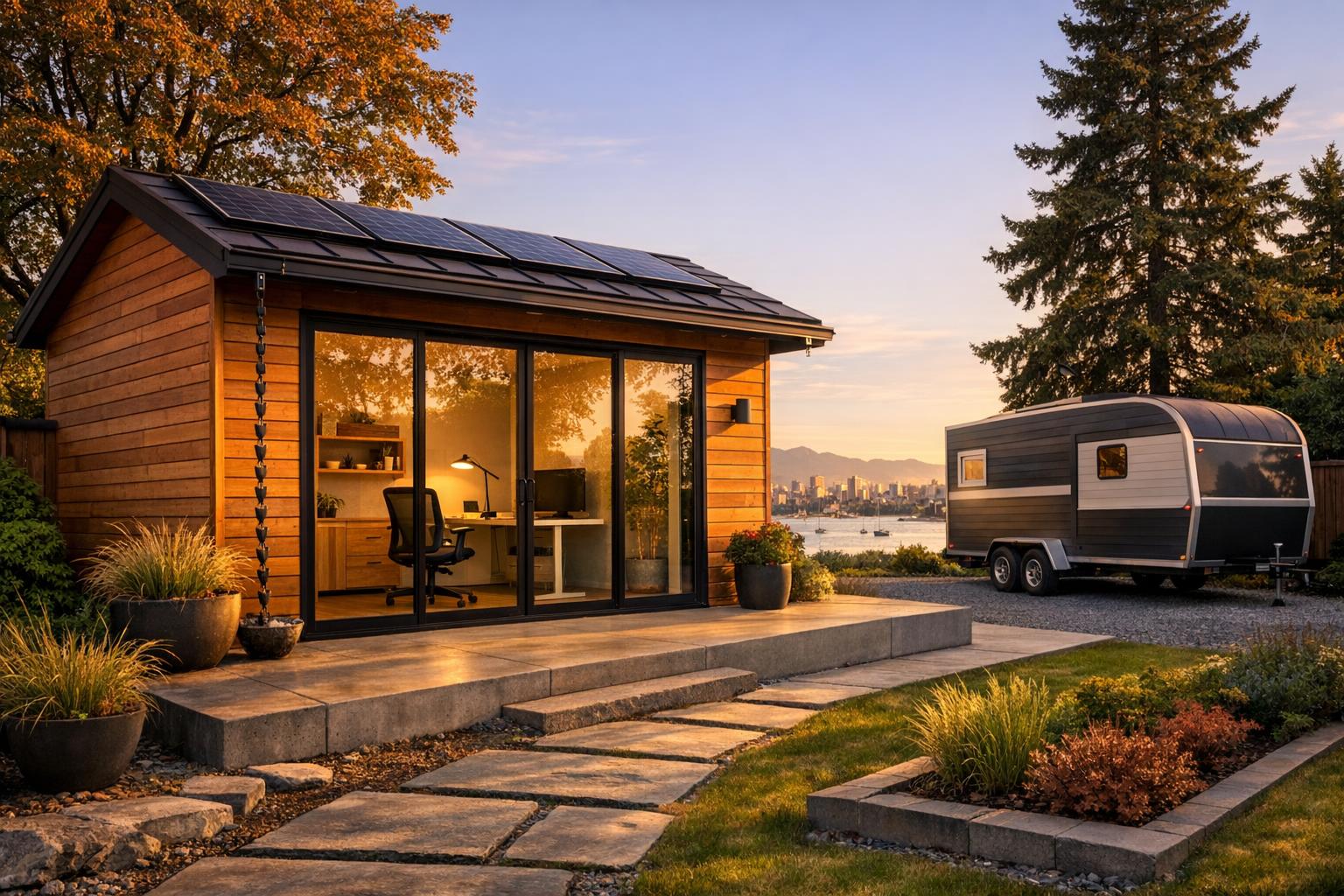
ADUs are permanent or semi-permanent secondary units on an existing property. They usually work best for stable, year-round living and professional work from home use. Learn more about ADUs as smart urban housing and the ADU home office in Canada.
Best for:
- people with access to land
- workers who need reliable utilities
- people who want easier code compliance and resale value
Typical cost: roughly $100,000 to $250,000+, depending on site work and finish. See ADU cost to build in Canada.
Tiny homes on foundation
These are small permanent dwellings built to stay put. They often offer better insulation, plumbing protection, and utility stability than more mobile options. See tiny home foundation options in Canada and guidance on a winter-proof tiny home in Canada.
Best for:
- long-term tiny home living
- cold-climate living
- people who do not plan to relocate often
Typical cost: often overlaps with custom tiny home pricing and can rise with land and servicing.
Tiny houses on wheels (THOWs)
A THOW is a towable compact home. It gives more flexibility than a fixed tiny house, but it also brings more legal and insurance questions. See advice on moving a tiny home in Canada and tiny home financing in Canada in 2025.
Best for:
- Canada digital nomads who want a home-like interior
- people moving seasonally
- workers who want mobility without living in a van
Typical cost: around $60,000 to $120,000.
Converted vans and RVs
These offer the most mobility and the least space. They can work well for solo professionals with light equipment, but they are harder for full-day video calls, long desk sessions, or winter comfort.
Best for:
- short-term travel
- solo remote work
- people who value movement over square footage
Typical cost: around $40,000 to $100,000 depending on conversion quality.
Manufactured or modular units
These are factory-built units delivered in sections or as complete structures. They can offer faster timelines, more predictable code compliance, and sometimes simpler financing than fully custom builds. Compare prefab house modern housing with a prefab passive house ADU in Canada.
Best for:
- buyers who want speed and standardization
- stable sites with utility access
- people comparing prefab options
Typical cost: roughly $90,000 to $200,000.
How to choose the right one
- How much desk and storage space do you need?
- Do you need privacy for calls?
- Can the unit handle Canadian winters?
- Are hookups available, or will you be off-grid?
- Can you finance it?
- Will it keep value?
- Can it legally stay on site year-round?
For remote work, a dedicated workspace, privacy, and enough power matter more than fancy finishes. In Canada, winter upgrades are also essential. Good insulation, condensation control, underfloor protection, and dependable heating are not extras. They are basic requirements.
Before buying, try renting a similar setup and ask builders about CSA standards, code compliance, towing weight, freeze protection, and moisture control. Helpful references include guides to Canadian snow load requirements and cold climate tiny home construction.
Designing a productive work from home setup in a tiny home
A compact office has one job: help you work well without taking over the whole home. That means it must support posture, cut noise, provide enough power and light, and create some separation between work mode and home mode. See ideas for an ADU home office in Canada and tiny home privacy strategies.
In a small space, smart layout matters more than size. Useful design ideas include:
- a folding or Murphy-style desk
- a wall-mounted monitor arm
- shelves and pegboards for vertical storage
- under-bench drawers
- acoustic curtains or rugs to soften sound
- felt wall panels and door seals to reduce echo
- a desk facing a window for natural light
- a desk under a loft if headroom is comfortable
Ergonomics simply means making your body comfortable while you work. Keep the top of the screen at or just below eye level. Keep elbows near 90 degrees. Keep feet flat on the floor or on a footrest. Place the keyboard so your shoulders stay relaxed. A good reference point is accessible design for tiny homes.
A good compact equipment list includes:
- chair or stool with back support
- mounted or portable monitor
- docking station
- webcam and small light
- noise-cancelling headset
- surge protector
- cable management
- backup battery or UPS for short outages
For mobile housing, gear must be secured for travel. Desks should lock or fold down safely. Ventilation matters too, because computers and chargers create heat in a small insulated room. Lighting also matters more than most people expect, and this guide to tiny home light design can help.
Work from home in a tiny space works best when every item has a place and one area stays reserved for professional tasks. That consistency helps concentration. It also supports satisfaction, which matters because teleworkers often do better when their home setup is calm and intentional.
In practice, the best tiny office is usually not the fanciest one. It is the one that feels quiet, dependable, and easy to reset at the end of the day.
Internet connectivity for tiny home living and digital nomads
For remote work, internet quality is not just about fast downloads. You also need good upload speed for video calls, low latency for live conversations, stable service through the day, and redundancy so work does not stop when one connection fails. The basics are covered in guides to internet for tiny homes in Canada and universal Wi-Fi for tiny homes in Canada.
Here are the basics in plain language:
- Bandwidth: how much data can move at once
- Latency: the delay between sending and receiving data
- Redundancy: a backup connection if the main one fails
For many people, a practical target is at least 50–100 Mbps where possible, with latency low enough for stable Zoom or Teams calls. If your work includes large uploads, design files, software builds, or frequent meetings, more headroom is helpful.
Best internet by housing type
ADUs and fixed homes
Fibre or cable broadband is usually the best primary option. Examples in Canada include Bell Fibe, Rogers, and Telus, depending on region. See best internet for tiny homes in Canada.
Rural fixed sites
If fibre is not available, fixed wireless may be the next best choice. Xplore remains a common example in rural areas. Satellite can also fill gaps. More on this is covered in the tiny home utilities guide for Canada.
Mobile housing
THOWs, vans, and RVs often rely on 5G hotspots, eSIM plans, and satellite systems. Starlink is often mentioned because it can work in rural Canadian locations where wired service is weak or unavailable. See portable homes for Canadian nomads and utility hookup options for tiny homes in Canada.
Hybrid setup
The safest setup for mission-critical work is often one main connection plus one cellular or satellite backup.
Useful best practices:
- test coverage maps before choosing a route or property
- ask neighbours about actual speeds, not just advertised ones
- watch hotspot data caps and overage fees
- use router settings or QoS to prioritize meetings
- add external antennas or boosters where legal and useful
- keep the network simple in small spaces
Canada digital nomads should pay close attention to regional gaps. Coverage quality varies widely by province and by rural corridor. Winter weather can also affect satellite performance if snow builds up on hardware.
In 2026, improving hotspot hardware, stronger mobile plans, and better remote connectivity tools make mobile housing more workable than it used to be. But the rule still stands: test the exact site.
A beautiful location is not enough if your upload speed collapses during meetings.
Utilities, energy and off-grid strategies for year-round living
Grid-tied means your home is connected to utility or municipal services, usually for electricity and often for water and sewer. Off-grid means the home produces and stores its own power and may also manage water and waste on site. See tiny home utilities in Canada and off-grid living in Canadian tiny homes.
For remote work, reliable power matters almost as much as reliable internet. A laptop user with one screen has lower energy needs than someone running multiple monitors, lights, routers, heating equipment, and office gear all day. Planning helps, especially with tiny home energy storage in Canada.
Key systems to think about:
- Power: solar panels, batteries, inverter, and generator backup
- Heating: heat pumps, electric heat, and propane backup
- Water: utility hookups or tanks, filters, and freeze protection
- Wastewater: sewer, septic, composting toilet, or other approved systems
For year-round tiny home living in Canada, winter-proofing is essential:
- strong insulation
- thermal breaks
- moisture control
- protected plumbing lines
- dependable sub-zero heating
Some off-grid setups use roughly 5–10kW solar arrays, around 20kWh of battery storage, and a generator backup. That level is not needed for everyone, but it shows how serious year-round off-grid living can be.
Heat pumps and strong insulation are especially important in Canadian climates. Composting toilets and tanked water systems are also common in mobile housing and off-grid builds, though local law still decides what is allowed. Related resources include solar-powered ADUs in Canada, a guide to the composting toilet for a tiny home in Canada, and planning for EV charging for tiny homes in Canada.
Cost, financing and insurance in 2026
The purchase price is only the start. Real ownership cost includes delivery, site prep, permits, utility hookups, towing gear, winterization, solar or electrical systems, furnishings, repairs, and insurance. Start with the hidden costs of ADU construction in Canada and the ADU financing guide for Canada.
Broad 2026 ranges vary by region, but many buyers are seeing numbers like these:
- ADUs: about $120,000 to $280,000+
- Foundation tiny homes: about $90,000 to $160,000+
- THOWs and other mobile housing: about $50,000 to $130,000+
- Vans and RV conversions: wide range depending on vehicle and finish
- Modular units: often sit between prefab and ADU pricing depending on delivery and site work
Financing also depends on the housing type:
- Construction or renovation loans: common for ADUs and permanent builds
- Home equity or refinance: useful if you already own property
- Manufacturer financing: sometimes available for prefab or modular units
- RV loans: sometimes available for THOWs or qualifying mobile units
- Personal loans: possible for smaller projects, though rates may be higher
Insurance deserves equal attention. An ADU may need a rider or separate dwelling endorsement under a homeowners policy. A THOW may need RV or specialty tiny house insurance. Remote workers should also check contents coverage for laptops, monitors, and other work gear, plus liability coverage. For more, review ADU insurance in Canada and tiny home insurance for remote living in Canada.
A key warning: insurance and financing often depend on whether the unit is certified, road legal, and permanently sited. CMHC-related lending support for some secondary suites and ADU-style projects may help in some cases, while RV-style lending may fit some towable units better. Broader context can be found in this explainer video.
Living logistics for Canada digital nomads and remote workers
A good tiny home or mobile setup is only part of the picture. Long-term success also depends on the admin side of life. See emerging ideas around tiny home co-ownership in 2026 and land-lease communities in Canada.
Canada digital nomads should build systems for:
- Mail and address management: services like Canada Post FlexDelivery can help, or you may use a stable family or business address where appropriate.
- Tax residency: where you ordinarily live, how long you stay in each place, and your ties to a province can affect tax obligations.
- Healthcare: provincial coverage usually depends on residence rules. Travellers and visitors may need travel insurance.
- Employment compliance: some employers only allow remote work in certain provinces or countries because of payroll, tax, privacy, or insurance rules.
- Coworking backup: useful when noise, bad weather, or weak internet makes your home setup less practical. See why coworking and return-to-office trends in Canada still matter.
- Community and mental health: solo, small-space living can become isolating without routine and connection, which is why tiny homes and mental health in Canada is an important topic.
Practical habits help:
- keep digital and paper copies of permits, insurance, registration, and service contracts
- schedule regular coworking or café days
- build a weekly rhythm for work, chores, exercise, and downtime
- track your locations and stays
- keep an emergency contact and service list
This part matters whether you are a Canadian resident moving across provinces or a visitor spending time in different regions. Coworking spaces and nomad communities are still useful support systems in 2026 because they offer structure, backup internet, and social contact. A related perspective is available through remote tech talent in small towns.
Case studies and profiles
1. Year-round ADU remote worker
A worker in Ontario adds an ADU on family property after checking zoning, servicing rules, and permit requirements. They install fibre as the main connection and keep satellite backup for outages. Inside, the unit has a real desk, door, monitor arm, and sound control, making work from home feel separate from home life. This kind of ADU suits full-time remote work because it offers stability, legal clarity, and proper utilities. For regulatory context, see Canadian ADU regulations.
2. Seasonal mobile housing nomad
A Canada digital nomad uses a THOW to move between BC in summer and the Maritimes in autumn. Their setup includes 5G for everyday use, Starlink for rural stops, roof solar, and route planning based on coverage maps and legal parking options. For them, mobility matters more than extra space. Mobile housing supports remote work because the home moves with the season instead of locking them to one market. See moving a tiny home between provinces.
3. Tiny house office conversion
A hybrid worker places a tiny house on wheels in a backyard and uses it only as a dedicated office. This solves noise, focus, and boundary problems without requiring full-time tiny home living. It shows that a small unit can support work from home even if it is not the main residence. Related reading: building an office shed vs an ADU in Ontario.
Practical checklist and decision flowchart
Before you buy, build, finance, or tow anything, work through this path.
Decision flow
- Do you need full mobility or one stable location?
- Will you live there year-round in a cold climate?
- Do you need full legal residential status or just seasonal use?
- Is your job bandwidth-heavy?
- Do you already have land or access to a host property?
- What is your true all-in budget?
Quick matching guide
- Need stability + land access: ADU
- Need permanence + small footprint: foundation tiny home
- Need flexibility + home feel: THOW
- Need maximum mobility: van or RV
- Need faster build + easier compliance: modular unit
Top 10 action items
- Verify zoning and legal use.
- Check utility access or off-grid feasibility.
- Test internet options at the exact site.
- Calculate the true all-in cost.
- Confirm financing and insurance eligibility.
- Decide whether a dedicated work from home zone fits.
- Plan for heating and winterization.
- Create a backup connectivity plan.
- Confirm employer location rules.
- Trial tiny home living or mobile housing through a rental or short stay first.
Red flags
- buying before checking municipal rules
- assuming a THOW can be lived in anywhere year-round
- relying on one internet source
- underestimating winter costs
- ignoring insurance classification
- choosing a layout with no private work area
Frequently Asked Questions
Can I reliably do remote work from a tiny home?
Yes, if tiny home living includes dependable power, an ergonomic setup, and both primary and backup internet. See tiny home remote work in Canada and broader remote work trends in 2026.
What internet is best for a tiny home in rural Canada?
Fibre is usually best if available. If not, Starlink or fixed wireless are often the strongest options, with cellular backup for extra reliability. This is especially useful for Canada digital nomads and other remote work users in rural areas. See internet for tiny homes in Canada.
Do ADUs increase property value?
Often, yes. A legal ADU can add flexible living space or rental potential, but the value impact depends on location, build quality, and compliance. Remote work demand can also make this flexibility more attractive. See secondary unit benefits in Canada.
Are tiny homes legal everywhere in Canada?
No. Tiny home living is not legal in the same way everywhere. Provincial and municipal rules vary, and mobile housing like THOWs is often treated differently from permanent homes. Review tiny home legal requirements in Canada and this video explainer.
What power setup is best for work from home in mobile housing?
A reliable mix of inverter, battery storage, solar, and backup generation is usually best. The right size depends on how much equipment you run each day. See tiny home energy storage in Canada.
What should Canada digital nomads know about taxes and residency?
Canada digital nomads should track where they stay, understand residency ties, and check how healthcare and tax rules apply to their situation. Professional advice is often wise. See tiny home co-ownership in 2026 and this residency-related explainer.
How do I winter-proof a tiny home for remote work?
Focus on insulation, moisture control, protected plumbing, and dependable heat. In Canada, winter-proofing is essential for both comfort and reliable remote work. See winter-proof tiny homes in Canada.
Can I finance a tiny house on wheels?
Sometimes. Some buyers use RV loans or specialty lenders, depending on the unit’s classification, certification, and road-legal status. See tiny home financing in Canada.
Final thoughts and next steps
In 2026, remote work still plays a major role in housing decisions. Tiny home living, ADUs, and mobile housing each solve different problems. Some people need a stable work from home base with full utilities and clear legal status. Others want mobility, lower costs, and a lifestyle that fits Canada digital nomads.
The best choice depends on your need for movement, your climate, your local rules, your internet options, and your budget. What matters most is not choosing the trendiest option. It is choosing the one that lets you live legally, work reliably, and handle Canadian conditions year-round.
Remote work continues to shape how people compare housing in 2026, even as the balance between home, hybrid, and office work keeps changing, as seen in reporting on return-to-office in Canada and remote work trends in 2026.
Next step: before you commit to any build or purchase, verify the legal status, test the internet, and model the full cost. That simple sequence will save far more trouble than chasing the perfect floor plan first.
Leave a Reply