
Estimated reading time: 13 minutes
Key Takeaways
- School to tiny home community conversion gives Canadian towns, municipalities, and school boards a practical way to turn surplus school sites into affordable housing.
- Closed schools are often located on serviced land in established neighbourhoods, which can speed up delivery compared with building on raw land.
- There are several viable models, including interior school conversion, tiny home communities, ADU redevelopment, and hybrid mixed-use communities.
- Success depends on early work around feasibility, zoning, code compliance, financing, partnerships, and community engagement.
- In 2026, this approach matters because housing supply, affordability, and land availability remain under pressure across Canada.
Table of contents
- School to Tiny Home Community Conversion in Canada 2026
- Key Takeaways
- Why decommissioned schools are strong candidates for housing reuse
- The housing opportunity in Canada in 2026
- Feasibility assessment — the first questions towns and school boards should answer
- Choosing the right reuse model
- Legal, regulatory, and policy considerations in Canada
- Financing the project and building a workable business case
- Design and technical considerations for successful tiny home communities and ADU redevelopment
- Community engagement and public acceptance
- Governance, ownership, and long-term management
- Step-by-step implementation roadmap for 2026 projects
- Risks, obstacles, and how to reduce them
- Metrics for success and how to monitor outcomes
- Canada-focused case studies and precedents
- Practical playbook — policies, templates, and tools towns and school boards should prepare
- Frequently Asked Questions
- Conclusion — next steps for towns and school boards in 2026
School to Tiny Home Community Conversion in Canada 2026
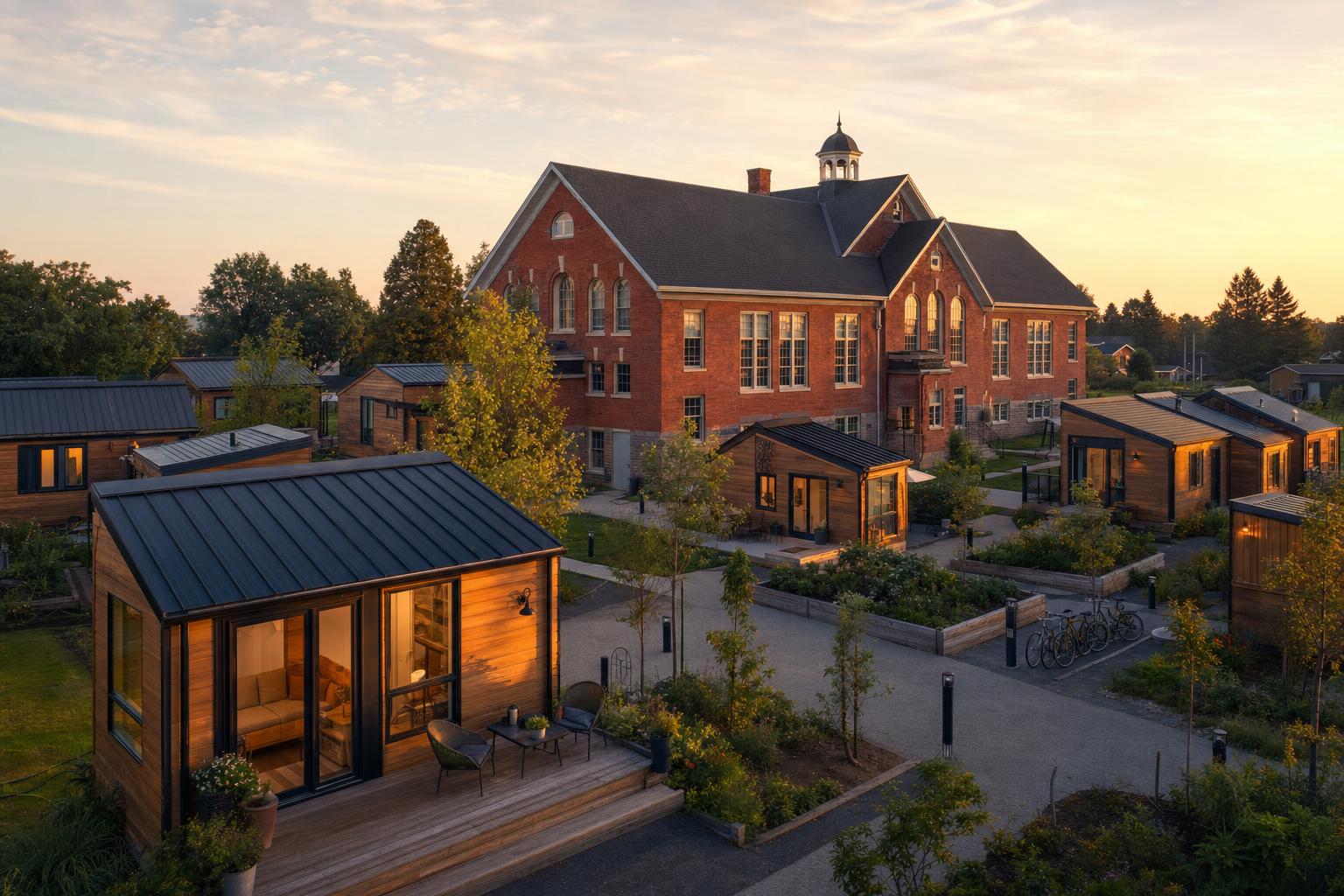
School to tiny home community conversion means turning a closed, surplus, or decommissioned school building and school site into compact homes, clustered small dwellings, accessory-style housing, or a mixed-use residential community.
This guide explains how towns, municipalities, and school boards in Canada can use school conversion to create tiny home communities and ADU redevelopment projects that expand affordable housing and bring vacant public land back into use in 2026. It is written for municipal planners, school boards, councillors, housing nonprofits, developers, and community groups that need a practical path through feasibility, approvals, financing, design, partnerships, risks, and delivery.
A school to tiny home community conversion is not just an idea. In many parts of Canada, closed schools sit on serviced land in established neighbourhoods, close to roads, utilities, parks, transit, and daily services. That makes them strong candidates for affordable housing reuse. In practice, there are two main paths: convert the school building itself into small homes or shared housing, or redevelop some or all of the site into tiny home communities or ADU redevelopment.
With home prices high, rents under pressure, and more public focus on housing supply, reusing school sites can help communities add homes faster than starting from raw land. Federal housing efforts and supply acceleration programs have also increased pressure to find practical sites that can move quickly, including through programs and research associated with CMHC.
Why decommissioned schools are strong candidates for housing reuse
School conversion works because former schools are often underused public assets in places where people already want to live. Many have water, sewer, power, road access, sidewalks, and neighbourhood recognition in place. That lowers some of the friction that comes with starting a project on untouched land.
Public asset reuse can lower cost
Land is often one of the biggest barriers to affordable housing in Canada. When a school board or public owner already controls the land, the project may avoid full market land acquisition costs. That can improve feasibility and help funds go into homes, not just land purchase.
Community continuity matters
A vacant school can become a drag on the block. It may create safety concerns, visual decline, and pressure for speculative redevelopment. Keeping the site active through school conversion helps preserve it as a neighbourhood anchor.
Even when the use changes, the social role of the place can continue. That is especially true in projects shaped around urban renewal ADU communities and ADU retrofits for affordable housing.
One site can hold many housing types
Many school sites are 2 to 5 acres or more. That is enough space for a mix of homes, green space, shared pathways, play areas, childcare, or community rooms. Tiny home communities can fit on part of a site, while another part may support family units, supportive housing, or retained public uses.
This flexibility aligns well with multi-unit tiny home developments and co-living ADU developments in Canada.
Revitalization can follow new housing
More residents can help nearby shops, transit, parks, and local services. A well-planned project can create a vibrant place, not just a cluster of homes.
That means landscaping, shared open space, safe walking routes, gathering areas, and sometimes retained civic uses such as daycare or a meeting room. These ideas are reflected in community services for tiny homes and ADUs and shared ADU backyards and green space.
Reuse can support climate goals
Adaptive reuse may reduce embodied carbon when compared with full demolition and rebuild. Even where some demolition is needed, salvaging materials and reusing foundations, structure, or site servicing can support land efficiency and anti-sprawl goals.
Strategies such as zero-waste design for ADUs and tiny homes and upcycling Canadian ADUs show how reuse can be practical as well as environmentally responsible.
Different contexts, different forms
In urban areas, a former school may be best for interior conversion or compact infill. In suburban areas, a hybrid of retained building and new small homes may work. In rural Canada, a schoolyard may be ideal for modular tiny home communities where land is available but housing stock is limited.
That makes this strategy relevant to rural ADUs and small-town revitalization as well as tiny homes in Northern Canada.
Demographic change also matters. In some provinces, more than 500 school closures are projected by 2030 because of enrolment shifts. That creates a growing pool of sites with redevelopment potential. For municipalities trying to meet housing targets under Official Plans or Official Community Plans, reuse of school lands can support infill goals without pushing growth farther outward.
As a planning principle: preserving some public function on the site can also reduce opposition compared with a full private redevelopment that cuts off community access. National housing context from CMHC continues to reinforce the need for supply-oriented reuse strategies.
The housing opportunity in Canada in 2026
The housing backdrop in Canada in 2026 is clear: rents remain high in many markets, home ownership is out of reach for many households, and vacancy is tight in a large number of communities. Governments want more housing supply, and they want it faster.
That is why school to tiny home community conversion is relevant now. It can:
- unlock infill land inside existing neighbourhoods
- deliver homes faster than large master-planned growth areas
- support lower-cost housing forms
- combine adaptive reuse with modular construction
In this article, affordable housing means housing priced below local market levels. In some projects, deeper affordability may be possible through public funding, rent supplements, or supportive housing programs. In others, the goal may be modestly below-market rental or ownership options that still improve access.
The local need will vary. A former school site may serve:
- seniors who want to downsize
- young workers priced out of nearby rental
- small families needing stable homes
- essential workers
- people exiting homelessness with support in place
The key point is this: not every closed school should become the same thing. But many can become housing, and in 2026 that matters because speed, cost, and land availability are all under pressure at once.
Broader housing supply discussions led by CMHC and practical affordable housing solutions both point in the same direction: public land reuse is becoming harder to ignore.
Feasibility assessment — the first questions towns and school boards should answer
Every school conversion project should start with a desktop feasibility study before public promises are made. A basic early review often costs about $20,000 to $50,000 and takes 1 to 3 months, depending on the site.
The goal is a go / no-go screen. That means a quick early-stage check of whether the site is legally, technically, financially, and politically viable enough to justify full design work. Many projects fail because teams skip servicing or code issues too early.
Core feasibility checklist
Assess these items first:
- Site size and shape: Can the lot fit roads, setbacks, snow storage, amenity space, utility routes, and emergency access?
- Existing utilities: Is there enough water, wastewater, stormwater, hydro, gas, and broadband capacity?
- Soils and grading: Are geotechnical review, drainage work, slope stabilization, or frost-depth considerations needed?
- Environmental condition: Does the site need a Phase 1 ESA, and if needed, a Phase 2 contamination review?
- Building condition: Is the structure sound? What is the state of the roof, envelope, mechanical systems, and life-safety systems?
- Heritage status: Is the school listed or designated, and what parts must be retained?
- Local housing demand: Is the stronger need for tiny home communities, family units, supportive housing, or mixed-income housing?
- Financial reality: Does the project still work after remediation, servicing upgrades, and operating costs are counted?
How to test demand
Use:
- CMHC Rental Market Reports
- municipal housing needs assessments
- local waitlists
- nonprofit housing provider input
- service agency data
Tiny home communities may fit single adults, seniors, and fast-delivery pilot models. ADU redevelopment may better support family households, gentle density, or a mixed low-rise pattern if local bylaws allow it. Helpful background can be found in tiny home community startups in Canada and an ADU glossary of Canadian terms.
Canadian climate matters
Winterized construction standards are essential in Canada. Small homes and retrofits need strong insulation, airtight construction, heat recovery ventilation, and moisture control. Compact homes are less forgiving when envelope design is weak, so cold-climate performance must be part of the first review, not an afterthought.
This is consistent with technical guidance from CMHC, Codes Canada, and practical resources on winter-proof tiny homes in Canada and cold-climate tiny home construction.
Choosing the right reuse model
There is no single model for school to tiny home community conversion. The right strategy depends on the building condition, site size, local zoning, housing need, and available partners. A typology is simply the physical form of housing and how the site is organized.
Model 1: Interior building conversion
This means converting classrooms, offices, or wings into compact units, co-living suites, or supportive housing rooms. It works best when the school is structurally sound and the corridor layout can support housing conversion.
Typical features include:
- private or semi-private suites
- shared kitchens or in-unit kitchenettes
- laundry rooms
- community rooms
- counselling or support rooms
- accessible entrances and lifts
This model can preserve heritage character and reduce demolition, especially when informed by retrofitting heritage homes and ADUs and an accessible tiny home guide for Canada.
Model 2: Site subdivision for tiny home communities
This model keeps some, little, or none of the original structure and creates clusters of detached or semi-detached small homes on the schoolyard. It needs clear planning for:
- fire separation
- pathways
- utility corridors
- waste and recycling areas
- shared open space
- a common building if needed
It can work well in phases, with one part of the site built first. Operational ideas can be drawn from tiny home community startups and communal kitchens for tiny homes in Canada.
Model 3: ADU redevelopment on all or part of the site
ADU redevelopment means creating compact secondary-style dwellings such as garden suites, laneway-style homes, coach houses, or other small detached units where bylaws allow them or where special permissions are approved. On former school sites, the legal category may differ from a backyard ADU, but the design logic is similar: low-rise, flexible, gentle density.
This model fits municipalities that support infill and neighbourhood-scale housing growth. See accessory dwelling units guide and urban infill tiny homes and ADUs.
Model 4: Hybrid mixed-use community
Part of the school stays in civic or service use, while housing is added elsewhere on the site or in another wing. Possible retained uses include:
- childcare
- health services
- maker space
- food hub
- community hall
This often improves economics and public support, particularly when shaped as ADU community hubs for nonprofits and social enterprises or linked with community gardens for tiny homes in Canada.
Model 5: Temporary-to-permanent transition
A site may begin with interim modular or tiny homes while longer-term financing and approvals are secured for a larger buildout. This can bring homes online sooner.
That approach is relevant to temporary ADUs for emergency housing and disaster recovery ADU planning.
The strongest projects often mix typologies rather than relying on a single building form or resident group.
For example, a retained school wing might hold supportive units, while the yard holds small detached homes and a family-oriented low-rise edge. A typology mix reduces risk because the project does not rely on just one resident group or one funding stream. This flexibility aligns with broad housing guidance from CMHC and practical ideas around multi-purpose ADU spaces in Canada.
Legal, regulatory, and policy considerations in Canada
This is often the hardest part. Legal disposal of school land and municipal approvals are common bottlenecks.
In plain language, zoning controls what can be built and where. Building codes control how safely it must be built.
School board surplus property process
In many cases, a school board must first declare a property surplus before it can be sold, leased long term, or transferred for redevelopment. The exact process varies by province. It may include circulation to municipalities or other public bodies before wider disposal.
Provincial examples
In Ontario, the Education Act framework shapes surplus school property processes. In British Columbia, the School Act framework applies. Alberta and Quebec have different governance and disposal structures, so local legal review is needed.
Municipal planning approvals
A project may require some or all of the following:
- Official Plan or Official Community Plan conformity
- rezoning or a site-specific zoning amendment
- subdivision approval
- development permit or site plan approval
- building permit
- occupancy approval
Common zoning barriers
- minimum lot size
- minimum floor area
- parking minimums
- height limits
- setback controls
- unclear use definitions for tiny homes
Code and life safety
Tiny home communities and building conversions must address:
- accessibility
- fire separation
- egress
- alarms and sprinklers
- emergency vehicle access
- winterization and thermal performance
Heritage and environmental reviews
Heritage status does not always block redevelopment. It often shapes what must be kept, restored, or adapted. Environmental due diligence is also critical, especially where older buildings or former site uses create contamination risk.
Wheeled, modular, or permanent?
The legal treatment may differ depending on whether the homes are:
- wheeled tiny homes
- modular factory-built homes
- permanent foundation homes
ADU redevelopment may move more easily in municipalities that already support garden suites, laneway housing, or secondary units. But there is no single nationwide rule in Canada. Local bylaws must always be checked.
Useful starting points include the Ontario Ministry of Education, Ontario laws, BC Laws, Codes Canada, the Impact Assessment Agency of Canada, a Canadian ADU regulations guide, and an ADU legal clinic guide for Canada 2026.
Financing the project and building a workable business case
Many possible projects fail not because the site cannot be built, but because the capital stack is too weak. A capital stack is the mix of money sources used to fund development.
A pro forma is the project’s financial model. It shows expected costs, revenues, and returns or subsidy needs.
Land strategy options
Possible land approaches include:
- discounted sale
- long-term ground lease
- land contribution by a school board or municipality
- land banking for future phases
A ground lease is a long-term lease of land where another group develops and runs the housing while the public owner keeps title to the land.
Capital sources
- CMHC and federal housing programs
- provincial affordable housing programs
- municipal incentives such as fee waivers, tax relief, grants, or faster approvals
- philanthropy or social finance
- private debt and equity in mixed-income models
Operating support
- rent supplements
- support service funding
- replacement reserves
- property management funding
Partnership structures
- nonprofit developer
- housing co-op
- public-private partnership
- community land trust
Key pro forma items
Budget for:
- land value or lease cost
- demolition and remediation
- servicing upgrades
- soft costs
- retrofit or modular construction
- financing costs
- operating costs
- vacancy assumptions
- replacement reserves
Indicative ranges vary by project, but early planning often uses broad benchmarks such as:
- retrofit: about $150 to $250 per square foot
- wider redevelopment: about $200 to $400 per square foot
- modular tiny homes: around $120,000 per unit in some cases
Affordable housing usually needs stacked funding, not one grant. Revenue may come from below-market rental, mixed-income rental, rent-to-own, or long-term lease income. If permitted, mixed-use features such as childcare or small neighbourhood-serving commercial space can also help support the project over time.
Funding research and program pathways can be explored through CMHC, an ADU financing guide for Canada, ADU grants and municipal incentives in Canada, and ADU financing and co-ownership in Canada.
Design and technical considerations for successful tiny home communities and ADU redevelopment
Good design is not just about appearance. It affects livability, operating cost, code compliance, and public acceptance.
Unit types and sizes
A strong mix may include:
- tiny homes around 200 to 400 sq ft
- micro-units
- compact one-bedroom units
- small family-oriented homes
- ADU-style homes around 400 to 800 sq ft
A mix of sizes improves social and financial resilience. Helpful references include the sweet spot for ADU size in Canada and tiny home design in Canada.
Retrofitting existing school buildings
School conversion may require:
- turning classrooms into suites
- adding new plumbing stacks
- creating private bathrooms and kitchens where possible
- improving windows, envelope, and insulation
- upgrading HVAC with HRVs or ERVs
- adding soundproofing
- providing barrier-free access
Site planning priorities
Tiny home communities and ADU redevelopment need clear planning for:
- internal roads
- fire access
- snow clearing and storage
- pedestrian-first routes
- lighting and safety
- bike parking
- reduced car parking where transit exists
- stormwater management
- gardens, play areas, and gathering spaces
Shared facilities
Shared spaces can make compact homes feel more livable. Useful features include:
- laundry
- parcel and mail area
- community kitchen
- event room
- office or support space
- storage
- waste and recycling space
Sustainability and operating cost
Long-term affordable housing depends on low operating costs. Strong options include:
- material salvage from the original school
- low-carbon materials
- passive solar design
- solar power
- geothermal
- district energy where feasible
Climate-responsive design matters in Canada. Cold temperatures, snow loads, freeze-thaw cycles, and moisture risks affect small homes and retrofits strongly. Compact homes can still feel comfortable when they have good storage, daylight, shared amenity space, and careful layout.
In this context, ADU redevelopment should be seen as a flexible low-rise infill strategy, not only as backyard suites. For technical grounding, review Codes Canada, CMHC, net-zero ADU sustainable communities, and eco-friendly building materials in Canada.
Community engagement and public acceptance
Projects often succeed or fail based on trust. Technical merit alone is not enough.
A practical engagement sequence
- meet internal stakeholders first
- brief municipal staff and elected officials
- engage nearby residents early, before formal applications
- include alumni, former students, service providers, and community groups
- conduct Indigenous consultation where required and appropriate
What to address early
Neighbourhood concerns often focus on:
- traffic and parking
- property values
- design quality
- maintenance
- resident profile
- tenancy management
- retained public benefits
These concerns should be addressed with evidence, transparent operations plans, and clear design information.
Better tools improve trust
Use:
- co-design workshops
- clear site plans
- renderings
- before-and-after comparisons
- plain-language fact sheets
Helpful framing
Explain that the project:
- reuses a public asset
- responds to local housing need
- makes the site safer and more active than vacancy
- can retain green space or community services
Benefit-sharing can also help, such as a public meeting room, daycare, community garden, or local hiring and training pathways. Engagement should begin before rezoning, not after most decisions are already made.
Useful references include the United Nations Declaration Act information from Justice Canada, neighbour relations for tiny homes in Canada, and tiny home community workshops in Canada.
Governance, ownership, and long-term management
Governance affects long-term affordability, maintenance quality, and accountability. It is a strategic choice, not just paperwork.
Common options
- school board sells the site
- school board keeps the land and uses a long-term ground lease
- municipality acquires the site and partners with a nonprofit
- community land trust holds the land
- co-op or nonprofit runs the housing
Main trade-offs
A sale can bring quick revenue but reduces public control. A ground lease keeps public ownership and may better protect public goals. A land trust or co-op structure can support long-term affordability.
These approaches are reflected in examples such as a tiny home co-op model, community governance for tiny homes in Canada, and ADU cohousing for affordable living in Canada.
Management needs
Every project needs clear rules for:
- tenant selection
- maintenance standards
- reserve funding
- safety and site operations
- resident governance
Tiny home communities especially need clear expectations around common areas, storage, servicing, pets, waste, and shared stewardship. That is why resources on shared ADUs and sound management strategies can be surprisingly useful at the planning stage.
Step-by-step implementation roadmap for 2026 projects
A school to tiny home community conversion should move in phases. Some phases may overlap, especially if modular units are used on one part of the site while the original building is still under review.
Phase 0: Explore the idea (0–3 months)
- identify candidate schools
- confirm asset and enrolment status
- begin internal board and municipal discussions
- complete a rapid site screen
- secure early executive and political sign-off
Phase 1: Feasibility and business case (3–9 months)
- commission technical studies
- compare tiny home communities and ADU redevelopment concepts
- test servicing capacity
- review market and affordability needs
- draft the capital stack
- choose a governance direction
Phase 2: Partnerships and approvals (6–18 months)
- issue an EOI or RFP if needed
- refine concept design
- complete community engagement
- apply for rezoning, subdivision, and site approvals
- align with provincial disposal rules
Phase 3: Detailed design and procurement (12–24 months)
- prepare construction drawings
- tender retrofit work or modular supply
- finalize funding agreements
- lock in the operating model
Phase 4: Construction and occupancy (12–36 months)
- complete servicing and remediation
- retrofit the building or install modular homes
- complete inspections
- secure occupancy approvals
- begin leasing and move-in
Modular and phased approaches can shorten delivery. Even so, projects should carry about a 20% time buffer for weather, approvals, servicing upgrades, and procurement delays in Canada. See ADU construction delay solutions in Canada and prefab passive house ADUs in Canada.
Risks, obstacles, and how to reduce them
Readers need realism here. School conversion has real barriers, but many are manageable if they are identified early and tracked throughout the project. Risk management should be a live register, updated as the work moves forward.
Political risk
- leadership changes
- new board or council priorities
Reduce it by: using formal resolutions, cross-party framing, and early alignment.
Community opposition
- density concerns
- parking fears
- concern about resident profile
Reduce it by: early engagement, pilot phases, transparent management plans, and strong design quality.
Financial risk
- grant uncertainty
- inflation
- interest rate pressure
Reduce it by: a diversified funding stack, phased construction, and contingencies.
Technical risk
- hidden building problems
- contamination
- servicing shortfalls
Reduce it by: early audits, specialist consultants, and conservative budgets.
Regulatory risk
- zoning mismatch
- approval delays
- code interpretation issues
Reduce it by: pre-application meetings, planning advice, and site-specific bylaw work if needed.
Heritage risk
- limits on demolition
- façade retention requirements
Reduce it by: adaptive reuse design, selective retention, and heritage consulting.
Additional reading includes heritage home ADU zoning rules and guidance on ADUs in heritage homes.
Metrics for success and how to monitor outcomes
Success is more than unit count. Good reporting should be built into governance agreements from the start.
Useful KPIs include:
- total units delivered
- deeply affordable units delivered
- occupancy rate
- cost per unit
- time from surplus declaration to occupancy
- GHG reduction or embodied carbon savings
- local jobs and apprenticeships
- tenant stability
- tenant satisfaction
- neighbourhood satisfaction
- use of shared community amenities
Illustrative benchmark figures might include:
- 95% occupancy
- cost under $250,000 per unit in some scenarios
- 50% GHG reduction
- 80% resident and community satisfaction
These numbers will vary by project, but they help teams move from general goals to measurable outcomes. National housing data from CMHC plus market-oriented tools like ADU investment in Canada and ADU resale and Canadian property value can support more robust evaluation.
Canada-focused case studies and precedents
These are best read as illustrative examples and precedents. They show what models are possible, but each local project still needs legal, technical, and financial validation.
Case study 1: Simcoe County DSB, Ontario
A former school site adapted into a roughly 40-unit modular or tiny home style affordable housing community would show that rural and small-town school lands can become housing assets.
The main lessons are:
- modular delivery can speed occupancy
- zoning flexibility may unlock a hard site
- public land reuse can improve affordability
Case study 2: BC Housing tiny homes pilot, Vancouver
A subdivided school property with a mix of tiny homes and ADU-style units would highlight how provincial housing agencies and local operators can work together.
The lessons are:
- mixed typologies serve different household sizes
- pilot sites can test policy changes
- lower-infrastructure approaches may open more options in some contexts
Case study 3: Edmonton tiny home village
A former schoolyard used for interim wheeled units under flexible zoning and nonprofit management would show the value of pilot models. The strongest lesson is that management quality matters as much as the units themselves.
International parallels
A school-to-co-housing retrofit in Bristol points to the value of keeping heritage identity while changing use. A phased school conversion and ADU model in Portland shows how a site can evolve over time instead of needing one final buildout on day one.
For broader precedent research, review BC Housing and Tiny House Alliance Canada.
Practical playbook — policies, templates, and tools towns and school boards should prepare
Many groups know school conversion is promising but do not know what documents they need first. A practical playbook should include:
- Surplus-school transfer or disposition policy checklist: used by boards and municipalities at the start to confirm legal steps.
- Partner RFP or EOI outline: used when seeking a nonprofit, co-op, or private partner after initial feasibility.
- Sample ground lease heads of terms: used during early deal structuring to set roles, rent, term, and performance rules.
- Community benefits agreement template: used during engagement and approvals to record public benefits.
- Due diligence checklist: used by project managers and consultants during feasibility to track studies and risks.
- Rezoning and approvals tracker: used during planning to monitor each required approval and deadline.
- Concept evaluation matrix: used in option testing to compare tiny home communities, ADU redevelopment, and mixed-use layouts.
These tools reduce process friction and help non-experts move from concept to implementation. Digital process support may also come from ADU digital permitting in Canada and an ADU legal clinic guide.
Frequently Asked Questions
Can a closed school legally be turned into housing in Canada?
Yes, often. But the site usually must first go through surplus property rules and then municipal planning approvals. The rules vary by province and municipality. Good starting points are Ontario laws and BC Laws.
Are tiny home communities legal on former school sites?
Sometimes. Legality depends on zoning definitions, servicing, and building form. In many cases, site-specific rezoning is needed. See Codes Canada and this guide to tiny home permits in Ontario.
How does ADU redevelopment fit on a former school property?
ADU redevelopment can work as a low-rise infill strategy. The homes may resemble garden suites, coach houses, or small detached units, even if the legal category is not exactly the same as a backyard ADU. More detail is available in this guide to types of ADUs in Canada.
How much does school conversion cost?
Costs vary a lot. Early benchmarks may include retrofit at about $150 to $250 per square foot, larger redevelopment at $200 to $400 per square foot, and some modular tiny homes around $120,000 per unit before shared site costs.
How long does school to tiny home community conversion take?
Often 2 to 4 years from early screening to occupancy. Modular and phased approaches may be faster.
Who pays for affordable housing on former school sites?
Usually a mix of land contribution, CMHC or federal programs, provincial funding, municipal incentives, nonprofit capital, and private financing. Useful resources include CMHC, an ADU financing guide for Canada, and information on ADU mortgages in Canada 2026.
Can heritage school buildings still be reused?
Yes. Heritage status may limit demolition or major changes, but it does not automatically block housing reuse. See retrofitting heritage homes and ADUs and ADUs in heritage homes.
What are the biggest reasons projects fail?
The most common reasons are unclear governance, weak funding, unresolved servicing issues, and community opposition that starts too late in the process.
Conclusion — next steps for towns and school boards in 2026
School to tiny home community conversion is a practical way to turn surplus public land into homes and lasting community value in Canada. The timing is strong: housing need is urgent, many school assets are underused, governments want more supply, and modular plus small-home delivery models are more established than they were a few years ago.
For towns, municipalities, and school boards, the first five actions are clear:
- identify candidate school sites
- complete a rapid feasibility screen
- confirm the disposal and planning pathway
- engage partners and the community early
- build a realistic capital stack and governance plan
School conversion will not solve every housing challenge. But for many communities, it is one of the most practical ways to create affordable housing on land that is already public, serviced, and known.
In 2026, the real opportunity is not just to close a school site chapter well, but to reopen it as housing that fits local need.
Leave a Reply