
Solar-Powered ADU Communities in Canada: Why 2026 Is the Breakout Year for Net-Positive Neighborhoods
Estimated reading time: 13 minutes
Key Takeaways
- Solar-powered ADU communities combine small homes, solar panels, battery storage, smart controls, and grid connection to create neighbourhoods that can produce more energy than they use over a year.
- In Canada, this model is gaining momentum because cities need more housing, lower emissions, and better resilience at the same time.
- Recent growth in solar and ADU activity, supported by sources like Natural Resources Canada and CMHC, is helping move these projects from niche concept to practical 2026 opportunity.
- The strongest outcomes come when housing design, energy planning, site layout, and policy are coordinated from the start.
- Homeowners, developers, and municipalities can all play a role in building net-positive energy ADU communities in existing Canadian neighbourhoods.
Table of contents
- Solar-Powered ADU Communities in Canada: Why 2026 Is the Breakout Year for Net-Positive Neighborhoods
- Key Takeaways
- Who This Is For
- Executive Summary for Municipal Planners
- Why Solar-Powered ADU Communities Matter in 2026
- 2025 Trends That Set the Stage for Solar-Powered ADU Communities
- What Net-Positive Energy Means for ADU Communities
- Solar Power Systems and Technical Options for Net-Positive ADU Communities
- Design Patterns and Site Planning for Solar-Powered ADU Communities
- Policy, Incentives, and Permitting for Canadian Neighborhoods
- Case Studies and Prototypes to Inspire Solar-Powered ADU Communities
- Financing and Business Models for ADU Communities
- Step-by-Step Implementation Roadmap for Homeowners, Developers, and Municipalities
- Risks, Barriers, and How to Solve Them
- Design Tools, Resources, and Further Reading
- Conclusion
- Frequently Asked Questions
Who This Is For
This guide is for:
- Homeowners planning an ADU or secondary suite with solar power
- Developers building low-rise infill or courtyard-style ADU communities
- Municipal planners and policymakers seeking housing plus decarbonization
What each group will get:
- Inspiration from early models and prototypes
- A clear explanation of solar power and shared energy systems
- A practical roadmap for net-positive energy ADU communities
- Canadian policy, financing, and design ideas that fit real neighbourhood conditions
Executive Summary for Municipal Planners
- In 2026, solar-powered ADU communities are becoming a scalable response to housing shortages and clean energy goals.
- These projects can become net-positive energy neighborhoods, producing more energy than they use over a year.
- The shift is being driven by 2025 trends such as lower solar and battery costs, zoning reform, and strong ADU demand.
- The best results come from combining housing, energy, and site planning early in the process.
- Canadian neighborhoods can use these models to add gentle density without waiting for large tower projects, especially through urban infill approaches.
“2025 saw ADU permits surge 40% in major Canadian cities, fueled by falling solar prices and net metering expansions. Now, in 2026, homeowners, developers, and municipalities have an immediate opportunity to cluster these into net-positive energy powerhouses.” – Canadian Renewable Energy Association Report, 2026, via the Canadian Renewable Energy Association
Why Solar-Powered ADU Communities Matter in 2026
Solar-powered ADU communities matter because they solve more than one problem at once.
Canada needs more homes. Many cities and suburbs also need gentler forms of density that fit existing streets. ADUs help because they can be added to underused land without changing the feel of a block too much. At the same time, buildings need to use less energy, and local power systems need to become cleaner and more resilient, as reflected in guidance and research from ADU infill planning resources.
ADUs on their own help with housing. Solar power on its own helps with energy bills and emissions. But when the two are planned together at a community scale, the benefits get much bigger, especially in models like solar-powered ADUs in Canada.
A cluster can:
- Add housing in places where full redevelopment is hard
- Lower energy use with efficient building design
- Generate local clean electricity
- Share batteries and controls
- Export surplus power back to the grid
- Improve resilience during peak demand or outages
This is why 2026 feels like a tipping point. Building teams are more familiar with ADUs. Municipalities are more open to missing-middle housing. Consumers are more comfortable with electrification. Solar-plus-storage economics are improving. Last year, Canadian solar capacity grew 25%, and 2025 trends also included strong ADU approvals and solar installations, supported by information from Natural Resources Canada, CMHC, and practical insights on shared solar panel strategies in Canada.
To see why this model works, it helps to first define what net-positive energy actually means at the community level.
2025 Trends That Set the Stage for Solar-Powered ADU Communities
The rise of solar-powered ADU communities did not happen by accident. Several 2025 trends helped make 2026 the year of action.
Trend 1: Falling solar equipment costs
Lower solar costs improve project feasibility for both one-off ADUs and larger clustered developments. The brief points to panel costs dropping 15% to about $1.20 per watt, which helps shorten payback and lowers the barrier for rooftop and shared-array systems, according to the Canadian Renewable Energy Association.
Trend 2: Falling battery storage costs
Battery storage helps projects use more of their own solar energy, store daytime surplus, and shift power into evening hours. The brief notes battery costs fell 20% to about $250 per kWh, making shared storage more realistic for ADU communities. Broader battery and storage context can be explored through NREL, IEA, and Canadian applications such as energy storage for small homes.
Trend 3: ADU permitting growth
Demand for secondary dwellings is no longer a niche market. The brief notes that BC issued 12,000 ADU permits, up 50% year over year, while Ontario issued 8,500 amid zoning relaxations tied to the More Homes Built Faster Act, 2022. That signals a broad shift in market demand and planning practice, also reflected in CMHC data and guides on ADU permitting in Ontario.
Trend 4: Zoning reform and pilot bylaws
More cities are testing missing-middle housing reforms. The brief notes that 15 or more cities amended bylaws for clustered ADUs, and some offered density bonuses for high-performance projects. This matters because solar-powered ADU communities need both housing permission and energy-friendly design freedom. See policy context from the Federation of Canadian Municipalities and examples of density bonuses for backyard homes.
Trend 5: Net metering and export value
Net-positive energy depends on what happens to surplus electricity. Net metering and export rules shape whether excess solar generation creates strong project value. Better export policies make larger community-scale systems more attractive, especially in frameworks like community solar for small-home developments.
What this means in practice
In 2026, these should not be seen as separate trends. Solar, batteries, ADUs, and zoning reform work best as one neighbourhood development model, particularly when projects follow solar-ready ADU design guidance.
Other market signals also matter in Canadian neighborhoods:
- 60% of Canadian homeowners say they would consider ADUs for rental income or multigenerational living, according to CMHC and supporting commentary on ADUs and housing affordability.
- Municipalities are becoming more open to clustered infill, with examples discussed in co-building and clustered tiny home developments.
- Utilities are seeing more distributed generation applications, as reflected in guidance on utility connections for Canadian ADUs.
- Residents are more familiar with heat pumps, EVs, and home electrification through resources like heat pumps for small homes and EV charging for tiny homes in Canada.
What Net-Positive Energy Means for ADU Communities
Net-zero and net-positive are related, but they are not the same.
- Net-zero energy means a building or project produces about as much energy as it uses over a year.
- Net-positive energy means it produces more energy than it uses over a year.
That extra energy can be:
- Stored in batteries
- Shared across buildings
- Used for common loads
- Exported to the grid
This article focuses on the community scale, not just one building. That is important because one ADU may not have enough roof space to carry all its own load. A cluster can do much better by balancing roof area, energy use, battery storage, and shared infrastructure, as shown in net-zero and sustainable ADU community models.
Simple metrics that matter
For non-experts, these are the key numbers to track:
- Annual electricity generation in kWh
- Annual electricity use in kWh
- Annual surplus exported or shared
- Carbon reduction compared with standard construction
- Return on investment and payback period
The brief gives a useful model: a cluster of 10 ADUs using about 40 kWh per day each could produce more than 150,000 kWh per year while consuming about 130,000 kWh, leaving about 20,000 kWh for export or sharing. A common target annual surplus is 2,000 to 5,000 kWh per ADU, depending on location and design. Tools and references from RETScreen and Natural Resources Canada are especially useful here.
Shared systems also improve economics and carbon performance. Shared batteries cut duplication. Mixed loads reduce sharp peaks. Shared canopies create more solar area. Bigger systems can lower cost per unit. High-performance envelopes, such as R-40 walls and good building orientation, also improve winter performance in Canadian climates. Typical annual solar yield in Canada is often around 1,200 to 1,600 kWh per kW installed, depending on site conditions, based on guidance from NRCan home energy efficiency resources, RETScreen modelling tools, and design principles used in Passive House ADUs in Canada.
Net-positive does not mean off-grid. Many projects stay connected to the grid and use net metering or export tariffs, as discussed in guides to tiny home utilities in Canada and solar smart grid ADU systems.
| Metric | Single ADU | 10-unit cluster |
|---|---|---|
| Typical PV flexibility | Limited by one roof | Shared across many roofs and canopies |
| Annual energy balancing | Harder | Easier |
| Battery approach | Small dedicated battery | Shared battery bank |
| Cost per unit | Often higher | Often lower |
| Surplus potential | Modest | Stronger |
| Resilience | One home | Whole cluster support potential |
Solar Power Systems and Technical Options for Net-Positive ADU Communities
Good solar-powered ADU communities start with simple technical choices that work together.
4.1 Rooftop PV on individual ADUs
Rooftop PV means solar panels mounted on the roof. For an ADU of about 800 square feet, a common rule of thumb is 5 to 8 kW of solar where roof shape allows.
In plain terms:
- A 6 kW system might use about 15 panels at 400W each
- An 8 kW system might use about 20 panels at 400W each
Actual sizing depends on:
- Roof area
- Roof pitch
- Direction the roof faces
- Shade from trees or nearby buildings
- Snow loads
- Local sun levels
In Vancouver-like conditions, a 5 to 8 kW roof-mounted system can produce roughly 7,000 to 12,000 kWh per year, based on modeling through RETScreen and examples such as how much solar an ADU may need.
4.2 Shared arrays and canopies
Not every ADU gets a perfect roof. That is why many ADU communities use shared arrays on:
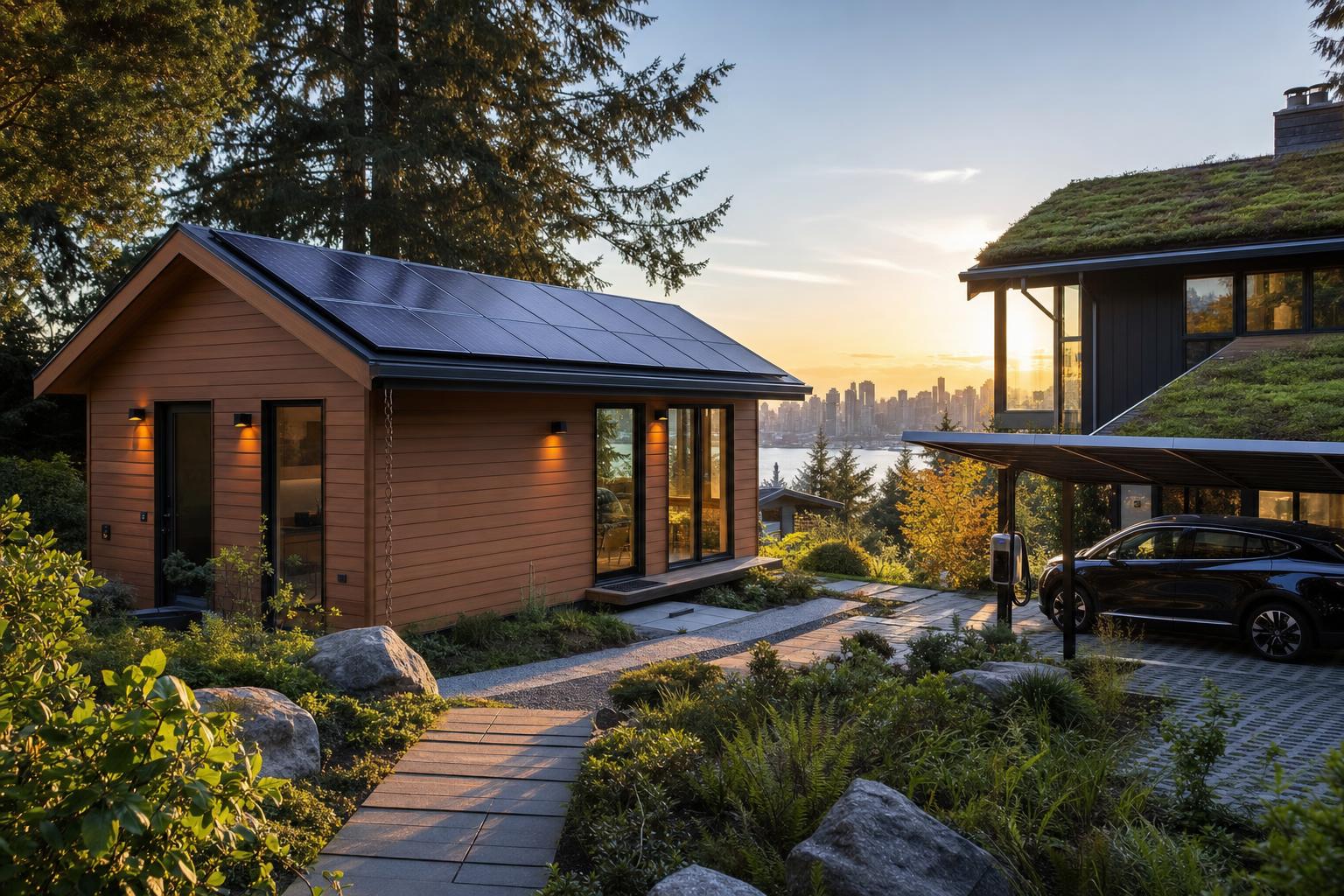
- Parking canopies
- Common buildings
- Ground-mount racks
- Bike storage roofs
Shared parking canopies can often deliver about 1 to 2 kW per parking space. They work especially well in courtyard layouts, laneway developments, and larger suburban sites. Shared infrastructure often improves both economics and output, as shown by Natural Resources Canada and applied examples of solar panel sharing in Canada.
4.3 Battery storage
A battery stores solar energy made during the day for use later.
It helps with:
- Evening electricity use
- Backup power
- Lower peak demand
- Better timing for exports
A practical rule of thumb is:
- 10 to 20 kWh per ADU
- Or about 100 kWh shared for a 10-unit cluster
4.4 Smart inverters, controls, and demand management
A smart inverter is the device that turns solar electricity into usable power for the building and coordinates with the grid.
Smart controls help shift loads into sunny hours. This is called load shifting.
Examples:
- Charging EVs at midday
- Heating hot water when solar output is high
- Running certain appliances during solar-rich hours
This matters because better timing can improve self-use and support net-positive energy performance. In some time-of-use scenarios, this can save about $500 per year per unit, based on electricity rate structures from the Ontario Energy Board and strategies like solar water heating for tiny homes.
4.5 Microgrids and peer-to-peer energy sharing
A microgrid is a local energy network that links multiple buildings, solar systems, and batteries.
This is still an emerging option in many Canadian neighborhoods because rules vary. But it is promising for clustered ADU communities where several units can benefit from shared generation and storage, particularly through models like smart-grid-ready ADU systems.
4.6 EV integration
EV charging adds electricity demand, but it can also help absorb daytime solar output. Over time, vehicle-to-home and vehicle-to-building systems may also support backup power and resilience, especially where projects plan for EV charging in small-home communities.
4.7 Efficiency first
A net-positive neighbourhood is not built by adding oversized solar to wasteful buildings.
Efficiency lowers the size and cost of the energy system. Priorities include:
- Strong insulation
- Tight air sealing
- Heat pumps
- LED lighting
- Smart thermostats
- Efficient hot water systems
Heat pumps can deliver 200% or more coefficient of performance in suitable conditions, which means they provide more heat energy than the electricity they consume. See NRCan air-source heat pump guidance and practical design discussion in eco-friendly ADU heating in Canada.
Rules of thumb
- PV sizing: 5 to 8 kW per 800 sq ft ADU
- Storage sizing: 10 to 20 kWh per ADU, or 100 kWh shared for 10 units
- Annual yield: about 1,200 to 1,600 kWh per kW installed, depending on site
- Design target: aim for about 20% surplus above modeled annual load
Use RETScreen for energy modeling and PVsyst for detailed shading analysis.
Design Patterns and Site Planning for Solar-Powered ADU Communities
Site planning can make or break performance before the first solar panel is installed.
Orientation
In most Canadian neighborhoods, roofs and arrays do best when they face south or within about 30 degrees of south. This helps capture more low-angle winter sun, based on general solar siting guidance from Natural Resources Canada.
Shading control
Shading can sharply reduce output. Plan for:
- Smart tree placement
- Setbacks that protect solar access
- Lower buildings to the south where possible
- Roof forms that avoid self-shading
Cluster layouts
Several layouts work well for ADU communities.
Courtyard or U-shaped cluster
- Good for shared canopies and common spaces
- Works on deeper urban infill sites or suburban lots
Row-style laneway suites
- Good for tight urban lots
- Best when roofs are simple and repeated
Perimeter siting
- Leaves the centre open for shared amenities, battery rooms, and solar structures
Roof design
Roof pitch, snow shedding, and structure all affect solar power output. In snowy climates, simple roof shapes often work best. They are easier to frame, easier to panelize, and easier to keep clear of snow buildup.
Prefabricated and modular ADUs
Modular ADUs can be designed from the start for solar panels, conduit runs, and inverter locations. The brief notes that integrated prefab approaches may cut install time by about 30%, though that should be verified for any final project or supplier claim. See additional context from Natural Resources Canada, prefab vs. custom ADU comparisons, and DIY prefabricated ADU kit guidance.
Landscape and stormwater
A resilient project also plans for:
- Permeable paving
- Bioswales
- Smart snow storage
- Green roofs where appropriate
- Drainage that protects foundations and shared pathways
Shared amenities
Community rooms, bike sheds, and parking canopies can all carry PV arrays. A prototype shared canopy of 50 kW serving 20 ADUs shows how common space can become an energy asset, using assumptions that can be tested in RETScreen and related examples such as shared ADU green space planning.
Designing for Canadian neighborhoods
Design needs to fit local context.
That means thinking about:
- Heritage streets
- Laneway access
- Snow and freeze-thaw cycles
- Setback rules
- Neighbour privacy
- Good street appearance
Aesthetic fit matters. Projects that look intentional and well integrated usually face less resistance. See examples in neighbour relations guidance and Canadian ADU architectural design.
Policy, Incentives, and Permitting for Canadian Neighborhoods
Policy is what turns a good idea into a buildable project.
6.1 Federal support
Federal financing can help cover efficiency, electrification, and solar-related upgrades. One major example is the Canada Greener Homes Loan, which offers up to $40,000 at 0% interest for eligible projects. Program details can change, so verify current 2026 rules before applying. Additional context is available in this guide to financing green ADU upgrades.
6.2 Provincial incentives
Stacked incentives can improve payback a lot.
| Province | Solar or energy incentive | ADU or housing support | Export / net metering notes | Permitting notes |
|---|---|---|---|---|
| Federal | Greener Homes Loan | Indirect support through retrofit financing | Varies by utility | Verify 2026 eligibility |
| BC | CleanBC and related efficiency supports | ADU-friendly market conditions in many cities | Utility rules vary | Check local city zoning and BC Hydro process |
| Ontario | Home efficiency and utility rebate pathways may apply | Bill 23 changed the housing context | TOU and utility export rules matter | Check local municipality and utility |
| Quebec | Utility and provincial energy supports may apply | Housing and energy rules vary by municipality | Verify Hydro-Québec export rules | Confirm interconnection process |
Sources: Better Homes BC, Save on Energy, and Hydro-Québec.
6.3 Municipal zoning and bylaw reform
Municipalities can unlock ADU communities by changing:
- Number of units allowed on a lot
- Lot coverage limits
- Height and setback rules
- Parking minimums
- Density bonuses for high-performance or net-positive energy projects
Cities such as Vancouver are updating missing-middle rules, while Edmonton and Calgary continue to refine infill and permitting approaches. A broader roundup is available in tiny-home-friendly municipalities for 2026.
6.4 Interconnection and net metering
Interconnection means connecting a solar system to the utility grid.
This can become a key bottleneck. Export limits, application timelines, and transformer capacity all affect whether a project can act as a true net-positive energy community. See practical issues discussed in utility connections for Canadian ADUs.
6.5 Permitting workflow
A typical sequence looks like this:
- Pre-design and site feasibility
- Planning and zoning review
- Building permit
- Electrical permit
- Utility interconnection application
- Final inspection
- Commissioning and performance setup
6.6 Municipal checklist
Municipalities can accelerate adoption by:
- Auditing local ADU and solar bylaws
- Publishing pre-approved design guidance
- Reducing parking barriers
- Creating pilot districts
- Offering fast-track review for high-performance projects
- Coordinating planning and utility review earlier
- Tracking outcomes and refining policy
Because programs change quickly, verify current 2026 details with local program administrators before using any incentive or permit pathway.
Case Studies and Prototypes to Inspire Solar-Powered ADU Communities
This market is still early, so the best examples include a mix of real policy contexts and modeled prototypes. That is useful. It shows what is already happening and what is feasible now.
Case study 1: Vancouver prototype cluster
Site type: urban infill cluster
Units: 8 ADUs
System: 45 kW shared PV
Storage: 80 kWh
Performance: about 25% annual surplus
Payback: about 6 years
Key lesson: shared infrastructure can make small lots work much harder
This example is best framed as a prototype based on 2025 Vancouver pilot concepts unless a public project source is confirmed. The main lesson is that even compact urban sites can support shared solar power and storage when units are clustered well. Policy context: Vancouver and urban renewal ADU community models.
Case study 2: Toronto laneway cluster
Site type: tight urban laneway infill
Units: 6
System: mixed rooftop plus canopy arrays
Storage: shared small battery bank
Performance: about 15,000 kWh exported annually
Financing model: private development with utility bill savings and export value
Key lesson: limited lot area does not rule out net-positive design
Toronto is a strong example of how laneway policy can support compact ADU communities with creative roof and canopy design. See Toronto planning resources and related urban infill guidance.
Case study 3: Halifax or Atlantic Canada prefab prototype
Site type: larger suburban or edge-of-urban parcel
Units: 15 prefabs
System: 90 kW PV
Storage: shared bank sized to site needs
Incentives: about $250,000 assumed in the prototype
Returns: about 18% IRR in the model
Key lesson: prefab plus ground-mount solar can scale quickly on larger sites
This should be presented as a hypothetical scale-up model based on current incentive and energy assumptions unless a public project source is verified. Planning context: Halifax and prefab Passive House ADU concepts in Canada.
Case study 4: Suburban backyard retrofit cluster
Site type: 4 to 6 backyard ADUs behind existing homes
Units: 5
System: rooftop PV plus shared rear-lane canopy
Storage: one shared battery
Performance: net-positive possible with efficient envelopes and careful load management
Financing: homeowner group, co-ownership, or developer-led infill
Key lesson: modest lots can still become local energy networks
This is especially relevant for smaller developers and homeowners who want to work with existing houses instead of full site assembly. See shared ADU approaches and tiny home co-ownership models for 2026.
Financing and Business Models for ADU Communities
Technical feasibility is not enough. Solar-powered ADU communities also need to make financial sense.
8.1 Cost components
Main costs include:
- ADU construction
- Solar PV equipment
- Battery storage
- Electrical upgrades
- Utility interconnection
- Shared canopies, conduits, and controls
- Engineering, permitting, and energy modeling
A prototype cost example in the brief shows a 10-unit cluster at about $800,000 for ADUs plus $250,000 for PV and storage, or about $105,000 per unit. This should be treated as a modeled example, not a universal benchmark. One useful planning tool is RETScreen.
8.2 Ownership models
Common models include:
- Homeowner-owned: one owner pays for and benefits from the system
- Developer-owned: the project owner builds and operates the energy system
- Co-op or shared ownership: residents or owners share capital and savings
- Energy-as-a-service: a third party owns the equipment and sells energy service to residents
8.3 Funding and financing tools
Possible tools include:
- Green loans
- Mortgages
- Municipal financing where available
- Grants and rebates
- Utility incentives
- Private capital for larger clusters
8.4 Payback and cash flow
Simple payback is one measure, but lifetime value is often more useful. Shared systems can reduce cost per unit and speed up returns.
A homeowner example from the brief:
- Upfront cost: about $25,000
- Annual savings: about $2,500
- Payback: about 8 years
A developer energy-as-a-service example:
- Service rate: about $0.12 per kWh
- Grid comparison rate: about $0.15 per kWh
- Payback: about 7 years in the model
These are planning examples only. Real results depend on local utility rates, financing terms, export rules, and incentives. See references from Natural Resources Canada, the Ontario Energy Board, and financing guides such as ADU mortgages in Canada for 2026 and ADU financing in Canada.
Step-by-Step Implementation Roadmap for Homeowners, Developers, and Municipalities
This is the practical playbook section.
9.1 Homeowner roadmap
Step 1: Define goals
Decide what matters most:
- Rental income
- Space for family
- Lower bills
- Backup power
- Lower carbon impact
Step 2: Assess the site
Look at:
- Roof size
- Roof direction
- Shade
- Lot layout
- Utility service capacity
Step 3: Engage professionals
You may need:
- ADU designer
- Solar installer
- Structural engineer
- Energy modeler
Step 4: Model the system
Estimate annual energy use and desired surplus. RETScreen is a free Canadian tool that can help.
Step 5: Apply for permits and incentives
Check local zoning, building rules, electrical approvals, and utility interconnection.
Step 6: Build and commission
Coordinate building work and solar work so conduits, panels, inverters, and batteries are planned together.
Step 7: Monitor and optimize
Track performance. Shift loads to sunny hours where possible.
9.2 Developer roadmap
- Select sites that can support clustered infill
- Run a feasibility study and pro forma
- Set the energy strategy early
- Meet the municipality before final design
- Complete engineering and procurement
- Sequence construction to avoid rework
- Commission systems and onboard residents to smart energy use
9.3 Municipal roadmap
- Audit current ADU and solar rules
- Identify barriers in permitting and interconnection
- Create pilot zones
- Offer fee reductions or expedited review
- Publish sample site layouts and pre-approved guidance
- Run public education
- Measure project outcomes and update policy
Quick decision matrix
| Decision point | Option A | Option B |
|---|---|---|
| Site type | Urban lot | Suburban lot |
| Project scale | Single ADU | Cluster |
| Solar strategy | Individual rooftop | Shared canopy / shared array |
| Ownership | Private | Shared / co-op / EaaS |
Risks, Barriers, and How to Solve Them
Every project faces barriers. The best approach is to name them early and design around them.
Interconnection delays
Why it happens: utility review times, local transformer limits, and application backlogs
Mitigation:
- Engage the utility early
- Use standard application packages
- Consider phased energization
- Pre-apply through utility portals where available
Shading and winter performance
Why it happens: snow cover, low sun angles, trees, and nearby buildings
Mitigation:
- Optimize tilt and orientation
- Use snow-shedding roof design
- Add shared arrays where rooftops underperform
- Model winter production conservatively
Upfront costs
Why it happens: higher capital cost at the start, even when lifecycle value is strong
Mitigation:
- Stack grants and loans
- Use shared ownership
- Phase the build-out
- Prioritize efficiency first to reduce system size
Neighbourhood resistance
Why it happens: worries about parking, appearance, and density
Mitigation:
- Use strong visual design
- Show low-rise forms
- Explain energy and housing benefits
- Hold local information sessions
Heritage or design constraints
Why it happens: visible rooftop solar may not suit some streetscapes
Mitigation:
- Use rear-yard canopies
- Choose lower-profile panels
- Shift some generation to shared off-roof systems
Operational complexity
Why it happens: multi-building energy systems need active management
Mitigation:
- Put service agreements in place
- Use smart controls
- Provide resident guidance
- Track system performance over time
Design Tools, Resources, and Further Reading
Useful tools and sources for solar power, ADU communities, and Canadian neighborhoods:
- RETScreen: Canadian energy modeling and solar yield estimation tool. https://natural-resources.canada.ca/climate-change/canadas-green-future/retscreen/7465
- NRCan home energy efficiency resources: guidance on building performance and envelope upgrades. https://natural-resources.canada.ca/energy-efficiency/homes/20546
- CMHC: housing market and ADU-related resources. https://www.cmhc-schl.gc.ca/
- PVsyst: detailed solar design and shading analysis software. https://www.pvsyst.com/
- Better Homes BC: provincial energy incentive portal. https://betterhomesbc.ca/
- Vancouver planning: local infill and housing policy context. https://vancouver.ca/
- Toronto planning: laneway and infill policy context. https://www.toronto.ca/
- Halifax planning: local development context. https://www.halifax.ca/
- Edmonton planning: infill and cluster policy context. https://www.edmonton.ca/
- Calgary planning: permitting and municipal process context. https://www.calgary.ca/
- Solar-ready ADU planning: https://www.adustart.ca/solar-ready-adu-design-guide-canada
- Community solar and shared power: https://www.adustart.ca/community-solar-tiny-home-guide
Conclusion
Solar-powered ADU communities show how gentle density and distributed clean energy can work as one system. Instead of treating housing, electrification, and resilience as separate issues, Canadian neighborhoods can address them together, as explored in net-zero ADU community planning.
The big shift is this: what looked like separate 2025 trends now forms a clear 2026 model. Lower solar and battery costs, growing ADU demand, better code familiarity, and zoning reform have opened the door, with future-facing ideas also discussed in futureproofing tiny homes in Canada.
Homeowners can begin with one efficient ADU and rooftop solar. Developers can scale shared-system models across clustered sites. Municipalities can remove friction, test pilot districts, and support net-positive energy outcomes through smarter bylaws and permitting, supported by topics like digital ADU permitting in Canada and ADU legal support in 2026.
Done well, solar-powered ADU communities can become catalysts for more resilient, affordable, and net-positive energy Canadian neighborhoods.
Frequently Asked Questions
What is a solar-powered ADU community?
A solar-powered ADU community is a group of accessory dwelling units designed with solar panels, efficient building envelopes, battery storage, smart controls, and grid connection. The goal is to reduce energy use and, in many cases, produce more electricity than the community consumes over a year.
What does net-positive energy mean?
Net-positive energy means a project generates more energy than it uses annually. That surplus can be stored, shared among units, used for common loads, or exported to the grid.
Can a single ADU be net-positive, or is a cluster better?
A single ADU can be designed for net-zero or even net-positive performance, but a cluster usually performs better because roof area, batteries, and energy loads can be shared more efficiently across multiple units.
Are solar-powered ADU communities off-grid?
No. Most are still grid-connected. In fact, grid connection is often essential because it allows the project to export surplus electricity and draw power when solar production is low.
How much solar does an ADU usually need?
A common rule of thumb is about 5 to 8 kW of solar for an 800 square foot ADU, depending on roof shape, orientation, shading, climate, and total electric loads.
How much battery storage is typical?
Many designs use about 10 to 20 kWh of storage per ADU, or a shared battery system such as roughly 100 kWh for a 10-unit cluster. Final sizing depends on backup goals, rate structures, and how much evening demand the project wants to cover.
Why is 2026 such an important year for this model in Canada?
Because several trends are finally aligning: stronger ADU demand, continued solar growth, improving battery economics, more familiarity with electrification, and policy reforms that make gentle density easier to approve.
What are the biggest barriers?
The most common barriers are interconnection delays, upfront capital costs, shading, winter performance concerns, and local zoning or neighbourhood resistance. Most can be reduced with early planning, strong design, and better coordination between planners, utilities, and project teams.
Leave a Reply