

Estimated reading time: 14 minutes
Key Takeaways
- Solar shading for tiny homes is one of the fastest ways to reduce overheating, especially through sun-exposed windows.
- NRCan summer shading guidance shows effective shading can cut cooling loads by up to 18% in tested scenarios.
- External shading such as overhangs, awnings, exterior blinds, and vegetation usually works better than interior curtains because it blocks heat before it enters.
- Passive cooling works best when shading is paired with cross-ventilation, stack effect roof venting, and night flushing.
- The best setup depends on region, with different strategies for the West Coast, Prairies, Ontario and Quebec, and northern or remote locations.
- Low-cost upgrades like reflective film, shade cloth, privacy screens, and roof-vent fans can improve comfort quickly without a full rebuild.
- For many small homes, vans, trailers, and RV-like spaces, better shading means lower AC use, fewer fan hours, and less off-grid battery strain.
Table of contents
- Why Solar Shading Matters in Canadian Summers
- Passive Cooling Basics Every Tiny Homeowner Should Know
- How Solar Shading Works to Reduce Heat Gain
- Best Solar Shading Strategies for Tiny Homes
- Integrating Shading into Tiny Home Design
- Climate-Specific Solar Shading Tips Across Canadian Summers
- Sizing and Design Rules Readers Can Actually Use
- DIY Solar Shading Projects and Low-Cost Upgrades
- Products and Materials to Compare Before You Buy
- Energy Efficiency Benefits and Savings Estimates
- Costs, Payback, and Where to Check 2026 Incentives
- Case Study — Tiny Home Retrofit Example in Ontario
- Maintenance, Seasonal Use, and Winter Trade-Offs
- Quick-Check Design Checklist
- 7-Step Action Plan for Readers
- FAQ
Solar shading for tiny homes is one of the simplest and highest-impact ways to keep a compact interior cooler and reduce cooling loads during Canadian summers.
In plain terms, solar shading means design strategies or devices that block unwanted summer sun before it overheats the home. Passive cooling means lowering heat gain and letting heat escape naturally, without leaning too hard on air conditioning. Energy efficiency here means staying comfortable with less electricity, fewer fan or AC run hours, and, for off-grid setups, less pressure on solar panels and batteries. And tiny home design includes small-footprint houses, trailer-based tiny homes, vans, and RV-like spaces that heat up fast because there is so little interior air volume.
This matters even more in 2026. Summers are getting hotter, overheating events are more common, and low-energy comfort matters more than ever. A compact, well-insulated tiny home can still become too hot very quickly if solar gain is not controlled, especially through windows.
This guide explains why that happens, how solar shading for tiny homes works, which strategies make sense in different parts of Canada, what they cost, and which low-cost upgrades are worth trying first. For deeper background, see passive cooling for tiny homes in Canada, tiny home energy efficiency guidance, and this Canadian climate passive cooling video explainer.
Why Solar Shading Matters in Canadian Summers
In a tiny home, there is less indoor air to soften temperature swings. That means a few hours of direct sun through glass can raise the temperature fast. In tiny home design, windows are often the weak point in summer comfort, especially large south-facing and west-facing windows.
This happens because of solar heat gain. Sunlight passes through glazing, hits floors, walls, and furniture, and then turns into heat. That heat is re-radiated indoors and gets trapped.
The smaller the interior volume, the faster unwanted solar gain can make the entire space feel uncomfortable.
The result is a hotter interior, longer fan or AC runtime, worse sleep, more battery drain in off-grid homes, and sometimes the need for a larger cooling system than the home should need.
Good solar shading can block high summer sun while still allowing lower winter sun to help warm the space. That makes it useful in more than one season. Canadian Centre for Housing Technology testing found cooling loads could be cut by up to 18% with effective shading. Better shading also improves energy efficiency, supports smaller mechanical systems, and can extend off-grid battery life.
Canadian summers also vary by region:
- West Coast: milder but often humid
- Prairies and interior: hotter, drier, with bigger day-night swings
- Ontario and Quebec: hot and humid
- Northern and remote regions: shorter warm season, but sometimes intense heat and long daylight
So the best solar shading setup depends on where the tiny home sits and how it is used. For related regional planning, see climate-responsive tiny home design and seasonal tiny home living in Canada. A helpful outside perspective is also available from RMI on passive cooling in a tiny house.
Passive Cooling Basics Every Tiny Homeowner Should Know
Solar shading works best when it is part of a wider passive cooling plan. In tiny home design, that matters because there is limited thermal mass and not much room for large cooling equipment. A good passive cooling approach uses shade, airflow, heat escape, and smart operation together.
If you want a broader overview first, start with this passive cooling guide, RMI’s passive cooling article, or the video explainer.
Cross-ventilation
Cross-ventilation means air moves through the home from one opening to another, carrying heat out. The goal is a clear path, not just random open windows.
Best practice:
- Put lower inlet openings on the cooler side, often north or east
- Put outlet openings higher and on warmer sides, often south or west
- Keep a direct airflow path through the main living area
In a 20-ft tiny home, this could mean opening a lower front window on the shaded side and a higher rear window on the sunny side. Air enters cool, moves through the space, and exits warm. This works better when east and west glazing is limited, because low morning and afternoon sun is harder to control. For related indoor comfort issues, see air quality in tiny homes.
Stack effect and roof venting
Stack effect means warm air rises and escapes through high openings. As it leaves, it pulls cooler air in through lower openings.
This matters a lot in lofted tiny homes and trailer-based homes because heat gathers near the ceiling and sleeping loft.
- roof vents
- vented skylights
- operable clerestory windows
In a tiny home, even a small layer of hot air near the roof can make the whole interior feel uncomfortable. Roof venting helps remove that trapped heat quickly. Related utility planning is covered in tiny home utilities in Canada.
Night flushing
Night flushing means opening windows and roof vents in the evening or overnight to purge built-up daytime heat. It works best where nights cool down, especially in Prairie and interior climates.
It can partly make up for the fact that many mobile tiny homes do not have much thermal mass. The simple routine is:
- open up in the evening when outdoor air cools
- let heat escape overnight
- close windows and shades in the morning before heat rises
That cycle can improve comfort and energy efficiency with almost no equipment cost. See also seasonal tiny home living.
Insulation and airtightness trade-offs
High insulation and airtightness still help in summer because they slow heat flow. But they work best when paired with good shading and planned ventilation. If a tiny home is very airtight and has poor solar shading, heat and humidity can get trapped.
In humid regions, comfort is not only about temperature. Moisture control matters too. A shaded home that cannot release humidity may still feel sticky and uncomfortable.
When these pieces work together, passive cooling reduces cooling demand and can lower the size of the solar PV and battery system needed for off-grid living. For related reading, see off-grid living in Canadian tiny homes, tiny home energy efficiency, and passive solar basics.
How Solar Shading Works to Reduce Heat Gain
Solar shading for tiny homes works by stopping sun before it gets through the glass. That is the key idea. Once sunlight passes through a window, it becomes much harder to manage.
Three simple heat types matter here:
- Radiant heat gain: direct sun energy entering through glass
- Conductive heat gain: heat moving through materials like walls or windows
- Convective heat gain: warm air moving and spreading heat indoors
External solar shading intercepts radiant energy outside the home. That means the glass stays cooler, indoor surfaces absorb less heat, and there is less conductive and convective heat buildup inside. Interior blinds help with glare and some comfort, but they are weaker because the sun has already entered.
That is why exterior awnings, overhangs, screens, and blinds usually outperform interior curtains and shades.
For more technical context, see how passive solar keeps you cool in summer, RMI’s guide, and smart glass and solar-control considerations for tiny homes.
Best Solar Shading Strategies for Tiny Homes
The best approach is a simple hierarchy:
- Start with external shading
- Add supportive materials like better glazing or reflective surfaces
- Use internal shading as the last layer
| Strategy | How it works | Best use case | Pros | Cons | Estimated cooling reduction | DIY or pro |
|---|---|---|---|---|---|---|
| Fixed overhangs/eaves | Blocks high summer sun | Stationary tiny homes | Durable, clean look | Less flexible | Moderate to high | Both |
| Retractable awnings/exterior blinds | Adjustable summer shading | Mobile or mixed-climate homes | Flexible, seasonal | More moving parts | 15–20% | Both |
| Vegetative shading | Plants shade walls/windows | Stationary homes | Nice look, privacy | Slow to establish | Moderate | DIY |
| Films/low-e glazing | Reduces solar gain through glass | Retrofit situations | Easy retrofit | Usually secondary | Low to moderate | Both |
| Cool roof/light cladding | Reflects solar heat | High-sun climates | Whole-roof benefit | Does not target windows | Moderate | Both |
| Interior blinds/curtains | Reduces glare, some heat | Any home as backup | Cheap, easy | Least effective | 5–10% | DIY |
External fixed shading — overhangs and deep eaves
Fixed shading means permanent parts of the building sized to block high-angle summer sun. Overhangs work because summer sun sits high in the sky, while winter sun sits lower. A well-sized overhang can block heat in summer and still let in useful winter sunlight.
This is often the cleanest solar shading for tiny homes that stay in one place. The main trade-off is flexibility. If the home faces the wrong way, a fixed overhang may not solve all overheating problems. For broader layout strategy, see tiny home design in Canada and intro to passive solar.
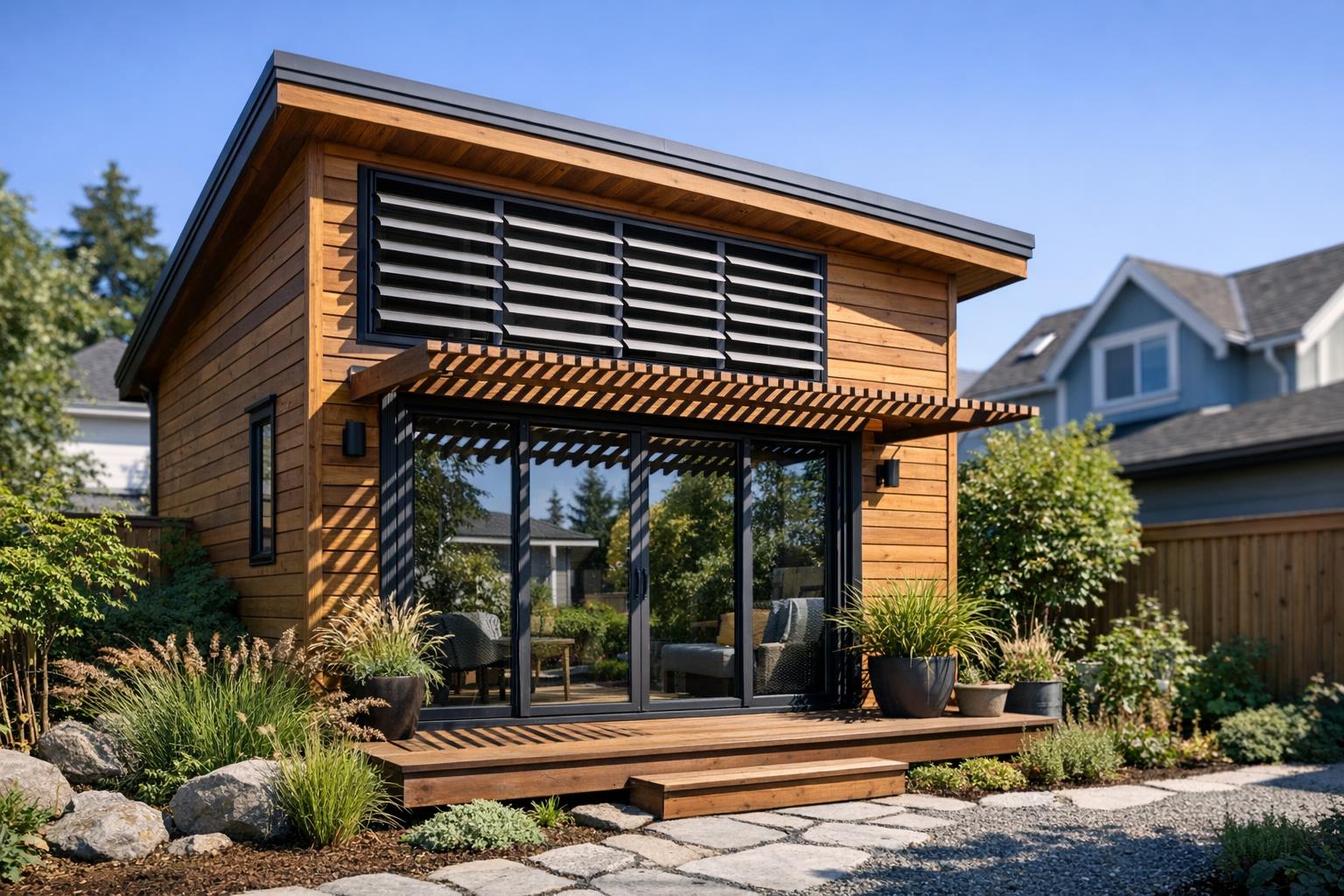
Adjustable shading — retractable awnings, exterior blinds, louvered pergolas
Adjustable shading can be used in hot weather and pulled back in winter or during travel. This makes it a strong fit for mobile tiny homes and mixed climates.
Common options include:
- retractable fabric awnings
- external roller blinds
- exterior venetian blinds
- small louvered pergolas over decks or patios
These systems offer flexibility and can often reduce cooling demand by about 15–20% in good conditions. See also climate-adaptive decks in Canada.
Vegetative shading — deciduous vines and potted shade trees
Vegetative solar shading uses plants to shade windows and walls in summer. Deciduous plants are useful because they lose leaves in winter and allow more sun in.
Tiny-home-friendly ideas include:
- deciduous vines on a trellis
- movable planters
- potted small trees near west-facing decks
Benefits include cooling, privacy, a softer outdoor space, and better looks. Limits include watering, pruning, and setup time. It is less practical for people who move often. For related small-space landscape ideas, see landscaping ideas for ADUs in Canada and small-space ADU landscaping. Another useful overview is this passive solar article.
Glazing choices and solar control films
Glazing upgrades and films are helpful, especially in retrofits, but they usually come after exterior shading.
Useful terms:
- Low-e coating: thin coating that reduces heat transfer and can limit solar gain
- Solar control film: film added to glass to reduce heat and glare
- Selective tinting: stronger solar control on the hottest windows, often west-facing
These are useful where awnings or overhangs are hard to install. See smart glass and efficiency options for tiny homes.
Reflective roofs, cool roofs, and light-coloured cladding
Tiny homes often have a large roof area compared to their interior size, so roof heat matters. A cool roof has high solar reflectance and rejects more heat. Light-coloured cladding and ventilated rainscreen gaps can help too.
This works especially well in dry, sunny regions where roofs take a lot of direct sun. Related examples include green roof considerations for tiny homes and tiny home curb appeal strategies.
Internal shading — blinds, curtains, cellular shades
Internal shading should be the last line of defence. It can reduce glare and some heat, but it is less effective because the solar radiation already came through the glass.
In some cases, internal shading can also create extra heat stress on high-performance glazing. As a rough guide, interior shading alone may only reduce cooling load by about 5–10%. See also tiny home privacy strategies.
Integrating Shading into Tiny Home Design
The best results come when solar shading for tiny homes is built into the layout early.
Smart tiny home design usually means:
- place more glazing on the south side, where overhangs work best
- keep east and west glazing limited
- place windows to support cross-ventilation
- treat shaded outdoor living space as part of thermal design
Small homes also have real limits:
- not much wall area for add-on devices
- roof space may already be used by solar panels, skylights, or vents
- mobile homes need travel-safe attachments
- too many add-ons can look cluttered
Helpful solutions include overhangs that double as deck covers, trellises that act as privacy screens, and fold-down awnings for trailers and vans.
Stationary homes usually benefit more from fixed overhangs, pergolas, and plantings. Mobile homes usually do better with retractable, lightweight, secure systems. See U.S. DOE passive solar home guidance, tiny home design Canada, and solar-ready ADU design planning.
Climate-Specific Solar Shading Tips Across Canadian Summers
No single setup fits every region. Match solar shading and passive cooling to local weather.
West Coast
Canadian summers on the West Coast are often milder, but bright sun and humidity can still overheat a compact space. Best fits include adjustable shading, strong ventilation, and deciduous vines or trellises for stationary homes. For related climate detail, see coastal tiny homes and weatherproofing in Canada.
Prairies and Interior
These areas often get hotter, drier weather, stronger sun, and cooler nights. Focus on cool roofs, strong shading on south and west windows, and aggressive night flushing. Broader building context is covered in cold-climate tiny home construction.
Ontario and Quebec
Hot and humid conditions mean both heat and moisture must be managed. Exterior blinds or awnings work well, but they should be paired with controlled ventilation and attention to trapped humidity in airtight homes. Indoor moisture planning ties closely to air quality in tiny homes.
Northern and remote regions
These regions may have shorter summers, but they can still get intense heat and very long daylight hours. Flexible shading is often best so winter solar gain is not lost. Simple, durable systems are also easier to maintain in remote areas. See northern Canada ADU solutions and off-grid tiny home living.
Sizing and Design Rules Readers Can Actually Use
These are rules of thumb, not engineering calculations.
Overhang sizing basics
Overhang depth depends on window height, latitude, sun angle, and how much summer sun you want to block. A simple rule is:
- projection = window height × summer sun angle factor
Near 45°N latitude, a 4-ft-high window may need roughly 2 to 3 ft of overhang for meaningful summer shading. Exact sizing should be checked with a solar angle calculator for the real site. See passive solar basics and NRCan guidance.
Window-to-floor area and airflow placement
Useful rules:
- south glazing around 10–15% of floor area
- put inlet openings about 1–2 ft above the floor
- place outlet openings near the ceiling
This gives daylight and some winter sun without letting summer overheating take over. See also tiny home light design and DOE passive solar home guidance.
How to read product specs
Two key specs matter:
- SHGC or shading coefficient: how much solar heat gets through; lower is better for summer control
- Visible transmittance: how much daylight gets through; higher keeps the interior brighter
A practical target is a low shading coefficient below about 0.3 for strong summer control, while visible transmittance above about 0.5 helps prevent a cave-like interior. For related glazing guidance, see smart glass for tiny homes.
DIY Solar Shading Projects and Low-Cost Upgrades
For many owners, the goal is simple: improve comfort fast without rebuilding the whole home.
Quick wins
Low-cost upgrades include:
- reflective window film: about $20–50, around 1 hour
- simple exterior shade cloth or temporary awning
- louvered privacy or shade screen: about $100, weekend project
- roof-vent fan or night purge fan to support passive cooling
These work best as targeted fixes. Film helps on problem windows. Shade cloth is flexible but temporary. Privacy screens can shade decks or west walls. Roof-vent fans help remove trapped heat at night. For more, see window film and solar control for tiny homes and air quality planning.
Mini project outline — retractable awning
A simple retractable awning can be a solid DIY solar shading for tiny homes project.
Materials
- cedar slats or fabric frame
- rope or pulley hardware
- mounting rails
- weather-resistant fasteners
Rough cost
- about $150–300 in materials
- many small projects land near $200
Time
- about 4–6 hours
Basic steps
- Measure the window or wall section to shade.
- Decide on projection and mounting height.
- Assemble the slat panel or fabric frame.
- Mount rails and pulleys into structural framing.
- Test the deployment angle and travel clearance.
- Secure it for wind and, if mobile, for transport.
In a suitable setup, this kind of shading may cut cooling demand by around 15%. Related outdoor integration ideas can be found in climate-adaptive decks.
Products and Materials to Compare Before You Buy
Keep product choices brand-neutral and compare by category.
- Fabric awnings: lighter, often cheaper, easier for mobile homes
- Metal awnings: more durable, often better for stationary homes
- External roller blinds: clean look, easy adjustment
- External venetian blinds: better control of light angle, more parts to maintain
- Low-e glazing: strong long-term performance if replacing windows
- Breathable insulation materials: helpful when envelope upgrades are part of the cooling plan
For mobile tiny home design, weight, wind resistance, and stowability matter. For stationary homes, durability and low maintenance matter more.
DIY works well for simple films, cloth shades, and small awnings. Professional installation is often better for automated systems, structural attachments, and weatherproof details.
| Item | DIY cost | Pro cost | Install time |
|---|---|---|---|
| Awnings | $150–400 | $800+ | About 1 day |
| Films | $50–100 | About $200 | About 2 hours |
Where budget allows, triple-pane low-e glazing can be a strong tiny-home-friendly upgrade. See tiny home window strategies and smart glass efficiency options.
Energy Efficiency Benefits and Savings Estimates
The main payoff is lower cooling load, fewer run hours for fans or AC, and less strain on off-grid systems. Combined shading and passive cooling can cut cooling demand by roughly 20–40% in tiny homes, depending on climate, glazing, and how much direct sun the home gets.
One research example shows how big the effect can be:
- 10 m² of unshaded south glazing: about 5 kWh/day of heat gain
- shaded: about 2 kWh/day
- roughly 60% reduction in solar gain
A simple way to think about cooling load is:
Cooling load ≈ glazing area × SHGC × sun hours
Then reduce that result by a shading factor of roughly 0.2 to 0.5, depending on the solution. In plain language:
- glazing area = how much window area gets sun
- SHGC = how much heat the glass lets through
- sun hours = how long the window gets strong sun
- shading factor = how much the shade cuts that heat
For off-grid homes, lower cooling demand means less daily power draw, longer battery life, and less need for oversized solar arrays. See how much solar an ADU may need, off-grid living guidance, and DOE passive solar homes.
Costs, Payback, and Where to Check 2026 Incentives
Ballpark costs in CAD:
- overhangs: $500–1,000, payback about 3–5 years
- awnings: $300–1,000, payback about 2–4 years
- films: $100–300, payback about 1–2 years
Actual payback depends on:
- local electricity prices
- off-grid or grid-tied setup
- how much cooling was used before the upgrade
- DIY versus pro installation
- number, size, and direction of windows
Before buying, check 2026 incentives and rebates through NRCan resources and local utilities. Program rules can change, so any rebate should be verified at the time of installation rather than assumed. You can also review broader financing and policy context in this green upgrades financing guide and Canada federal housing policy updates.
Case Study — Tiny Home Retrofit Example in Ontario
Here is an illustrative example, not a promise of exact results.
Before
- 20-ft trailer-based tiny home
- no exterior shading
- peak summer interior temperature around 32°C
- fan use around 2 kWh/day
Retrofit
- added external awnings
- added roof vents
After
- peak interior temperature around 24°C
- fan use around 0.5 kWh/day
- about 75% drop in fan energy use
- retrofit cost about $400
- around 2-year payback
Why it improved:
- less direct solar gain through windows
- better heat escape through roof venting
- lower need for active cooling
The result was more stable indoor temperatures and noticeably better comfort during hot Ontario weather. For related maintenance and performance thinking, see ADU maintenance checklist Canada.
Maintenance, Seasonal Use, and Winter Trade-Offs
Good tiny home design in Canada must balance summer cooling with winter solar gain.
Seasonal care matters:
- retract or store awnings in winter and under snow load
- prune vines each year
- inspect pulleys, fasteners, and fabric for UV and weather wear
- clean films and glazing carefully
The main trade-off is simple: too much permanent solar shading can reduce useful winter heating. In mixed climates, adjustable devices and deciduous plants are often the best compromise.
For mobile homes, every external part must also be secured before travel. See moving a tiny home in Canada and tiny home winterization checklist.
Quick-Check Design Checklist
Use this checklist to review solar shading for tiny homes quickly:
- site assessed for summer sun path
- south orientation prioritized where possible
- east and west glazing minimized
- overhangs or exterior shading sized and planned
- external shading prioritized over internal blinds
- cross-ventilation path established
- roof or high exhaust vent included
- climate-specific strategy matched to region
- off-grid power savings considered
- winter sun access preserved where possible
7-Step Action Plan for Readers
- Assess the site, home orientation, and hottest windows.
- Measure glazing area and identify the main heat-gain surfaces.
- Calculate a basic overhang or shading size.
- Prioritize external solar shading first.
- Add ventilation upgrades for cross-flow and night flushing.
- Test performance during a hot week and monitor indoor temperatures.
- Adjust the setup by season to protect winter heat gain and summer comfort.
A practical starting point is often enough: fix the worst window first, then improve airflow, then reassess.
FAQ
Do tiny homes need air conditioning if shaded properly?
Not always. In many Canadian summers, a tiny home with good solar shading, strong ventilation, and night flushing may stay comfortable without regular AC use. But very hot or humid climates, poor orientation, and heavy west-facing sun can still make backup AC useful. See heat pump options for tiny homes and RMI’s passive cooling guidance.
What’s the best shading for mobile tiny homes vs stationary ones?
Mobile homes usually do best with retractable awnings, pulley systems, and travel-safe exterior devices. Stationary homes usually have a stronger case for fixed overhangs, pergolas, trellises, and deciduous plantings. For mobility-related planning, see moving a tiny home in Canada and tiny home on wheels comparisons.
How do you balance summer shading with winter heat gain?
The best balance usually comes from adjustable exterior devices, deciduous vegetation, and properly sized overhangs. These block high summer sun while still allowing lower winter sunlight to enter. See passive cooling for tiny homes in Canada, NRCan shading guidance, and this passive solar overview.
Are interior blinds enough on their own?
Usually not. Interior blinds help with glare and privacy, but they are generally the least effective shading layer for reducing total heat gain because the sunlight has already entered through the glass. They work best as a backup to exterior shading.
Which windows should be shaded first?
Start with the windows that get the harshest summer sun, usually west-facing first, then large south-facing glass if overhangs or external devices are missing. In tiny homes, one problem window can have an outsized effect on comfort.
Resources and further reading:
- NRCan summer shading guidance
- U.S. DOE passive solar home guidance
- RMI passive cooling in a tiny house
- Passive solar basics
- Canadian climate video explainer
- Tiny home cooling support
- Tiny home energy efficiency guide
- Tiny home design strategies
- Solar-ready planning guide
It is also wise to check provincial building code and regulation pages for 2026 updates, especially for structural attachments, egress, and mobile installations.
Overheating in tiny homes is often a solar gain problem first. That is why solar shading for tiny homes is usually the highest-impact first move. When you combine external shading with passive cooling, you get better comfort, stronger energy efficiency, and less dependence on fans or AC during Canadian summers. The right solution depends on climate, window orientation, and the limits of the tiny home design.
A practical starting point is simple: assess the hottest windows, add one external shading upgrade, and use night-flush ventilation where the climate allows it. Before installing anything permanent, verify 2026 code rules, structural needs, and available incentives for your location.
Leave a Reply