

Estimated reading time: 12 minutes
Key Takeaways
- Outdoor movie night is one of the most practical tiny home events for building connection in a shared ADU community.
- It works well for Canadian tiny living because it fits small courtyards, backyards, rooftops, and flexible indoor-outdoor spaces.
- Smart planning matters: weather, bugs, smoke, wind, noise bylaws, accessibility, and legal screening rights all need attention.
- You do not need expensive gear. A projector, screen, neighbour-friendly audio, and simple seating can be enough.
- With a backup plan, clear roles, and repeatable checklists, one movie night can grow into a lasting community tradition.
Table of contents
- What are tiny home events, and why does an outdoor movie night work so well?
- Choose the right format: outdoor movie night vs indoor backup
- Site selection, timing, and Canadian tiny living factors for 2026
- Legal checklist for 2026: film licensing, permits, and insurance
- Equipment guide for small outdoor spaces
- Comfort, accessibility, and safety checklist
- Food, waste, wildlife, and neighbour-friendly hosting
- Promotion and RSVP system that builds ongoing social engagement
- Program ideas that make the event more than just a screening
- Budgeting, sponsorships, and partnerships
- Step-by-step planning checklist from 4 weeks out to event night
- Printable day-of timeline and troubleshooting guide
- Measuring success and turning one event into a recurring series
- Frequently Asked Questions
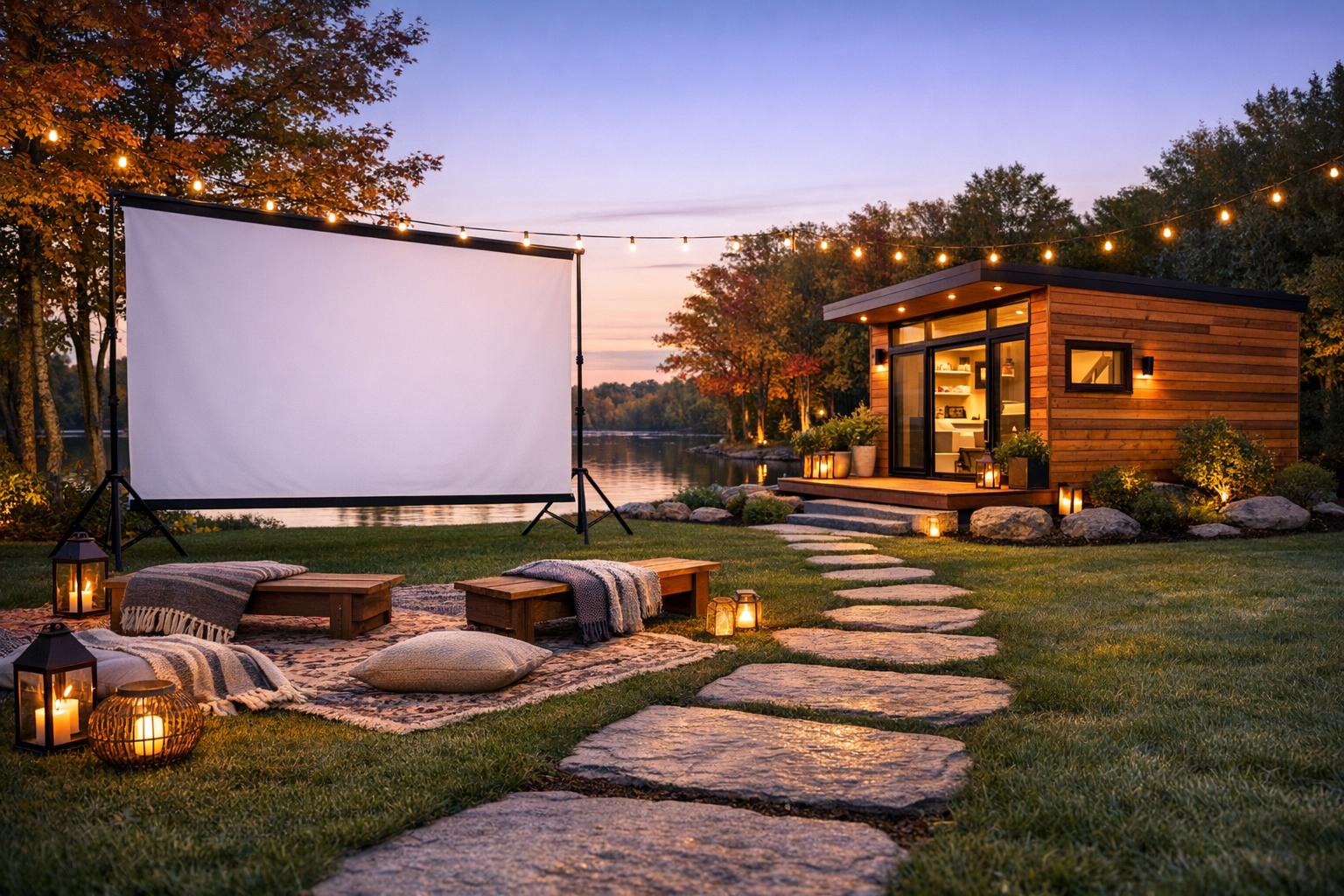
Tiny home events are one of the easiest ways to build connection in 2026, especially when an ADU community wants something simple, affordable, and easy to repeat. An outdoor movie night works especially well because it fits the reality of Canadian tiny living: small shared yards, compact courtyards, laneway homes, backyard suites, rooftops, and flexible indoor-outdoor spaces.
In plain terms, an outdoor movie night is a low-cost gathering where neighbours watch a film together using a projector, a screen, and portable seating. It does not need a big hall, expensive gear, or a formal program. That is exactly why it works so well for shared small-space living.
Still, in Canada, the details matter. Daylight changes by region. Weather can turn fast. Mosquitoes, smoke, wind, bylaws, shared-space etiquette, and indoor backup plans all shape the experience. For practical setup inspiration, resources like movie night ideas and fun outdoor movie night ideas can help you visualize what works in compact spaces.
A great movie night does not feel overly produced. It feels easy to join.
What are tiny home events, and why does an outdoor movie night work so well?
Tiny home events are gatherings designed for compact living. They can be one-time events or recurring traditions, but the common thread is simple: they work with limited storage, shared amenities, and small indoor spaces.
Common examples include:
- Potlucks
- Repair cafés
- Seed or garden swaps
- Book exchanges
- Skill-sharing nights
- Outdoor movie night screenings
An outdoor movie night stands out because it is flexible. If 8 people come, it still feels intimate. If 40 people come, it can still work with more chairs and a larger screen. People can arrive with a blanket, stay for the full film, or simply join the social part before the movie begins.
That low-pressure format suits a mixed ADU population. Owners, renters, families, single adults, seniors, and shift workers can all participate in different ways. For a broader look at community-focused small-space gatherings, see tiny home gatherings in Canada and ADU community events in Canada.
Social outcomes — friendship, belonging, and reduced isolation
Social engagement means more than a quick hello. It means neighbours start to recognize each other, trust grows, ideas get shared, and people feel less alone.
An outdoor film night helps because conversation happens naturally:
- Before the movie while people settle in
- During snack breaks
- After the film when people react to what they watched
This is often easier than formal networking. In small homes, many residents value privacy. They may not want a long hosted dinner. Casual gatherings with flexible participation usually work better. Someone can come, chat for 10 minutes, and head home without feeling awkward.
Over time, recurring tiny home events can help an ADU community build stronger ties. People become familiar. Small favours become easier. Informal mutual aid often grows from repeated, comfortable contact. You can see related ideas in these guides on community events and the psychology of tiny homes.
Why movie nights fit tiny home and ADU living better than many other events
Some gatherings need too much space, storage, cooking, or noise. Movie nights do not. They can happen in:
- A courtyard
- A driveway pad
- A side yard
- A rooftop terrace
- A shared garden
- A common room
That matters in Canadian tiny living, where indoor entertaining space is often very limited. Portable gear can be stored off-site, shared among residents, or rented only when needed.
Movie nights also scale well. A modest setup can serve a small group, while a larger screen and stronger audio can support a whole-site gathering. A few throws, cushions, and simple lights can make even a compact screening feel intentional. For design inspiration, browse projector movie night ideas, outdoor movie night ideas, and shared-space examples like shared ADU backyards and green space.
Choose the right format: outdoor movie night vs indoor backup
The first planning choice is straightforward: will the event be outdoors, indoors, or outdoors with an indoor pivot ready to go?
In Canadian tiny living, flexible planning matters. Weather, smoke, insects, wind, and evening temperatures can change quickly. Good 2026 planning means deciding the backup before the invitation goes out. Preparedness resources like tiny home emergency preparedness in Canada and disaster-proofing tiny homes reinforce why backup planning is essential.
When an outdoor movie night is the best choice
An outdoor movie night works best when your site has:
- A flat viewing area
- Some distance from bedroom windows
- Power access or battery backup
- Lower ambient light after sunset
- Enough room for walking paths
Good spots include:
- Backyard pads
- Central courtyards
- Side-lot greenspace
- Rooftop terraces with railings and approval
- Shared garden spaces
In an ADU community, the best site is often not the biggest one. It is the one most residents can reach easily and safely.
A few practical design tips help:
- Face the screen away from streetlights when possible
- Keep fairy lights on pathways and snack tables only
- Avoid decorative lights near the screen
- Use pillows, blankets, and simple seating clusters to make the space feel inviting
Helpful setup inspiration can be found in movie night projector ideas, Wayfair’s outdoor movie night guide, climate-adaptive decks in Canada, and rooftop spaces for ADUs.
Indoor alternatives for small spaces and bad-weather nights
Indoor backup is essential for spring, shoulder seasons, smoky days, bug-heavy evenings, and cold nights. In Canadian tiny living, it is not a bonus feature. It is part of the event plan.
Practical indoor options include:
- A common room screening
- A garage or workshop used for one evening
- A covered amenity room
- A larger resident unit, if rules and capacity allow
For indoor setup:
- Put the projector on a stable side table or shelf
- Centre it with the screen
- Black out windows with curtains or temporary coverings
- Turn off overhead lights to reduce glare
- Keep only low path lighting near exits
- Leave clear walking lanes
For small groups, a cozy fort-style arrangement can work surprisingly well. Blankets, floor cushions, and soft seating can make a small room feel warm rather than cramped. See more in outdoor and indoor movie night ideas, tiny home privacy strategies, and soundproofing tiny homes for privacy.
Site selection, timing, and Canadian tiny living factors for 2026
The best date and start time depend on region, daylight, bugs, humidity, and who is attending. A family screening needs different timing than an adults-only documentary night.
Seasonal calendar by region across Canada
Here is a simple planning guide:
- BC and Alberta: May to September often works well, though sunsets can be late.
- Ontario and Quebec: June to August is strongest, with some humid and bug-heavy July nights.
- Prairies: Late May to early September is usually safest, with more wind planning needed.
- Atlantic and Maritimes: July to September often works best, though evenings can cool faster.
A good screening time is usually dusk, not full darkness. Guests can arrive while there is still light, and the movie can begin as the sky darkens.
For family events, start pre-show activities 45 to 60 minutes before the film. If you are comparing event timing or rental options, see tiny home festivals in Canada and backyard movie night rental guidance.
Weather, daylight, mosquito season, and temperature planning
Check these factors every time:
- Forecast 7 days out
- Forecast 48 hours out
- Wind speed on event day
- Air quality if wildfire smoke is possible
- Temperature after sunset
A practical rule: consider moving indoors if rain is likely, winds are strong enough to shift the screen, or the temperature will stay below about 10°C during a longer movie.
Comfort fixes include:
- Ask guests to bring blankets
- Keep spare throws on hand
- Offer tea, cider, or hot chocolate
- Use citronella where allowed
- Set up fans
- Cover snacks
- Remove standing water near the site
In some regions, late summer and early fall feel better because mosquito pressure drops. For seasonal planning help, review movie night planning ideas, outdoor screening comfort ideas, and tiny home air quality in Canada.
Noise bylaws, quiet hours, and shared-space permissions
Always check local noise rules. Volume limits and quiet hours vary by city, so confirm current 2026 guidance on your own municipal website before promoting the event.
In an ADU community, you may also need approval from:
- Property managers
- Condo or strata boards
- Housing co-op boards
- HOA or site operators
Neighbour-friendly sound practices help protect social engagement:
- Point audio toward the seating area
- Use directional speakers
- Keep volume moderate
- End before quiet hours begin
For more context, review movie night rental considerations, noise bylaws for ADUs, and HOA and ADU rules in Canada.
Legal checklist for 2026: film licensing, permits, and insurance
Legal mistakes can undo an otherwise excellent event. The most common mistake is assuming that owning or streaming a movie at home means you can legally show it to a group. Usually, that is not the case.
Public performance rights explained simply
Public performance rights are the legal permission needed to show a film outside normal private home viewing. If you invite a group to a courtyard, common room, or shared semi-public area, assume a licence is needed unless you have clearly confirmed otherwise.
Lawful options include:
- Contacting distributors directly
- Using licensed community screening services
- Asking libraries or institutions about screening licences
- Choosing public domain films
- Using community-friendly licensed content
Low-cost options do exist, but always verify rights for your exact use.
Legal resources box for Canada:
- Criterion
- Swank Motion Pictures
- SOCAN
- Your city’s municipal bylaw pages
This matters even for a small outdoor screening. Additional context is available in movie night event advice and ADU legal clinic guidance for Canada.
Permits, insurance, and property rules
Film rights are only one part of legal planning. You may also need:
- Site booking approval
- An event permit
- A fire permit for heaters or fire pits
- Liability insurance or a rider
- Written sign-off from a manager or board
In Canadian tiny living sites, management often cares about:
- Clear pathways
- Emergency access
- Electrical safety
- Cleanup
- Shared outdoor wear and tear
Use this practical checklist:
- Confirm film rights
- Confirm site permission
- Check local bylaws
- Verify insurance needs
- Check heater and fire rules
- Save emergency contacts
For insurance-related planning, see tiny home insurance in remote Canada.
Equipment guide for small outdoor spaces
You do not need perfect cinema gear. For tiny home events, the goal is simple:
- People can see the film
- People can hear the film
- The setup is safe
Screen options — DIY, portable, and inflatable
DIY white sheet or blackout cloth on a frame
- Lowest cost
- Good for small groups
- Needs tight stretching to avoid wrinkles
Portable folding screen
- Better image
- Faster setup
- Good for repeat tiny home events
Inflatable screen
- Most dramatic look
- Best for larger ADU community gatherings
- Needs blower power and wind planning
DIY setups are a strong entry point, while inflatables are usually better as premium rentals. Compare examples in outdoor movie setup ideas, backyard movie rental options, and tiny home showroom guide in Canada.
Projector brightness, throw distance, and image quality
Lumens, or ANSI lumens, help indicate how bright the picture will look.
For an outdoor movie night:
- 2,200+ ANSI lumens is a practical starting point after full dusk
- 2,200 to 4,200 lumens gives more flexibility for larger screens or partial ambient light
Throw distance means how far back the projector must sit to create a certain image size.
Before choosing a projector, check:
- Your screen size
- The projector throw ratio
- Table or stand location
- Power access
- Cable length
For compact sites, short-throw models can help when depth is limited. For more detail, see projector tips for movie nights and projector rental guidance.
Audio, microphones, and neighbour-friendly sound
Sound matters more than many hosts expect. People will forgive a less-than-perfect image. They usually will not stay if they cannot hear clearly.
Use:
- Bluetooth speakers for small groups
- Compact PA or directional speakers for larger setups
- A simple microphone for welcome remarks and discussion prompts
Directional sound supports social engagement while reducing neighbour complaints by keeping audio focused on the audience. See noise reduction in Canadian housing and soundproofing and privacy ideas.
Power, batteries, extension cords, and GFCI safety
Keep power safety simple:
- Use outdoor-rated extension cords
- Keep cords away from foot traffic
- Use GFCI-protected outlets
- Tape down or cover cables
- Keep power sources dry and off wet ground
Power options include:
- Battery-powered projectors for small events
- Battery packs for short setups
- Quiet generators where permitted
For more on safe setup, check utility connections for Canadian ADUs.
Low-cost vs premium equipment table
| Item | Low-cost first-time host | Mid-range recurring tiny home events | Premium or rental setup |
|---|---|---|---|
| Screen | DIY sheet or blackout cloth | Portable folding screen | Large inflatable screen |
| Projector | Borrowed basic projector | 2,200+ ANSI lumen projector | Higher-brightness rental unit |
| Audio | Single Bluetooth speaker | Pair of compact speakers | Directional PA system |
| Power | Existing outlet + safe extension cord | Battery pack + outlet backup | Managed power plan or rental support |
| Seating/comfort | Bring-your-own chairs and blankets | Folding chairs, cushions, throws | Full lounge seating, decor, blankets |
For future events, keep a budget spreadsheet template so you can compare buying, borrowing, and renting over time.
Comfort, accessibility, and safety checklist
A good event should feel welcoming, not merely functional. Comfort and inclusion shape turnout, repeat attendance, and overall social engagement.
Seating, lighting, accessibility routes, and captions
Use these accessibility steps:
- Check for a clear, level route for wheelchairs, walkers, and strollers
- Reserve spaces at the front or side for mobility devices
- Offer blankets, low chairs, folding chairs, and some higher seats
- Light the route to washrooms and exits
- Turn captions on by default where possible
- Create a quiet or lower-stimulation area at the edge
These actions support broader participation because more residents can join comfortably. See accessible tiny home guide Canada and accessible design for tiny homes.
Heat, fire pits, ventilation, first aid, and emergency planning
In Canadian tiny living, evenings can cool quickly. Plan for:
- Patio heaters where allowed
- Fire pits only if permitted and supervised
- Spare blankets
- A warm drink station
For indoor backup events, ventilation still matters. Small rooms can feel stuffy fast.
Basic safety steps:
- Keep a first-aid kit onsite
- Mark the nearest washroom
- Keep emergency access clear
- Assign one volunteer as safety lead
- Weight or anchor the screen and frame
For related planning, see tiny home fire safety in Canada and tiny home emergency preparedness.
Printable accessibility and safety checklist
Use a simple one-page checklist for your ADU community:
- Wheelchair-accessible route checked
- Captions enabled
- Quiet or sensory break area marked
- First-aid kit stocked
- Emergency contact list ready
- Path lights on
- Cables secured
- Heater and fire rules confirmed
A printable one-page event checklist and volunteer role sheet help standardize future events. For community process examples, see tiny home community workshops in Canada and accessible ADU design in Canada.
Food, waste, wildlife, and neighbour-friendly hosting
Food should add comfort, not create clutter, odours, or wildlife problems. In shared outdoor space, small details have a bigger impact.
Potluck vs hosted snacks vs local partners
Potluck
- Best for social engagement
- Lowers host cost
- Needs labels for ingredients and allergens
Host-supplied snack table
- Easier to control
- Best for smaller groups
Local café or food partner
- Useful for larger ADU community events
- Can reduce volunteer work
Good low-mess food options:
- Popcorn cups
- Wrapped cookies
- Tea
- Hot chocolate
- Sparkling water
- Mild, low-odour snacks
Low-waste service and wildlife/waste control
Low-waste habits fit tiny living well. Try these:
- Use reusable cups or bowls when practical
- Label recycling, compost, and landfill clearly
- Assign one cleanup lead
- Avoid putting food out too early
- Seal waste right after the event
This is especially important where raccoons and other scavengers can access shared-area garbage. More ideas are available in zero-waste tiny home living and community tool sharing for tiny homes.
Smoking, scent, and noise etiquette
To protect goodwill in an ADU community:
- Use a no-smoking rule or a smoking area away from seating
- Encourage scent-aware practices
- Set a firm end time before quiet hours
These standards make repeat events easier to approve. Review Canadian HOA rules for ADUs and noise bylaw guidance for ADUs for related considerations.
Promotion and RSVP system that builds ongoing social engagement
Promotion should not only fill one night. It should help create a steady rhythm of community activity.
What to include in the invitation
Every invitation should include:
- Event name
- Date
- Gather time and film start time
- Exact location in the ADU community
- What to bring: chair, blanket, mug, bug spray
- Indoor or rain backup note
- RSVP method
- Accessibility details
- Snack details
- Quiet-hour finish time
This removes uncertainty and boosts attendance. For community invitation ideas, see ADU community events and tiny home community workshops.
Sample promotion templates
Flyer sample
Join our tiny home events series with a summer outdoor movie night in our ADU community.
Date: Saturday, July 18
Gather at 7:15 PM | Film starts at dusk
Bring a chair or blanket, a mug, and bug spray.
Indoor backup available.
Designed for neighbour social engagement and cozy Canadian tiny living.
Short social post
Outdoor movie night this Friday in our ADU community. Easy, friendly, and low-key. Bring a blanket and join our tiny home events series for a fun evening of social engagement.
Newsletter blurb
Our next tiny home events gathering is an outdoor movie night built for Canadian tiny living. Expect simple snacks, relaxed seating, and easy social engagement before the film starts at dusk.
RSVP wording
Please RSVP by Thursday so we can plan seating, captions, snacks, and the indoor backup option.
On-site signage copy
Welcome to tonight’s outdoor movie night. Seating is open. Captions are on. Quiet area and washroom route are marked.
For inspiration, revisit movie night ideas and ADU event examples.
Best channels for small communities
Use both digital and physical channels:
- Bulletin boards
- Email newsletter
- WhatsApp or Signal group
- Facebook group
- Nextdoor
- QR-code posters
In an ADU community, not everyone uses the same platform. A film poll can also build engagement before the event starts. See community governance for tiny homes in Canada for broader organizing ideas.
Volunteer roles and rotating host model
Recurring tiny home events work best when one person is not doing everything.
Suggested roles:
- Event lead
- Tech lead
- Welcome host
- Snack and waste lead
- Accessibility and safety lead
- Cleanup lead
A rotating host model helps too. Different blocks, homes, or resident teams can take turns each season. That spreads labour and builds stronger long-term social engagement across the site. For related models, see community governance for tiny homes and ADU community hubs and social enterprises.
Program ideas that make the event more than just a screening
The best movie nights include a little more than just pressing play.
Pre-show icebreakers and themed nights
Easy ideas:
- What is your best tiny living hack?
- What do you wish neighbours knew about small-space living?
- Name tags with unit numbers or pronouns, if useful
Theme ideas:
- Family night
- Documentary night
- Local filmmaker night
- Sustainability night
- Canadian tiny living story night
Themes help connect the event to identity and belonging. Related inspiration appears in community art for tiny homes and ADUs and tiny home festivals in Canada.
Post-film discussion and voting for the next event
Keep discussion optional and brief. Ten minutes is usually enough.
Prompt ideas:
- What part of the film stayed with you?
- Did this theme connect to life in our community?
- What should our next tiny home events night be?
Then vote on the next film or event type. This is how one screening turns into a real series.
Suggested film list and content notes
Always verify screening rights before use.
Possible categories:
- Public domain classics
- Family-friendly favourites with proper licensing
- Short film blocks
- Canadian-themed documentaries
- NFB or local shorts where screening terms allow
Examples to research and verify:
- Metropolis
- Night of the Living Dead
- Canadian documentary shorts
Shorter films often work well for Canadian outdoor screenings because cooler temperatures and quiet hours limit runtime. For general film-night inspiration, review movie night ideas and setup tips.
Budgeting, sponsorships, and partnerships
Cost should not stop a first event. Think in three tiers:
- Ultra-low-cost: borrow gear and use potluck snacks
- Mid-range: buy or rent basic equipment
- Enhanced: sponsored community event
Suggested budget ranges
| Category | Ultra-low-cost | Mid-range | Enhanced |
|---|---|---|---|
| Screen/projector | Borrowed or DIY | Basic rental or purchase | Premium rental |
| Sound | Borrowed speaker | Compact speaker pair | PA system |
| Power | Existing outlet | Added battery pack | Managed event power |
| Snacks/drinks | Potluck | Simple host table | Partner-supported snacks |
| Blankets/decor | BYO | Modest extras | Full comfort setup |
| Printing/signage | Minimal | Printed signs | Branded materials |
| Licensing/permits | As needed | As needed | Full formal setup |
A small outdoor movie night can stay in the low hundreds if gear is borrowed and food is simple. A mid-range event may cost a few hundred more if rentals or purchases are involved. Compare options using backyard rental pricing ideas and broader cost guides like ADU cost guidance in Canada.
Sponsorship and in-kind support
Local businesses may support an ADU community event with:
- Snack donations
- Discounted rentals
- Gift cards
- Printing support
Why would they help?
- Hyperlocal visibility
- Support for neighbourhood social engagement
- Alignment with community-centred housing
Sample sponsor outreach email
Hello,
We are planning a small outdoor movie night for our ADU community in 2026. The event is designed to support neighbour social engagement in a Canadian tiny living setting. We are looking for in-kind support such as snacks, printing, or rental discounts. In return, we can include your logo on our flyer and thank your business at the event.
A simple sponsor outreach email can make repeat events more affordable. For partnership possibilities, review ADU grants and municipal incentives in Canada and ADU concierge services in Canada.
Step-by-step planning checklist from 4 weeks out to event night
This timeline makes tiny home events easier to repeat.
3–4 weeks before
- Choose host team and date
- Estimate attendance
- Pick the outdoor site and indoor backup
- Check ADU community rules
- Start film licensing inquiry
- Draft budget
- Recruit volunteers
- Set up RSVP method
1–2 weeks before
- Confirm film and legal permissions
- Test projector and speakers
- Walk the site at the real screening time
- Share invitations on all channels
- Plan seating map and accessibility route
- Confirm weather backup
- Prepare bug and cold-weather supplies
- Organize snacks and bins
2–3 days before
- Recheck forecast and air quality
- Confirm power source
- Charge batteries
- Print signs and volunteer sheet
- Send reminder with what to bring
- Reconfirm start time based on dusk
Day of event
- Make the final weather call
- Inspect the site
- Test equipment
- Do a safety sweep
- Place bins and signs
- Set up seating and pathways
- Brief volunteers
- Run the event
- Clean up and secure waste
A printable one-page event checklist is especially helpful here. For workshop-style planning tools, see tiny home community workshops in Canada.
Printable day-of timeline and troubleshooting guide
A simple hour-by-hour plan reduces stress.
Hour-by-hour sample timeline
- 4:00 PM: Site check, weather check, bylaw reconfirmation
- 5:00 PM: Set up screen, projector, and seating
- 6:00 PM: Sound check and signage
- 7:00 PM: Guest arrival and pre-show mingling
- Dusk / around 8:00 PM: Start film
- 10:00 PM or earlier: Cleanup and quiet exit
Keep this as an hour-by-hour timeline for every screening. Useful references include movie night timing ideas and rental setup guidance.
Troubleshooting quick fixes
- Screen looks dim → Wait for darker conditions, reduce nearby light, switch to brighter mode
- Wind moves the screen → Anchor it, change location, or move indoors
- Audio is weak → Move speakers closer to viewers instead of only raising volume
- Mosquitoes are intense → Offer repellent, shorten pre-show, pivot indoors
- Temperature drops fast → Bring out blankets, serve hot drinks, shorten runtime
- Rain starts → Move to the indoor backup
This matters even more in small-space outdoor hosting, where conditions can change fast. Preparedness guides like tiny home emergency preparedness and disaster-proofing tiny homes are useful references.
Measuring success and turning one event into a recurring series
Success is not just about head count. It is about social engagement and whether people want another event.
What to measure
Track:
- Number of attendees
- Number of first-time participants
- RSVP-to-attendance ratio
- Volunteer turnout
- Survey feedback
- How many people met someone new
- Interest in future social engagement activities
These measures tell you much more than online likes. For community metrics and event patterns, see ADU community events and tiny home gatherings in Canada.
Post-event survey and photo consent
Ask simple questions:
- What worked well?
- Was the event comfortable and accessible?
- Was the film a good fit?
- What would make the next event easier to attend?
- What other tiny home events would you like in this ADU community?
If photos or video may be shared publicly, ask for consent first. For creative community event examples, see community art for tiny homes and ADUs.
How to build a recurring calendar for 2026
One screening can become:
- Monthly summer movie nights
- Fall indoor screenings
- Seasonal themed events
- Resident-voted community gatherings
Regular scheduling is what turns one event into real social engagement. A sample flyer and social post pack, volunteer role sheet, and updated legal resources box for Canada make that much easier year after year.
A well-planned outdoor movie night is one of the easiest and most affordable tiny home events for building connection. It suits an ADU community because it works in small shared spaces, allows flexible participation, and supports the everyday rhythm of Canadian tiny living. With the right legal checks, good-enough equipment, strong accessibility planning, and a solid weather backup, it can become a lasting part of community life in 2026.
Frequently Asked Questions
Do I need a licence to host an outdoor movie night in a shared ADU space?
Usually, yes. If the screening happens in a courtyard, common room, or other shared area, assume you need public performance rights unless you have confirmed otherwise. Start with providers like Swank Motion Pictures, Criterion, or your local institution and municipal guidance.
What is the best projector brightness for a small outdoor movie night?
For most small community screenings, 2,200+ ANSI lumens is a practical baseline after dusk. Brighter models offer more flexibility if you have ambient light or a larger screen.
What if the weather changes at the last minute?
Have an indoor backup planned before you send the invitation. If rain, smoke, strong wind, or cold temperatures make the outdoor setup uncomfortable or unsafe, pivot quickly and notify guests through your RSVP channel.
How do we keep the event neighbour-friendly?
Point speakers toward the audience, keep volume moderate, use scent-aware and no-smoking practices, and finish before local quiet hours. Checking noise bylaws for ADUs ahead of time helps prevent conflict.
What are the easiest ways to make the event accessible?
Provide a clear route, reserve spaces for mobility devices, offer mixed seating heights, light pathways, and keep captions on by default where possible. Even a few simple accessibility steps can dramatically improve participation.
Leave a Reply