

Estimated reading time: 12 minutes
Key Takeaways
- A yurt ADU legal project is possible in 2026, but only in some jurisdictions and only when the structure is approved as a real dwelling.
- Classification is everything. A yurt may be treated as a tent, accessory building, seasonal structure, or full dwelling depending on local rules.
- Backyard yurt Canada approvals are highly local. Provincial code, municipal zoning, and site-specific restrictions can all affect the outcome.
- ADU regulations 2025 trends made backyard housing easier in many places, but they did not automatically legalize yurts.
- Foundation, insulation, utilities, fire safety, and engineering are often the biggest hurdles between a yurt idea and legal occupancy.
- Soft-wall yurts usually face a tougher permit path than rigid-wall or hybrid systems designed to perform more like standard dwellings.
Table of contents
- Is a Yurt ADU Legal in 2026?
- Key Takeaways
- Why Yurts as ADUs Are Gaining Attention in 2026
- The Short Answer — Is a Yurt ADU Legal in 2026?
- Legal Basics — ADU vs Temporary Dwelling vs Accessory Structure
- ADU Regulations 2025 — What Changed and Why It Matters in 2026
- Backyard Yurt Canada — How Legality Works in Practice
- Technical Requirements for Making a Yurt Legal as a Backyard Dwelling
- Step-by-Step Permitting Roadmap
- Costs and Timelines in 2026
- Financing, Insurance, and Resale Realities
- Pros and Cons of Choosing a Backyard Yurt
- Alternatives and Hybrid Solutions
- Real-World Examples
- Future Outlook for 2026 and Beyond
- Frequently Asked Questions
Is a Yurt ADU Legal in 2026?
If you are asking whether a yurt ADU legal setup is possible in 2026, the short answer is yes, sometimes. But a yurt ADU legal project is not just about putting a round structure in your yard. It must be approved as a real dwelling under local zoning, building, fire, and utility rules.
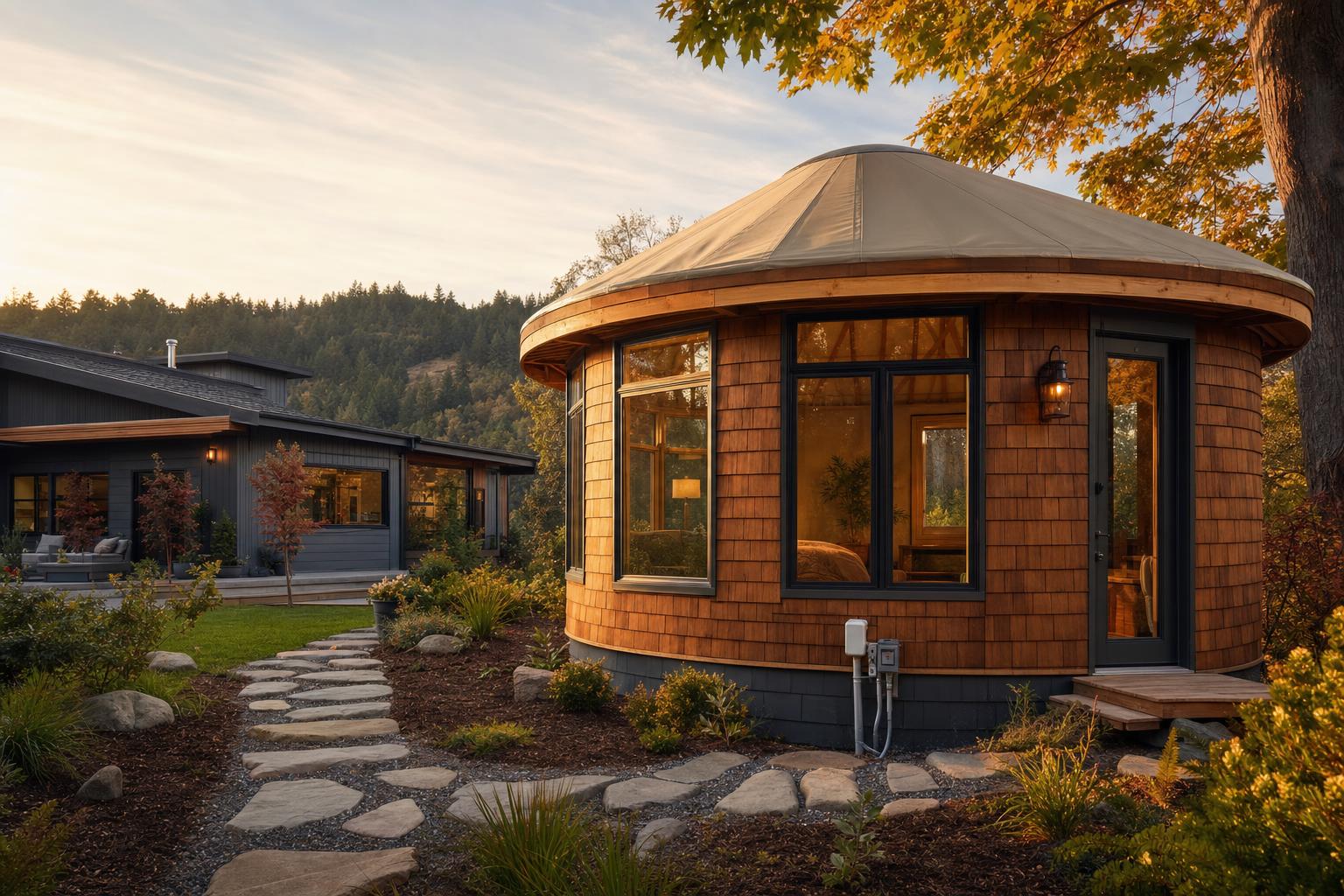
A yurt is a circular dwelling that began as a tent-like structure with lattice walls and a central roof ring. Modern yurts can look very different. Some use insulated fabric systems. Others use rigid walls, engineered roof systems, permanent foundations, and full utility hookups.
That is why they now show up in discussions about alternative dwelling trends and small space innovation. They also overlap with the broader shift toward compact housing and non-traditional design seen in tiny home design.
An ADU is a small, self-contained secondary home on the same lot as a main house. In Canada, similar terms include garden suite, laneway house, and secondary suite. So when people search for backyard yurt Canada rules, what they usually mean is this: can a backyard yurt be permitted as a legal place for someone to live?
This article is informational, not legal advice. Rules vary by municipality, province, and sometimes by site conditions or local interpretation. Before buying a yurt kit, you should verify details with your local planning and building department.
Below, you will find the key issues: why yurts are trending, legal categories, ADU regulations 2025 trends and what they mean in 2026, Canadian guidance, technical requirements, permitting steps, costs, insurance, financing, and realistic alternatives. For additional background, see year-round yurt living in Canada, one builder’s experience with yurt permits and building codes, a general yurt permitting guide, and a discussion of whether building a yurt ADU is the future of affordable housing.
Why Yurts as ADUs Are Gaining Attention in 2026
Yurts are getting attention because they sit inside bigger alternative dwelling trends.
People are looking at backyard housing for a few simple reasons:
- Housing is expensive
- Families want space for parents, adult children, or guests
- Owners want rental income
- Some people want a lower-impact building form
- Others want a flexible office, studio, or live-work setup
This is where small space innovation matters. It means designing compact homes that use less land, fewer materials, and often faster building methods. You can see that broader movement in topics like tiny home living benefits, micro-dwelling urban housing, and compact living with smart storage design.
Why do yurts appeal to homeowners?
- The shell can cost less than a full detached suite
- Kits can go up faster than a custom build
- The round design feels unique
- They offer a stronger connection to nature
- Some owners start with seasonal use before trying for full upgrades
Still, there is an important catch. A lower shell cost does not equal a lower legal ADU cost. Once you add a proper foundation, insulation, engineering, plumbing, electricity, heating, and permits, the budget can rise fast.
“Interest is not the same as easy approval.”
Interest in backyard yurt Canada projects is growing because conventional housing costs remain high. Some Canadians are exploring non-traditional dwellings as a way to create extra space at lower cost, at least in theory. See discussions from affordable housing advocates, Canadian yurt living coverage, a public thread on how some Canadians are choosing to live in a yurt, and practical references from permit guides and personal-use yurt examples.
The Short Answer — Is a Yurt ADU Legal in 2026?
Yes, a yurt can be yurt ADU legal in some jurisdictions in 2026.
But legality depends on:
- How the structure is classified
- Zoning rules
- Building permits
- Structural compliance
- Energy code compliance
- Utility approvals
- Fire safety
- Site servicing
In many places, a yurt is not automatically treated like a standard detached suite. It may be treated as:
- A tent
- A seasonal structure
- An accessory building
- An unconventional dwelling needing special review
The key question is not, “Can this fit in my yard?” The key question is, “How will my local authority classify it?”
Also, a manufacturer calling a yurt “residential” does not make it legal in your municipality. The local authority decides what counts as a dwelling and what evidence is needed. That point comes up repeatedly in real permit stories and in the general yurt permits and building codes journey and this yurt permitting guide.
Legal Basics — ADU vs Temporary Dwelling vs Accessory Structure
Understanding classification is the most important part of a yurt ADU legal project.
ADU, secondary suite, or garden suite
This is a self-contained dwelling on the same lot as a main home.
It usually includes:
- Sleeping space
- Bathroom
- Kitchen or kitchen facilities
It also usually must meet rules for:
- Structure
- Fire safety
- Exits
- Utilities
- Energy performance
- Occupancy
Temporary structure or tent
This is often meant for:
- Short-term use
- Seasonal use
- Recreation
- Events
Some temporary structures may be exempt from a building permit under certain size or spacing rules. But permit exemption does not mean legal year-round living.
Accessory structure
This usually means a non-habitable building such as a:
- Shed
- Studio
- Workshop
- Gazebo
Rules are often easier when there is:
- No plumbing
- No sleeping
- No cooking
- No full-time occupancy
Once people start sleeping, bathing, cooking, or renting it out, the legal category often changes.
Why classification matters
Classification affects:
- Whether full-time living is allowed
- Which permits are required
- Whether utilities can be added
- Insurance options
- Financing options
- Future resale value
A common mistake is installing a “temporary” yurt and later using it like a rental home. That can trigger enforcement, fines, or forced removal. This issue is discussed in the permit guide, affordable housing commentary, one owner’s permit experience, and forum threads like how can we make our yurt legal.
ADU Regulations 2025 — What Changed and Why It Matters in 2026
When people refer to ADU regulations 2025, they usually mean the broad wave of 2025-era policy changes that made detached backyard housing easier in many places.
There was not one universal law. Instead, many provinces, cities, and U.S. states moved in a similar direction.
Common themes included:
- More support for detached backyard dwellings
- Fewer parking requirements in some areas
- Smaller minimum lot limits
- More pre-approved plans
- More focus on infill housing and gentle density
These changes can help a yurt ADU legal project if a municipality focuses on use, size, setbacks, and safety rather than on standard house shape alone.
That said, most reforms did not mention yurts directly.
So the barriers often remain:
- A fabric wall system may not fit normal code assumptions
- Energy code rules can be hard to meet in cold climates
- Staff may still prefer conventional framed construction
- Local interpretation still matters
The practical takeaway is simple. ADU regulations 2025 may create a friendlier background for backyard dwellings in 2026. They do not automatically make every yurt legal. For context, see this housing analysis, the permit guide, and practical code experience.
Backyard Yurt Canada — How Legality Works in Practice
For backyard yurt Canada readers, the biggest point is this: there is no single federal yurt law.
Instead:
- Building rules are mostly provincial
- Zoning and land use are mostly municipal
- Extra controls may come from strata, condo, HOA, health, conservation, or site-specific agencies
That means a yurt ADU legal project may be decided by several layers at once. One layer may allow detached suites, while another may still reject the structure type. This layered reality is reflected in many permit stories, including this one.
Ontario overview
Ontario rules do not place yurts neatly into one simple ADU category.
Municipal staff may view a yurt as:
- A tent
- A building
- An accessory structure
- A dwelling
That often depends on:
- Size
- Foundation type
- Utility hookups
- Intended use
- Whether it is seasonal or year-round
Important Ontario ideas include:
- A structure over 10 m² may trigger building rules
- Plumbing often changes the review path
- Some tents under certain thresholds may be permit-exempt
- Permit-exempt does not mean legal for year-round occupancy
If the goal is a detached garden suite, expect close review of structural design, winterization, fire safety, plumbing, utility servicing, and wall system performance. In Toronto-style urban settings, common concerns include setbacks, lot coverage, distance from the main home, servicing, and whether an unconventional wall system meets dwelling standards. For first-hand discussion, see permit experiences and a community thread on building codes for living in a yurt.
British Columbia overview
BC municipalities are often comfortable with laneway houses and detached secondary dwellings. That helps, but only up to a point.
An ADU-friendly city may still reject a soft-wall yurt as a full-time dwelling.
Likely outcomes:
- Seasonal or limited-use yurts may be easier
- Rigid-wall or engineered round structures may have a better chance
- Full-time occupancy will likely need stronger proof
Review points often include:
- Foundation design
- Wind load engineering
- Snow load engineering
- Insulation
- Moisture control
- Fire safety
- Emergency egress
This shows why alternative dwelling trends do not automatically mean broad approval for every non-traditional structure. See related commentary in this article and the permit guide.
Alberta overview
In Alberta, cities like Calgary may allow detached secondary suites, but a year-round yurt dwelling will likely need full compliance evidence.
Likely hurdles include:
- Snow load
- Fire code
- Energy code
- Utility servicing
- Permanent or engineered foundation details
There is a major legal difference between a backyard structure used as a studio and one used as a rentable home. A non-habitable outbuilding is much easier to classify than an occupied detached suite. This distinction appears often in the permit guide and forum discussions like making a yurt legal.
Quebec overview
Quebec municipalities, especially in urban areas, often focus on permanent, code-compliant dwelling forms.
A backyard yurt may be easier to accept in:
- Recreational settings
- Seasonal use cases
- Tourism contexts
It may be harder to accept as a standard detached urban residence.
Likely concerns include:
- Permanent occupancy rules
- Heating
- Insulation
- Plumbing approvals
- Neighbourhood fit
This is another reminder that support for more housing does not always mean support for unconventional forms. See general permitting guidance and real permit case notes.
Brief U.S. comparison for context
Some U.S. states moved faster on ADUs. California is a strong example, and cities like Portland and Austin are often cited as active ADU markets.
Even there, a yurt ADU legal outcome still depends on code-compliant design. Soft-wall yurts may struggle more than rigid-wall or hybrid systems.
So while ADU regulations 2025 trends can create a better policy setting, they still do not remove structural and safety requirements. For a broader perspective, see this analysis and a quick social example here.
Technical Requirements for Making a Yurt Legal as a Backyard Dwelling
Local officials usually care less about whether a yurt looks attractive and more about whether it performs like a safe dwelling.
Foundation and structural support
For a yurt ADU legal project, many jurisdictions want a permanent or frost-protected foundation.
Some places may accept:
- An engineered platform on piers
- A foundation designed for local frost conditions
- A structure anchored for local wind and snow loads
A seasonal platform may not satisfy year-round occupancy rules.
Structural review often looks at:
- Wind load
- Snow load
- Anchoring
- Roof loading at the central ring
- Stability of lattice or wall systems
This is a major issue for backyard yurt Canada because snow and freeze-thaw conditions can be severe. Related references include a yurt permitting guide, tiny home foundation options in Canada, and a Canadian snow load requirements guide.
Insulation, winterization, and moisture control
For backyard yurt Canada, winterization is one of the biggest barriers.
Year-round use usually needs:
- Roof insulation
- Wall insulation
- Floor insulation
- Vapour control
- Moisture control
- Condensation management
- Reliable heating
- Protection against mould and material damage
Soft-wall systems often struggle to meet cold-climate energy expectations. That does not make them impossible, but it does make approval harder.
Rigid-wall or hybrid yurts may be more realistic for lawful year-round use. This is where small space innovation can help, because newer systems are trying to combine yurt design with stronger performance. See year-round yurt living in Canada, the permit guide, future-of-affordable-housing discussion, and this article on winter-proof tiny homes in Canada.
Utilities and servicing
A yurt becomes harder to treat as temporary once it includes:
- Plumbing
- Sewer or septic connection
- Electrical wiring
- Gas service
- A kitchen
- A bathroom
These often trigger:
- Electrical permits
- Plumbing permits
- Septic or health approvals
Off-grid systems do not automatically avoid regulation. Composting toilets and greywater systems may still need approval.
For many owners, this is where a yurt ADU legal plan becomes much more complex than expected. Useful references include permit journey notes, forum questions on legality, utility connections for Canadian ADUs, and composting toilet guidance.
Fire safety, egress, and occupant protection
Fire safety means basic life-safety rules are met.
That usually includes:
- Smoke alarms
- Carbon monoxide alarms
- Safe clearances for heaters
- Lower fire spread risk
- Safe materials and installations
Egress means people can get out safely in an emergency.
Review points may include:
- Distance from nearby structures
- Door width and swing
- Escape window size and location
- Heating appliance standards
- Chimney and stove clearances if using wood heat
A wood stove can be appealing in a yurt, but it often adds more code requirements, not fewer. See the permitting guide, tiny home fire safety in Canada, and forest fire safety for tiny homes.
Step-by-Step Permitting Roadmap — How to Find Out if a Yurt ADU Legal in Your Yard
Use this checklist before spending real money on a kit.
1. Check zoning and lot eligibility
Confirm whether your lot allows:
- Detached ADUs
- Garden suites
- Laneway homes
- Backyard dwellings
Then check:
- Setbacks
- Lot coverage
- Height limits
- Maximum unit size
- Floodplain rules
- Shoreline rules
- Heritage controls
- Wildfire or slope restrictions
- HOA, strata, or condo limits
2. Define your intended use
The answer may change depending on whether the yurt will be:
- A studio or office
- A guest space
- A seasonal sleeping area
- A full-time dwelling with kitchen and bath
3. Ask how the municipality would classify it
Ask planning and building staff direct questions:
- Would this be treated as a tent, accessory structure, or dwelling?
- Is year-round occupancy allowed?
- Would a fabric wall system be accepted?
- What permit package is required?
This step matters more than any sales brochure.
4. Prepare documents
You may need:
- A site plan
- Setback measurements
- Foundation details
- Structural documents
- Engineering from the manufacturer
- Insulation details
- Energy performance data
- Utility servicing plan
- Fire and egress layout
5. Submit permit applications
Possible approvals include:
- Building permit
- Electrical permit
- Plumbing permit
- Septic or health permit
- Development review
- Zoning review
6. Plan for inspections
Expect possible checks for:
- Foundation
- Structural stages
- Electrical rough-in
- Plumbing rough-in
- Final inspection
- Occupancy approval
7. Do not build first and ask later
Unpermitted work can lead to:
- Stop-work orders
- Fines
- Insurance issues
- Resale problems
- Forced removal
This is where ADU regulations 2025 trends help only a little. Even in friendlier policy settings, your specific backyard yurt Canada proposal still needs the right classification and approvals. For more, review the yurt permitting guide, permit journey, forum experiences, and ADU permits in Canadian cities.
Costs and Timelines in 2026
Many people confuse kit price with full legal dwelling cost. They are not the same.
Cost layers often include:
- Yurt shell or kit
- Platform or foundation
- Engineering
- Insulation upgrades
- Plumbing
- Electrical
- Sewer or septic connection
- Permit fees
- Site work
- Heating
- Ventilation
Broad guidance:
- A shell and basic platform may start in the tens of thousands
- A fully permitted, winterized, serviced yurt dwelling may reach the low six figures in some markets
- Cold climates and urban sites often cost more
Timelines also vary.
Typical phases:
- Feasibility research: days to weeks
- Design and permit prep: weeks to months
- Municipal review: several weeks to several months
- Installation: the shell may go up quickly, but the full project takes longer once servicing and inspections are included
That is why small space innovation can save time in some parts of the build, while still facing slow permit and servicing steps. For budgeting context, see this article, the permit guide, hidden costs of ADU construction in Canada, and ADU build costs in Canada.
Financing, Insurance, and Resale Realities
Financing a yurt ADU legal project can be harder than financing a standard backyard suite.
Financing
Traditional lenders may hesitate if the structure is:
- Non-standard
- Not permanently affixed
- Hard to appraise
- Not fully permitted
Because of that, owners often rely on:
- Cash
- HELOCs
- Personal loans
Lenders are usually more comfortable with code-compliant dwellings on proper foundations.
Insurance
Insurance can also be tricky.
An insurer may classify a yurt as:
- A seasonal structure
- An outbuilding
- A non-standard dwelling
An unpermitted occupied yurt may be hard to insure properly. Clear disclosure matters. If the use is not declared correctly, claims may be denied. See ADU insurance in Canada and tiny home insurance in 2025.
Resale
A permitted ADU may add usefulness and market appeal. An unclear or unpermitted yurt may lower buyer confidence and affect appraised value. This is an important reality for backyard yurt Canada owners who may sell later. For comparison, see general permit guidance and ADU resale value in Canada.
Pros and Cons of Choosing a Backyard Yurt
Here is a balanced view.
Pros
- Lower potential shell cost
The shell may cost less than a conventional detached suite.
- Faster installation
Kit-based systems can go up quickly.
- Distinctive design
A yurt offers a look and feel that many standard ADUs do not.
- Flexible use
It may work as a guest space, studio, retreat, or dwelling, depending on approvals.
- Lower material intensity
Yurts align with some alternative dwelling trends focused on lighter construction.
- Strong example of small space innovation
For people seeking compact, non-traditional housing, yurts are a clear form of small space innovation.
Cons
- Legal ambiguity
Codes often do not clearly address yurts.
- Harder path to full approval
A yurt ADU legal result can take more interpretation and proof.
- Winter performance challenges
Canadian climates are tough on many soft-wall systems.
- Upgrades can erase savings
Utilities, engineering, insulation, and permits raise costs fast.
- Financing and insurance may be harder
Conventional prefab ADUs often have an easier path.
For many buyers, the yurt is cheapest at the idea stage, not always at the legal occupancy stage. See this discussion, the permit guide, personal-use yurt examples, permit experience notes, and Canadian yurt living analysis.
Alternatives and Hybrid Solutions
Some people love the yurt idea but need an easier permit path.
Options to compare include:
- Tiny homes on permanent foundations
- Prefab ADUs
- Modular backyard suites
- Converted garages
- Hybrid or rigid-wall yurts
A yurt may be the better fit when:
- The site is rural or semi-rural
- The use is seasonal or flexible
- The municipality is open to unconventional structures
- The owner values aesthetics and lower shell cost
A conventional ADU may be better when:
- The municipality is strict
- Financing matters
- Insurance matters
- Resale clarity matters
- Year-round legality is the top goal
Hybrid and rigid-wall systems sit in the middle. They keep some round-yurt appeal while fitting better with code expectations. This is one of the more realistic paths in modern alternative dwelling trends and small space innovation. To compare options, see yurt ADU analysis, prefab ADU vs custom build, steel-framed small homes in Canada, and this hybrid-style example.
Real-World Examples
Example 1: Early municipal review saved the project
A backyard yurt Canada owner started by asking the municipality how the structure would be classified. Staff said the first design looked too much like a seasonal tent. The owner then upgraded the foundation, added engineering documents, and changed the use description.
The lesson: early classification talks can save money and delay. See this permit journey, the general permitting guide, and ADU legal clinic guidance.
Example 2: Soft-wall year-round use hit a wall
Another owner wanted a soft-wall yurt as a full-time dwelling. The permit path became difficult because of insulation, winter use, and code expectations. The project shifted toward seasonal use or redesign as a more rigid structure.
The lesson: the more a yurt is meant to behave like a normal house, the more proof is needed. See this building code discussion, the permit guide, and winter-proof tiny home guidance.
Example 3: Prefab garden suite proved easier
In another comparison, a standard prefab garden suite was easier to finance, insure, and explain to the municipality.
The lesson: unusual design can be appealing, but simple legality has real value. Compare permit complexity with prefab ADU vs custom build.
Future Outlook for 2026 and Beyond
Expect alternative dwelling trends to keep shaping housing policy.
The pressure is coming from:
- Housing affordability
- Gentle density goals
- Multigenerational living needs
- Sustainability concerns
What may happen next?
- More municipalities may update detached suite rules
- Some provinces or cities may offer clearer guidance on non-traditional dwellings
- Performance-based code pathways may become more important
That could help round or hybrid structures over time. But safety and energy performance will still matter most.
So even if ADU regulations 2025 created a more open climate, it does not follow that every yurt will be accepted. The future may be better for unconventional housing, but not rule-free. That is the core lesson of both small space innovation and real code enforcement. For broader context, see this housing outlook, Canadian year-round yurt living, and discussion of how housing pressure is pushing people toward yurts.
Frequently Asked Questions
Is a yurt considered an ADU?
Only if the municipality classifies it as a dwelling and it meets zoning and code requirements. Otherwise, it may be treated as a tent or accessory structure, which usually means different limits on occupancy and utilities. See this guide, this permit journey, and an ADU glossary for Canadian terms.
Can I live year-round in a backyard yurt in Canada?
In some places, yes, but only if it is properly permitted and winterized. Many areas may limit yurts to seasonal or non-dwelling use, especially where insulation, fire safety, or servicing do not meet residential standards for backyard yurt Canada living. See permit notes, year-round yurt living in Canada, building code discussion, and year-round vs seasonal tiny homes in Canada.
What were the ADU regulations 2025 changes and do they help yurts?
ADU regulations 2025 generally refers to reforms that made backyard housing easier in many places through gentler density rules, simpler approvals, or more ADU support. They can help yurts when the design can meet code as a true dwelling, but few reforms mention yurts directly. For more, see this permitting guide, this housing article, and Canada federal housing policy 2025.
How much does a permitted yurt ADU cost?
The shell and platform may start in the tens of thousands. A fully permitted, insulated, serviced yurt ADU legal project can rise into the low six figures depending on climate, site, and utility work. See this cost discussion, the permit guide, and ADU build cost guidance.
Is a rigid-wall yurt easier to permit than a fabric yurt?
Often yes. Rigid-wall or engineered hybrid systems may more easily meet structural, insulation, and code review requirements than soft-wall models. That makes them one of the more practical forms of small space innovation in this category. See this overview, this example, and prefab passive house ADU guidance.
A yurt ADU legal project in 2026 is possible, but only in the right place, with the right design, and with early review from local officials. The biggest issues are classification, foundation, winterization, utilities, and municipal interpretation.
For many backyard yurt Canada projects, the planning and paperwork are more demanding than buyers expect. ADU regulations 2025 trends may make backyard housing easier in general, but they do not remove the need for code compliance.
The practical path is clear:
- Check zoning first
- Ask how the municipality would classify the yurt
- Compare soft-wall, rigid-wall, and standard ADU options
- Review engineering, insulation, and servicing details before purchase
Always verify the final answer with your local planning and building department before treating a yurt as a legal dwelling. For final reference points, review the permit guide, builder permit experience, and community code discussion.
Leave a Reply