

Basement ADU Conversion Canada: A Practical Step-by-Step Guide (2026)
Estimated reading time: 18 minutes
Key Takeaways
- This post is an actionable roadmap to convert a raw basement into a legal, rentable secondary suite under current Canadian guidance.
- Start with a feasibility check (height, moisture, radon, utilities, egress) before paying for drawings.
- Permits, fire separation, egress windows, MEP capacity and inspections are the critical legal steps — skip them at your peril.
- Budget realistically: typical 2026 ranges in urban Ontario are ~CAD $80K–$180K depending on scope; include contingency.
- Use local municipal resources and the NBCC as your legal baseline — then confirm specifics with a pre-application meeting.
Table of contents
- Quick overview
- 1) Is your basement suitable?
- 2) Canadian regulations for a legal ADU or secondary suite
- 3) Planning & design for a secondary suite
- 4) Permits & approvals step-by-step guide
- 5) Construction step-by-step guide
- 6) Inspections, final approvals & occupancy
- 7) Costs, financing & ROI
- 8) Renting, operating & maintenance
- 9) Resources, permit checklist & downloads
- 10) FAQs & troubleshooting
- Calls to action & next steps
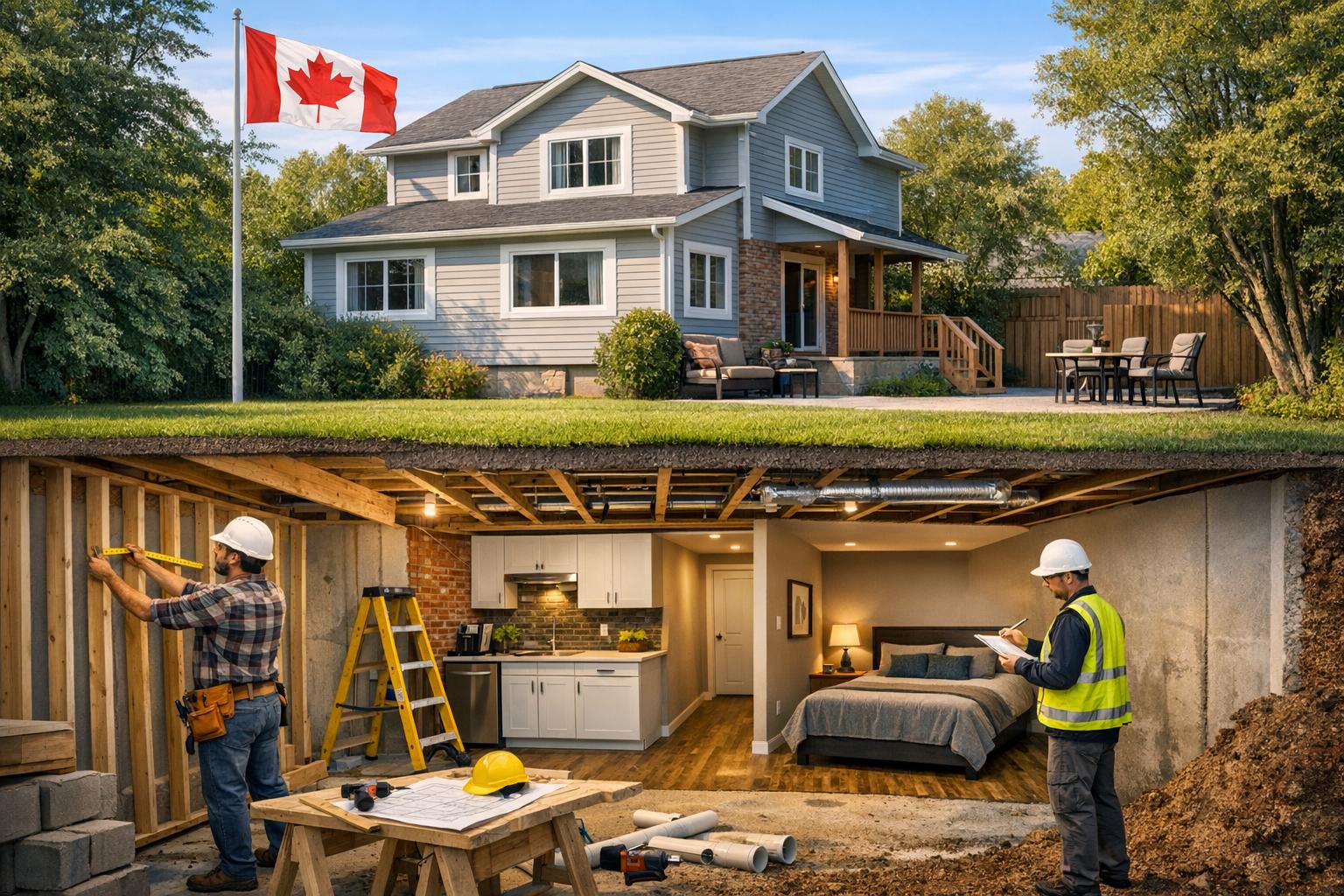
A basement ADU conversion in Canada can turn unused space into a safe, legal rental. This post is a complete, actionable roadmap for turning a basement into a legal, rentable secondary suite that meets Canadian regulations. For Ontario examples, start with local guidance like Bedrock Basements’ overview and the City of Hamilton’s ADU page.
“A basement ADU, when done right, adds rental income and long-term home value — but it must be permitted and built to code.”
1) Is your basement suitable? (basement conversion feasibility checklist)
Feasibility means technical, regulatory and financial checks you must do BEFORE full design/permits. This is the fastest way to avoid expensive rework in your basement conversion.
Feasibility checklist (do these checks first)
Ceiling height (measure, map, record)
Measure continuous finished ceiling height. Target: minimum 6 ft 5 in (195 cm) continuous clearance; beams/ducts may dip to 6 ft 2 in (188 cm) only over limited runs—record measurements at multiple points and draw a simple height map. This helps you see if you’ll need framing changes or underpinning. (Bedrock Basements)
Moisture and waterproofing (find the real problem, not the paint)
Check for chronic damp, efflorescence, cracks, prior repairs. Pull back a small section of wall finish where possible; recommend professional inspection and describe common remediation (exterior excavation & membrane, interior perimeter drainage + sump pump). If you ignore water, your finishes can fail fast. (Bedrock Basements)
Radon (test before you close walls)
Test radon pre-construction with a long-term test kit; if >200 Bq/m3 plan mitigation (sub-slab depressurization). Plan it early so you can route pipes and fans cleanly. (Bedrock Basements)
Structural constraints (don’t guess what’s load-bearing)
Locate load-bearing walls, support beams and footings; note any columns, grade beams, or evidence of settlement—record photos. If you want bigger openings or a new stair, you may need an engineer. (Bedrock Basements)
Utilities capacity & locations (map everything)
Map furnace, hot water tank, electrical panel, incoming sewer lateral and gas meter. Note whether mechanicals are in the intended unit footprint and whether capacity upgrades (bigger hot water tank, electrical subpanel) may be needed. This affects layout and cost more than most people expect. (Bedrock Basements)
Separate entrance feasibility (access + grading + rules)
Check side/rear access options; document grade and slope, presence of utility lines; note municipal rules that may restrict front-door secondary suite entrances. Also check if you can add steps, a landing, lighting, and safe snow/ice management. (Bedrock Basements, City of Hamilton ADU)
Quick size-based cost/time estimate (set expectations)
- Small studio (~400 sq ft): CAD $80,000–$120,000, timeline 3–4 months.
- Medium 1‑bed (~600 sq ft): CAD $120,000–$150,000, timeline 4–5 months.
- Large 2‑bed: CAD $150,000–$180,000+, timeline 5–6 months.
Sources: HomeReno ADU cost comparison, Bedrock Basements.
Action steps (what to do this week)
- Measure and sketch the basement.
- Photograph utilities, cracks, damp spots, and windows.
- Create a one-page feasibility memo: height map, utility map, key photos, rough layout idea.
- Bring it to a pre-application meeting with your municipality.
2) Canadian regulations for a legal ADU or secondary suite (zoning + code + fire safety)
For basement ADU conversion Canada, rules come in layers: the National Building Code of Canada (NBCC) is a model code; provinces adopt and enforce building codes; municipalities control zoning and issue permits. Use the 2025/2026 NBCC as a reference point, and confirm updates with your local authority before finalizing drawings. Refer to the National Building Code via the NRC site for the model code text.
Reference: National Building Code (NRC) and the Canadian Regulations guide.
Illegal suite vs legal ADU vs secondary suite (use these definitions)
- Illegal suite = any residential unit created without permits; risk: fines, insurance denial, teardown orders.
- Legal ADU = permitted, code-compliant unit with occupancy certificate.
- Secondary suite = the local/provincial term (e.g., Ontario uses “secondary suite”) for a permitted ADU.
Common legal requirements to check (most cities have these)
Zoning/density
Confirm ADU allowance on your lot type (single-detached/semi/row). Check municipal zoning maps for permitted uses and any cap on units. If zoning blocks it, you may need a variance or a different plan. (Hamilton ADU page)
Minimum room sizes & ceiling height
Use the NBCC/minimums and municipal bylaws — record measured compliance (6’5″ / 195 cm rule example). (Bedrock Basements)
Egress windows/doors
Provide egress windows with required clear opening and door egress per code. If you need bigger windows, plan for cutting concrete, adding lintels, and building window wells. (Bedrock Basements)
Fire separation & sprinklers
Describe 1-hour fire-rated separation assemblies, self-closing fire doors, and where sprinklers may be mandated by municipality/NBCC. (Bedrock Basements)
Sound transmission
Note STC rating guidance (specify double drywall, resilient channels) as required by many municipalities. (Bedrock Basements)
Parking requirements
Some municipalities require an extra parking stall; near transit or in certain zones parking may be waived — check local rules. (Hamilton ADU page, Frontier Building Group)
Separate meters
Explain when separate hydro/gas/water meters are required or optional — note billing/apportioning options. (Bedrock Basements)
Plumbing fixture counts
Remind to check provincial code for fixture counts per occupant (water closets, sinks, showers). (Bedrock Basements)
Municipal variation (how to localize your plan)
Ontario example: Hamilton has a clear ADU page and process notes. For BC, Alberta, and other provinces: check your city’s zoning map and secondary suite page. Start local with your municipal zoning map + “additional dwelling unit” search.
Typical municipal questions to ask at pre-application (verbatim)
- “Is an ADU/secondary suite permitted on my lot?”
- “Are there frontage, parking or lot coverage limits affecting my plan?”
- “What minimum ceiling height and egress dimensions do you enforce for basement suites?”
- “Do you require sprinkler systems or 1-hour fire separations for basement suites in my zone?”
- “Which inspections will be required and what are expected timelines?”
- “Are there grant programs or fee rebates available in my municipality?”
3) Planning & design for a secondary suite (layout, egress, soundproofing)
Good planning & design makes your secondary suite safer, easier to rent, and easier to get approved. Your goals: safety, compliance, comfort, and marketability.
Pick a layout that fits your basement (and the rental market)
- Studio: ~350–450 sq ft — open living/kitchen + separate bathroom; require egress window from sleeping area.
- 1‑bedroom: ~500–700 sq ft — separate bedroom with closet, living/kitchen, 4‑piece bath.
- 2‑bedroom: 600–900+ sq ft — two bedrooms, 4‑piece bath, storage; check occupant load for egress requirements.
Source: HomeReno ADU cost comparison.
Egress windows, doors, and stairs (code-driven design)
Egress windows
Minimum clear opening dimensions derived from NBCC/municipal rules; spec a window well with ladder where required. Plan drainage in the well so you don’t create a water trap beside your foundation. (Bedrock Basements)
Exterior door + stairs
Exterior door: suggest 36 in clear width if possible; stairs to code: max 7.75 in rise, min 9 in run, min width 36 in — verify local code and state “confirm with local building department.” (Bedrock Basements)
Fire & life safety (what keeps a basement suite safe)
- 1-hour fire separation walls between primary dwelling and ADU where required
- Self-closing fire doors
- Smoke detectors hard-wired & interconnected
- CO detectors in sleeping areas per NBCC/municipal rule
- Emergency lighting & illuminated exit signage if required by local authority
Source: Bedrock Basements.
Mechanical systems and ventilation (MEP)
Basements need good air, stable heat, and safe exhaust. Plan MEP before you frame.
HRV/ERV ventilation
HRV/ERV: require mechanical ventilation for below-grade habitable spaces — specify model sizing instructions and include commissioning note. (Bedrock Basements)
Heating options
– Shared central system: lower install cost, but comfort and control can be harder.
– Separate ducting or mini-split heat pump: better tenant control and comfort, but higher upfront cost and possible electrical upgrades.
Hot water
Indicate when a larger tank or instant heater is needed; consider indirect feed from main tank with dedicated loop if sharing. (Bedrock Basements)
Soundproofing, insulation, moisture control
- Resilient channel + double drywall on partition walls for sound
- Batt insulation R-values per 2026 code (confirm locally)
- Vapour barrier placement per climate zone
- Drain tile & sump pump where needed
- Radon mitigation: sub-slab depressurization if tests high
Accessibility and future-proofing
- Consider 32–36 in clear doorways
- Zero-step entry where possible
- Backing in bathroom walls for future grab bars
- Design a bedroom space that can adapt
Sources: Bedrock Basements, HomeReno.
4) Permits & approvals step-by-step guide (how to get a legal ADU)
This section is a clear procedural checklist to obtain permits & approvals for a legal ADU under Canadian regulations.
Permits & approvals (numbered steps — use verbatim)
- Pre-application call/visit to local building/planning department — bring feasibility memo and sketches.
- Prepare submission package: site plan, floor plans, elevations, structural drawings for changes, HVAC/MEP drawings, energy compliance report and specifications.
- Apply for zoning variances if required (parking, setbacks) and attach rationale.
- Pay application & review fees (typical range CAD $1,000–$5,000) — attach sample municipal fee range citation.
- Address reviewer comments; resubmit revised drawings as required.
- Permit issuance and conditions (permit card, required inspections schedule).
Sources: Bedrock Basements, HomeReno, Hamilton ADU page.
Typical documents checklist (copy-ready)
- Completed permit application form
- Site plan to scale showing lot, grades, entry location and parking
- Floor plans (existing & proposed) with dimensions and room labels
- Elevations showing proposed exterior changes/entry
- Structural drawings (if underpinning or openings)
- MEP drawings (electrical load calculations, HVAC schematic, plumbing schematic)
- Energy compliance report
- Professional seals where required (architect/engineer)
- Proof of payment for fees
- Contractor insurance & WSIB clearance
Timeline expectations (and how to speed it up)
Typical review time 2–6 weeks; total permit process 1–3 months depending on complexity. Expedite by pre-submission meeting, complete documents, and addressing obvious code issues in advance.
When you likely need an architect/engineer
- Structural modifications (underpinning, new openings)
- Complex MEP changes
- Variance applications
- Underpinning and structural design
For Ontario-specific permitting guidance, see the ADU Permitting in Ontario Guide. For British Columbia guidance, see the ADU Permitting in British Columbia Guide. For financing, see the ADU Financing Canada Guide.
5) Construction step-by-step guide (basement conversion phases that pass inspections)
This construction step-by-step guide breaks work into phases, with what inspectors will check at each stage for a legal ADU.
Pre-construction (before any demo)
- Obtain 3 competitive written quotes; require contractor insurance certificate, WSIB clearance, references and a written contract with payment schedule, warranty, change-order process and completion milestone dates.
Phase 1 — Preparation
- Temporary protection (dust barriers)
- Move or protect existing mechanicals
- Prepare for mould remediation if present (containment, HEPA filtration)
- Site cleanup and materials staging
Phase 2 — Structural & rough‑in
- Underpinning/lowering floor: include engineered drawings, excavation safety plan and dewatering; confirm shoring and inspection schedule.
- Framing: stud walls layout, fire separation wall assemblies (specify firestop locations).
- Egress window installation: well dimensions, drainage, ladder access and flashing details.
- Rough plumbing: layout waste stacks, venting, and fixture locations; rough in hot & cold lines with adequate slope.
- Rough electrical: panel capacity check, run circuits, install subpanel if required, emergency lighting wiring if required.
- HVAC duct runs or mini‑split mounting locations; HRV/ERV rough‑in ductwork and condensate routing.
Sources: Bedrock Basements, SuiteBuilders.
Phase 3 — Rough inspections
- Structural shoring/underpinning sign-off (if applicable)
- Rough plumbing water & sanitary piping
- Rough electrical circuits & bonding
- HVAC ducting & combustion air clearances
Have plans on-site, permit card visible and labeled circuits.
Phase 4 — Insulation, fire‑stopping & soundproofing
- Install insulation to code R-values
- Vapour barrier placement
- Sound-rated assemblies (document STC targets)
- Firestop sealing of service penetrations
Phase 5 — Drywall, tape/finish, painting
- Moisture-resistant drywall where required
- Surface prep for finishes
- Control humidity and drying time to avoid mould
Phase 6 — Finish carpentry & fixtures
- Install cabinets/kitchen fixtures
- Install sanitary fixtures (toilet, sink, shower/bath)
- Install lighting and switchgear
- Finalize flooring
Phase 7 — Final MEP connections & commissioning
- Connect appliances
- Set heating setpoints
- Commission HRV with airflow balancing
- Test smoke & CO alarms
- Run full electrical load test
Phase 8 — Final inspections & occupancy
- Schedule final inspections with municipal authority
- Prepare permit card, as-built drawings and required certification paperwork
- Obtain certificate of occupancy (or equivalent)
Inspection checklists (copy-ready bullets)
Rough-in checklist
– Piping slopes
– Trap primers where required
– Electrical grounding & conductor sizes
– Fireblocking at top/bottom of walls
– Combustion air clearances
Final checklist
– Egress windows/doors
– Smoke/CO alarms
– Hot water delivery
– Proper clearance around appliances
– Accessible shutoffs
– Occupancy signage if required
6) Inspections, final approvals & occupancy (Certificate of Occupancy for a legal ADU)
To make your unit a legal ADU (or secondary suite), you must pass inspections and complete the occupancy steps under Canadian regulations.
What inspectors will check (copy language)
“Egress: window/door dimensions and path; Fire separation: wall assemblies & door hardware; Alarms: smoke & CO detectors hard-wired & interconnected; Utilities: safe hot water and sanitary drainage layout; Electrical: breaker labeling and safe terminations.”
How to prepare for each inspection (verbatim)
- “Have permit and drawings on-site and available to inspector.”
- “Label circuits and mechanical devices.”
- “Clear access to egress windows, mechanical rooms and panels.”
- “Provide contractor/installer contact on site.”
Final occupancy sequence (keep it simple)
Pass final inspections → apply for Certificate of Occupancy (or municipal equivalent) → register the ADU as a legal dwelling with the municipality if required.
Why you shouldn’t rent an unpermitted suite
Potential fines, insurance denial, mortgage/resale complications and possible forced removal. (Bedrock Basements)
7) Costs, financing & ROI (budget template for basement ADU conversion Canada)
If you’re budgeting for a basement ADU conversion in Canada, start with a real range.
Typical costs (2026)
Typical 2026 Toronto ranges: CAD $80,000–$180,000 depending on scope. (Source: HomeReno, Bedrock Basements)
Cost breakdown (starter budget)
| Category | % Range | Example CAD Range |
|---|---|---|
| Structural/Egress | 20–25% | $20K–$40K |
| MEP upgrades | 25–35% | $25K–$50K |
| Finishes/kitchen/bath | 20–30% | $20K–$50K |
| Permits/design/engineering | 3–10% | $5K–$15K |
| Contingency (recommended) | 10–20% | $12K–$27K |
Financing options (common in Canada)
- HELOC: commonly used for renovations — variable rate, fast access.
- Renovation loan / unsecured loan: for lower-scope builds.
- Construction mortgage: for large-scale structural projects.
- Grants & incentives: example — Chatham‑Kent ADU incentive up to CAD $32,000 (Chatham‑Kent ADU page).
ROI worked example (copy-ready)
“Example: $24,000 annual rent (gross) at 80% occupancy → $19,200 net rent; on a CAD $130,000 project, payback ~6.8 years before tax/maintenance. Include assumptions: property tax increase, vacancy, management costs.”
Tax & insurance implications (exact phrasing)
- “Declare rental income on tax returns; consult an accountant for allowable expenses and depreciation rules.”
- “Notify insurer — premiums often rise for rental units or unpermitted suites (unpermitted risk = possible denial).”
8) Renting, operating & maintenance for a secondary suite (leases + utilities)
Once your legal ADU is approved, treat it like a long-term housing business: clear lease, clear safety plan, clear maintenance routine.
Tenant onboarding & legal compliance (renting)
- Use provincial tenancy lease templates (link to your provincial tenancy board page).
- Screening checklist: Government ID, references, credit check, employment verification.
Maintenance checklist (copy-ready)
- Seasonal HVAC inspection & filter change (spring & fall).
- Quarterly test of smoke and CO alarms (record tests).
- Sump pump check before heavy-rain season; backup battery/secondary pump where required.
- Egress window well clearing annually and ladder maintenance.
Utilities & billing options (simple and fair)
- Separate meters: clearer billing, but higher setup cost and sometimes extra approvals.
- Apportioned billing: simpler setup, but you must explain the split.
Sample lease clause (adapt for your province):
“Utilities: Tenant is responsible for [hydro/gas/water] as follows: [separately metered OR apportioned at __% based on floor area]. Payment due within __ days of invoice.”
9) Resources, permit checklist & downloads (legal ADU tools)
Use these resources to speed up your basement ADU conversion and reduce mistakes with Canadian regulations.
Authoritative links (bookmark these)
- Bedrock Basements — Ontario guidance
- Hamilton ADU page
- SuiteBuilders — basement apartments
- HomeReno — ADU cost comparison
- Chatham‑Kent ADU grant page
- National Building Code (NRC)
Contact list template (copy-ready)
- Inspector contact
- Local planning intake
- Architect
- Structural engineer
- Licensed plumber
- Licensed electrician
- HVAC contractor
- Radon mitigator
10) FAQs & troubleshooting (legal ADU answers)
Can I install a kitchen?
Yes if plumbing, ventilation and egress meet code. Next step: confirm your kitchen exhaust/venting plan and show it on MEP drawings for permit review. (Bedrock Basements)
Do I need a separate furnace?
Not always; shared systems are acceptable if capacity and fire separation meet code. Next step: have an HVAC pro confirm sizing, then commission and balance after install. (Bedrock Basements)
What if my ceiling is too low?
Measure precisely; options: underpin to lower slab (engineered), or apply for variance but expect limited approvals—consult engineer. Bring your height map to the building department before paying for drawings. (Bedrock Basements)
How long does permitting take?
Typical 1–3 months; expedite by pre-application meeting and complete submissions. Next step: submit site plan, floor plans, MEP, and energy report to reduce rework cycles. (HomeReno)
What are common pitfalls & fixes?
- Moisture — install drainage & sump
- Improper egress — install compliant windows/door
- No permits — stop and apply immediately
Next step: do moisture + radon checks before insulation and drywall. (Bedrock Basements)
Troubleshooting checklist (quick site problems)
- Mould: stop work, fix moisture source, use proper containment and HEPA filtration.
- Radon: retest; plan sub-slab depressurization if high.
- Septic capacity (rural): verify system capacity before adding fixtures.
- Grade/drainage: ensure downspouts, grading, and window wells drain away from the house.
Calls to action & next steps (basement ADU conversion Canada)
- Book a free pre-application meeting with your local building department — bring your feasibility memo.
- Download the Permit Checklist PDF and Contractor Bid Worksheet from your project downloads page.
- Get three contractor quotes and schedule a consultation with a local architect/engineer — recommended before permit submission.
Suggested internal links (add on publish): Downloads page: “Permit Checklist PDF” + “Contractor Bid Comparison Spreadsheet”; Blog category: “Basement Renovations”; Services/contact page: contractor quote request.
All regulatory references updated for 2026 — always confirm current provincial/municipal rules before starting work.
Internal resource links to explore: Ontario ADU zoning guide, Canadian Regulations guide, Permitting Ontario guide, Permitting BC guide, Financing Canada guide.
Leave a Reply