

Estimated reading time: 12 minutes
Key Takeaways
- An ADU greenhouse is a compact greenhouse pod designed to support an accessory dwelling unit or tiny home with efficient, small-space growing.
- In 2026, rising grocery costs and interest in local food production make these pods especially relevant for Canadian homeowners.
- Success in Canadian climates depends on insulation, glazing, ventilation, humidity control, snow-load design, and realistic crop planning.
- For most winter setups, greens, herbs, seedlings, and microgreens offer the best return compared with heat-hungry summer crops.
- Permits, zoning, and structural review matter, especially for attached, rooftop, or utility-connected greenhouse pods.
Table of contents
- What is an ADU greenhouse pod?
- Why ADU greenhouse pods make sense for tiny homes and urban agriculture
- Core design rules for Canadian climates
- Heating and season-extension strategies for year-round food production
- Best layouts and growing systems for a small ADU greenhouse
- Crop selection for year-round growing in Canadian climates
- Simple crop calendar for Canadian homeowners in 2026
- Ventilation, humidity control, lighting, and automation
- Water, fertility, and pest management in a compact greenhouse pod
- How to integrate an ADU greenhouse into daily tiny home living
- Permits, zoning, and safety checks for Canadian municipalities in 2026
- Costs, operating expenses, and ROI
- Mini case study ideas and example scenarios
- Step-by-step starter checklist for homeowners
- Frequently asked questions
- Resources and planning points
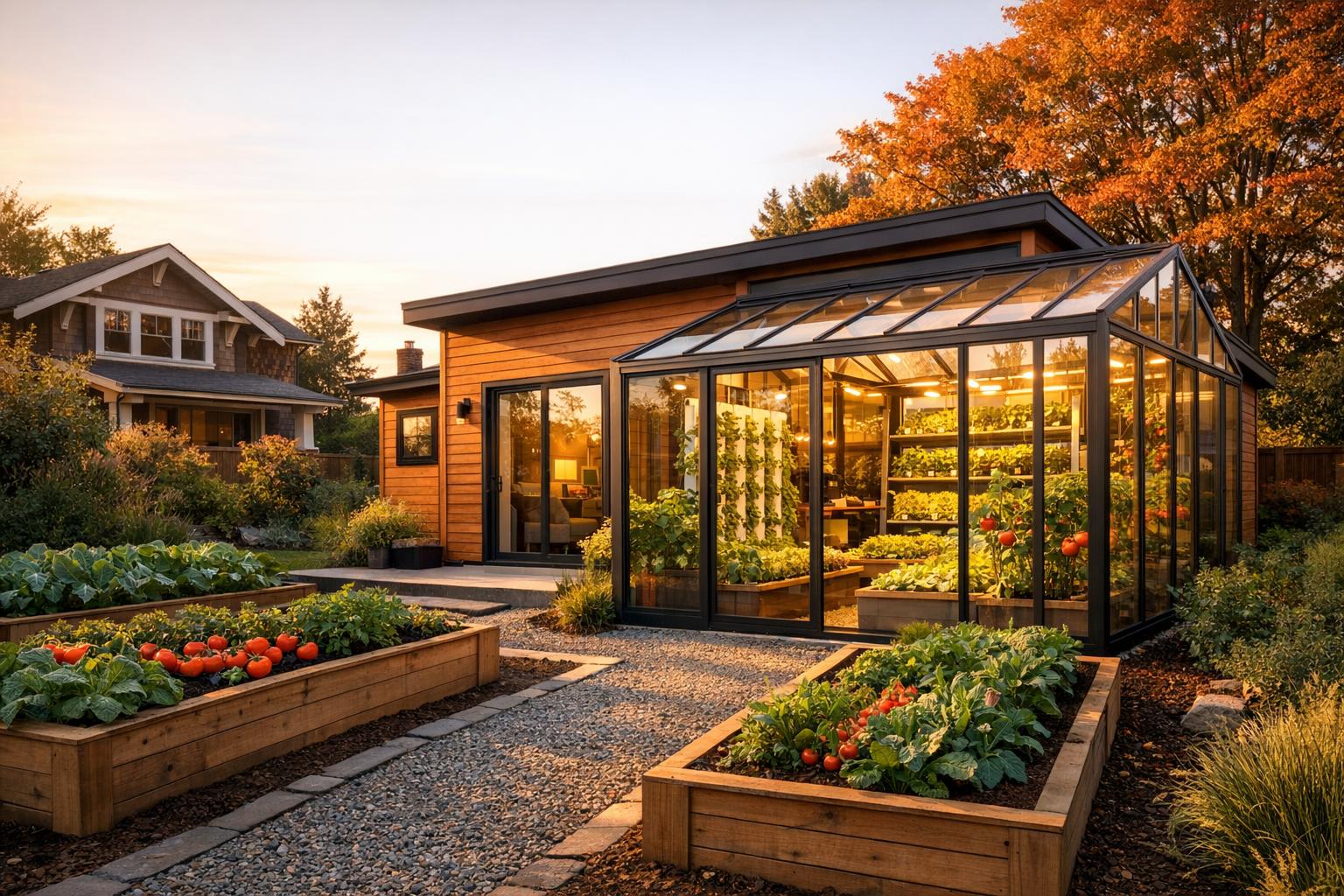
An ADU greenhouse is a compact greenhouse pod built to work with an accessory dwelling unit or tiny home. It can be attached, placed beside it, or built as a small standalone growing space.
In 2026, this idea matters more than ever because more Canadians want local food production, grocery costs are high, and city lots are often small. For homeowners interested in tiny home gardening and urban agriculture, a greenhouse pod can be one of the smartest ways to turn underused space into a productive growing area.
It also fits into the broader shift toward resilient small-scale living seen in Tiny Home Living: Discover the Big Benefits and Lifestyle Rewards of Living Small, Tiny Homes Urban Agriculture: Exploring Canada’s Sustainable Living Trend and 2025 Innovations, Community Gardens Tiny Homes Canada: Building Sustainable and Connected ADU Communities with Shared Green Spaces, Urban Farming Tiny Homes: Innovative Canadian Design Solutions and Practical Guide for 2025, and Urban Gardening ADU: Innovative Solutions for Food Security and Community Empowerment in Canadian Cities.
In Canadian climates, success depends on smart design. Cold weather, snow, wind, moisture, and energy use all shape what works. The right structure, heating plan, crop list, and humidity control make year-round growing much more realistic.
What is an ADU greenhouse pod?
An ADU greenhouse pod is a small, efficient growing enclosure made for limited residential space. It supports tiny home gardening without needing a full backyard farm. These pods are designed to do more with less space, less heat loss, and less wasted movement.
Common forms include:
- A lean-to greenhouse attached to a south-facing wall
- A freestanding pod in the yard
- A vestibule and greenhouse hybrid near an entry
- A modular or prefab unit delivered in parts for faster setup
Some homeowners also consider terrace or rooftop placement. That can work, but only if engineering, drainage, access, and local rules allow it. If you are exploring rooftop or elevated options, related planning challenges are similar to those covered in Rooftop ADU: Innovative Solutions for Urban Housing and Densification in Canadian Cities, Rooftop Tiny Homes: Innovative Solutions for Urban Housing Challenges in Canadian Cities, and Transforming Rooftop Spaces for ADUs: Innovative Decks, Gardens, and Outdoor Living Solutions for Canadian Homes.
Typical size ranges are easy to picture:
- Very compact: about 4–8 m²
- Mid-size: about 8–15 m²
- Larger small-scale pod: about 15–25 m²
Even a very small pod can handle useful jobs, such as:
- Starting seedlings
- Growing herbs and leafy greens
- Producing microgreens
- Extending the season for tomatoes or peppers
- Overwintering tender plants
Prefab pods usually offer quicker assembly, cleaner detailing, and parts designed for weather. DIY builds may cost less upfront, but they need careful planning for insulation, ventilation, snow load, and code compliance.
For many homeowners, the best choice depends on whether speed, budget, or customization matters most.
If you are comparing build approaches, see Prefab ADU vs. Custom Build: A Comprehensive Guide on Construction Cost, Build Timeline, and Sustainable Materials and DIY Prefabricated ADU Kit: The Ultimate Canadian Homeowner’s Guide to Building Your Backyard Suite.
Why ADU greenhouse pods make sense for tiny homes and urban agriculture
An ADU greenhouse makes small-space food production easier and more reliable. Instead of relying only on outdoor beds, you can grow close to the kitchen in a controlled space. That matters for both tiny home gardening and wider urban agriculture goals.
The practical benefits are simple:
- Fresh herbs and greens are only a few steps away
- Weather is less of a problem than in open beds
- Pests are easier to manage than in an exposed garden
- Harvest windows are longer
- Narrow side yards and underused spaces become productive
For homeowners, there are lifestyle benefits too. A greenhouse pod can make a small property feel richer and more alive. Plants add colour, scent, and a sense of calm.
If the ADU is rented, the pod may also work as a useful amenity, especially for tenants who value fresh food and green living. This also aligns with the amenity and value-boosting themes explored in Backyard Homes Canada: A Complete Guide to Backyard Suites, Secondary Dwellings, and Increasing Property Value, How a Secondary Unit Can Boost Property Value and Rental Income: Key Benefits for Canadian Homeowners, and ADU Investment: A Comprehensive Guide to Profitable Canadian Real Estate Opportunities in 2025.
For communities, this setup supports urban agriculture in a practical way. It helps reduce the distance food travels, teaches children where food comes from, and adds local growing capacity without needing large land parcels. It also fits with community-oriented planning ideas in Urban Infill: How Tiny Homes and ADUs Drive Gentle Density Solutions in Canadian Cities and ADU-Friendly Neighbourhoods Canada: A Complete 2025 Guide to Secondary Suites, Tiny Homes, and Housing Innovation.
Still, expectations should stay realistic. A compact pod will not replace a full grocery bill, especially in colder Canadian climates. But it can steadily produce:
- Salad greens
- Herbs
- Seedlings
- Microgreens
- Some high-value crops like basil or strawberries
That makes it a strong small-scale resilience tool, not a total food solution.
Core design rules for Canadian climates
Canadian climates vary a lot. A greenhouse that works in coastal British Columbia may struggle on the Prairies or in northern Ontario. An ADU greenhouse should be designed for the exact site, not copied from a warm-climate example.
Orientation
Good orientation improves winter food production without raising energy use.
- Aim for south or south-east exposure when possible
- Reduce shade from fences, trees, and nearby buildings
- In dense cities, winter sun access matters even more because days are short
Glazing
Glazing is the clear material that lets light in, such as glass or polycarbonate.
- Double-wall or multiwall glazing is often better for cold climates than single-layer material
- It reduces heat loss
- Diffused glazing spreads light more evenly and can lower summer scorching
Insulation
Insulation is key wherever winter stays below zero for long periods.
- Insulated north walls and knee walls help reduce heat loss
- Wind-exposed sites benefit most
- R-value means resistance to heat flow: a higher R-value means better insulation
Airtightness
Small leaks can create big problems in winter.
- Seal panel joints well
- Add weatherstripping to doors and vents
- Check all cable, pipe, and fastener penetrations
A drafty pod costs more to heat and creates uneven plant growth. For more cold-climate envelope strategies, see How to Build a Winter-Proof Tiny Home Designed for the Harsh Canadian Climate, Cold Climate Tiny Home Construction: Comprehensive Strategies for Maximizing Energy Efficiency in Northern Canada, and Climate-Responsive Tiny Home Design: Essential Strategies for Resilient Canadian Construction and Sustainable Living.
Thermal mass
Thermal mass means materials that store heat during the day and release it later. This helps reduce temperature swings.
Examples include:
- Water barrels
- Stone
- Masonry
- Dense flooring
Snow load
Snow load is the weight of snow on the roof. Canadian greenhouse pods need stronger engineering than many hobby kits sold for mild regions.
- Roof slope matters
- Frame strength matters
- Local snow load standards matter
Wind
A pod in an open yard may face strong winter gusts.
- Anchor it well
- Add windbreak fencing or planting where allowed
- Protect doors and exposed corners
Humidity and condensation
Condensation happens when warm, moist air hits a cold surface and turns into water. In a greenhouse, that can mean wet framing, mold, and plant disease.
To reduce it:
- Keep air moving
- Use insulated framing details
- Vent moist air when needed
- Consider dehumidification in tight winter setups
A good pod balances warmth, light, airflow, and moisture rather than focusing on only one feature.
Heating and season-extension strategies for year-round food production
True year-round food production in Canadian climates usually needs both passive design and active heating. In the coldest regions, winter crops may need lower expectations or higher energy inputs.
Passive solar design
- Capture as much winter sun as possible
- Reduce night heat loss
- Use insulated curtains or thermal covers when useful
Thermal mass support
Thermal mass does not replace heating, but it can smooth out day-to-night swings.
- Water barrels are common
- Masonry can also help
- Best used with good sun exposure
Electric heating
For a small ADU greenhouse, electric heat is often the easiest option.
- Easy to install
- Simple to automate
- Works well with thermostats
The trade-off is operating cost, especially during dark, cold periods.
Propane or gas backup
- Useful in very cold conditions
- Needs careful ventilation and safety planning
- May be less suitable in very compact attached pods unless properly designed
Solar thermal or air collectors
- Helpful as a supplement
- Usually not enough by themselves in deep winter
Ground-to-air or geothermal-inspired systems
- Can improve temperature stability
- Need more planning and installation work
- Better suited to custom builds than simple starter pods
Compost heat
Compost can release heat as it breaks down, but it is not a reliable standalone source for most homeowners. It works better as a niche supplement.
Winter growing reality
For many people, the smartest winter strategy is not trying to grow summer crops in January. It is focusing on cold-tolerant, slower-growing crops that can still provide useful harvests with lower heating costs.
Helpful frost protection tools include:
- Row covers inside the greenhouse
- Root-zone heating
- Night curtains
- Sealing drafts around doors and vents
That approach often makes year-round tiny home gardening more affordable and less stressful. It also pairs well with heating-focused guides like Heat Pump for Tiny Home: Efficient Heating and Cooling Solutions for the Canadian Climate, Hydronic Heating Tiny Homes: Efficient Radiant Floor Solutions for Warm and Energy-Saving Canadian Winters, and Eco-Friendly Heating ADU Guide 2026: Tech, Costs, Case Studies.
Best layouts and growing systems for a small ADU greenhouse
Layout has a huge effect on food production. In a small ADU greenhouse, poor layout wastes light, floor space, and time.
In-ground beds
- Can help moderate root temperature
- Good for stable growing zones
- Less flexible if you want to change the layout later
Raised beds
Raised beds are often the best middle option for tiny home gardening.
- Easier on the back
- Better soil control
- Clear planting zones
- Good use of edge space
Containers
- Great for herbs and dwarf varieties
- Useful for rental-friendly or movable setups
- Need more frequent watering
Hydroponics
Hydroponics means growing plants in water with nutrients instead of soil.
- Very efficient for greens and herbs
- Can increase food production per square metre
- Needs monitoring of nutrients, pH, and cleanliness
Aeroponics
- Very space-efficient
- More technical
- Less forgiving if equipment fails
Aquaponics
- Interesting and productive
- Usually more complex than most first-time homeowners need
Space-saving layout ideas
A compact pod can grow more with smart planning:
- Vertical shelving for microgreens and starts
- Tiered benches for seedlings
- Hanging rails for herbs
- Movable benches for flexible use
- A narrow central path with productive edges
Practical rules help too:
- Keep tall plants where they will not block winter sun
- Leave enough aisle space for harvesting and cleaning
- Put water storage near the entry
- Separate seedling areas from mature fruiting crops when possible
If you want more small-space planning ideas, see Tiny Home Design in Canada: Expert Tips for Maximizing Small Living Spaces and Revolutionizing Tiny Home Storage: Smart Solutions, Innovative Design, and ADU Organization for Maximum Space Efficiency.
Crop selection for year-round growing in Canadian climates
In Canadian climates, crop choice matters as much as the structure. The best crops match the light level, temperature, and available growing area.
Best winter or low-light crops
- Lettuce
- Spinach
- Kale
- Asian greens
- Arugula
- Parsley
- Cilantro
- Chives
- Microgreens
- Overwintered scallions
Shoulder season crops
- Swiss chard
- Bok choy
- Pea shoots
- Radishes
- Baby turnips
- Seedlings for outdoor transplanting
Warm-season crops for brighter months
- Tomatoes
- Peppers
- Cucumbers
- Basil
- Strawberries in containers or vertical towers
For winter, the best strategy is to focus on crops with:
- Quick turnover
- Compact growth
- Cold tolerance
- High value per square metre
For summer, the strategy changes:
- Add shading
- Increase ventilation
- Use trellises for vertical growth
- Support pollination if the pod stays closed
It is important to be realistic. Fruiting crops in winter usually need more heat and extra lighting. That raises cost fast. For most tiny home gardening setups, greens and herbs give the best return in winter.
Simple crop calendar for Canadian homeowners in 2026
This crop calendar is broad. Exact timing depends on province, hardiness zone, sun exposure, and how much heating or lighting your ADU greenhouse uses.
| Season / Month | Sow or Plant | Harvest | Greenhouse Tasks | Heating / Light Notes |
|---|---|---|---|---|
| Late winter | Microgreens, spinach, lettuce, herbs, spring seedlings | Microgreens, early greens | Watch condensation, clean trays, start transplants | Low light is common; use LEDs for seedlings if needed |
| Spring | Chard, bok choy, radishes, peas for shoots, tomatoes and peppers for transplant | Greens, herbs, microgreens | Increase venting, harden off plants if moving outdoors | Heating may still be needed at night |
| Summer | Tomatoes, cucumbers, peppers, basil, strawberries | Heavy harvest of warm-season crops | Vent daily, prune, trellis, manage watering | Shade cloth may be more important than heating |
| Fall | Kale, spinach, arugula, parsley, cilantro, overwinter crops | Greens, herbs, late summer crops | Check seals, test heaters, inspect fans and backup power | Start winter crops before day length drops |
| Winter | Cold-tolerant greens, scallions, microgreens | Slow but steady greens harvest | Control humidity, reduce drafts, clean surfaces often | Heat and lighting depend on region and crop goals |
Homeowners in colder inland or northern Canadian climates should expect slower winter growth and shorter harvest windows unless they use stronger heating and supplemental lighting.
Ventilation, humidity control, lighting, and automation
A productive pod is not just warm. It is controlled. In many cases, environmental control is what separates a useful ADU greenhouse from one full of stressed plants.
Ventilation
Ventilation removes excess heat and stale air.
- Roof vents, side vents, and operable doors support natural airflow
- Fans help when passive airflow is not enough
- Summer overheating can happen quickly
- Winter humidity can also build up fast
Humidity control
Too much humidity encourages fungal disease and condensation. Too little can stress seedlings.
Helpful tools include:
- Fans
- Strategic venting
- Proper plant spacing
- A dehumidifier in tightly enclosed pods
Supplemental lighting
LED grow lights help when natural light is weak.
Best uses include:
- Winter greens
- Seed starting
- Cloudy regions
- Multi-level shelves
In winter, light is often a bigger limit than temperature.
Temperature control
- Thermostats for heaters
- Automatic vent openers
- Shade cloth for summer
- Freeze or overheat alarms
Monitoring and automation
Start simple and automate the highest-risk tasks first.
Useful tools:
- Temperature sensors
- Humidity sensors
- Soil moisture meters
- Smart plugs or controllers
Simple examples:
- Fan turns on above a set temperature
- Heater turns on below a set point
- Lights run on a timer for seedling shelves
In most Canadian climates, freeze protection and summer venting are the first jobs to automate. Smart systems like those in Smart Home Technology for ADUs: A Complete Guide to Maximizing Comfort, Security, and Efficiency in Canadian Tiny Homes, Smart Home Maintenance Tiny Homes: How Automation Enhances Safety, Upkeep, and Longevity in Canadian Living, and Air Quality Sensor Technology for Canadian Tiny Homes: Smarter Indoor Health Solutions for 2026 can make this easier to manage.
Water, fertility, and pest management in a compact greenhouse pod
In a compact ADU greenhouse, problems can spread quickly. Good care routines support healthier plants and steadier food production.
Water management
Drip irrigation is often the best option for small pods.
- Efficient
- Consistent
- Helps reduce wet foliage and disease
Hand watering works for very small setups, but it can be uneven. Rainwater collection may help where it is allowed and where storage is practical. Greywater use is often more restricted than people expect, so local rules matter.
If you are exploring water strategies, see Rainwater Harvesting for Tiny Homes in Canada: Eco-Friendly Water Management Solutions, Urban ADU Rainwater Recycling: Practical Water Solutions for Small City Lots and Sustainable Urban Living, and Greywater Recycling ADU: A Practical Guide to Designing, Building, and Complying with Canadian Standards for Off-Grid Living.
Fertility
Soil systems can use:
- Compost
- Worm castings
- Slow-release organic amendments
- Balanced liquid feeds
Hydroponic systems need a complete nutrient solution and monitoring of pH and electrical conductivity. Too much fertilizer can cause salt buildup or lush weak growth.
Pest management
Integrated pest management means using several low-toxicity methods to prevent and control pests instead of relying only on sprays.
Strong prevention steps include:
- Sanitation
- Insect screening
- Quarantining new plants
- Avoiding overcrowding
- Cleaning tools and surfaces
Common greenhouse issues include:
- Aphids
- Whiteflies
- Spider mites
- Fungus gnats
- Powdery mildew
- Botrytis
Possible responses include:
- Sticky traps
- Insect netting
- Beneficial insects
- Better airflow
- Pruning
- Removing infected material quickly
Weekly inspection matters. In enclosed tiny home gardening spaces, small pest outbreaks can become big ones fast.
How to integrate an ADU greenhouse into daily tiny home living
The best ADU greenhouse is one that fits daily life. If it is awkward to reach, slow to maintain, or always messy, it becomes a burden.
Smart integration ideas include:
- Put the entry where it is easy to reach in winter
- Add a boot tray or mudroom transition if attached
- Store tools, feed, and harvest bins in moisture-safe containers
- Design the path so daily care takes about 10 to 15 minutes
Good dual-use options include:
- Greenhouse plus mudroom
- Greenhouse entry buffer that reduces direct cold air into the home
- Tenant amenity for an ADU
- Seed-starting zone mixed with edible and decorative plants
There are limits too. Attached pods need careful moisture control so humidity does not move into living spaces. Some very small households may be happier with a simple greens-and-herbs setup instead of trying to grow everything. That is still a meaningful form of urban agriculture.
It also complements compact-living and privacy-focused planning in Compact Living: Smart Storage, Stylish Design, and Multi-Functional Spaces for Urban Homes, Tiny Home Privacy: Essential Strategies and Design Solutions for Small Spaces and ADU Interiors, and Enhancing Privacy in Tiny Home Design: Practical Strategies for Household Harmony in Canadian Living.
Permits, zoning, and safety checks for Canadian municipalities in 2026
Rules for an ADU greenhouse depend on the municipality, the province, the size of the structure, and whether it is attached. In 2026, homeowners should treat permit review as a required planning step, not an afterthought.
Check these items before building:
- Does the greenhouse count as an accessory structure?
- What are the setback rules from lot lines?
- Are there height limits?
- Are there lot coverage limits?
- Does an attached pod change the building classification?
- Is a foundation required?
- Is structural review needed for snow and wind loads?
- Are electrical permits required for heaters, fans, or lights?
- Are plumbing permits needed for water lines or drains?
- What fire safety clearances apply to heaters?
- Where is safety glazing required near doors or impact zones?
Rooftop or deck-mounted pods need extra caution because of:
- Structural load
- Waterproofing
- Drainage
- Safe access
- Guard compliance
Use local municipal resources to confirm current requirements:
For broader permit support, see Canadian ADU Regulations: A Comprehensive Provincial Guide to Secondary Suites, Zoning Laws, and Building Permits, Navigating ADU Permits in Canadian Cities: A Complete Guide to Zoning Laws, Legal Requirements, and the Building Process, ADU Permitting in Ontario: A Comprehensive Guide for Homeowners to Navigate Regulations, Avoid Mistakes, and Ensure Compliance, and ADU Permitting in British Columbia: A Clear and Comprehensive Guide for Homeowners.
Costs, operating expenses, and ROI
Many homeowners ask if an ADU greenhouse will pay for itself. The honest answer is: sometimes partly, but it depends on the build type, climate, energy use, and what you grow.
DIY pod
- Lower upfront cost
- More owner labour
- Higher risk of poor cold-climate detailing
Prefab pod
- Faster installation
- Cleaner look
- Better weather sealing in many cases
- Higher upfront cost
Custom build
- Best fit for unusual sites and attached designs
- Highest flexibility
- Often highest total cost
Main upfront cost categories
- Structure and frame
- Glazing
- Foundation or base
- Insulation
- Fans and vents
- Heating system
- Lights
- Benches or beds
- Irrigation
- Sensors and controls
- Permit and engineering fees
Operating costs
- Electricity for heat and lights
- Water
- Nutrients or soil amendments
- Repairs and replacement parts
ROI: two ways to think about it
Direct financial return
- Savings on herbs, greens, seedlings, and premium produce
- Possible added appeal for an ADU rental
Non-financial return
- Fresher food
- Learning and hobby value
- Family education
- More resilient local food production
- Reduced food miles
In colder Canadian climates, heating costs can be the deciding factor. The best return often comes from high-value crops and smart season extension, not from trying to grow everything all winter.
If your project is partly an investment, it may also be worth reading ADU House Hacking: The Smart Path to Affordable 2025 Housing, Maximizing Returns: The Ultimate Guide to ADU Investment in Canadian Real Estate, and Understanding Hidden Costs in ADU Construction: A Comprehensive Guide for Canadian Homeowners.
Mini case study ideas and example scenarios
These are illustrative scenarios, not verified case studies.
Southern Ontario attached pod
A lean-to ADU greenhouse beside a small secondary suite grows winter greens and herbs, plus spring seedlings. Moderate electric backup heat keeps temperatures stable.
Main lesson: insulation and condensation control matter just as much as sunlight.
Vancouver backyard pod
A detached pod focuses on herbs, microgreens, and shoulder-season salad crops. Winter is milder, but humidity stays high.
Main lesson: coastal conditions need strong airflow and disease prevention.
Prairie detached pod
A freestanding greenhouse pod uses strong anchoring, thermal mass, and backup heat. Winter crops are selective because of severe cold and wind.
Main lesson: structure and heating must handle climate swings.
Montréal urban courtyard pod
A narrow-footprint pod supports tiny home gardening with vertical shelves, seedling benches, and salad greens.
Main lesson: small spaces can still support useful food production when layout is carefully planned.
Step-by-step starter checklist for homeowners
Use this simple path to plan an ADU greenhouse in 2026.
- Define your goal
- Year-round salads
- Seed starting
- Herbs
- Mixed vegetable production
- Assess your site
- Sun exposure
- Snow drift zones
- Water and power access
- Privacy and neighbour distance
- Choose pod type
- Attached
- Standalone
- Prefab
- DIY
- Pick a growing system
- Soil beds
- Containers
- Hydroponics
- Set winter expectations
- Low-energy greens
- Fully heated all-season production
- Estimate budget
- Build cost
- Annual operating cost
- Check permits and bylaws
- Setbacks
- Structure
- Utilities
- Finalize your crop plan
- Summer crops
- Winter crops
- Sowing and harvest timing
- Build environmental controls
- Ventilation first
- Heating second
- Automation third
- Start small in season one
- Test the system
- Expand later if it works well
Maintenance schedule
Daily or near-daily
- Check temperature
- Check water
- Check venting
Weekly
- Inspect pests
- Prune
- Clean surfaces
- Monitor nutrients or soil condition
Monthly
- Inspect seals
- Test fans, heaters, and sensors
- Check drainage
Seasonally
- Rotate crops
- Deep clean
- Update planting calendar
- Inspect the structure after storms or snow
Frequently asked questions
Can an ADU greenhouse really grow food year-round in Canada?
Yes, but what is realistic depends on crop choice, insulation, and energy input. In milder Canadian climates, year-round greens are easier. In colder regions, winter food production usually needs more heating, better sealing, and careful crop selection.
What are the easiest crops for beginners?
For tiny home gardening, start with lettuce, spinach, herbs, microgreens, and seedlings. They are compact, quick, and forgiving.
Does a small greenhouse always need heating in winter?
Not always. A pod can extend the season without much heat. But true winter food production is easier with some heating or with very cold-tolerant crops.
Is hydroponics better than soil in a compact pod?
Not always better, just different. Hydroponics can increase output and reduce soil mess. Soil is simpler for many beginners and can be more forgiving.
How much space do I need for an ADU greenhouse?
Even a very small ADU greenhouse can support herbs, greens, and seed starting. Good layout matters more than size alone.
Will a greenhouse raise humidity problems in my home?
It can if the greenhouse is attached and poorly detailed. Good air sealing, ventilation, and moisture control are important to protect the living space.
Do I need a permit?
Often yes, or at least formal verification. The answer depends on size, structure type, utilities, and local rules. This is especially important in urban urban agriculture projects where lot constraints are tighter.
Resources and planning points
If you are moving from ideas to real planning, start with a clear process.
Useful next planning steps include:
- Sketch your site and mark sun exposure
- Choose your main crops by season
- Compare prefab and DIY options
- Review local planning and building requirements
- Get quotes from builders or greenhouse suppliers
Helpful resource categories to review:
- Canadian greenhouse suppliers and prefab pod makers
- Horticulture extension guides for greenhouse growing
- Local urban agriculture groups
- Cold-climate building science resources for moisture and insulation
A successful ADU greenhouse is not the one with the most features. It is the one that matches your site, your routine, your budget, and your local Canadian climates. When those pieces line up, even a small pod can support steady tiny home gardening and meaningful home food production all year.
Leave a Reply