

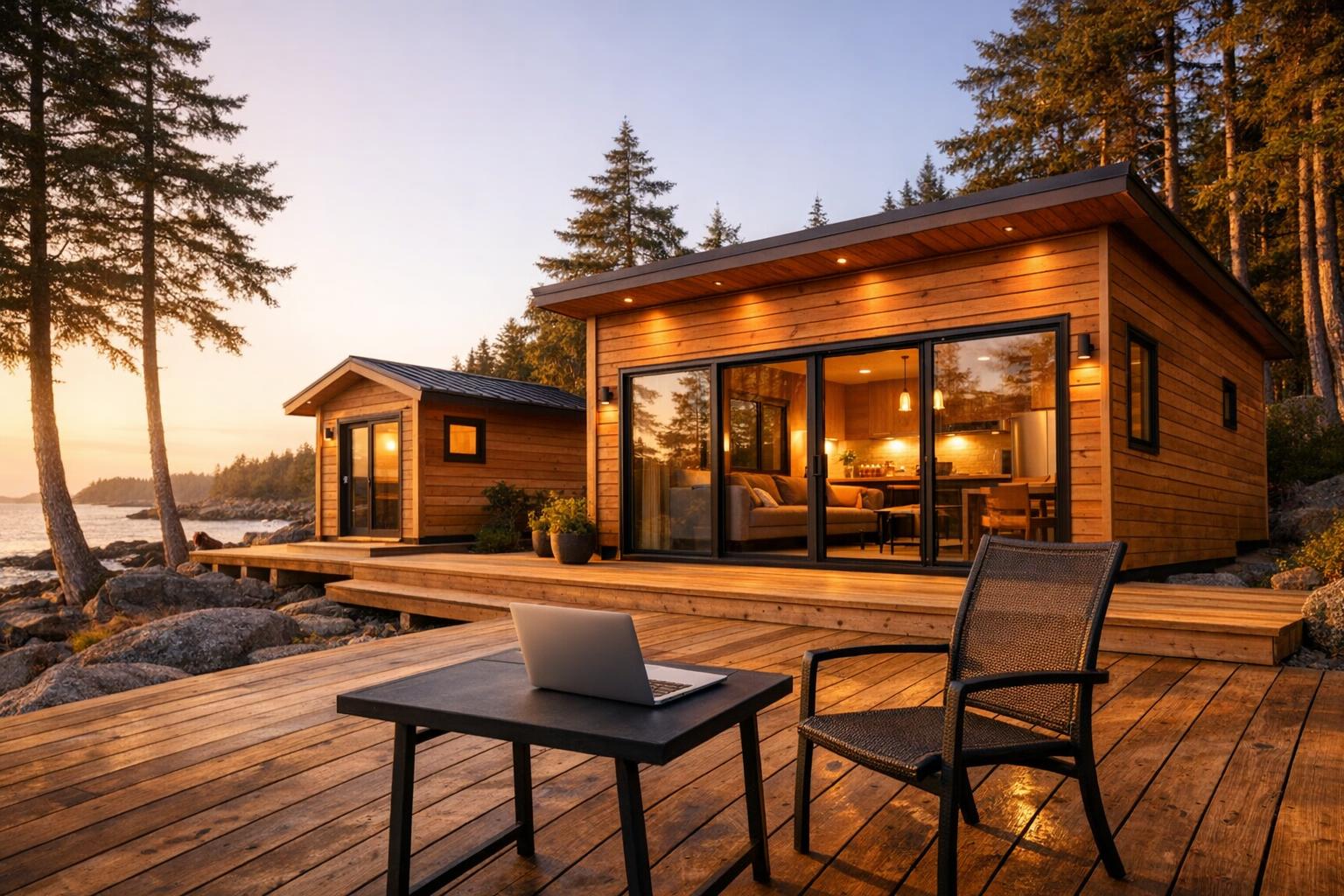
Tiny Home Rentals for Remote Workers in Canada: A Real 2026 Opportunity
Estimated reading time: 12 minutes
Key Takeaways
- Tiny home rentals for remote workers are gaining traction because flexible work remains durable in the Canadian market.
- 2025 housing trends continue to pressure affordability, creating demand for smaller, more efficient rental options.
- ADU investing is often the easiest entry point for homeowners who already control usable land.
- Units that perform best are designed for real daily work: strong internet, privacy, comfort, and a dedicated workspace.
- Before building, owners should verify zoning and permitting rules and model returns conservatively.
- The opportunity is strongest where remote-capable workers want lower costs, more privacy, and occasional access to major cities.
Table of Contents
- Why 2026 Is a Strong Moment for This Market
- Who Remote Workers Are and What They Want
- ADU Investing Fundamentals for Beginners
- Designing Tiny Home Rentals for Remote Workers
- Legal, Zoning, and Permitting in Canada
- Financing, Costs, and Projected Returns
- Operations and Property Management
- Marketing Tiny Home Rentals for Remote Workers
- Risks, Challenges, and How to Reduce Them
- Real-World Style Examples
- Implementation Checklist and Realistic Timeline
- Appendix and Useful Resources
- Frequently Asked Questions
Tiny home rentals for remote workers are not a fringe idea anymore. In 2026, they sit at the intersection of two durable trends: long-lasting work flexibility and ongoing housing affordability pressure in Canada.
That matters because many owners already control the hardest part of the equation: the land. If you have a garage, basement, laneway lot, or room for a backyard unit, you may already have a path to income through a garage conversion ADU, a basement ADU conversion, or one of the backyard home options now gaining value in Canada.
This guide explains how to assess remote-worker demand, compare ADUs with standalone tiny homes, design for work-from-home living, and think through legal requirements, regulations, financing, operations, and ROI. If you want a practical weekend-level evaluation process, this is it.
Flexible work did not vanish. It settled into a lasting pattern, and that is exactly why this niche deserves a serious look.
Supporting data from Canadian remote work statistics and trends and broader remote work trend analysis makes the case clear: the tenant base is still there.
Why 2026 Is a Strong Moment for This Market
The simplest way to understand this opportunity is to look at two forces at the same time: housing pressure and work flexibility.
First, housing. Across many Canadian markets, affordability remains tight, rental supply is strained, and conventional development is still expensive and slow. That is why ADU investing in Canada is attracting attention. Smaller units can often be delivered faster and with less capital than large multi-unit projects, though owners still need to account for hidden construction costs and updated build-cost ranges.
Second, work patterns. According to Robert Half’s Canadian remote work data, 56% of Canadian professionals rank hybrid work as their top choice. Hybrid and remote postings remain meaningful, and a notable share of Canadians still work mostly from home. That means the demand pool is smaller than during peak pandemic years, but still large enough to support a focused rental niche.
Why is this good for investors and homeowners?
- Remote workers are less tied to a downtown commute.
- Many will trade location prestige for privacy and lower rent.
- They often care more about internet and functionality than building amenities.
- Secondary markets, suburban edges, and exurban zones become more viable.
That is where tiny home rentals fit especially well. With strong internet planning, better sound control, and a location that still allows occasional urban access, a small unit can become very competitive.
There is also a sector angle. Remote and hybrid work remain especially relevant in technology, marketing, creative, legal, and finance-related fields. That supports stronger target markets not only in Toronto, Vancouver, Montreal, and Calgary, but also in nearby commuter belts and smaller communities with growing appeal to distributed workers. For example, interest in remote tech talent in small towns, remote work retreats, and tiny-home-friendly municipalities shows where this demand can cluster.
In short: 2025 housing trends created the setup, and the Canadian job market keeps the tenant pool alive. Additional context from return-to-office reporting in Canada and a broader Canada vs. US remote work comparison reinforces that flexible work remains a real housing signal, not just a temporary story.
Who Remote Workers Are and What They Want
One mistake owners make is treating remote workers as one single renter profile. They are not. Market this niche too broadly and your listing becomes vague.
It helps to think in segments, especially when reviewing remote work trends and the needs of digital nomads in Canada.
Local remote employees
These are salaried workers who spend most days at home but may commute part of the week. They usually want:
- lower rent than the city core
- a comfortable home for the long term
- parking or transit access
- stable internet
- a proper home office setup
This group often aligns well with 6- to 12-month leases, especially in units designed with an ADU home office, reliable internet for tiny homes, and realistic parking expectations based on local rules such as whether an ADU requires parking.
Digital nomads and contract workers
This group includes developers, freelancers, consultants, writers, and designers. Their priorities are usually different:
- flexible lease terms
- furnished units
- high-reliability Wi-Fi
- easy move-in
- quiet space for deadlines and calls
They can support stronger pricing, but they also increase turnover. Owners should understand rental contract structures for tiny homes and the realities of hosting guests in ADUs and tiny homes.
Cross-border remote workers
These are Canadians working for US-based firms. In the right markets, this can be a premium segment. A comparison source on remote work in the US vs. Canada suggests a meaningful share of Canada’s remote tech workforce works for US employers. That can support higher rents for units with office-grade functionality.
Across all groups, the housing needs are surprisingly consistent:
- internet of at least 100 Mbps down and 10 Mbps up
- a dedicated workspace, not just a table corner
- privacy for calls
- storage for work gear
- stable heating and cooling
Lease structure matters too:
- Short-term: 1 to 4 weeks
- Mid-term: 1 to 3 months
- Long-term: 6 to 12+ months
For most owners, monthly and long-term stays are the most stable fit. They reduce turnover costs and support better occupancy forecasting. That is often the most sensible operating model for tiny home rentals in this niche.
ADU Investing Fundamentals for Beginners
ADU investing means adding or acquiring a secondary self-contained residential unit on the same property as a main home. These units can be detached or integrated into an existing structure, and they are increasingly viewed as smart urban housing solutions.
Common formats include:
- detached backyard cottages
- converted garages
- basement suites
- laneway houses
- in-law suites or accessory apartments
This differs from some standalone tiny home rentals. An ADU often uses land you already own. A standalone tiny home may require a separate parcel, a pad lease, or a more complex land strategy. See the differences in common ADU types, tiny home land lease structures, and the tiny home on wheels comparison.
ADU investing vs. standalone tiny home rentals
ADU investing pros
- uses existing land
- often easier to finance
- can reach revenue faster
- often suits stable long-term renters
ADU investing cons
- zoning can be restrictive
- setbacks and parking rules may limit design
- code compliance can add cost
Standalone tiny home rental pros
- portable in some cases
- easy to brand distinctly
- can feel more private
- can scale if land is available
Standalone tiny home rental cons
- may have higher setup costs
- often need more site servicing
- financing can be harder
For many homeowners, ADUs are the better entry point because they support clear goals:
- add rental income
- offset mortgage payments
- improve property flexibility
- increase resale appeal through a legal unit
In some markets, a legal income unit may improve value by roughly 10% to 20%, depending on legality, quality, location, and demand. See more on secondary unit benefits and ADU resale value in Canada.
A practical beginner rule:
- Homeowners should first confirm the lot can legally support a second dwelling.
- Investors should model both rent and resale impact before spending.
If you already own a property with usable space, ADU investing usually beats starting from zero with a new land purchase. That is especially true once you check local zoning and available financing paths.
Designing Tiny Home Rentals for Remote Workers
A remote-worker rental must do two jobs well: it must feel like a real home, and it must support productive work every day. That is why design drives rent.
Resources on home office ADU productivity and the idea of a remote work retreat in Canada both point to the same lesson: function wins.
Workspace design
A true workspace is not just a stool at a counter. Aim for:
- desk depth around 24 inches or more
- room for a real chair
- nearby power outlets
- cable management
- task lighting
A fold-down desk can work if it still feels ergonomic. Tenants also care about video-call appearance, so a simple, clean background matters. Good examples can be informed by tiny home light design, space-smart furniture choices, and smart lighting.
Layout that separates work and life
Even small units need psychological separation between working, sleeping, and relaxing. In a compact layout, this can be done with:
- shelving
- sliding partitions
- built-in millwork
- curtains
- partial walls
Privacy strategies from tiny home privacy planning, multifunctional loft design, and smart furniture for ADUs can help preserve usability without increasing footprint.
Kitchen and daily living
Remote workers cook more than vacation guests, so the kitchen should feel like a real kitchen. Prioritize:
- full-size or apartment-size appliances
- enough prep space
- real cabinet or pantry storage
- proper ventilation
- seating that works for daily use
See more in guides to tiny home kitchen design in Canada and related Canadian kitchen layouts.
Internet and tech infrastructure
This may be the single biggest rent driver.
- 100+ Mbps download
- 10+ Mbps upload
- strong router placement
- full-unit coverage testing
Upload speed is critical for video calls and cloud work. In rural settings, a backup hotspot is a smart move. Owners should review internet setup for tiny homes, Wi-Fi coverage planning, and even adjacent infrastructure ideas like remote sensing basics if they are evaluating more advanced off-grid or rural systems.
Power and utility resilience
Helpful upgrades include:
- UPS or battery backup for modem and router
- surge protection
- plenty of desk outlets
- clear breaker labels
These details can make a major difference in tenant satisfaction. Consider related resilience options like energy storage solutions and solar water heating ideas.
Comfort, insulation, and sound
Remote workers spend more hours inside the unit than many renters. Comfort becomes premium value.
- good insulation
- weatherstripping
- heavier doors
- quiet HVAC
- proper ventilation
- blackout curtains where needed
- separation from noisy mechanical systems
Better acoustic performance improves focus, call quality, and tenant retention. See noise reduction in Canadian housing, soundproofing for privacy, and acoustic design for tiny homes.
Accessibility and mobility
Useful nearby or on-site features include:
- parking where needed
- secure bike storage
- easy transit access
- coffee shops nearby
- parks, gyms, and coworking spaces
Related planning resources include car-free ADU living, the accessible tiny home guide, and curbless entry options.
Sustainability
Many renters in this segment value practical sustainability. Useful upgrades include:
- solar-ready setup
- ENERGY STAR appliances
- LED lighting
- low-flow fixtures
- recycling and compost options
These are not just branding features. They can support comfort, lower utilities, and better positioning. Explore solar-ready ADU design, net-zero ADU concepts, and eco-friendly materials in Canada.
Legal, Zoning, and Permitting in Canada
There is no single national rulebook for this. Rules vary by municipality, and sometimes by neighbourhood. A project that works on one lot may fail on another nearby.
That is why owners should begin with the Canadian ADU regulations guide and compare it with local rules. Also note that some references to tiny-home-friendly municipalities in 2026 can help identify more supportive markets.
1. Zoning permission
Confirm whether your lot allows:
- secondary units
- detached backyard units
- laneway houses
- garage or basement conversions
You also need to review setbacks, lot coverage, size caps, and parking rules. Helpful references include the Ontario ADU zoning guide, information on whether you can build an ADU in a front yard, and details on parking requirements.
2. Building permits and code
Even if zoning allows the use, the unit must still meet code. That can include:
- fire separation
- ceiling height
- egress windows
- plumbing and electrical permits
- insulation and ventilation standards
- utility upgrades
Review local expectations using resources on ADU permits in Canadian cities, tiny home fire safety, and utility connections for Canadian ADUs.
3. Rental operation rules
If you plan short-term or hybrid stays, check local bylaws carefully. In some areas, short-term rentals are restricted to principal residences. Also, do not assume regular homeowner insurance will cover the rental.
Owners should review short-term rentals in ADUs, related tax issues, and available tiny home insurance options in Canada.
A practical due diligence sequence:
- contact the municipal planning department
- request written confirmation of permissions
- review local short-term rental bylaws
- get a zoning opinion from a real-estate lawyer
- speak with your insurer before spending heavily
- confirm inspections and final occupancy requirements
Some municipalities in British Columbia, Ontario, Alberta, and Manitoba are viewed as more ADU-friendly, while parts of Quebec and Atlantic Canada can be more restrictive. Still, general impressions are never enough. Verify everything. Provincial references such as BC permits for tiny homes, the Ontario permitting guide, and the Alberta permitting guide are useful starting points.
Also remember the basics:
- get permits and inspections
- use proper landlord or rental insurance
- use formal leases
- report rental income to the CRA
- track deductible expenses
This is not legal advice. It is a reminder that compliance is the first filter in both ADU investing and tiny home rentals. For additional help, see resources like the ADU legal clinic in Canada, insurance for remote-use tiny homes, and ADU taxes in Canadian real estate.
Financing, Costs, and Projected Returns
Before you fall in love with the design, test the math.
Start with updated financing references such as the ADU mortgage guide for Canada 2026 and the broader ADU financing guide.
Typical cost ranges in Canada
Broad illustrative examples:
- garage conversion: $40,000–$80,000 CAD
- backyard ADU, 300–400 sq ft: $100,000–$180,000 CAD
- laneway house, around 600 sq ft: $150,000–$250,000 CAD
- in-law or basement suite: $50,000–$120,000 CAD
Real costs vary by labour, site conditions, permits, servicing, furnishing, office setup, and energy upgrades. Review current cost-to-build estimates, possible hidden costs, and site-specific items like foundation options for tiny homes.
Financing options
Main paths include:
HELOC
Flexible and useful for owners with equity.
Renovation loan
Helpful if the unit is part of a broader home improvement plan.
Secondary mortgage or private lender
Can move faster, but often at higher cost.
Construction loan
Often better suited for detached new-build ADUs.
Government or CMHC-related programs
Availability varies by province and municipality.
Look into municipal incentives and grants and options related to green-upgrade financing.
Revenue models
Long-term lease model
- stable occupancy
- lower turnover cost
- best for salaried remote workers
Mid-term monthly model
- strong fit for contractors and transition tenants
- often better yield than long-term
- still manageable operationally
Hybrid short-/mid-term model
- can earn more
- creates more turnover
- comes with more regulation and seasonality risk
Modeled examples from ADU income case studies and a broader investment guide suggest that returns can be attractive, but they are highly sensitive to occupancy, costs, and financing.
Toronto-style sample scenario
- backyard garage retrofit
- total investment: $120,000
- financing: $60,000 HELOC at 5%
- rent: $2,400 per month
- operating costs: $600 per month
- annual profit: $21,600
- cash-on-cash return: about 18%
The point is not the exact percentage. The point is the method.
Build two models every time:
- a conservative case with lower occupancy and higher costs
- a strong case with premium rent and steady occupancy
If the deal only works in the best case, it is too fragile. That is especially true when market assumptions depend on remote work staying strong, even if current labour data from Robert Half and the US vs. Canada comparison remain supportive.
Additional practical references include house hacking with ADUs and how housing costs compare across ADU and tiny home models.
Operations and Property Management
A well-built unit can still underperform if operations are weak. Profit is not just about the build. It is about execution.
Resources on optimizing rental profitability and ADU concierge services in Canada show how operational quality directly affects occupancy and reviews.
Core management tasks include:
- cleaning and turnover
- maintenance response
- tenant communication
- screening
- lease administration
- utility and internet monitoring
Remote workers are especially sensitive to:
- Wi-Fi outages
- HVAC failures
- noise
- confusing check-in processes
- slow support response
That means your systems should be remote-friendly from the start. Owners may want to implement tools supported by ideas like water leak detection and smart home maintenance for tiny homes.
Useful tools include:
- smart locks
- self check-in
- digital welcome guide
- Wi-Fi instructions
- emergency contacts
- local coffee shop and coworking recommendations
- contactless payment tools
- property management software
Explore smart home technology for ADUs and broader tiny home safety planning.
When outsourcing makes sense:
- you have 3 or more units
- the property is far from home
- you rely on higher-turnover stays
When self-management is realistic:
- you have 1 or 2 units
- you live nearby
- most stays are monthly or longer
Operational discipline protects occupancy, tenant satisfaction, and long-term performance. For owners scaling up, it may be worth reviewing concierge support for ADUs and tiny homes and even longer-term community considerations like community governance in tiny home settings.
Marketing Tiny Home Rentals for Remote Workers
Generic vacation-rental marketing is not enough. If your unit is designed for work-from-home living, the listing needs to prove that immediately.
Presentation matters, which is why ideas from tiny home staging and even the structure of a tiny home open house can improve conversion.
Listing optimization
Lead with the features remote workers care about:
- photos of the office or desk area
- natural light
- quiet video-call backdrop
- internet speed-test screenshot
- clear floor plan
Useful listing phrases include:
- ideal for remote workers
- dedicated office
- 100+ Mbps internet
- quiet for video calls
The best positioning is not cute tiny house. It is productive, private, flexible housing for remote workers. See related angles in tiny home remote work positioning in Canada and guides to creating a remote work retreat.
Platform strategy
- Airbnb for monthly stays
- Furnished Finder for mid-term furnished demand
- Kijiji and local rental sites for long-term leases
- Facebook groups and Reddit communities for niche reach
- LinkedIn, recruiters, and HR contacts for corporate housing leads
Broader business framing can be informed by tiny home rental business guidance, even if your use is more housing-focused than tourism-focused. Some owners also draw inspiration from adjacent positioning in tiny home eco-tourism, though remote-worker listings need a more practical tone.
Pricing strategy
- monthly discounts for 30+ day stays
- incentives for 6- to 12-month leases
- seasonal adjustments
- premium pricing when utilities, parking, or coworking access are bundled
Also highlight nearby amenities clearly:
- coffee shops
- transit
- parks
- gyms
- coworking spaces
In the Canadian job market, this niche performs best when your listing reflects how people actually live and work now.
Risks, Challenges, and How to Reduce Them
This is an attractive niche, but it is not passive and it is not risk-free.
Main risks include:
- Canadian job market shifts if employers reduce flexibility
- regulatory changes affecting ADUs or short-term rentals
- wear and tear from heavy use
- seasonality in short-stay demand
- tenant quality issues
Mitigation is practical:
- diversify between long-term and mid-term leases
- target both local professionals and cross-border workers
- keep reserve funds
- choose durable finishes
- maintain proper insurance
- keep permits, leases, and tax records organized
- monitor local policy updates
The encouraging part is that remote and hybrid work have stabilized rather than disappearing. That is supported by Canadian remote work statistics, return-to-office reporting, and planning ideas on futureproofing tiny homes in Canada.
The real risk is usually not zero demand. It is weak underwriting.
Real-World Style Examples
1. Backyard ADU for a long-term remote consultant
A homeowner converts a detached garage into a 400 sq ft unit for around $110,000. The project follows a typical garage conversion ADU path and includes strong internet based on best-internet planning for tiny homes. It rents for $2,350 per month to a consultant who wants privacy and lower cost than downtown.
2. Tiny home on a rural lot for digital nomads
An owner places a prefab unit on a rural site and adds a small coworking-style amenity. The build is informed by prefab tiny home options in Canada and a workable land strategy. It is listed for nightly and monthly stays and attracts workers seeking quiet, nature, and work-ready infrastructure.
3. Multi-ADU investor strategy
An investor redevelops an underused property into several smaller units with mixed lease lengths. This is closer to a small portfolio model, using principles from multi-unit tiny home development and co-building strategies. It offers better scalability, but needs stronger operations and more capital.
Implementation Checklist and Realistic Timeline
Use this framework to test and launch a project. It may also help to visit a tiny home showroom in Canada or attend one of the tiny home festivals to compare layouts and finishes in person.
Weeks 1–2: Feasibility
- review zoning and lot rules
- research local demand and rental comps
- inspect the site or existing structure
- get early contractor quotes
- estimate rent by lease type
- build a basic ROI model
Weeks 3–6: Design and permitting
- draft the layout
- confirm code path and approvals
- decide on office zone, kitchen, and storage
- file permit applications
- review insurance requirements
Months 2–4: Build or retrofit
- hire contractor
- track milestones and budget
- coordinate utilities
- schedule inspections
- verify internet options early
Month 4–5: Furnishing and tech
- install internet
- test upload and download speed
- furnish workspace
- add smart lock
- set up lighting, window coverings, and house manual
Month 5–6: Listing and launch
- get professional photos
- write listing copy
- set pricing and minimum stays
- publish on selected platforms
- begin outreach for monthly and corporate tenants
Ongoing
- screen tenants
- maintain HVAC, plumbing, and Wi-Fi
- track income and expenses
- review occupancy and pricing
- monitor policy changes
Appendix and Useful Resources
A compact resource list can speed up due diligence:
- Municipal planning lookup: search your city plus “secondary suite,” “garden suite,” “laneway house,” or “ADU.”
- Provincial housing resources: review current small-housing and secondary-suite guidance.
- CRA reminder: report rental income and track deductible expenses carefully.
- CMHC and financing references: review current renovation, refinance, and housing supply programs.
- ROI worksheet: compare build cost, vacancy, financing, operating costs, and rent by lease type.
Guest house manual checklist for remote workers:
- Wi-Fi name and password
- speed expectations
- backup hotspot information
- HVAC instructions
- quiet hours
- emergency numbers
- local coffee shop and coworking suggestions
Helpful planning visuals include:
- sample floor plans
- simple ROI tables
- listing screenshot examples
- internet speed-test samples
- implementation checklist printouts
Tiny home rentals for remote workers make sense in 2026 because two trends now overlap: durable flexible work and affordability pressure carried forward from 2025. That creates room for small, well-designed units that support both living and working.
The projects that usually perform best get three things right:
- they are legally compliant
- they are designed around remote-worker needs
- they use disciplined financial modeling and solid operations
For many homeowners, ADU investing is still the simplest path because it uses land you already control. Standalone tiny home rentals can work too, but they often involve more complexity around land, servicing, and financing.
The smartest next step is not picking finishes. It is checking zoning and building a realistic ROI model. If the lot works, the numbers work, and the design truly supports remote work, this can be one of the more practical small-scale housing plays in Canada for 2026.
Frequently Asked Questions
Are tiny home rentals for remote workers actually viable in Canada in 2026?
Yes, in many markets they are viable because flexible work remains durable and housing affordability is still under pressure. The best opportunities tend to be in suburban, exurban, and secondary markets where renters want more privacy and lower costs.
Is ADU investing usually better than buying land for a standalone tiny home?
For many homeowners, yes. ADU investing often works better because it uses land you already have, which reduces project complexity and can make financing easier.
What features matter most to remote-worker tenants?
The biggest priorities are strong internet, a dedicated workspace, privacy for calls, reliable heating and cooling, and enough storage for work equipment. Soundproofing and layout separation also matter more than many owners expect.
Do I need to check local zoning before planning a unit?
Absolutely. Start with local zoning, then move to permits, code compliance, insurance, and rental bylaws. A useful starting point is the Canadian ADU regulations guide.
What lease type is usually best for this niche?
For most owners, monthly or long-term leases are the best balance of stability and profitability. They usually create steadier occupancy and lower turnover costs than short-stay models.
Can a tiny home or ADU increase property value?
In some markets, yes. A legal and well-built income-producing unit can improve resale appeal and potentially add value, especially when it is fully compliant and designed well.
Leave a Reply