

Estimated reading time: 11 minutes
Key Takeaways
- Child-free living changes compact-home design by shifting priorities toward adult routines, privacy, entertaining, work, and calm.
- The best ideas from tiny home trends 2025 still matter in 2026, especially biophilic design and screen-free spaces, warm minimalism, and tactile materials.
- The ADU lifestyle for child-free households works best when every square foot has a clear purpose.
- Modern couples benefit most from layouts that balance storage, flexibility, guest use, and work-from-home needs.
- Strong small space design relies on multifunctional furniture, hidden storage, cohesive finishes, and visual warmth.
- In Canada, ADU planning should always include bylaws, permit timing, utility connections, and future-proofing from the start.
Table of contents
- Why child-free living changes design priorities
- Big-picture small space design principles for two-person homes
- Tiny home trends 2025 that still matter in 2026
- ADU lifestyle: unique opportunities and constraints
- Three practical layout concepts for modern couples
- Room-by-room small space design solutions
- Furniture, fixtures, and multifunctional product strategy
- Storage hacks and organization rules for two people
- Materials, finishes, and colour palettes for modern couples
- Tech, comfort, and sustainability
- Outdoor living and small-site strategies
- Accessibility and future-proofing
- Budgeting, timeline, and build-vs-renovate decision-making
- Practical examples and mini case studies
- Sources of inspiration and builder references
- Quick design checklist
- Frequently Asked Questions
Child-free living means building a home around adult priorities instead of child-focused needs. For many modern couples in 2026, that changes everything about compact-home planning. A small home can now support quiet mornings, work calls, hobbies, hosting friends, and easy upkeep without wasting precious square footage on rooms or features that do not match real daily life.
That helps explain why the ADU lifestyle and tiny homes keep growing. Many couples are not choosing them only to save money or reduce their footprint. They are choosing them to create calm, stylish, low-maintenance homes that feel personal and efficient. The strongest ideas from 2026 interior design trends still overlap with the best of tiny home thinking: natural materials, multifunctional pieces, organic forms, and spaces that feel less digitally noisy.
This guide shows how to design for two people in a compact home. It covers layouts, storage, furnishings, materials, comfort, and budgeting. It also explains which ideas from 2025 still work now and how they shape the ADU lifestyle in 2026.
The strongest direction now mixes minimalism, sensory comfort, flexibility, sustainability, and visual warmth.
Why child-free living changes design priorities
Child-free living changes the whole design brief. The home no longer needs to revolve around playrooms, toy storage, stroller clearance, kid-safe corners, or family-sized traffic flow. Instead, the space can be planned around adult routines, better aesthetics, quiet, and flexibility.
For modern couples, that often means different priorities:
- A lounge made for conversation and entertaining
- A hobby zone for reading, gaming, music, art, fitness, or crafts
- A work-from-home setup with privacy and decent acoustics
- Easy maintenance for frequent travel
- Guest sleeping space without a full extra bedroom
This is not about having less home. It is about having a home that fits better.
In the ADU lifestyle, every square foot must earn its place. That makes adult-focused planning even more useful. A seating area can be designed for long dinners with friends instead of toy baskets. A storage wall can hold records, art supplies, or travel gear instead of bulky family clutter. A spare nook can become a desk, bar, or reading corner.
There is also more freedom in finishes and styling. Without heavy child-focused durability pressures, couples can choose sleeker materials, tailored upholstery, refined lighting, and cleaner decor. This is one reason living room design trends for 2026 increasingly lean toward polished warmth rather than purely practical family layouts. Likewise, a more curated look is easier to preserve in a kid-free home interior.
Privacy also becomes more important than people expect. Even in a two-person household, separate routines, remote work, and different sleep schedules matter. That is why privacy in tiny homes is such a valuable planning topic from the beginning.
Big-picture small space design principles for two-person homes
Small space design is the art of making limited square footage feel useful, open, and calm. Good design does that through layout, furniture scale, storage planning, and visual consistency.
1. Minimalism with purpose
Keep what supports daily life or adds real beauty. In child-free living, this often means fewer but better things:
- One comfortable sofa instead of extra chairs
- One good dining table instead of a desk plus a table
- One storage wall instead of several small cabinets
The goal is not emptiness. It is clarity.
2. Multipurpose zoning
In compact homes, one zone often needs two jobs:
- Dining table + desk
- Lounge + guest bed
- Entry bench + shoe storage
- Bedroom wall + office niche
This helps modern couples use one footprint in smart ways without feeling crowded.
3. Material cohesion
Use the same wood tone, metal finish, and colour palette across the home. Repetition makes a compact home feel bigger because the eye moves smoothly from one area to the next.
Try this simple mix:
- Light oak or warm walnut
- Matte black or brushed brass accents
- Warm white, sand, sage, and cocoa tones
4. Visual expansion
Make the home feel larger with smart visual moves:
- Keep flooring continuous across connected rooms
- Use furniture with visible legs
- Choose low-profile seating
- Reduce bulky upper cabinets where possible
- Hang curtains high
- Keep trim colours consistent
- Add mirrors or glass where they help light travel
In 2026, minimal homes should still feel warm. Layer in wood, linen, woven textures, matte finishes, and soft forms. The move is away from sharp, cold minimalism and toward organic flow, something reinforced by both biophilic, screen-free design thinking and modern residential trend forecasts. Light also matters more than people think in compact homes, which is why tiny home light design should be addressed early.
Tiny home trends 2025 that still matter in 2026
Tiny home trends 2025 still shape today’s homes, but the smart move in 2026 is to separate lasting ideas from short-lived looks.
What endured from tiny home trends 2025
Some trends still work because they improve daily life:
- Biophilic design: plants, wood, natural light, botanical prints, nature-inspired colours
- Screen-free calm: rooms that feel restful and less digitally chaotic
- Eco-conscious materials: sustainable wood, lower-impact finishes, long-life furniture
- Earthy neutrals: sage, terracotta, cocoa, sand, warm off-white
- Sensory textures: linen, rattan, jute, matte stone, soft upholstery
These ideas fit both small space design and child-free living because they help compact homes feel peaceful.
What evolved in 2026
The trend direction is now more practical:
- Hidden tech instead of gadget clutter
- Modular walls or partitions for privacy
- Micro-utility choices like compact HVAC, stacked laundry, slim appliances, and integrated storage
- Curved shapes that soften tight spaces
- Lofted sleeping where ceiling height allows
- Better indoor-outdoor flow through glazing, patios, greenery, and light curtains
Use trends as a framework, not a shopping list. In a tiny home or ADU, every trend must earn its square footage.
Quick tip: add a few non-toxic plants or botanical prints to make tight rooms feel calmer and more natural. For a deeper look, explore biophilic design in tiny homes and how biophilic design supports wellness.
ADU lifestyle: unique opportunities and constraints
The ADU lifestyle means living in an accessory dwelling unit. It is usually smaller, self-contained, and often sits on the same lot as a main home.
For child-free living, this model has real appeal:
- A separate entrance gives privacy
- Backyard placement can feel independent
- The home can be built around personal routines, not family expansion
- Lower maintenance supports travel, creative work, side income, or semi-retirement
Many modern couples like the balance. An ADU can feel private and simple while staying close to family, transit, or city services.
Still, there are limits. Most ADUs land somewhere around 400 to 800 square feet. Utility connections can add cost and planning work. Permits and approvals can take time. Site conditions may affect setbacks, privacy, glazing, and outdoor space.
In Canada, this matters even more. In places like BC and Ontario, ADUs are part of the housing conversation, but rules vary by municipality. Couples should always check Canadian ADU regulations, Ontario permitting requirements, and BC ADU permitting guidance before moving ahead.
The trade-off is clear.
The ADU lifestyle offers flexibility and independence, but success depends on disciplined planning and strong small space design.
If location is still part of the decision, it also helps to review ADU-friendly neighbourhoods in Canada and examples of Canadian ADU architecture and design.
Three practical layout concepts for modern couples
In a compact home, layout matters more than decor. A beautiful space can still fail if movement, privacy, and storage are weak.
Layout A: Open one-bedroom ADU around 500 sq ft
This layout suits modern couples who want real bedroom privacy and still like to host.
Plan idea:
- Kitchen along one wall or in an L-shape
- Small island or peninsula for prep and dining
- Lounge next to kitchen
- Separate bedroom with built-ins and under-bed storage
- Sofa bed or modular guest seating in living room
Best for:
- Couples who entertain sometimes
- Partners with different sleep schedules
- Homes where one person may work from the lounge zone
Why it works:
- Public and private zones are clearly separated
- The living room still feels social
- Guests do not need a full spare room
Layout B: Split-level loft plan around 450 sq ft
This is a smart small space design choice when height is available.
Plan idea:
- Main floor with living area, compact kitchen, bathroom, and office nook
- Loft sleeping zone above part of the footprint
- Stair storage or ladder shelving
Best for:
- Couples comfortable with vertical living
- Homes needing stronger day-night separation
Why it works:
- Uses height instead of width
- Frees the lower floor for work, hobbies, or lounging
Caution:
- Loft sleeping is not right for everyone
- Ceiling height, safe access, and future mobility all matter
Layout C: Convertible studio around 350 sq ft
This layout works when flexibility matters most.
Plan idea:
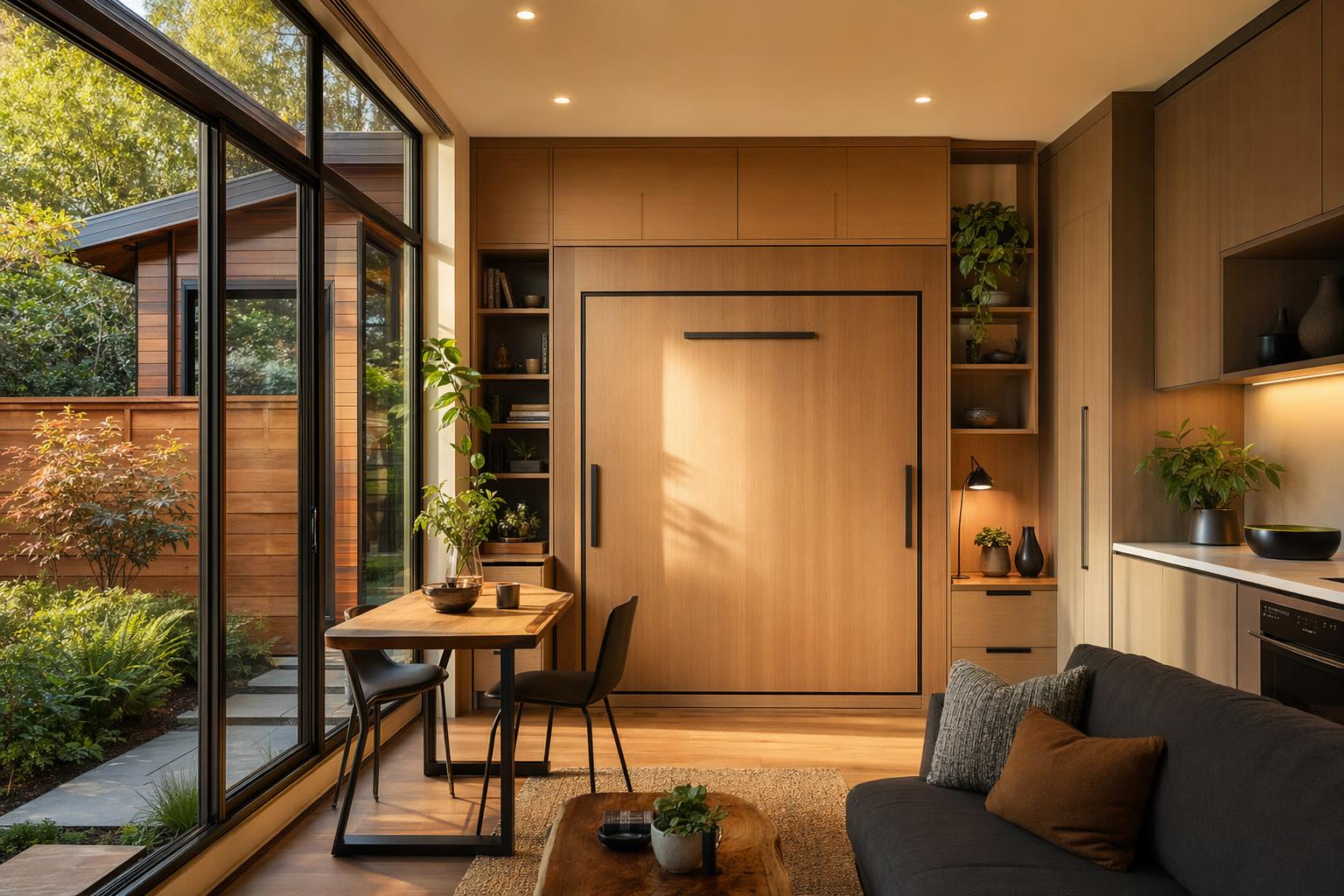
- Murphy bed or wall bed
- Sliding partition to partly divide sleeping and living
- Folding table for dining and work
- Full-height storage wall
Best for:
- Couples committed to tidy routines
- Very small footprints
- Highly efficient ADU lifestyle setups
Why it works:
- One room changes use through the day
- Storage is built into the architecture
- It gives maximum function in minimum area
Quick comparison
- Best for entertaining: Layout A
- Best for privacy in a small footprint: Layout B
- Best for maximum efficiency: Layout C
Room-by-room small space design solutions
This is where good ideas become daily-life wins.
Kitchen
A compact kitchen should support real cooking for two.
Use:
- Full-function compact appliances
- Pull-out pantry storage
- Deep drawers instead of lower cupboards
- Island or peninsula for prep and dining
- Vertical rail systems for utensils
- One consistent material palette to reduce clutter
For modern couples, a kitchen should work hard without looking busy. Browse ideas for tiny home kitchen design in Canada and compact Canadian kitchen layouts for practical inspiration.
Bathroom
A wet-room bathroom can make an ADU lifestyle home feel larger. A wet room integrates the shower into the main bathroom with waterproof finishes and a cleaner footprint.
Useful features:
- Wet-room or walk-in shower
- Pocket door
- Stacked washer-dryer
- Wall niches
- Recessed medicine cabinet
- Large-format tile with fewer grout lines
Bedroom
In child-free living, the bedroom can feel more restful because it only needs to serve adult comfort.
Use:
- Low-profile bed with drawers
- Built-in wardrobes or slim closet systems
- Wall sconces instead of table lamps
- Blackout shades
- Upholstered headboard
- Soft layered textiles
Living and entertaining
For child-free living, the lounge often matters more than in larger family homes. It is where conversation, downtime, reading, and hosting happen.
Use:
- Modular sofa
- Wall-mounted media
- Storage bench seating
- Nesting side tables
- Conversation-first furniture layout
- One standout piece, like a sculptural chair or side table
A little proportional contrast can add character without clutter. See how tiny home gatherings and hosting guests in an ADU can shape the layout.
Work-from-home zone
Many modern couples need office space even in a tiny home.
Make it work with:
- Fold-down desk or cabinet desk
- Soft wall treatment or acoustic panel
- Wall-mounted monitor arms if needed
- Task lighting
- Cable storage
- Desk built into a hallway niche, bedroom wall, or living room millwork
The best work area disappears when the workday ends. For ideas, review ADU home office productivity planning, home office layouts in Canadian ADUs, and remote work in tiny homes.
Furniture, fixtures, and multifunctional product strategy
In small space design, choose furniture by function first, style second, and trend fit third.
Good choices include:
- Murphy beds or wall beds
- Extendable dining tables
- Benches with hidden storage
- Ottomans with lift-up tops
- Sofas under about 80 inches when scale demands it
- Wall-mounted sconces
- Slim console desks
- Curved oak consoles
- Linen-upholstered storage ottomans
One common mistake is buying lots of tiny furniture. That often makes a room feel more cluttered. It is usually better to buy fewer, properly scaled pieces and keep clear walking paths around them.
Rounded edges also help. They soften tight rooms and reflect the warmer look that followed tiny home trends 2025 into 2026. If you are trying to keep a refined adult look, the principles behind a kid-free interior aesthetic remain useful. For layout-friendly pieces, see smart furniture for Canadian ADUs and this modular furniture guide.
Storage hacks and organization rules for two people
Storage is one of the biggest success factors in child-free living inside a small footprint.
A practical rule set helps:
- Every item needs a home
- Shared storage should be divided on purpose
- Sentimental items should be curated, not piled up
- Seasonal rotation matters
Useful storage ideas:
- Vertical wall rails and shelves
- Under-bed drawers
- Under-stair storage
- Ceiling-mounted hanging racks
- Full-height closets
- Labeled bins for hobbies
- Entry bench storage for shoes, bags, and daily gear
A helpful decluttering benchmark is a wardrobe cap of about 10 linear feet for two people, depending on lifestyle. It is not a hard rule, but it can stop storage creep before it starts.
Clean adult-focused interiors work best when clutter is hidden and only the right things stay visible. More ideas can be found in these tiny home storage solutions.
Materials, finishes, and colour palettes for modern couples
The right palette should do three jobs:
- Make the home feel larger
- Stay calm over time
- Add texture so minimalism does not feel cold
A strong direction for modern couples is:
Base tones
- Alabaster
- Sand
- Warm white
- Soft greige
Accent tones
- Sage
- Cocoa
- Terracotta
Natural materials
- Oak
- Walnut
- Rattan
- Jute
- Linen
Durable surfaces
- Quartz
- Stone-look counters
- Hardwood or quality wood veneer
These work because warm neutrals reflect light softly. Repeated natural textures create comfort. Durable finishes also cut maintenance and replacement costs.
In 2026, curves, softness, and tactile finishes help compact homes feel welcoming instead of severe. Explore sustainable flooring for tiny homes and eco-friendly building materials in Canada if sustainability is part of the brief.
Tech, comfort, and sustainability
In 2026, smart compact-home design is not just about fitting more in. It is also about making the home easier and cheaper to live in.
Useful systems include:
- Smart thermostats
- Heat-pump HVAC
- Solar-ready roof planning
- Low-flow plumbing fixtures
- Battery backup
- Adaptive lighting that shifts by time of day or mood
Why they matter:
- Smart thermostats improve comfort and reduce energy waste
- Heat pumps are efficient and suit small homes well
- Solar-ready planning helps future-proof the home
- Low-flow fixtures reduce water use
- Battery backup helps during outages
- Smarter lighting cuts lamp clutter and improves mood
These choices fit both the ADU lifestyle and better small space design because they support comfort without adding bulk. Consider smart home technology for ADUs, tiny smart home systems in Canada, and solar-ready ADU planning when mapping long-term costs.
Outdoor living and small-site strategies
For the ADU lifestyle, outdoor space often acts like an extra room.
Useful ideas include:
- Pocket patio for dining
- Fold-down deck or platform
- Privacy screens or hedges
- Compact shed for overflow storage
- Bistro seating
- String lights or wall lights
- Potted greenery for a biophilic feel
This matters because outdoor zones reduce pressure on the interior. They support entertaining, quiet coffee breaks, hobbies, and evening lounging. Even a tiny courtyard can make a 400 to 600 sq ft home feel much larger.
For modern couples, this outdoor layer often adds the sense of freedom that makes child-free living in a compact home feel luxurious. See examples of landscaping for ADUs, outdoor ADU design, and climate-adaptive decks.
Accessibility and future-proofing
Future-proofing matters even for younger child-free living households.
Needs change. Guests may have mobility issues. Good planning also helps resale and long-term comfort.
Useful features include:
- No-step entry
- 36-inch doors
- Lever handles
- Curbless shower
- Main-floor sleeping if possible
- Reinforced bathroom walls for future grab bars
- Flexible partitions instead of awkward fixed barriers
This does not mean making the home feel clinical. It means quietly building in options so the ADU lifestyle stays usable over time. Helpful references include accessible design for tiny homes and ADUs, accessible ADU design in Canada, and universal design principles.
Budgeting, timeline, and build-vs-renovate decision-making
This is the reality-check section.
Typical numbers in Canada can look like this:
- Tiny home prefab: about $100K to $200K
- ADU build: about $250K to $400K for roughly 400 sq ft
- Permit timelines: often 3 to 9 months
Costs shift based on:
- Site servicing
- Foundation type
- Utility hookups
- Custom millwork
- Window size
- Kitchen and bathroom complexity
- Engineering and local permit rules
Build path options
Prefab or modular
- Faster
- More predictable pricing
- Less flexible
Custom build
- Better tailored to site and lifestyle
- Longer timeline
- Often costs more
Renovation or conversion
- Good for garages or existing structures
- May save some structural cost
- Can uncover hidden issues
In some regions, including BC, there have been programs tied to secondary suites or ADUs. Check current local programs for 2026 before relying on any incentive.
Useful planning reads include prefab ADU vs custom build, ADU build costs in Canada, hidden ADU construction costs, and this ADU financing guide.
Practical examples and mini case studies
Real examples make the design advice easier to picture.
Case study 1: Vancouver downsizers
Sarah and Mike, a modern couple, moved from a 2,000 sq ft house into a 600 sq ft backyard ADU.
Before
- Too much unused family-scale space
- High upkeep
- Cluttered flow
After
- Loft bedroom
- Office nook
- Biophilic styling shaped by tiny home trends 2025
- Murphy desk for working from home
Results
- $280K build
- 8-month timeline
- 70% less square footage
The biggest gain was not just smaller bills. It was more freedom and less maintenance. Their child-free living setup felt more intentional than their old house.
Case study 2: Ontario tiny home remodel
Alex and Jordan live in a 400 sq ft prefab.
Upgrades
- Sustainable oak finishes
- Curved forms
- Wet-room bath
- Better storage planning
Results
- $150K
- 4 months
- 50% lower utilities
The space felt bigger after the remodel, not because it grew, but because the layout, storage, and finish choices worked better together. You can also pull aesthetic cues from broader interior design trends for 2026 and compact-home presentation ideas like tiny home staging.
Sources of inspiration and builder references
If you want to keep exploring the ADU lifestyle and small space design ideas, these are useful places to watch for inspiration:
- Lanefab Design/Build
- Multiply Homes
- Tiny Home Builders Canada
- Nomad Micro Homes
- @tinyhousecanada on Instagram
- @aducanada on TikTok
- Canadian House & Home trend coverage
- Dwell small-space features
When reviewing a builder or designer, look for:
- Experience with compact layouts
- Local code knowledge
- Strong custom storage solutions
- Clear pricing
- A portfolio that shows lived-in function, not just pretty photos
Quick design checklist
Layout
- Open zones where possible
- A clear privacy strategy
- Guest sleeping flexibility
- A work-from-home option
Storage
- Vertical storage used well
- Under-bed or under-stair storage
- Entry storage included
- A declutter audit done early
Trends
- Biophilic materials
- Modular partition ideas
- Smart tech with low visual clutter
- Warm neutral palette
Budget
- Permits checked
- Utility costs estimated
- Prefab and custom compared
Child-free living in a tiny home or ADU is not only about compromise. It is about designing with precision around how two adults actually live. The best 2026 homes for modern couples balance comfort, minimalism, flexibility, and personality.
The most useful lessons from tiny home trends 2025 are the ones that improve real life: biophilic warmth, multifunctionality, sustainable choices, and calm visual design.
You do not need a huge lot or a massive budget to build a beautiful, efficient home. The biggest wins usually come from the right layout, a strong storage plan, and a warm, durable material palette.
Frequently Asked Questions
What does child-free living change in home design?
It shifts priorities away from child-focused features and toward adult comfort, entertaining, work, hobbies, privacy, and easier maintenance. In a compact home, that usually means fewer specialized rooms and more flexible shared spaces.
Are tiny home trends 2025 still relevant in 2026?
Yes. The most durable ideas still work well, especially biophilic design, earthy palettes, sustainable materials, screen-free calm, and multifunctional furniture. The difference in 2026 is that these trends are being used more practically and with less visual clutter.
What size ADU works well for modern couples?
Many couples do well in the 400 to 800 sq ft range, depending on layout and storage. A one-bedroom ADU around 500 sq ft often offers the best balance of privacy, entertaining, and daily comfort.
What is the best layout for a two-person tiny home?
It depends on lifestyle. A one-bedroom plan is best for privacy and hosting, a loft plan works well when ceiling height is available, and a convertible studio is ideal when maximum efficiency matters most.
How can couples make a small home feel bigger?
Use continuous flooring, a cohesive material palette, built-in storage, fewer better-sized furniture pieces, visible furniture legs, layered lighting, and clear zones for daily routines. Outdoor living space can also make a small home feel much larger.
Is the ADU lifestyle good for child-free households?
For many couples, yes. It offers privacy, lower maintenance, flexible living, and the ability to build around personal routines. The main challenges are permitting, utility connections, and making every square foot count.
What are the biggest storage rules for two people in a small home?
Give every item a dedicated place, divide shared storage intentionally, rotate seasonal items, and avoid letting open surfaces become catch-all zones. In compact homes, hidden storage matters just as much as square footage.
How much does an ADU or tiny home cost in Canada?
Costs vary, but a prefab tiny home may land around $100K to $200K, while an ADU build can range from about $250K to $400K for roughly 400 sq ft. Site servicing, permits, utilities, and custom finishes can raise costs significantly.
Leave a Reply