

Estimated reading time: 13 minutes
Key Takeaways
- Rain gardens are shallow planted basins that capture runoff from roofs, walkways, and Canadian driveways, then let it soak into the ground instead of rushing into storm drains.
- They are a practical form of stormwater management for tiny homes, ADUs, cottages, and compact urban lots, especially where space is tight.
- A driveway-edge rain garden can help reduce runoff, filter pollutants, support pollinators, and improve curb appeal without sacrificing parking or access.
- On small properties, even a narrow strip or compact basin can make a meaningful difference when it is properly sized, planted, and drained.
- For Canadian conditions, success depends on planning for clay soil, frost, snowmelt, salt exposure, and safe setbacks from foundations.
- Many small rain gardens are DIY-friendly, with rough 2026 costs around CAD $300–$900 DIY or CAD $2,000–$6,000 professionally installed.
Table of contents
- Rain Gardens Beside Canadian Driveways: A 2026 Guide for Tiny Homes, ADUs, and Small Lots
- What you’ll learn about rain gardens on small lots
- Why rain gardens work for stormwater management
- Assess your site before you build
- Best design and placement options along Canadian driveways
- Soil, drainage, and frost considerations for Canada
- Plant selection for Canadian rain gardens
- Step-by-step build for a small rain garden next to a driveway
- Maintenance plan and seasonal tasks
- Permits, regulations, and incentives in Canada
- Examples and mini case studies
- Ecosystem and property co-benefits
- Final summary and practical checklist
- FAQs about rain gardens beside Canadian driveways
Rain Gardens Beside Canadian Driveways: A 2026 Guide for Tiny Homes, ADUs, and Small Lots
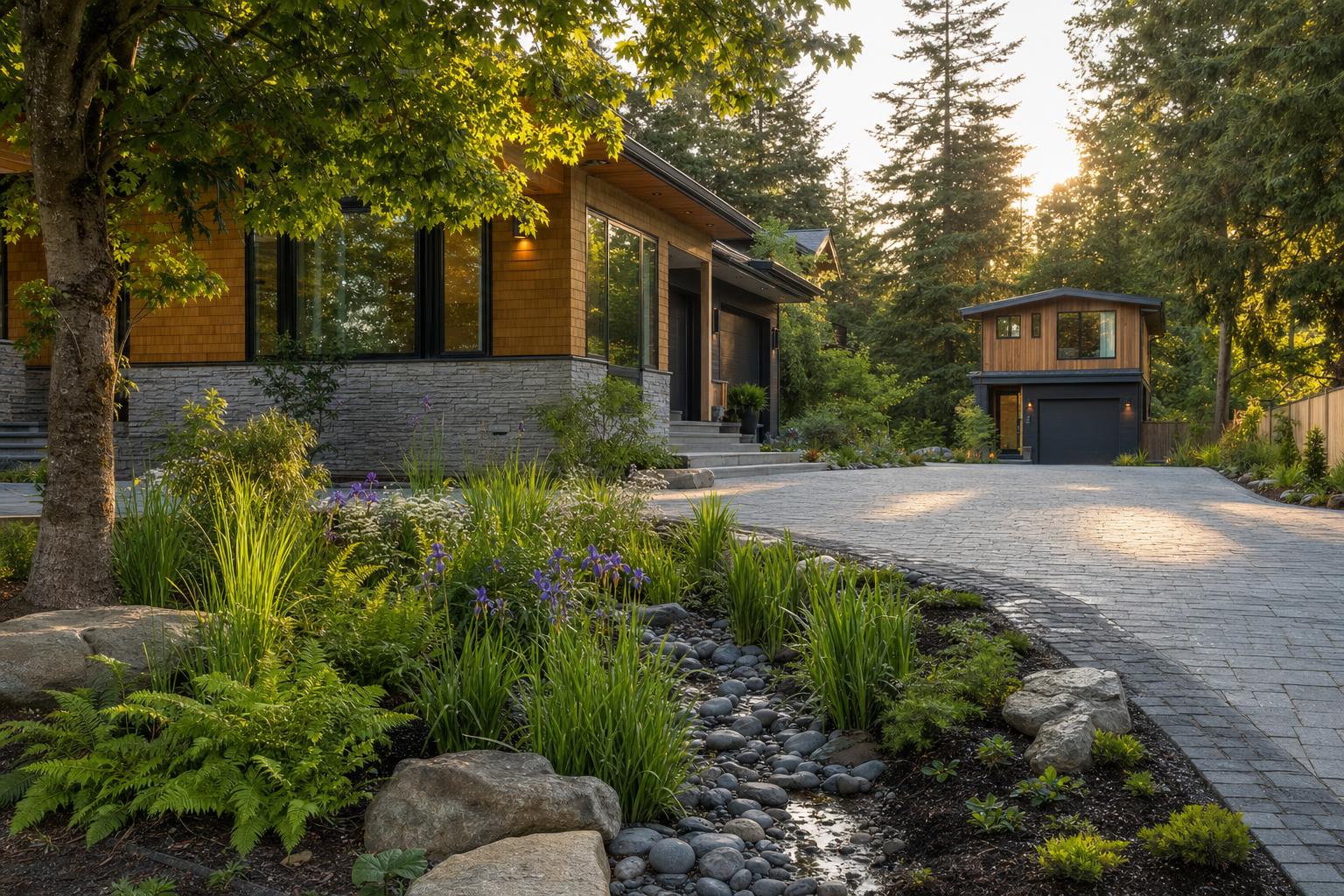
Rain gardens are shallow, planted depressions that collect runoff from hard surfaces like roofs, walkways, and Canadian driveways, then let that water soak into the ground instead of rushing into storm drains. This 2026 guide shows homeowners how to use rain gardens beside driveways to improve stormwater management on small properties, especially tiny homes and ADUs.
That matters more now than it did a few years ago. Across Canada, heavier rain, more freeze–thaw cycles, and denser urban lots are making small-scale green infrastructure a smart fit for everyday homes. On a compact property, even a narrow planting strip can help manage water better. Rain gardens are one of the simplest ways to start.
For many homeowners, the goal is simple: reduce runoff from roofs and driveways without giving up parking, access, or yard space. A driveway-edge rain garden can do that in a way that is affordable, often DIY-friendly, and useful through the seasons. It can also turn a plain edge of lawn or gravel into sustainable landscaping that looks good and works hard, with added guidance from Canadian housing and site planning resources at CMHC and technical rain garden references at Sustainable Technologies.
If you own a tiny home, backyard ADU, cottage, or small urban lot, this guide is for you. It is also for anyone worried about how Canadian driveways add to local flooding, icy sidewalks, dirty runoff, and soggy edges around the home.
What you’ll learn about rain gardens on small lots
In this guide, you’ll learn how to:
- Use rain gardens beside driveways to reduce runoff, help clean water, support pollinators, and improve curb appeal.
- Size and place a rain garden for tiny homes, ADUs, and other compact sites.
- Choose soil and drainage details for Canadian driveways, including clay, frost, snow, and salt.
- Pick hardy plants for Canadian climates.
- Build a small rain garden step by step.
- Maintain it through spring, summer, fall, and snowmelt season.
- Compare rough 2026 DIY and professional cost ranges.
- Check permits, bylaws, and possible rebates tied to stormwater management and sustainable landscaping.
- Adapt small-lot layouts that work in real life.
These ideas are supported by practical homeowner and technical guidance on stormwater management, rain gardens for homeowners, and broader groundwater protection benefits from Groundwater.org.
Why rain gardens work for stormwater management
A rain garden is a shallow, planted basin built to temporarily collect runoff from nearby hard surfaces and let it filter into the soil. In plain terms, it slows water down, holds it for a short time, and helps it sink in instead of racing across pavement. This is the basic logic behind how to design rain gardens to effectively control stormwater runoff, and it is echoed in homeowner guidance from Mass.gov and technical references at Sustainable Technologies.
The four main ways rain gardens help
Infiltration
Water ponds in the basin, then moves down through the soil and into the ground below. This reduces direct runoff from Canadian driveways and roofs. See more on infiltration and runoff control.
Retention and detention
The garden stores water for a short time during a storm. That lowers peak flow and can reduce local puddling and minor flooding. This role is widely recognized in rain gardens as a sustainable solution for stormwater management and by Groundwater.org.
Evapotranspiration
This means plants take up some water and release it back into the air. That helps the system dry out after rain. For a useful explanation, see rain gardens as living stormwater infrastructure.
Pollutant removal
Soil and roots help trap or break down sediment, nutrients, metals, and oily residue from driveways before that runoff reaches creeks, lakes, or storm sewers. More detail is available from Mass.gov rain garden guidance and Groundwater.org.
A well-placed rain garden does not just move water somewhere else. It slows, stores, filters, and reuses natural processes to manage runoff right on site.
Why this matters beyond drainage
Rain gardens support sustainable landscaping in a few other ways too:
- Native plants can support birds, bees, and other pollinators.
- Less runoff means less erosion and less pressure on city drainage systems.
- More planting beside pavement can cool the space compared with bare asphalt or gravel.
These broader benefits are discussed in living stormwater infrastructure, rain garden benefits, and municipal summaries such as Rain Garden Benefits.
Why rain gardens suit tiny homes and ADUs
Rain gardens work well on small sites because they do more than one job at once. They can fit in narrow strips, edge spaces, or small basins. They can manage water, add beauty, soften a driveway, create screening, and define space around tiny homes and ADUs. They are often most effective exactly where small lots need them most: in the runoff path beside pavement. For more compact-site thinking, see landscaping ideas for ADUs in Canada.
Assess your site before you build
Think of this as a mini stormwater audit for your property. Good stormwater management starts with knowing where water comes from and where it wants to go. If your property also has a compact backyard suite, note how the drainage interacts with the ADU, because small-lot layouts can benefit from integrating landscaping and runoff control together. See rain garden integration for ADUs in Canada and ADU landscaping ideas.
Identify runoff sources
On small lots, the main hard surfaces are usually:
- The main house roof
- The roof of a tiny home or ADU
- Canadian driveways and parking pads
- Paved paths and patios
Watch your lot during rain or right after snowmelt. Look for:
- Where water sheets off the driveway
- Where downspouts empty
- Where puddles form
- Where icy spots show up in cold weather
Rain gardens work best when they catch runoff close to the source, as noted in stormwater solutions for homeowners.
Measure impervious area and estimate size
A simple homeowner method is to add up the roof and driveway area draining toward the proposed garden.
Example:
- Roof area draining to garden: 40 m²
- Driveway area draining to garden: 20 m²
- Total contributing area: 60 m²
A common rule of thumb for small first-flush events is to size the rain garden to about 5–10% of that area, with around 15 cm of ponding depth.
Using the larger end:
- 60 m² × 0.1 = 6 m² rain garden
That could be a bed about:
- 1.5 m × 4 m
If one larger basin will not fit, several smaller rain gardens can still improve stormwater management on tiny homes and compact lots. Sizing guidance like this appears in rain garden design references.
Canada-specific driveway realities
Slope
If a driveway is steep, water may race past the garden. A curb cut, small berm, or stone edge can help guide runoff into the basin.
Freeze–thaw
The garden should drain within 24–48 hours. That helps limit ice, root stress, and long wet periods. This drain-down target is emphasized in CMHC guidance and Sustainable Technologies.
Snow storage and melt
Do not make the rain garden your main snow pile. Heavy snow loads can compact soil and damage plants. But the garden can still catch meltwater if salt is managed well.
Road salt and de-icing products
Salt can harm plants and affect soil. Set the bed back a little from the worst salt path and use tougher plants near the edge.
Vehicle loads
Keep the rain garden out of tire tracks. Add edging if needed so cars do not creep into the planting area.
Safety clearances and dig-safe checklist
Before digging, check these basics:
- Keep rain gardens at least 3 m from foundations and basements, especially on clay soil.
- Stay at least 3–5 m from septic systems, leaching beds, and wells.
- Avoid buried utilities.
- Always contact your provincial utility locate service before digging. For projects tied to an ADU or secondary suite, it is also smart to review local utility connection guidance before finalizing the plan.
Best design and placement options along Canadian driveways
Choose the layout that fits your lot, not just the one that looks nicest on paper. The best rain gardens sit where water already wants to flow.
Option 1: Edge-of-driveway bioretention strip
This is a long, narrow rain garden that runs beside the driveway.
- Typical width: about 0.6–1.2 m
- Best for narrow urban lots, laneway suites, and tiny homes with side drive access
- Captures sheet flow directly off pavement
This is often the easiest way to fit sustainable landscaping onto a tight site.
Option 2: End-of-driveway pocket basin
This is a compact rain garden placed at the low end of the driveway.
- Good where runoff currently heads to the sidewalk or street
- Can also receive water from a downspout
- Suits cottages, ADUs, and short driveways where side space is limited
Option 3: Linear swale or bioswale
This is a shallow vegetated channel that slows runoff and moves it toward a deeper basin.
- Works well on slightly longer lots
- Good when you need both flow direction and infiltration
- Needs a planned overflow path for bigger storms
Option 4: Permeable paving paired with a rain garden
This combines a water-friendly parking surface with planted storage and filtration.
- Permeable pavers or gravel reduce runoff at the source
- The adjacent rain garden adds extra stormwater management capacity
- Often costs more, but gives stronger performance
Quick comparison
- Best for narrow lots: edge-of-driveway strip
- Best for low-point runoff: pocket basin
- Best for longer flow paths: swale
- Best for highest performance: permeable paving plus rain garden
Useful visuals for this topic include a plan view of a small lot with a tiny home or ADU, driveway, and rain garden strip, plus a cross-section showing the driveway edge, ponding area, soil layers, and overflow route. For more outdoor design ideas that pair well with compact homes, see ADU outdoor design in Canada and small-space ADU landscaping.
Soil, drainage, and frost considerations for Canada
Many rain gardens succeed or fail below the mulch line.
Recommended soil mix
Bioretention soil needs to drain fast enough to avoid standing water but still support plant growth. A useful mix by volume is:
- 50–60% sand
- 20–30% low-clay topsoil
- 20–30% compost
Too much clay slows drainage. That can lead to long ponding, root problems, and winter icing beside Canadian driveways. See soil guidance for rain gardens and technical rain garden recommendations.
Native soil testing and underdrain decisions
Many parts of Canada have clay-heavy soils. Test infiltration before you build.
Without an underdrain
- Best if water drains within 24–48 hours
- Simpler and cheaper
With an underdrain
- Uses perforated pipe in gravel
- Helps when native soil drains slowly
- Reduces the chance of long ponding and icing
- Costs more and adds complexity
If water sits too long after rain, consider an underdrain. More detail is available in rain garden technical guidance.
Frost and freeze–thaw design
Freeze–thaw movement can affect grading, pipes, and edges beside Canadian driveways.
Helpful build notes:
- A bed depth of about 30–45 cm with roughly 15 cm of ponding often works for small rain gardens.
- If you use pipes, slope them properly and protect the outlet.
- Flexible HDPE materials usually handle ground movement better than rigid parts.
- Keep the 24–48 hour drain-down goal in mind.
Salt management
Salt is a real issue beside driveways in Canada. To reduce damage:
- Keep the main planting zone about 0.3–0.6 m from the heaviest plow or shovel line where possible.
- Put the most salt-tolerant plants closest to the driveway.
- Add fresh mulch each year to catch sediment and reduce salt contact.
- In late winter or early spring, flush the top soil with fresh water where practical.
If you want to make the landscape even more resilient, rain gardens pair well with climate-resilient ADU planning and native plant landscaping for ADUs.
Plant selection for Canadian rain gardens
The best rain garden plants can handle wet feet during storms and drier soil between storms. Native or well-adapted hardy plants are often the best choice for resilience, habitat, and lower care. Check local native plant groups or conservation authorities to confirm what suits your region. Helpful references include Groundwater.org rain gardens and University of Minnesota rain garden plant guidance.
Perennials for rain gardens
- Joe-Pye weed (Eutrochium spp.)
Tall, moisture tolerant, and great for pollinators. - Swamp milkweed (Asclepias incarnata)
Likes moist soil and supports monarchs and other pollinators. - Blue flag iris (Iris versicolor)
A strong choice for wetter inner zones. - New England aster (Symphyotrichum novae-angliae)
Gives late-season flowers and habitat value. - Yarrow (Achillea millefolium)
Useful on drier or more salt-exposed edges. - Canada goldenrod (Solidago canadensis)
Tough and wildlife-friendly, but it can spread, so use care on small lots.
Grasses and sedges for stormwater management
Deep-rooted grasses help structure the soil and improve filtration.
Good options include:
- Switchgrass (Panicum virgatum)
- Little bluestem (Schizachyrium scoparium)
- Canada wildrye (Elymus canadensis)
- Tussock sedge (Carex stricta)
- Fox sedge (Carex vulpinoidea)
Sedges are especially useful in the wetter centre of rain gardens.
Shrubs for tiny homes and ADUs
Shrubs add screening, shape, winter interest, and a finished look around tiny homes and backyard suites.
Good options include:
- Red-osier dogwood (Cornus sericea)
- Ninebark (Physocarpus opulifolius)
- Serviceberry (Amelanchier spp.)
On tight lots, dwarf forms may fit better.
Plant by moisture zone
Match plants to where the water sits.
Bottom or wettest area
- Sedge
- Blue flag iris
- Swamp milkweed
Mid-slope
- Joe-Pye weed
- New England aster
- Switchgrass
Upper rim or drier salt-exposed edge near Canadian driveways
- Yarrow
- Salt-tolerant grasses
- Low shrubs
This kind of zoning gives four-season sustainable landscaping:
- Spring shoots
- Summer blooms
- Fall colour and seedheads
- Winter stems and structure
It also improves habitat and biodiversity, as noted in living stormwater infrastructure and rain garden habitat guidance.
Step-by-step build for a small rain garden next to a driveway
This is the practical core of the project.
Tools and materials checklist
You may need:
- Marking paint or flags
- Tape measure
- String line or level
- Shovels and spades
- Wheelbarrow
- Rake
- Tamper
- Soil mix
- Mulch
- Plants or seed
- Optional perforated pipe
- Gravel
- Edging stones
- Splash pad materials
Build steps in order
1. Mark the layout
Place the bed where runoff naturally enters. Shape it as a strip, pocket, or shallow bowl.
2. Excavate
Dig about 30–45 cm below surrounding grade. Leave about 15 cm for temporary ponding and 15–30 cm for soil media. Keep the bottom level.
3. Prepare the subgrade
Loosen the native soil to help infiltration. If needed, add gravel and a perforated underdrain sloped toward an outlet.
4. Add soil mix
Backfill with your bioretention mix, keeping the top lower than nearby grade for water storage.
5. Create inflow
Water can enter by:
- Sheet flow from a lowered driveway edge
- A shallow channel or stone runnel
- A short pipe from a downspout
Keep the inflow stable so it does not wash soil away.
6. Build a berm if needed
On the downhill side, a low berm can help hold water long enough for infiltration.
7. Plant
Put taller plants toward the back or centre. Use shorter plants near edges. Plant in groups of 3–7 for a natural look and easier care.
8. Mulch
Apply about 5–8 cm of shredded wood or leaf mulch to reduce weeds and protect soil.
9. Create an overflow route
Add a spillway or low point so large storms can leave safely to a grassed area, swale, or approved drainage point without erosion. See rain garden overflow guidance and technical rain garden design notes.
If you are also planning an ADU or backyard suite, it can help to review complementary build topics like tiny home foundation options in Canada, Canadian ADU regulations, and ADU permits in Canadian cities.
2026 DIY vs professional cost and time estimates
For a small 4–6 m² rain garden beside Canadian driveways:
DIY
- About 1–2 weekends
- Roughly CAD $300–$900
Professional installation
- Roughly CAD $2,000–$6,000
- More if underdrains, poor site access, or permeable paving are involved
Prices vary by region, soil conditions, and plant size.
Maintenance plan and seasonal tasks
Once established, many rain gardens need less routine work than lawn. Maintenance expectations are outlined in Mass.gov, Groundwater.org, and University of Minnesota rain garden resources.
First-year maintenance
Check weekly or every two weeks during the growing season.
- Water plants while roots establish
- Pull weeds
- Fix mulch that has moved
- Check inflow and overflow after storms
The first year is mainly about helping plants settle in and catching small drainage issues early.
Ongoing seasonal care for Canadian driveways
Spring
- Clear winter debris
- Cut back dead stems, though some can stay for habitat if you like the look
- Rake out sand and salt residue
- Top up mulch
Summer
- Spot-water during drought in the first 1–2 years
- Weed as needed
- Watch for plant stress
Fall
- Replace lost plants
- Divide crowded perennials
- Fill bare patches
Late winter or after snowmelt
- Check for compaction from snow storage
- Remove sediment from inlets
- Fix bypassing water or erosion
Troubleshooting common problems
Standing water for more than 48 hours
Likely compacted or clay-heavy soil. Loosen soil, amend it, or add an underdrain.
Erosion at inflow
Add a splash pad, rock apron, or spread the water more evenly.
Plant die-off
Check for salt damage, shade, drought, or over-saturation.
Clogged underdrain
Inspect the outlet. If drainage stays poor, bring in a professional.
Permits, regulations, and incentives in Canada
Rules for rain gardens vary by municipality, so check local requirements before building.
Verify:
- Property-line setbacks
- Distance from sidewalks and municipal drainage features
- Whether runoff is allowed to discharge to the street
- Whether drainage changes could affect neighbours
In 2026, it is also worth searching your city or region name with:
- rain garden rebate
- green infrastructure incentive
- stormwater credit
Some municipalities and conservation authorities support low impact development measures like rain gardens and permeable driveways. If you are already navigating ADU approvals, the same local planning channels often cover landscaping, drainage, and lot grading questions. See ADU legal clinic Canada 2026, tiny home-friendly municipalities 2026, and rain garden integration for ADUs.
When to hire a professional
Bring in a landscaper, stormwater specialist, or engineer if:
- The slope is steep
- Soil conditions are poor
- Groundwater is high
- A shared driveway serves multiple units
- Drainage changes might affect a neighbouring lot
Examples and mini case studies
These examples show what rain gardens can look like on small Canadian lots.
Narrow suburban lot with laneway suite
A narrow city lot has a side-by-side driveway and a laneway ADU.
Before
Runoff moves straight to the street and adds to sidewalk icing.
After
A 0.8 m-wide linear rain garden runs along the driveway and also takes water from a disconnected downspout.
Key lesson
Even a narrow strip can improve stormwater management without losing parking.
Suggested image alt text: “Linear rain garden along Canadian driveway beside tiny home”
Cottage or tiny home with spring snowmelt issues
A gravel driveway near a cottage or tiny home sheds grit and meltwater downhill.
Before
Snowmelt carries sediment away from the driveway.
After
An end-of-driveway pocket rain garden planted with sedges and red-osier dogwood catches seasonal flow.
Key lesson
A low-point basin can handle spring melt very well.
Suggested alt text: “Pocket rain garden capturing snowmelt at end of cottage driveway in Canada”
Backyard ADU with permeable paving
A compact infill lot has a shared parking pad for an ADU.
After
Permeable pavers drain toward a 4 m² corner rain garden, reducing puddles and runoff.
Key lesson
Combining surfaces and planting creates stronger stormwater management on tight sites.
Suggested alt text: “Tiny home ADU with permeable driveway and rain garden for stormwater management”
Ecosystem and property co-benefits
Rain gardens are not only about drainage. They can also make a property work better in other ways.
Possible benefits include:
- Access to stormwater fee credits or rebates in places that bill based on impervious area
- Reduced pressure on municipal drainage by managing water close to where it falls
- Better neighbourhood drainage in older or dense areas with limited sewer capacity
- Habitat for pollinators and more biodiversity
- Cooler outdoor spaces from added vegetation
- Better curb appeal and stronger perceived value for tiny homes and ADUs through sustainable landscaping
These co-benefits are reflected across guidance on stormwater management benefits, rain garden performance, municipal awareness of rain garden stormwater control, and outdoor design resources like ADU outdoor design and pollinator gardens for ADUs in Canada.
Final summary and practical checklist
Rain gardens are a practical, scalable way to improve stormwater management on small Canadian properties. They are especially useful beside Canadian driveways on infill lots, around tiny homes, and near ADUs where space is tight but runoff problems are common. Done well, they combine drainage function with attractive sustainable landscaping.
Use this checklist to get started:
- Map roof, driveway, and runoff paths
- Measure the area draining to the garden
- Choose a strip, pocket, or swale layout
- Check clearances and utility locates
- Pick a soil mix and plants suited to your region
- Decide between DIY and professional installation
- Verify permits, bylaws, and any 2026 rebates
- Build the basin, mulch it, and follow a first-year maintenance plan
FAQs about rain gardens beside Canadian driveways
How big should a rain garden be for a small Canadian driveway?
A common rule of thumb is to size rain gardens to about 5–10% of the contributing roof and driveway area, often with around 15 cm of ponding depth. On compact lots, several smaller basins can work instead of one large one.
Can I use salt on driveways next to rain gardens?
Yes, but use care. Canadian driveways often need some de-icing, yet less salt is better for the garden. Set plants back from the heaviest salt path, choose salt-tolerant species near the edge, and avoid over-applying de-icer.
How far from my tiny home or ADU foundation should a rain garden be?
A general minimum is 3 m from foundations. For tiny homes and ADUs, also check local code and site conditions, especially if you have clay soil or a basement.
Do rain gardens work in clay soils and Canadian winters?
Yes, rain gardens can still work in clay soils and cold climates, but soil amendment or an underdrain may be needed. The key is that the garden should drain within 24–48 hours to support good stormwater management and reduce ice risk beside Canadian driveways.
What plants work best in a rain garden beside a driveway in Canada?
Choose hardy native or adapted plants that handle both wet and dry periods. Good mixes often include perennials, grasses, sedges, and shrubs with some salt tolerance. This gives stronger sustainable landscaping and better long-term survival.
How much does a small rain garden cost in Canada in 2026?
A small DIY rain garden often costs about CAD $300–$900. Professional installation for a similar project is often about CAD $2,000–$6,000, depending on soil, access, and drainage needs.
Do I need a permit for a rain garden beside my driveway?
Maybe. Rules vary by municipality. Check local bylaws, setback rules, drainage rules, and whether runoff changes could affect streets, sidewalks, or neighbours.
Will a rain garden attract mosquitoes?
A properly designed rain garden should drain within 24–48 hours, which limits mosquito breeding. Long-term standing water usually means the soil or drainage needs fixing.
Can a rain garden help reduce basement or garage flooding?
It can help reduce surface runoff pressure when placed and built properly, but it should not be too close to foundations. Rain gardens support stormwater management, but they are not a fix for every drainage issue.
How soon will a new rain garden start working?
Rain gardens start capturing water as soon as they are built and connected to runoff. Plant growth, root strength, and overall appearance usually improve over the first 1–2 growing seasons.
Leave a Reply