

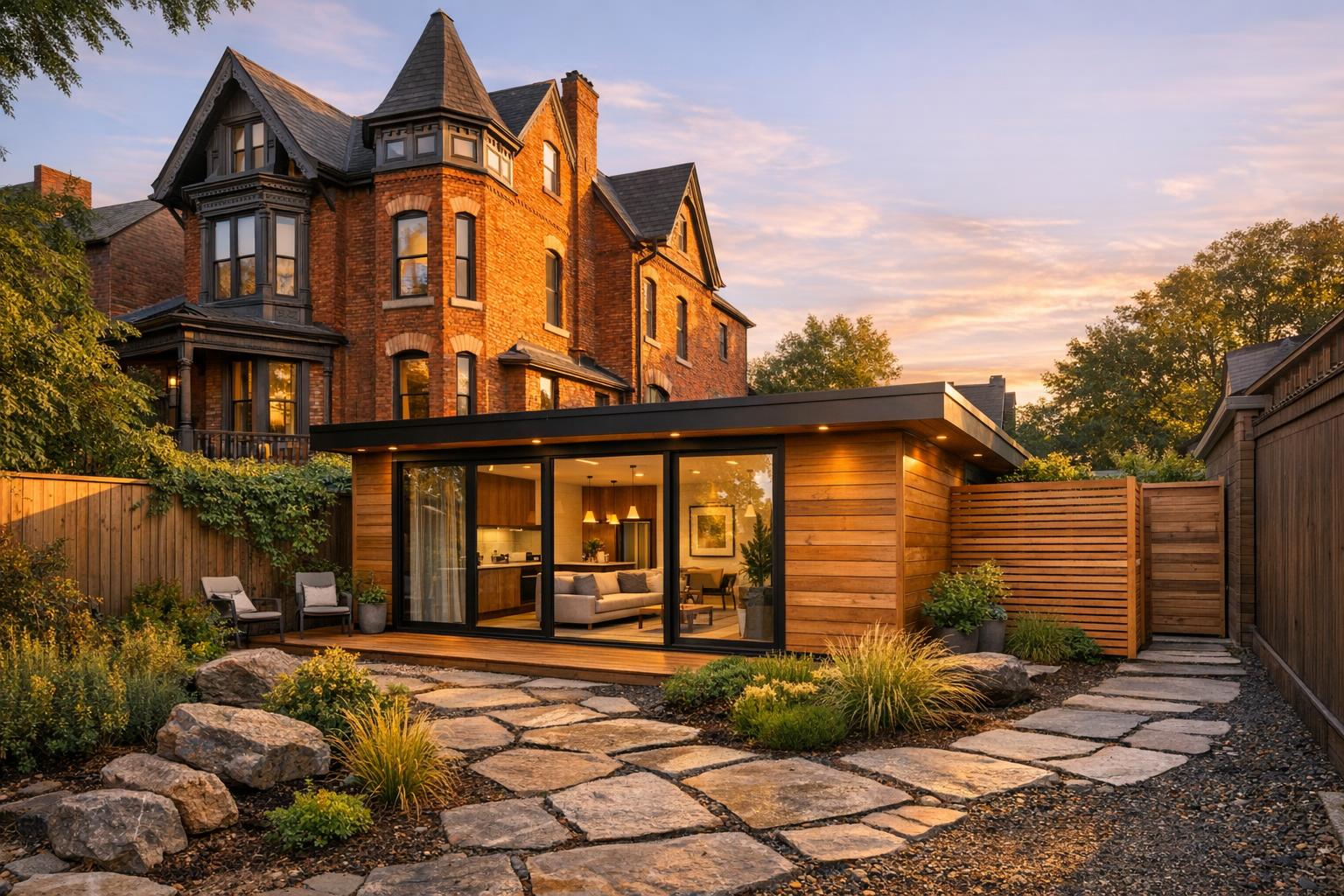
ADUs in Heritage Homes in Canada: 2026 Guide to Design, Approvals, Costs, and Historic Preservation
Estimated reading time: 14 minutes
Key Takeaways
- ADUs in heritage homes are possible across Canada, but success depends on protecting character-defining elements from the start.
- Municipal review is critical because zoning approval does not automatically mean heritage approval.
- Internal suites, rear additions, and detached garden suites can all work, but the best option depends on visibility, reversibility, and the building’s heritage value.
- Good ADU design for heritage homes is compatible, subordinate, and distinguishable rather than fake-historic or overly dominant.
- Timelines are often longer and costs are often higher than standard ADU projects because of extra studies, design care, and hidden building conditions.
- Rental income from a carefully planned secondary unit can help fund repairs and long-term upkeep of older properties.
Table of contents
- What “ADUs in Heritage Homes” Means
- Why ADU Design for Heritage Homes Requires a Different Approach
- Heritage Designation and ADU Rules in Canada
- Historic Preservation Principles for ADUs in Heritage Homes
- ADU Design Strategies That Respect Heritage Homes
- Technical Issues to Solve Before Building an ADU in a Heritage Home
- How to Get Approval for ADUs in Heritage Homes in Canada
- Who to Hire for a Heritage Home ADU Project
- What ADUs in Heritage Homes Cost in Canada in 2026
- Canadian Examples of ADU Design for Heritage Homes
- Common Heritage ADU Mistakes Homeowners Make
- Helpful Resources for Planning Secondary Units in Heritage Homes
- FAQs About ADUs in Heritage Homes
- Final Thoughts on ADUs in Heritage Homes
ADUs in heritage homes are becoming a practical housing option across Canada, but they need careful ADU design so historic preservation stays at the centre of the project.
This 2026 guide explains how to add secondary units to heritage homes, including design choices, regulations, timelines, and likely costs.
Adding a self-contained home to a protected or historically important house is possible. The key is to make sure the new unit does not damage the building’s heritage value. In plain terms, that means creating more living space while respecting the parts of the property that make it special.
This matters in 2026 for a few clear reasons:
- Housing demand is still high
- More cities now allow secondary units
- Heritage homes still face added review and stricter design expectations
- Rental income from a well-planned ADU can help pay for repairs and long-term upkeep
Across Canada, municipalities are treating additional dwelling units as part of the housing solution. Cities such as Hamilton also provide clear homeowner guidance on adding these units, showing that secondary housing is now part of mainstream planning. For owners of heritage homes, that creates opportunity, but only if the design is sensitive from day one.
See also: Sault Ste. Marie’s ADU initiative, ADU investment in Canada, and secondary unit benefits in Canada.
What “ADUs in Heritage Homes” Means
An ADU is a self-contained residential unit on the same property as a main home. It has its own:
- Kitchen
- Bathroom
- Sleeping area
In Canada, ADUs may also be called:
- Secondary dwelling units
- Secondary units
- Accessory dwelling units
- In-law suites
- Granny flats
- Garden suites
- Laneway homes
- Coach houses
- Carriage houses
Secondary units is the broad term. It includes extra self-contained homes created:
- Inside the main house
- Attached to the main house
- In a detached building on the same lot
Heritage homes also fall into more than one group.
Designated heritage homes are legally protected under municipal, provincial, or national rules.
Non-designated heritage homes may still be historically important, even if they are not formally protected. Some are in heritage conservation areas, so they still face design controls.
Historic preservation means protecting a building’s cultural value, physical integrity, and character-defining features while allowing thoughtful change.
In this article, the focus is on homeowners and professionals in Canada, especially those dealing with:
- Designated properties
- Homes in heritage conservation districts or areas
- Older houses with clear historic character
Local rules vary, so municipal review is always essential.
Common ADU types for heritage homes include:
- Basement suite
- Attic conversion
- Accessory apartment
- Rear addition
- Garden suite
- Coach house
- Carriage house
- Laneway house
Canadian municipalities already recognize both internal and detached forms of ADU design, including backyard homes such as coach houses and garden suites. For a broader overview, see this guide to types of ADUs in Canada.
Why ADU Design for Heritage Homes Requires a Different Approach
A standard ADU project usually focuses on:
- Zoning
- Building code
- Utility servicing
- Site access
ADUs in heritage homes must do all of that too, but they also have to protect heritage value.
That changes the whole design process.
The most important idea is the character-defining element. These are the physical features that show why a building matters historically. They often include:
- Façade layout
- Original windows
- Roofline
- Porch
- Trim
- Cladding
- Masonry
- The way the house sits on the lot
Heritage review often looks closely at:
- Visibility from the street
- Damage to original materials
- Size of the new unit compared with the main home
- Whether the change can be reversed later
- Whether the materials fit the house without pretending to be old
That means a proposal can be allowed by zoning and still be rejected on heritage grounds.
For heritage homes, historic preservation is not the last step. It is the starting point.
Good ADU design begins by asking what must stay protected, then shaping the unit around that answer.
Heritage Designation and ADU Rules in Canada
Heritage regulation in Canada works at three levels.
Federal
Parks Canada sets conservation standards and oversees places such as National Historic Sites.
Provincial
Each province has its own heritage laws.
Municipal
Cities and towns usually control the approvals that matter most to homeowners.
For most people, the municipal level is the most important because it usually covers:
- Heritage alteration permits
- Zoning permissions
- Minor variances
- Building permits
A property may fall into one of these common situations:
- Individually designated heritage property
- Listed on a heritage register
- Located in a heritage conservation district or area
- Non-designated, but still older and sensitive in context
There is no single national pathway for ADUs in heritage homes. Rules differ across Canada, and sometimes from one block to the next.
City examples
Vancouver
Laneway houses and garden suites are common forms, but heritage properties may still need heritage alteration approval.
Toronto
Internal suites and some detached garden suites may be possible. Heritage review may also call for a Heritage Impact Assessment.
Hamilton
Hamilton allows additional dwelling units under its bylaw, but heritage properties can face added review.
Ottawa and Halifax
Secondary units may be allowed, but planning staff or a heritage committee may need to review the proposal.
Smaller municipalities
Expect more variation. Some towns rely on early staff guidance rather than a large formal process.
Documents you may need
Many municipalities may ask for:
- Title deed
- Heritage designation document
- Statement of Significance
- Heritage Impact Assessment
- As-built drawings
- Site plan
- Utility servicing information
- Record of previous permits
Pre-application checklist
Before you spend money on full drawings, do these steps:
- Confirm whether the property is designated
- Check if it sits in a heritage conservation area
- Download zoning and heritage bylaw information
- Gather old drawings and current photos
- Identify the likely ADU type
- Note constraints such as lane access, trees, slope, servicing, or parking
Municipal ADU programs, local bylaw guidance, and Canadian research tools all show the same pattern: more support for secondary units, but extra care for heritage sites. Helpful starting points include the ADU Search resource centre, Surrey backyard home guidance, and this Canadian ADU regulations guide.
Historic Preservation Principles for ADUs in Heritage Homes
Strong historic preservation work follows a few core rules.
Compatibility
Compatibility means new work should fit the original building in:
- Scale
- Form
- Rhythm
- Material character
But it should not fake age.
Reversibility
Reversibility means the ADU should be removable in the future, where possible, without major damage to original fabric.
Minimal intervention
This means changing as little of the heritage building as needed to make the unit safe and functional.
Distinguishable new work
New work should look contemporary, not like a false copy of history.
Retention of character-defining elements
The features that express heritage value should stay in place and stay visible.
Use the Statement of Significance as a design brief
The Statement of Significance, often called the SoS, is one of the most useful documents in a heritage project. It helps you:
- Identify what must be protected
- Separate high-value features from less sensitive areas
- Build the ADU design around the heritage case, not against it
Elements often protected include:
- Primary façade
- Front porch and stairs
- Roofline and dormers
- Decorative trim
- Original windows and doors
- Brickwork, wood siding, and stone details
- Mature landscape features
- Historic outbuildings
This often shapes the best ADU type. If the front block of the house is highly protected, an internal basement suite or a detached rear unit may make more sense than an attached addition.
Canadian conservation practice, including standards-based approaches supported by current housing policy guidance in BC, supports this kind of careful, compatible, and readable change. See also this overview of heritage home ADU zoning rules.
ADU Design Strategies That Respect Heritage Homes
1. Placement strategy
For heritage homes, the best locations are often:
- Rear yard
- Side yard
- Laneway edge
- Basement
- Attic
- Existing outbuilding
These options usually protect the main public view of the house.
The primary façade should usually stay untouched because:
- It often holds the strongest heritage value
- It is the most visible part of the building
- Changes there are more likely to be refused
Detached rear placement often works best when lot depth and servicing allow it.
Avoid ADU design ideas that require:
- Removing mature trees
- Major grading changes
- Building tight against key heritage features
Useful references include the ADU Search resource centre, Sault Ste. Marie ADU guidance, and a review of whether you can build an ADU in a front yard in Canada.
2. Scale and massing
Subordinate massing means the new unit should look secondary to the main heritage home.
Practical rules include:
- Keep the ADU lower than the main ridge or eaves when possible
- Use setbacks and separation to reduce bulk
- Avoid additions that match the exact size or visual weight of the original house
- Align openings with the rhythm of the house, but do not copy old details exactly
Proportion matters more than exact duplication. A good addition feels calm and respectful.
3. Materials and detailing
Compatible but distinguishable is the goal.
Examples include:
- Siding boards with a similar scale
- Brick in a close but not identical tone
- Simpler trim on the new work
- Modern windows with heritage-friendly proportions
In most cases, rich historic detail should stay on the original building. The ADU should be simpler and quieter.
In Canada, durability also matters. Materials must handle moisture, freeze-thaw cycles, and long winters.
4. Entries and circulation
A separate entrance for secondary units should usually go at the side or rear.
Avoid changing the main front entry if that entry is part of the home’s heritage value.
Inside the house, preserve important:
- Hallways
- Staircases
- Front rooms
- Original room layouts where they matter to heritage value
For internal suites, good planning can reduce the need to cut up formal spaces.
5. Reversibility in practice
Reversibility is easier to understand with examples.
- Detached suites are often the most reversible
- Mechanical fasteners can reduce damage
- New service lines should go through less sensitive areas
- Avoid needless removal of original framing or finishes
Reversible does not mean cheap or temporary. It means future change is possible without major loss.
6. Internal vs attached vs detached ADUs
Internal suite
Best for low visual impact and often easier heritage review. Common problems include low ceilings, moisture, and egress limits.
Attached addition
Can improve light and layout, but it changes the original form and often gets stronger scrutiny.
Detached garden suite, laneway house, or carriage house
Often best for privacy and reversibility, but usually the most expensive and the hardest to service.
Canadian guidance recognizes all three approaches, from basement suites to detached garden homes. For more detail, review Ecohome’s complete guide to ADUs in Canada and this article on ADUs as smart urban housing.
7. Fire, sound, and egress without harming heritage value
Code issues for ADUs in heritage homes usually include:
- Fire separation
- Smoke and carbon monoxide alarms
- Emergency egress windows
- Acoustic separation
- Safe exits
Sensitive solutions include:
- Put fire-rated assemblies in less important areas
- Place egress windows on side or rear walls where possible
- Use compact systems to reduce exposed ducts and exterior vents on visible façades
Code compliance is not optional. But the way you meet code can still respect historic preservation.
Technical Issues to Solve Before Building an ADU in a Heritage Home
Older buildings often hide problems. These can affect budget, approval time, and design.
Structural assessment
Old foundations may be:
- Uneven
- Shallow
- Damp
- Too weak for extra loads
A structural engineer with heritage experience is important.
Helical piles are one possible low-disturbance solution. These are engineered foundation supports that can often be installed with less digging than a full new foundation. They can help reduce site disruption.
Some additions also need careful tie-ins, or even separation joints, so the old and new parts move safely. For broader project readiness, this guide on the special skills needed to build an ADU is also useful.
Moisture and envelope issues
Basements in heritage homes may have:
- Rising damp
- Poor drainage
- Stone foundations
- Older concrete
- Mold risk if finished the wrong way
Moisture problems should be fixed before building a basement suite.
Use moisture-aware, breathable approaches. In old walls, trapping water can do more harm than good.
Mechanical, electrical, and plumbing
Routing services through heritage homes takes care.
Try to avoid damage to:
- Decorative plaster
- Trim
- Historic framing
- Original finishes
Low-intrusion options can help:
- Ductless mini-splits or heat pumps
- Compact hot water systems
- Tight ventilation layouts
- Stacked plumbing runs
Visible exterior penetrations should be minimized on important façades.
For planning services and costs, review utility connections for Canadian ADUs and whether an ADU can have separate meters.
Energy upgrades in 2026
Energy upgrades are possible, but they should not erase heritage character.
Good options include:
- Attic insulation
- Rim joist insulation
- Interior storm windows
- Secondary glazing
- Retaining original windows when they matter
- Avoiding exterior insulation that covers trim or changes masonry appearance unless approved
A good retrofit improves comfort and efficiency while keeping the building readable as a heritage home.
Helpful references include Ecohome’s ADU guide and this Canadian guide to eco-friendly heating for ADUs.
Accessibility and universal design
Many secondary units are built for:
- Aging parents
- Long-term tenants
- Multi-generational living
Helpful features include:
- Wider passages
- Curbless showers
- Lever handles
- Blocking for future grab bars
- Low-step or level rear entry
A side or rear accessible entry is often a better fit for historic preservation than changing the front façade.
How to Get Approval for ADUs in Heritage Homes in Canada
Step 1: Confirm designation and zoning
Check:
- Is the property individually designated?
- Is it in a heritage conservation district?
- Does zoning allow the ADU type you want?
Do this before paying for full construction drawings.
Step 2: Book a pre-application meeting
A pre-application meeting is an early talk with planning and heritage staff.
Ask:
- Which ADU types are allowed here?
- Do I need a heritage alteration permit?
- Is a Heritage Impact Assessment required?
- Will I need variances?
- What is the usual timeline?
Step 3: Prepare heritage documents
Two key documents are common.
Statement of Significance
A summary of the home’s heritage value and its character-defining elements.
Heritage Impact Assessment
A report that explains how the project affects heritage value and how harm will be reduced.
These are often prepared by a heritage architect or consultant.
Step 4: Submit heritage application
For many designated heritage homes, a heritage permit or heritage alteration approval is needed before or alongside the rest of the process.
Typical submission items include:
- Site plan
- Elevations
- Materials list
- Photos
- Written rationale for compatibility and reversibility
Step 5: Zoning and variance review
A variance is special permission when a proposal does not meet a zoning rule, such as:
- Setback
- Lot coverage
- Height
- Parking
This process may include notice periods or hearings.
Step 6: Building permit
Building permit review looks at:
- Structure
- Fire safety
- Plumbing
- Mechanical systems
- Energy performance
- Code compliance
Heritage approval does not replace a building permit.
Step 7: Construction, inspections, and occupancy
Once approved, the work must match the submitted plans. This is especially important on heritage properties.
Expect:
- Staged inspections
- Possible heritage condition checks
- Final occupancy approval
Realistic timeline expectations
Typical ranges in Canada are:
- Pre-application: 1–2 weeks
- Design and documentation: 4–8 weeks
- Heritage review: 6–16 weeks
- Zoning or variances: 4–16 weeks
- Building permit: 2–4 weeks
- Construction: 3–12 months
From first planning to final completion, many ADUs in heritage homes take about 5 to 16 months before build completion, and sometimes longer if the site is complex.
Municipal guidance from Sault Ste. Marie and Hamilton shows how additional dwelling units are now more common, while approval timing still depends on local review. For a more specific overview, see this Ontario ADU permitting guide and ADU legal clinic guide for Canada 2026.
Who to Hire for a Heritage Home ADU Project
A strong team reduces risk.
Key roles
Heritage architect or heritage consultant
Helps interpret significance, prepare SoS or HIA documents, and shape ADU design that protects character.
Structural engineer
Checks the building and plans foundation or framing work.
Planner or zoning consultant
Useful when variances or planning arguments are needed.
Mechanical and electrical professionals
Design low-intrusion systems that fit older buildings.
Contractor with heritage experience
Knows how to open old buildings carefully and deal with hidden conditions.
Surveyor
Confirms property lines, setbacks, and site limits.
Questions to ask before hiring
- Have you worked on residential heritage homes before?
- Have you worked with this municipality’s heritage staff or committee?
- How do you balance code upgrades with historic preservation?
- Can you show examples of internal suites, attached additions, or detached secondary units on older properties?
- How do you handle hidden conditions in old buildings?
What ADUs in Heritage Homes Cost in Canada in 2026
Heritage projects usually cost more than standard ADUs. Reasons include:
- Specialized design work
- Careful demolition
- Better detailing
- Hidden repairs
- More approvals
Approximate cost ranges
- Basement or internal suite: CAD $60,000–$150,000
- Attached addition: CAD $150,000–$300,000
- Detached garden suite or laneway house: CAD $200,000–$400,000
- Heritage consultant, SoS, HIA, and review support: CAD $5,000–$15,000
These are planning ranges only. Actual costs depend on location, site conditions, and market pricing.
Typical heritage premiums
- Internal suite: often 10–20% more
- Attached addition: often 15–25% more
- Detached suite on a heritage lot: often 10–15% more
Main cost drivers
- Structural repair
- Foundation work
- Custom windows
- Servicing trenching
- Moisture repair
- Design revisions requested during review
Funding options in Canada
Common ways to fund ADU design and construction include:
- HELOC
- Renovation mortgage
- Financing supported by expected rental income
- CMHC-related options where available
- ADU mortgage products
Incentives and support examples
Some municipalities now offer direct help. Barrie, for example, offers a 50% permit fee reduction for additional residential units in 2026. Some cities may also offer:
- Heritage grants
- Property tax rebates
- Faster approvals
- Pre-approved ADU plans
Cost-saving strategies that still respect heritage homes
- Favour internal suites where feasible
- Phase work in stages
- Use durable compatible materials instead of exact replicas where not needed
- Talk to heritage staff early to avoid redesign
Municipal guidance and incentive programs show that cost planning should include both construction and approvals from the start. For financing ideas, review this ADU financing guide for Canada.
Canadian Examples of ADU Design for Heritage Homes
Vancouver example
A 1920s cottage sits on a heritage street with rear lane access.
Constraint:
The front façade and porch are highly visible and worth protecting.
ADU strategy:
A detached laneway house at the rear with a low roofline and muted materials.
Approval path:
Rear placement, subordinate scale, and minimal impact on the main house support the heritage case.
Lesson:
Detached secondary units can reduce impact on the main house and improve reversibility.
See this guide to laneway suites in Canada for a practical comparison.
Toronto example
A Victorian home sits in a heritage district.
Constraint:
The street-facing form and exterior details must stay largely intact.
ADU strategy:
An attic or basement conversion with a discreet side entry and very limited exterior change.
Approval path:
Internal work faces less visual concern than a large addition.
Lesson:
For many ADUs in heritage homes, internal suites are the least risky design route.
For similar conversion considerations, review this article on basement ADU conversion in Canada.
Halifax example
A heritage property includes an old carriage house.
Constraint:
The outbuilding is underused but historically valuable.
ADU strategy:
Restore the carriage house as a rental suite.
Approval path:
The project supports preservation by giving the building a useful long-term purpose.
Lesson:
Reusing a historic outbuilding can strengthen both the heritage and financial case.
Common Heritage ADU Mistakes Homeowners Make
Designing before understanding designation
Problem:
Owners pay for drawings before they know what rules apply.
Better approach:
Confirm designation, district rules, and zoning first.
Altering the front façade unnecessarily
Problem:
Front-facing changes are the most visible and often affect character-defining elements.
Better approach:
Use side or rear entries, or rework the interior instead.
Choosing fake-historic or clashing materials
Problem:
Exact imitation can look false. Harshly modern materials can also feel out of place.
Better approach:
Choose a material palette that is compatible but still distinguishable.
Underestimating hidden conditions
Problem:
Old houses may contain:
- Rot
- Damp basements
- Weak framing
- Lead paint
- Asbestos
- Old wiring
Better approach:
Plan for a 10–15% contingency and do early investigation.
Failing to talk to neighbours or committees early
Problem:
Concerns often focus on:
- Height
- Privacy
- Parking
- Overdevelopment
Better approach:
Use clear drawings, explain the heritage-sensitive design, and show how the ADU helps maintain the property.
Helpful Resources for Planning Secondary Units in Heritage Homes
Homeowner checklist
- Confirm designation status
- Gather the Statement of Significance and old drawings
- Choose the likely ADU type
- Book a pre-application meeting
- Hire a heritage consultant and engineer
- Prepare heritage and zoning submissions
- Set a budget contingency
Sample Heritage Impact Assessment outline
- Property identification
- Heritage context
- Description of proposed ADU
- Impact analysis
- Mitigation strategies
- Conclusion and recommendation
Questions to ask your municipality
- Is my property designated or in a conservation district?
- What secondary units are allowed here?
- Is an HIA mandatory?
- Are parking or servicing exemptions available?
- How long do heritage reviews usually take?
Questions to ask your heritage consultant
- Which elements are truly character-defining?
- Is internal conversion better than a detached suite here?
- How can the design be made more reversible?
- Which parts of the building are least sensitive to change?
Useful Canadian resources for ADU design, heritage homes, and historic preservation include the ADU Search resource centre, Ecohome’s ADU guide, Barrie’s ARU program page, and this ADU glossary of Canadian terms.
FAQs About ADUs in Heritage Homes
Can I add an ADU to a designated heritage home in Canada?
Usually yes, but approval depends on the designation level, local zoning, and whether the project protects character-defining elements. Internal suites often raise fewer visible heritage concerns than large additions. See heritage home ADU zoning rules for a useful overview.
Will a secondary unit affect my home’s heritage status?
Not if the project follows historic preservation principles and gets proper approval. In some cases, the added income helps fund repairs and long-term upkeep of heritage homes. The emotional and practical benefits of ADUs can also be part of that long-term value.
What approvals are usually needed?
Most ADUs in heritage homes need a heritage permit or heritage review, zoning approval or a variance if required, and a building permit. The usual sequence is heritage and planning review first, then code and permit review.
Can I improve energy efficiency without hurting heritage value?
Yes. Good options include interior storm windows, attic insulation, compact systems, and moisture-aware insulation plans that do not damage old assemblies. A helpful reference is this guide to eco-friendly heating for ADUs in Canada.
How long does approval usually take in 2026?
Often 5 to 16 months from early planning through approvals and occupancy path, depending on the city, the need for variances, and the level of committee review. Delays are common enough that this guide to ADU construction delays in Canada is worth reviewing.
Are laneway houses or garden suites possible on heritage properties?
Often yes, if zoning allows them and the placement and massing are sensitive. Detached units can be easier to justify because they are more reversible and less invasive to the main house. See laneway suites in Canada for examples.
Final Thoughts on ADUs in Heritage Homes
Adding ADUs in heritage homes is achievable in Canada when the project begins with heritage value, not as an afterthought.
The best results come from a simple formula:
- Confirm the designation
- Identify the character-defining elements
- Choose the least intrusive ADU type
- Use ADU design that is compatible, subordinate, and reversible
- Speak with municipal staff early
- Budget for extra time and contingency
A practical way to begin is to:
- Gather the Statement of Significance and zoning information
- Schedule a pre-application meeting
- Hire a heritage-experienced architect or consultant before locking in the concept
Canadian municipalities continue to expand support for secondary units, and some also offer fee reductions or guidance tools. But heritage homes still need a slower, more careful process. When done well, an ADU can add housing, create income, and help preserve a historic property for the long term.
Useful next reads include Barrie’s additional residential units page, Surrey’s backyard homes guidance, and this article on retrofitting heritage homes for ADUs.
Leave a Reply