

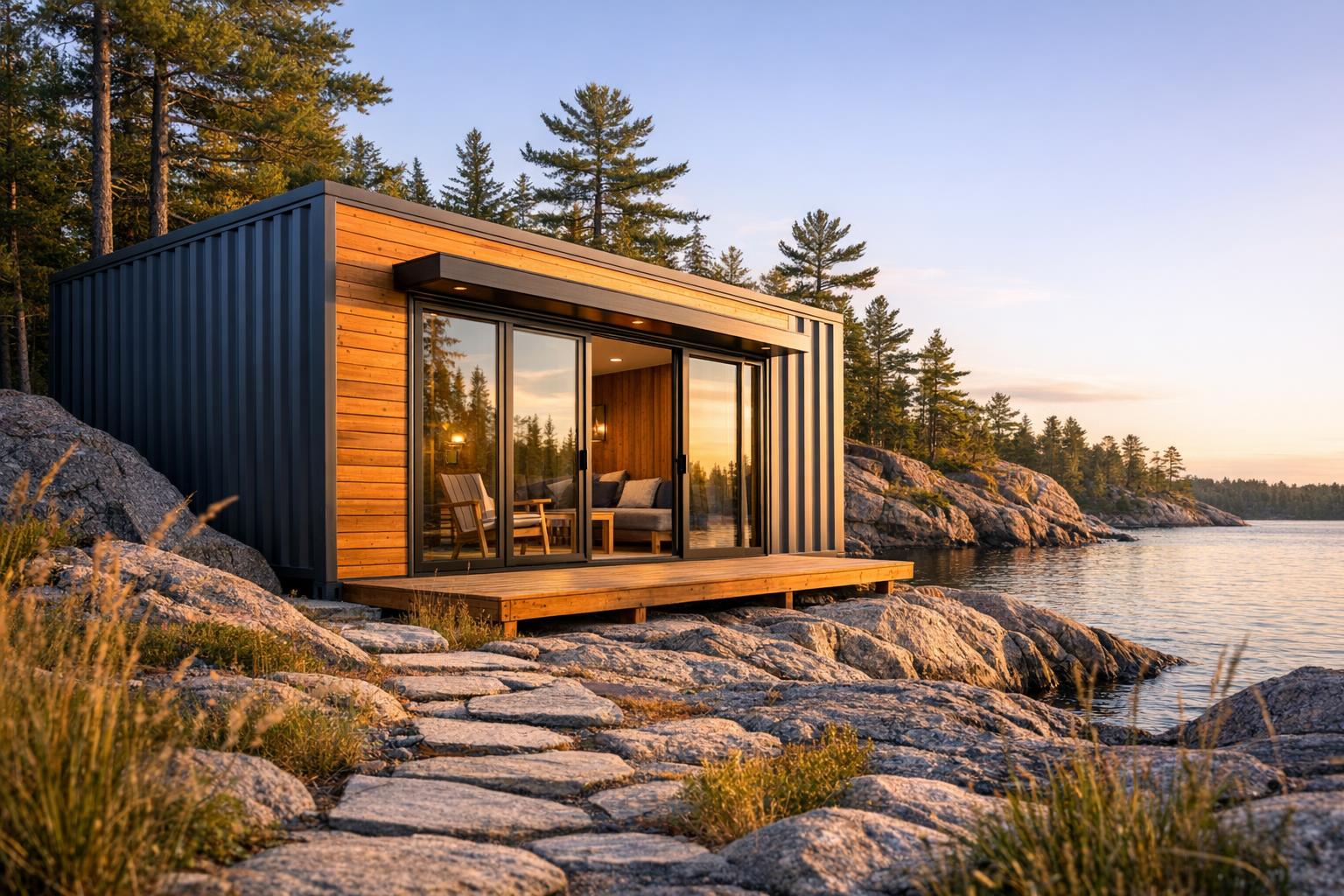
Estimated reading time: 12 minutes
Key Takeaways
- A shipping container ADU can work in remote Canada, but only when it is designed as true cold-climate housing, not as a basic steel-box conversion.
- Thermal bridging, condensation, ventilation, and foundation movement are among the biggest risks for any Arctic ADU or northern container project.
- Off-site prefabrication may reduce weather delays and site labour, which is part of why modular container homes attract attention in remote work.
- Public Arctic-specific performance data is still limited, so project-specific engineering remains essential in 2026.
- For many sites, a shipping container ADU is only one option among panelized prefab, volumetric modular, SIP systems, and other alternative construction methods.
Table of contents
- What is a shipping container ADU, and why is it being considered in remote Canada?
- Can a shipping container ADU really work in extreme Canadian climates?
- Why choose a shipping container ADU for remote Canada?
- The cold-climate housing challenge in remote Canada
- Arctic ADU-specific design considerations
- Practical design strategies and technical solutions
- Logistics, transport, and site work in remote Canada
- Codes, permitting, and community engagement
- Cost, lifecycle, and sustainability
- Real-world case studies: what current sources support, and what they do not
- Shipping container ADU vs other alternative construction options
- Practical planning tools
- Visuals and data that improve understanding
- Risks, pitfalls, and maintenance guidance
- Frequently Asked Questions
What is a shipping container ADU, and why is it being considered in remote Canada?
An ADU is an accessory dwelling unit. In simple terms, it is a smaller self-contained home on the same property as a main home, or a related secondary housing unit depending on local zoning and code rules. For a quick background, see this guide to accessory dwelling units.
A shipping container ADU is an ADU built from one or more steel intermodal containers. The shell is then modified with:
- insulation
- doors and windows
- heating and ventilation
- plumbing and electrical systems
- a foundation suited to the site
This concept gets attention in remote Canada because it appears to offer a more controlled, modular starting point for difficult sites.
Why the interest?
- prefabrication can reduce on-site construction time
- modular units can be partly finished off-site
- the steel shell gives a known starting size and shape
- transport can be simpler than moving many loose materials in some locations
But there is an important caution:
A shipping container is not housing just because it is strong.
In cold-climate housing, the hardest problems are usually not just structural. They are often about:
- heat loss
- thermal bridging
- condensation
- ventilation
- foundation movement
- moisture damage over time
Current Canadian industry sources help explain the appeal. Off-site prefabrication may reduce weather delays, modular building can support remote logistics, and some companies present steel modular systems as suitable for harsh conditions. See the Canadian discussion of modular container homes and the builder overview at Container Homes Canada.
Can a shipping container ADU really work in extreme Canadian climates?
Yes, a shipping container ADU can work in remote Canada, and in some near-Arctic settings, but only if it is designed like a high-performance enclosure rather than treated like a basic conversion. For context, see these resources on cold-climate tiny home construction and cold-climate homes in northern Canada.
That is the direct answer.
The real question is not whether steel boxes can exist in cold places. The real question is whether the finished dwelling can reliably control:
- heat flow
- air leakage
- interior humidity
- condensation
- snow and wind loads
- foundation movement
- service freezing
- long-term maintenance
The outcome depends on:
- climate zone
- site access
- soil and foundation conditions
- available trades
- permitting pathway
- utility strategy
- total budget
This article is educational, not a blanket recommendation.
A shipping container ADU may be more attractive where there is:
- limited labour on site
- high weather risk for site-built work
- a need for modular deployment
- a compact footprint
Other methods may be better where there is:
- limited room for thick insulation
- restrictive transport dimensions
- a need for larger family layouts
- a permitting environment that prefers conventional prefab wood-frame systems
The big takeaway: for an Arctic ADU or severe remote build, success depends less on the container idea itself and more on how the full building system is designed.
Why choose a shipping container ADU for remote Canada?
Predictable modular shell
A shipping container gives a standard steel box with known dimensions. That can help early planning for layout, transport, craning, and fabrication.
For teams building multiple units, that regular shape may also support more repeatable detailing and production.
Reduced on-site build time
One of the strongest arguments for a shipping container ADU in remote Canada is the chance to complete part of the work off-site. Interior framing, rough-ins, insulation, and some finishes may be done before the unit reaches the property.
That can mean:
- fewer weather delays
- fewer site days
- less exposure for trades
- less dependence on a short construction season
This is one of the clearest reasons container-based alternative construction keeps appearing in northern conversations. See the prefab angle in this modular container guide and broader context on prefab housing.
Transport and modular deployment potential
In some locations, moving a modular shell can be easier than coordinating a full conventional build with many separate deliveries. A shipping container ADU can fit transport planning more neatly than a one-off custom structure in certain situations. Related logistics issues are discussed in guides to moving a tiny home in Canada and moving a tiny home across provinces.
Still, easier does not mean cheap. Transport remains one of the biggest cost drivers in remote Canada.
Structural strength and durability of the steel shell
Shipping containers are built for heavy transport and stacking loads. That durability is part of the appeal.
But once you cut large openings for windows, doors, or open-plan rooms, the structural behaviour changes. Reinforcement is often required. The original shell should not be treated as a free pass. For related discussion, see metal-framed tiny homes in Canada.
Fit within broader cold-climate housing innovation
Container-based homes are only one branch of alternative construction. Other common options include:
- panelized prefab wood-frame
- volumetric modular
- SIP systems
- hybrid steel-and-wood assemblies
In cold-climate housing, the best option is usually the one that fits the site, code path, budget, and local skills.
The cold-climate housing challenge in remote Canada
Extreme temperatures
Very low outdoor temperatures increase heat loss quickly. Even a small insulation gap or air leak becomes serious.
This matters even more with a shipping container because steel is highly conductive. If the shell is not properly isolated, the home can lose heat fast and create very cold interior surfaces.
Thermal bridging
Thermal bridging is heat flow through a material that bypasses insulation.
In a shipping container ADU, thermal bridges can happen through:
- the steel shell
- steel framing members
- fasteners
- window bucks
- roof and floor edges
- poorly detailed attachments
The result can be:
- lower real R-value
- colder interior surfaces
- condensation
- mould risk
- occupant discomfort
For an Arctic ADU, this is one of the biggest design issues.
Condensation and moisture accumulation
Interstitial condensation means water vapour turns into liquid inside the wall or roof assembly when warm indoor air meets a cold surface.
Containers are vulnerable because:
- the steel shell can get very cold
- compact units have less room for forgiving assemblies
- humidity from people, cooking, and bathing can build up quickly
If moisture gets trapped, long-term damage follows.
Frost heave and difficult ground conditions
Frost heave occurs when soil rises as moisture freezes.
This can move foundations, twist supports, and create uneven settlement. In northern and Arctic contexts, permafrost and seasonal thaw make foundation design much more complex.
Wind, snow, and drifting
Many remote Canada sites face:
- high winds
- heavy snow loads
- drifting snow around walls and doors
- difficult roof drainage conditions
That affects roof design, entries, cladding details, and mechanical penetration placement.
Logistics and labour constraints
Remote projects often involve:
- fewer available contractors
- limited suppliers
- weather-dependent transport
- high mobilization costs
- material storage challenges
- theft and site security concerns
These issues can shape the project just as much as the design itself.
Cultural and community context
Northern housing should never be treated as only a technical problem.
Good cold-climate housing also needs to consider:
- local living patterns
- maintenance capacity
- culturally appropriate layouts
- community preferences
- long-term repairability
A technically clever Arctic ADU that is hard to maintain or poorly suited to local use is not a good solution.
Arctic ADU-specific design considerations
Public sources used for this guide do not provide enough Arctic-specific performance data for a true Arctic ADU specification. There are no strong public cold-climate metrics in the source set, no detailed remote logistics case studies with measured outcomes, and no confirmed Arctic off-grid sizing guidance.
That means every true Arctic project in 2026 needs project-specific engineering and code review.
Permafrost and foundation strategy
Where permafrost or unstable seasonal ground is present, the goal is often to reduce heat transfer into the soil and allow long-term adjustment if movement occurs.
Practical elevated support ideas may include:
- piers that lift the unit above grade
- raised assemblies that reduce snow contact
- adjustable supports where seasonal movement is expected
Some Canadian container builders reference helical piles and compacted gravel foundations for varied terrain, but actual use depends on geotechnical conditions and local engineering. See Container Homes Canada and this overview of tiny home foundation options in Canada.
Envelope performance targets
An Arctic ADU needs a high-performance enclosure with:
- continuous insulation
- minimal steel exposure to the interior
- very high airtightness
- careful vapor control
- dew-point management
Target insulation and airtightness levels should be set by climate zone, code pathway, and energy modelling in 2026.
In many cases, exterior continuous insulation is preferred because it keeps the steel shell warmer and lowers condensation risk.
Moisture control and indoor air quality
A tight building needs planned ventilation.
HRVs and ERVs matter because they:
- bring in fresh air
- remove stale air
- help control humidity
- recover heat from outgoing air
In compact cold-climate housing, moisture control is not optional. A small shipping container ADU can see indoor humidity rise very quickly from normal use.
Corrosion, salt air, and long-term resilience
Coastal northern areas may add extra corrosion risk from salt air and blowing moisture.
Good practice includes:
- inspect coatings often
- protect welded areas and cut edges
- separate dissimilar metals where possible
- use cladding and drainage details that shed water well
For a shipping container in remote Canada, corrosion planning is part of durability planning.
Practical design strategies and technical solutions
Shell modifications and structural reinforcement
When you cut openings into a shipping container, you remove part of the original wall structure. That applies to:
- windows
- doors
- large side openings
- connections between two containers
Reinforcement is usually required around major cut-outs. Any multi-container layout should be structurally reviewed. All cuts, welds, and penetrations need corrosion protection.
Insulation strategy: prioritize exterior continuous insulation
Exterior continuous insulation wraps the steel shell from the outside.
This helps because it:
- reduces direct heat flow through steel
- keeps the steel warmer
- pushes the dew point outward
- can preserve more interior space than thick interior-only framing in some cases
Possible approaches include:
- exterior mineral wool
- exterior foam-based insulation
- a rainscreen cladding system
- an interior service cavity for wiring and plumbing
The exact assembly still has to be selected for fire safety, moisture control, code compliance, and durability.
Spray foam trade-offs
Spray foam is often used in container projects because it adheres to steel and delivers high R-value in a thin layer.
But it has trade-offs:
- future inspection can be harder
- repairs can be harder
- it does not eliminate all thermal bridging
- it should not replace whole-assembly moisture design
For an Arctic ADU, spray foam may be part of the solution, not the complete solution.
Thermal bridge mitigation details
Thermal bridge control may include:
- continuous exterior insulation
- thermally broken attachment systems
- careful detailing at openings
- protected roof and floor edges
- fewer direct steel-to-interior connections
A thermal break is a material or detail that interrupts conductive heat flow.
This is one of the most important technical details in cold-climate housing. See related guidance on a Passive House ADU guide and net-zero ADU planning.
Windows and doors
Windows and doors are common failure points in severe climates.
Good practice includes:
- high-performance glazing
- insulated frames
- full air sealing
- flashed openings
- sloped sills
- placement that balances light and heat loss
Some design sources emphasize large glazing and compact layouts. That can work in milder climates, but in severe cold-climate housing, glazing decisions must be balanced carefully against thermal performance. See this container home design video and this article on smart glass efficiency.
Roof upgrades and snow management
A standard shipping container roof is not automatically ideal for long-term residential snow and drainage performance.
Many projects will need:
- a roof overbuild
- added insulation above the roof deck
- a better drainage plan
- snow-shedding and entry protection details
Snow drift near doors, mechanical penetrations, and service points should be part of site planning. For related context, see Canadian snow load requirements.
HVAC systems for cold climates
Heating, ventilation, and humidity control must work together.
A shipping container ADU may use:
- cold-climate mini-split heat pumps where suitable
- backup heat for extreme cold or outages
- HRV or ERV ventilation
- electric resistance heat
- radiant floor in some cases
In a small, well-insulated home, good ventilation can matter as much as heating capacity. See heat pump guidance for tiny homes and hydronic heating options.
Off-grid energy and utility planning
Some remote Canada sites do not have reliable grid access.
Possible strategies include:
- solar with battery storage
- generator backup
- low-load mechanical equipment
- envelope-first design to reduce energy demand
But winter solar limits are real, especially at high latitudes. Fuel delivery can also shape operating cost and risk.
The provided sources do not include Arctic-specific energy sizing guidance, so exact system design should come from a local energy model and equipment plan. Related reading includes off-grid living for Canadian tiny homes and how much solar an ADU may need.
Water, wastewater, and service freeze protection
Plumbing in cold regions must be protected from freezing.
That may include:
- insulated service runs
- heat tracing where needed
- enclosed lines
- keeping vulnerable systems inside the thermal envelope
- local wastewater solutions based on servicing conditions
These details vary widely by site and jurisdiction in remote Canada. See tiny home wastewater solutions in Canada and utility hookup planning.
Interior layouts optimized for ADU use
Compact planning improves comfort and efficiency.
Useful moves include:
- group plumbing fixtures together
- reduce unnecessary hall space
- add built-in storage
- use a mudroom or entry buffer where possible
- keep the mechanical closet easy to access
Current inspiration sources often highlight compact modular layouts and functional interiors. Those ideas can be useful, but they still need adaptation for real cold-weather performance. See the same container home layout example and this guide to tiny home kitchen design in Canada.
Logistics, transport, and site work in remote Canada
Transport route planning
This is one of the most underestimated parts of a shipping container ADU project.
A unit may move by:
- flatbed truck
- barge
- seasonal road
- specialized hauling equipment
Key checks include:
- route width and height
- turning clearances
- crane access
- seasonal restrictions
- staging areas
- escort and oversized-load permits if dimensions exceed standard limits
Transport feasibility should be checked before final design is locked in. See moving a tiny home in Canada and moving across provinces.
Site staging and security
Plan for:
- temporary storage
- weather protection
- safe access for installers
- theft and vandalism prevention
- staging space for cranes and support vehicles
A shipping container is strong, but the materials around it may still be exposed and vulnerable.
Prefabrication versus on-site assembly
More off-site completion can reduce weather risk. But it can also make transport harder if the finished unit is larger, heavier, or more delicate.
More on-site assembly gives flexibility, but it increases labour exposure and schedule risk.
Prefabrication is often promoted because it can reduce weather delays in harsh conditions. See prefab container advantages and this comparison of prefab ADU vs custom build.
Crew training and trade coordination
Not every builder is ready for container work.
Teams may need guidance on:
- cutting and reinforcing steel
- air sealing around metal structure
- protecting coatings
- coordinating penetrations
- controlling corrosion at attachments
That is one reason some alternative construction projects look simple on paper but become difficult in practice. See special skills needed to build an ADU.
Codes, permitting, and community engagement
Building code pathway
Canadian compliance for a shipping container ADU depends on the province or territory, occupancy type, local zoning, and whether the authority accepts the design as prescriptive or requires a performance-based path.
Some Canadian builders state that code-compliant container homes are possible. See their overview here.
The current research set does not include the needed 2026 territorial or provincial code references, so local verification is essential. Start with guides to Canadian ADU regulations and ADU permitting in Canada.
Zoning and approvals
Zoning should be checked at the start.
Questions may include:
- are ADUs allowed on the property
- what setbacks apply
- what lot coverage is allowed
- are design reviews required
- how must utilities be serviced
- will non-traditional construction trigger extra review
Zoning verification is described by Canadian builders as a standard early step. See Container Homes Canada and this list of tiny-home-friendly municipalities.
Permit documentation likely needed
Non-standard builds often need extra documentation, such as:
- structural drawings
- reinforcement details
- foundation engineering
- wall, roof, and floor details
- energy compliance information
- ventilation specifications
- transport and installation drawings if needed
A shipping container ADU usually benefits from more complete permit packages, not less. See digital permitting for ADUs and ADU legal support in Canada.
Community engagement and Indigenous collaboration
Best practice in remote Canada includes:
- discuss needs early
- avoid imposing southern assumptions
- consider local maintenance realities
- use durable and repairable systems
- support local workforce participation where possible
For Arctic ADU and cold-climate housing work, community fit matters as much as technical fit.
Cost, lifecycle, and sustainability
Cost categories
The cost of a shipping container ADU is not just the shell.
Typical cost areas include:
- container purchase and inspection
- shipping to the fabricator
- structural changes
- insulation and cladding
- windows and doors
- foundation
- plumbing, electrical, and HVAC
- transport to site
- craning and installation
- permits and engineering
- contingency
In remote Canada, logistics and envelope upgrades can easily outweigh simple shell savings. See ADU build cost guidance and hidden ADU construction costs.
Lifecycle performance
Long-term value depends on:
- energy use
- coating durability
- envelope quality
- service access
- maintenance burden
- occupant comfort
A container project only performs well if heat, air, and moisture are managed well over time.
Sustainability perspective
Reusing a shipping container may look attractive from a circular-economy perspective. But true sustainability should be judged across the full building system, including:
- insulation materials
- transport emissions
- service life
- operating energy
- long-term repairability
A shipping container ADU is one possible alternative construction path. It is not automatically the most sustainable one. See zero-waste ADU design and upcycling Canadian ADUs.
Funding and incentives note
The available research does not include current 2026 grants, utility rebates, or northern housing funding programs. Any published version of this topic should discuss funding only after current programs are verified. Background reading includes ADU grants and municipal incentives and an ADU financing guide.
Real-world case studies: what current sources support, and what they do not
The current source set does not include the full project names, measured performance data, or validated cost breakdowns needed for strong case studies.
What current sources do support:
- modular deployment can help with remote logistics
- some Canadian builders present container homes as code-oriented
- foundation approaches may include helical piles and compacted gravel
Sources include Sigma Container’s modular guide, Container Homes Canada, and this overview of northern Canada ADU solutions.
For now, the most honest approach is to use case-study frameworks.
Case framework A: remote coastal community
A useful shipping container ADU case in remote Canada should examine:
- project goals
- coastal corrosion risks
- transport and staging
- insulation and ventilation
- moisture and maintenance after occupancy
Likely lesson: corrosion protection at cuts, welds, and fasteners matters greatly, and coastal wind-driven rain increases the need for careful envelope detailing. See coastal tiny home weatherproofing and coastal ADUs in Atlantic Canada.
Case framework B: inland northern or permafrost community
A good Arctic ADU case should cover:
- soil and permafrost conditions
- elevated or adjustable foundation strategy
- heating system type
- winter comfort feedback
- seasonal movement observations
Likely lesson: foundation design and underfloor thermal detailing are decisive in cold-climate housing. See cold-climate homes in northern Canada and flood-resistant ADU design.
Case framework C: off-grid northern BC or Yukon
A useful alternative construction case should include:
- solar, battery, and generator strategy
- water and wastewater setup
- delivery sequence
- installed cost range
- labour and timeline constraints
Likely lesson: off-grid success depends more on systems integration than on the shipping container shell itself. See off-grid ADU mountain retreats and off-grid living in Canadian tiny homes.
Shipping container ADU vs other alternative construction options
Readers comparing options should look beyond trend appeal.
Panelized prefab wood-frame
Pros:
- often easier to insulate well
- familiar to more trades
- easier permitting in some places
Cons:
- more loose materials to ship
- more site assembly may be needed
Volumetric modular wood-frame
Pros:
- strong thermal performance potential
- factory-built quality control
- good for remote deployment
Cons:
- transport dimensions may still be limiting
- larger modules may be harder to move than a standard shipping container
SIP-based builds
Pros:
- strong insulation potential
- fast enclosure
Cons:
- detailing and moisture control still matter
- local trade familiarity varies
Small stick-built ADUs
Pros:
- very flexible layout
- familiar methods
- simpler repairs in many markets
Cons:
- more weather exposure
- longer on-site build time
- harder in remote Canada with labour shortages
Main takeaway
A shipping container ADU can work well, but in some cold-climate housing cases, a non-container modular system may offer better thermal performance with less detailing complexity and less interior space loss. Compare options through resources on prefab ADU vs custom build and modular homes and cost-efficient green building.
Practical planning tools
Pre-construction checklist
Before design is finalized, confirm:
- zoning and ADU eligibility
- transport route
- climate and wind exposure
- geotechnical and foundation input
- insulation approach
- utility or off-grid plan
- ventilation and freeze protection
- crane and logistics contingency
Sample specification framework
A project brief for an Arctic ADU should define:
- wall, roof, and floor assembly
- target airtightness
- window performance level
- foundation concept
- heating and ventilation system
- corrosion coating requirements
Hard code values should only be added once verified for the jurisdiction.
Cost-estimating worksheet headings
Useful categories include:
- shell
- structural modifications
- envelope
- MEP systems
- transport
- site work
- engineering
- contingency
Decision matrix
A simple matrix can compare a shipping container ADU against other alternative construction methods based on:
- climate severity
- route access
- budget
- approval complexity
- local trade familiarity
- thermal performance goals
Visuals and data that improve understanding
Strong visuals would help readers understand this topic much faster. The most useful examples are:
- wall section showing steel shell, continuous insulation, service cavity, and cladding
- thermal bridge detail at a window opening
- roof overbuild and drainage diagram
- foundation options for varied terrain
- one-container and two-container floor plans
- logistics flow from fabrication to a remote Canada site
Captions should naturally use terms like shipping container ADU, Arctic ADU, remote Canada, cold-climate housing, and shipping container.
Risks, pitfalls, and maintenance guidance
Common mistakes
Common errors include:
- assuming the steel shell is winter-ready
- using interior insulation alone
- under-designing ventilation
- forgetting crane and transport costs
- weak detailing around cut openings
- poor freeze protection planning
- using crews without container experience
Maintenance priorities
For long-term cold-climate housing performance, owners should:
- inspect coatings and welds
- monitor sealants and flashings
- service HRV or ERV systems
- check heating equipment regularly
- watch for condensation near corners and windows
- review foundation alignment where soil movement is possible
Resilience and contingency planning
In remote Canada, resilience planning may include:
- backup heat
- outage planning
- delayed parts planning
- fuel delivery backup
- occupant self-sufficiency during storms
For an Arctic ADU, resilience is part of the design brief, not an afterthought. See tiny home emergency preparedness in Canada and disaster-proofing tiny homes.
A practical conclusion for 2026: a shipping container ADU can be a practical option for remote Canada, but only when the project is designed as real cold-climate housing rather than as a basic conversion.
The strongest projects will combine:
- a compact program
- modular deployment where it truly helps
- access to fabrication capacity
- a robust insulation strategy
- a manageable transport route
- local validation for code, foundation, and services
Another construction method may be better when there is:
- a need for larger layouts
- a code-sensitive approval path
- limited budget for custom detailing
- a case where wood-frame modular offers easier thermal performance and permitting
Top 5 practical tips:
- Verify zoning and transport first.
- Design the enclosure around continuous insulation.
- Treat ventilation and humidity control as essential.
- Budget heavily for logistics and contingencies.
- Use engineers and builders who understand cold-climate container detailing.
FAQ
Are shipping container ADUs legal in Canada?
A shipping container ADU can be legal in Canada if local zoning allows the use and the project meets code and permit requirements. The container format alone does not make it legal or illegal. Zoning verification is a first step. See Container Homes Canada and this guide to ADU permitting in Canada.
Can a shipping container ADU handle Canadian winters?
Yes, if it is designed as a high-performance enclosure with continuous insulation, airtightness, and controlled ventilation. No, if it is treated like a bare steel box with only a minimal retrofit. See winter-proof tiny home guidance and a Canadian winterization checklist.
Are container homes good for Arctic climates?
Potentially, but Arctic ADU use needs project-specific engineering, foundation design, and strong moisture control. Public Arctic-specific data remains limited.
What foundation is best for a container ADU in remote Canada?
It depends on the soil and climate. Canadian builders reference helical piles and compacted gravel among possible options, but the final choice needs engineering. See builder notes here and this overview of foundation options in Canada.
Is a shipping container ADU cheaper than a regular ADU?
Not always. The shell price can be misleading because insulation, structural reinforcement, transport, and foundations can be major costs. See ADU cost guidance and understanding hidden ADU costs.
What is the biggest challenge in cold-climate container housing?
Thermal bridging and condensation control are among the biggest technical issues. See energy efficiency in tiny homes and the Passive House ADU guide.
Leave a Reply