

Estimated reading time: 14 minutes
Key Takeaways
- Tiny home seniors options are gaining traction in Canada as older adults look for safer, simpler, and more affordable housing that supports independence.
- An accessible ADU, a compact home, or a retirement park model can all support 55+ living and aging in place Canada when design and approvals are handled properly.
- Rules vary widely by province and municipality, so readers should verify 2026 zoning and tiny home policy changes, local code, servicing, and funding details before making decisions.
- For many households, the real value is not just a smaller home, but a smaller home paired with accessibility, stable tenure, nearby support, and lower maintenance.
- Good outcomes depend on the right housing model, clear legal structure, and thoughtful design informed by resources on tiny homes for seniors living, accessible ADU design in Canada, and tiny home retirement communities.
Table of contents
- Why Tiny Home Seniors Options Are Growing in Canada
- Tiny Home Seniors Housing Models: Tiny Homes, ADUs, and Retirement Parks Explained
- Retirement Park Design for Tiny Home Seniors and 55+ Living
- Accessible ADU and Tiny Home Design Features That Support Aging in Place
- Canada’s 2026 Policy and Zoning Landscape for Retirement Park and ADU Development
- Cost, Financing, and Affordability for Tiny Home Seniors in Canada
- Canadian Examples of Tiny Home Seniors and Accessible ADU Projects
- What Daily Life Looks Like for Tiny Home Seniors in a Retirement Park
- How to Launch a Tiny Home Seniors or Accessible ADU Pilot in 2026
- Checklist for Seniors Comparing a Retirement Park, Tiny Home, or Accessible ADU
- FAQs About Tiny Home Seniors, Retirement Parks, and Accessible ADUs
- Canada Resources for Tiny Home Seniors, ADUs, and 55+ Living
- Final Thoughts on Tiny Home Seniors and Aging in Place in Canada
Tiny home seniors options are getting more attention in Canada because many older adults want a safer, simpler, and more affordable way to live. This guide explains how tiny homes, an accessible ADU, and the retirement park model can support 55+ living and aging in place Canada in 2026.
Across the country, families, builders, municipalities, and housing providers are looking at smaller homes as housing costs rise, the population ages, and health systems stay under pressure. Tiny homes and ADUs are not a single fix, and they are not legal or practical everywhere. But in the right place, with the right design, they can give seniors more choice, dignity, and independence.
Readers should still verify local 2026 zoning, code, servicing, and funding rules because provincial and municipal requirements vary. Useful starting points include guides to Canadian tiny home communities, updates on Canada tiny home news, practical information on tiny homes for seniors living, and planning advice for accessible ADU design in Canada.
Why Tiny Home Seniors Options Are Growing in Canada
Canada is getting older. That means more people are looking for housing that sits between a large detached house and a full-care setting. Many want to stay independent, but with less upkeep, lower costs, and better access to family and services.
Current 2026 Statistics Canada and CMHC figures should be added before publication where exact demographic data is needed. For broader policy and market context, see Canadian tiny home developments and accessible ADU planning resources.
Why this fits aging in place Canada
Aging in place Canada means helping older adults remain in familiar communities for as long as it is safe and practical. That matters because staying near family, neighbours, doctors, and daily routines can support health and reduce stress.
Public policy has increasingly focused on helping people stay in community rather than move too early into institutional care. While this Parks Canada accessibility and inclusion planning link is broader than housing policy, it reflects the wider federal focus on accessibility and inclusion in public planning. Related housing ideas also appear in resources on ADUs for caregiving support spaces and accessible ADU grants in Canada.
Why tiny homes and an accessible ADU appeal to seniors
For many tiny home seniors households, the appeal is practical:
- Affordability: Smaller homes often use fewer materials and less energy.
- Lower maintenance: There is less floor area to clean, repair, heat, and cool.
- Location flexibility: A home may fit in a retirement park, a backyard suite setting, or a gentle-density project.
- Autonomy and dignity: Seniors may keep more privacy and control over daily life than in a more institutional setting.
Tiny homes are often around or under 500 to 600 square feet, though exact size depends on the model and local rules. That smaller footprint can reduce utility use and upkeep, but a tiny home is not automatically cheap. Land, servicing, permits, and tenure model all shape the true cost. See examples of small Canadian tiny home communities, a visual overview of tiny home construction and cost considerations, and guidance on the sweet spot for ADU size in Canada.
Gentle density and 55+ living
Gentle density
means adding more homes in a low-rise way that still fits the neighbourhood.
Examples include:
- garden suites
- laneway homes
- cottage courts
- small clustered developments
This matters for 55+ living because seniors often do not need large homes, but they do need homes close to transit, shops, clinics, and social life. Tiny home seniors communities and accessible ADU projects can add these options without high-rise construction. More detail is available through urban infill guidance and ideas for urban pocket parks with tiny homes.
Why retirement park models are part of the conversation
A retirement park can group smaller homes together with shared land, paths, services, and amenities. In the best version, that means lower-maintenance living with more social contact and easier service delivery.
Location flexibility also matters. Some seniors want a detached backyard suite near adult children. Others want a retirement-focused setting with peers and shared spaces. Both can support aging in place Canada when designed well. Relevant examples include types of tiny home communities in Canada, modular backyard suites in Canada, and tiny home retirement community models.
Tiny Home Seniors Housing Models: Tiny Homes, ADUs, and Retirement Parks Explained
The words in this space can be confusing because provinces and municipalities use different labels. Always check the local legal term.
Key definitions
Tiny home
A compact, self-contained dwelling, usually around or below 500 to 600 square feet, with a kitchen, bathroom, sleeping area, and living space. See sources on cozy Canadian tiny home communities, a tiny home explainer video, and tiny homes for seniors.
Common forms include:
- Tiny home on wheels (THOW): Built on a trailer chassis. Rules can be harder because some places treat these more like RVs than permanent housing.
- Tiny home on permanent foundation: More likely to fit standard residential approval pathways.
- Prefab or modular tiny home: Built partly or fully in a factory, then brought to site. For more, see community types in Canada and prefab tiny home imports in Canada.
Accessory dwelling unit (ADU)
A secondary self-contained home on the same lot as a main house. In Canada, it may also be called a:
- garden suite
- backyard suite
- carriage house
- laneway home
See modular backyard suite examples, Canadian ADU and tiny home news, and a guide to ADU types in Canada.
Accessible ADU
An ADU designed for mobility, safety, and long-term use. It is often described as an aging-in-place suite and uses universal design or barrier-free planning from the start. More detail is available on accessible ADU design.
Retirement park
A planned community of smaller homes or park-model units with shared infrastructure and amenities, often serving older adults. This can include land-lease or pad-lease arrangements. See retirement community planning ideas.
55+ living
Age-targeted housing, usually for residents aged 55 and older, often with social activities, lower maintenance, and some support services.
Model comparison
| Model | Best for | Main benefit | Main trade-off |
|---|---|---|---|
| Tiny home in a retirement park | Seniors who want peer community | Social life and shared amenities | Monthly park or pad fees may apply |
| Detached accessible ADU near family | Aging parents who want close support | Independence plus family proximity | Depends on lot rules and family dynamics |
| Attached ADU or basement suite | Smaller budget or colder climates | Lower build cost in some cases | Less privacy and sometimes weaker accessibility |
| Modular cottage cluster | Operators or non-profits building 55+ living | Scalable community design | Needs stronger planning and approvals |
Why tenure matters
The housing model is only part of the decision. The ownership structure matters just as much.
Common structures include:
- own the home and lease the pad
- rent both the home and lot
- co-op, land trust, or non-profit ownership
- rent-to-own or equity-sharing
These details affect:
- security of tenure
- resale rights
- inheritance and estate planning
- monthly fee obligations
- ability to modify the unit for accessibility
For tiny home seniors households, a beautiful unit can still be a poor fit if the lease is unstable or modifications are restricted. Terminology differs across Canada, so local legal review is important. Helpful reading includes retiring into an accessory dwelling unit.
Retirement Park Design for Tiny Home Seniors and 55+ Living
Good retirement park design should give privacy without isolation. It should be easy to walk, easy to understand, and easy to use with a cane, walker, wheelchair, or scooter.
Pedestrian-first design matters even more for older adults who may have slower reaction time, balance concerns, or visual impairments. When cars are slower and paths are smoother, people can move with more confidence.
Three useful layout models
1. Courtyard model
Six to twelve homes face a shared garden or courtyard. This supports casual social contact, clear sightlines, and easier snow clearing.
2. Pocket-neighbourhood clusters
Small groups of homes are linked by short walking paths and a common house. This feels like a small village and can reduce isolation.
3. ADU streets or back-lane infill model
Accessible ADU units are added behind or beside existing homes along a lane or secondary path. This works well in gentle-density neighbourhoods and family-proximity settings. For related planning ideas, review urban infill guidance.
Site planning features that help
A well-designed retirement park for tiny home seniors should include:
- wide, smooth paths
- gentle slopes
- benches at regular points
- covered outdoor seating
- strong, glare-free lighting
- easy-to-read signs and unit numbers
- clear emergency access
- scooter parking and charging
These features reduce falls, help visitors find units, and make day-to-day movement easier.
Shared amenities that matter
In small homes, shared spaces become very important. Useful amenities include:
- community hall or common house
- garden beds
- laundry or light maintenance support
- hobby room
- meal space
- clinic room or telehealth kiosk
- guest suite for family visits
This is one reason a retirement park can feel more like a small neighbourhood than an older trailer-park stereotype.
Social design is not optional
A strong 55+ living model should create natural interaction without forcing it. Good examples include:
- walking loops
- garden groups
- shared meals
- wellness classes
- volunteer events
- intergenerational programming
Social connection lowers isolation risk and can support better health over time.
That is one reason clustered housing and support-oriented ADUs continue to attract attention in Canadian planning discussions, including ideas around caregiving support spaces.
Accessible ADU and Tiny Home Design Features That Support Aging in Place
For seniors, accessibility is best built in from day one. Retrofits can help, but they often cost more and solve less.
Universal design means planning spaces so the widest range of people can use them, regardless of age or ability, without special adaptation.
Core accessibility checklist
An accessible ADU or tiny home seniors unit should aim for:
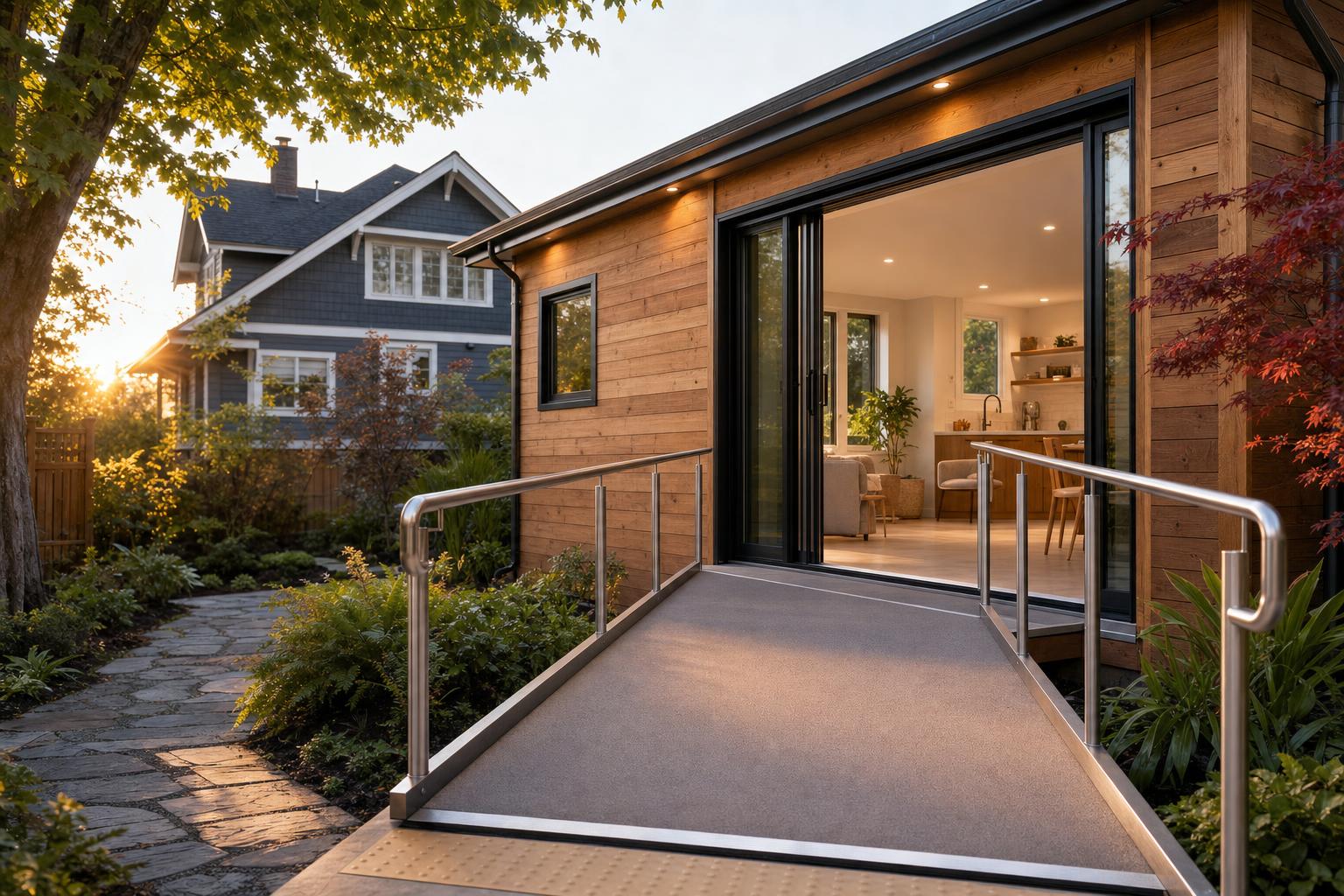
- no-step entry from parking or path
- gently sloped walkway
- doors around 36 inches where feasible
- wider halls and turning space
- single-level living
- lever handles
- non-slip flooring
- zero-threshold shower
- reinforced bathroom walls for future grab bars
- comfort-height toilet
- reachable shelves
- pull-out storage
- seated prep area or lower counter section
- accessible appliances
- high-contrast switches and edges
- strong, glare-free lighting
Technology that supports aging in place Canada
- motion-activated lighting
- video doorbell or remote entry
- smart thermostat
- telehealth-ready internet
- emergency alert system
- fall detection device
- wheelchair or scooter charging
Retrofit priorities in an older retirement park
If a unit is already built, start with the changes that improve safety and movement:
- add a ramp or regrade the path
- convert tub to walk-in or roll-in shower
- create one fully accessible route through the home
- replace round knobs and hard-to-turn taps
- improve lighting
- fix storage and circulation pinch points
Code and compliance
In Canada, design must align with provincial building rules, local bylaws, and in many cases accessibility provisions. CSA B651 is a key barrier-free design guide. Municipal standards may also apply to garden suites and secondary suites. Barrier-free
and accessible
are related terms, but they are not always identical in code language.
One important point: minimum code compliance may still fall short of real aging-in-place usability. A home can pass code and still be hard to use after a health change. Early input from an accessibility consultant can prevent costly mistakes. See more on accessible design for tiny homes and curbless entry tiny home design in Canada.
Canada’s 2026 Policy and Zoning Landscape for Retirement Park and ADU Development
There is no single national rule for tiny homes and ADUs in Canada. In most cases, the answer depends on provincial building frameworks and municipal zoning.
Common barriers
Projects may run into:
- minimum dwelling size rules
- land-use restrictions
- limits on homes on wheels
- water and sewer servicing requirements
- setbacks and lot coverage rules
- parking requirements
- age-restricted community rules
- fire access standards
Some municipalities have historically blocked very small dwellings through minimum-size rules or unclear land-use categories. For context, review tiny home bylaws in Canada.
Signs of change
The picture is improving. More municipalities are updating bylaws to allow:
- garden suites
- cluster housing
- gentle density
- tiny homes on foundations in some contexts
Edmonton is often cited as an example of reforms that made tiny homes on foundations possible as detached housing or garden suites under certain rules. Policies still vary widely by province and city, but the direction is more flexible than it was a few years ago. See tiny-home-friendly municipalities in 2026.
A practical approvals path
- Check permitted use
A permitted use is a land use the zoning already allows without rezoning. - Check if site-specific approval is needed
This means a discretionary approval, rezoning, or amendment because the current zoning does not clearly fit the project. - Confirm the building code path
Especially important for foundation units, modular homes, and homes on wheels. - Review servicing and safety
Water, sewer, drainage, snow storage, fire access, and emergency addressing all matter. - Review operating rules if services are added
If the project includes meals, care, or support staff, other licensing rules may apply.
Operators should speak with planners, building officials, and fire departments early. This saves time and can uncover deal-breakers before design money is spent. Province-specific statements should be legally reviewed and updated with 2026 local sources before publication. Practical help may also come from an ADU legal clinic in Canada.
Cost, Financing, and Affordability for Tiny Home Seniors in Canada
The price tag on the unit alone is not the real project cost. A lower-cost home can become expensive once land and servicing are added.
Main cost buckets
For a tiny home seniors project, total cost may include:
- land purchase or pad lease
- water, sewer or septic, and electricity
- road or path access
- foundation or wheel-based setup
- prefab or site-built construction
- accessibility upgrades
- permits and inspections
- design and consulting
- legal work
- shared amenity costs in a retirement park
Prefab and modular units can reduce site labour in some cases, but transport, craning, and site prep still add cost. For comparisons, see prefab ADU vs custom build.
Why the land situation changes everything
A backyard accessible ADU may be cheaper than a standalone tiny home community if the family already owns the lot. That removes one major cost variable.
By contrast, a retirement park may spread infrastructure costs across many units, but residents may face monthly land-lease or amenity fees.
Financing pathways
Common financing options include:
- mortgage for legal foundation-based dwellings
- HELOC for family-funded backyard suites
- operator financing or lease-to-own
- grants or loans for senior adaptations or housing innovation where available
HELOC use is commonly discussed for backyard suites built for aging parents. Program availability differs by lender and province. More information is available in this ADU financing guide for Canada and on ADU mortgage options in 2026.
Ongoing costs
Smaller homes can reduce:
- heating and cooling bills
- cleaning time
- repair burden
But seniors may still pay for:
- care services
- transportation
- snow removal
- park fees
- internet and monitoring systems
Tiny homes often have lower operating costs because of their size and efficient systems, but the real monthly picture depends on management and support needs. See energy efficiency in Canadian tiny homes.
Comparing options
| Option | Upfront cost | Monthly cost | Care included? | Maintenance burden | Accessibility flexibility |
|---|---|---|---|---|---|
| Tiny home in retirement park | Medium to high, varies | Medium, often with fees | Sometimes limited | Low to medium | Good if designed early |
| Accessible ADU near family | Medium to high, lot-dependent | Low to medium | Usually family-supported | Low to medium | Often very high |
| Condo or apartment | Medium to high | Medium to high | Usually no | Low | Varies by building |
| Retirement residence | Low to medium entry, often rental | High | Often yes | Low | Usually moderate |
| Long-term care | Usually not ownership-based | High/publicly regulated mix | Yes | Low | Care-focused |
For municipalities and developers, this housing can also support gentle density, broaden choice, and reduce pressure on future care systems when paired with proper supports. See affordable housing solutions.
Canadian Examples of Tiny Home Seniors and Accessible ADU Projects
Readers want real examples, but case details should be checked and updated for 2026 before publication. Some examples below are not senior-exclusive but still offer useful lessons for tiny home seniors, retirement park planning, and accessible ADU design.
1. Bluegrass Meadows Micro Village, near Terrace, BC
- Type: Micro-village
- Who it serves: General residents, not senior-exclusive
- Unit size: Small cabins and micro homes up to about 480 square feet
- Tenure model: Rental-style approach
- Accessibility lesson: Small homes need careful circulation and entry planning
- Community lesson: Shared setting shows how clustered small homes can create neighbourhood feel
- Key takeaway: Even non-senior-specific communities can teach useful lessons about scale, land use, and social design for 55+ living
Bluegrass Meadows has been described as the first tiny house community in Canada, with some rents reported around $700 for some units at the time of source reporting. These figures must be verified for 2026. See tiny home community startups in Canada.
2. Backyard suite model for aging parents
- Type: Detached accessible ADU
- Who it serves: Families supporting older parents
- Tenure model: Main lot owned by family
- Accessibility features: Often marketed with no-step access, main-floor living, and aging-in-place layouts
- Key takeaway: This model can balance privacy and support, but family expectations and legal setup should be discussed early
Canadian backyard suite builders now frame these units as practical homes for aging parents, adult children, or caregivers. This is a strong aging in place Canada model where lot rules permit it. See retiring into an accessory dwelling unit.
3. Edmonton zoning reform example
- Type: Municipal policy reform
- Who it serves: Broad housing market, with lessons for seniors
- Regulatory path: Bylaw modernization for tiny homes on foundations and garden suites
- Key takeaway: Policy reform can make small, accessible housing far easier to approve
This is not a retirement park case on its own, but it is highly relevant because legal pathways shape whether 55+ living models can scale. Related reading includes Canadian tiny home bylaw guidance.
4. Tiny home community and pad-lease models across Canada
- Type: Community and land-lease patterns
- Who it serves: Mixed residents depending on project
- Tenure model: Often own-home-plus-pad-lease
- Key takeaway: Security of tenure, monthly fees, and modification rights matter as much as unit design
This transferable lesson is important for tiny home seniors because aging in place depends on both affordability and stable tenure. See land-lease communities in Canada.
What Daily Life Looks Like for Tiny Home Seniors in a Retirement Park
Daily life in a small home is simpler in some ways and more demanding in others.
What often feels easier
Many residents value:
- less cleaning
- lower utility bills
- fewer unused rooms
- less yard work
- easier routines
What needs more planning
Small spaces also mean:
- less room for clutter
- greater need for built-in storage
- careful furniture choices
- smart kitchen and bathroom layout
- clear space for walkers or mobility aids
In a good retirement park, shared spaces act like an extension of the home. The hobby room, garden, meal space, and walking path become part of daily life.
Services matter as much as the unit
Strong 55+ living is not just about square footage. It also depends on:
- visiting clinicians
- meal delivery or shared meals
- transport support
- wellness checks
- home maintenance
- snow clearing
- social programming
Some communities may also support telehealth or visiting service providers through a shared room or kiosk.
Safety and resilience
A retirement park serving older adults should plan for:
- heat waves
- winter storms
- power outages
- wildfire smoke where relevant
- emergency call systems
- neighbour check-in networks
Some seniors may eventually outgrow independent tiny-home living if care needs become very high. The best communities plan referral pathways and support escalation rather than waiting for a crisis.
A simple day might include breakfast in a compact kitchen, a short walk on a level path, coffee in a common house, a virtual doctor visit, and help with snow clearing already built into the community. That is often the real promise of tiny home seniors housing: manageable living with support close by.
How to Launch a Tiny Home Seniors or Accessible ADU Pilot in 2026
For operators and municipalities, the best approach is to start with a pilot and learn from it.
1. Define the resident profile
Decide who the homes are for:
- age range
- income band
- mobility level
- expected care needs
- ownership preference
A project for active 55+ living will look different from one for frailer seniors.
2. Test site feasibility
Review:
- land size and slope
- servicing access
- transit
- proximity to clinics, shops, and parks
- winter conditions
- room for fire access and snow storage
3. Run policy and zoning review
Check:
- permitted uses
- site-specific approval needs
- size restrictions
- secondary suite or garden suite rules
- retirement park and park-model rules
Bylaw review is a first step, not a final one. Helpful sources include ADU legal clinic guidance for 2026 and tiny-home-friendly municipalities.
4. Conduct community engagement
Speak early with:
- nearby residents
- seniors’ groups
- disability advocates
- Indigenous communities where relevant
- service providers
This helps identify access, design, and acceptance issues before they become delays.
5. Set design standards
Choose:
- unit types
- universal design baseline
- outdoor accessibility rules
- amenity package
- storage and scooter needs
6. Build the financial model
Include:
- capital cost
- operations
- maintenance reserve
- staffing or services
- affordability targets
- vacancy assumptions
7. Coordinate permitting and emergency planning
Bring in the full team early:
- planner
- architect or designer
- civil engineer
- accessibility consultant
- fire official
- operator
Review drainage, freeze-thaw impacts, hydrants, addressing, emergency turning radius, and insurance.
8. Pilot and evaluate
A first phase of 10 to 20 units can test:
- occupancy
- resident satisfaction
- maintenance costs
- care and referral needs
- social outcomes
9. Scale carefully
Use pilot results to fix problems in:
- governance
- lease terms
- layout
- accessibility details
- service model
Typical timeline
- 6 to 18 months: policy work and community process
- 6 to 12 months: design and permitting
- 6 to 12 months: build and occupancy
That means many projects take 2 to 4 years from idea to occupied pilot.
Key risks to manage
- drainage and freeze-thaw damage
- wildfire and fire separation
- insurance gaps
- governance disputes
- weak maintenance reserves
- unclear resident communication
Checklist for Seniors Comparing a Retirement Park, Tiny Home, or Accessible ADU
This checklist is for decision support only. It is not medical or legal advice.
Questions about the home
- Is there a no-step entry?
- Can a walker or wheelchair turn in the bathroom and kitchen?
- Are the bedroom, bathroom, and laundry on the main level?
- Is there enough storage for medical supplies and seasonal items?
- Are floors slip-resistant?
- Can grab bars be added later if needed?
- Is there space to charge a scooter or mobility device?
Questions about the community
- What does the monthly fee include?
- Is maintenance included?
- Is snow clearing included?
- Are meals, transport, wellness checks, or emergency support available?
- Is this truly built for 55+ living, or only marketed that way?
- How close are clinics, groceries, and pharmacies?
- Are paths well lit and easy to walk in winter?
- Is the retirement park social if I want company, but private if I do not?
Questions about money and legal terms
- Do I own the home, the land, both, or neither?
- Can I resell the unit freely?
- What happens if I need to move out?
- Can my family inherit the unit or lease?
- Are annual fee increases capped?
- Can I modify the home for accessibility?
- What happens if the operator changes the rules?
Downsizing planning
Before choosing a tiny home seniors option, measure and plan:
- bed and sofa sizes
- dining table needs
- clothing and seasonal storage
- medication storage
- medical equipment storage
- internet and phone setup
- emergency contacts
- wills and powers of attorney
How to compare an accessible ADU vs a retirement park
An accessible ADU near family may offer:
- more family support
- lower social variety
- high privacy
- easier informal care
A retirement park may offer:
- more peer connection
- stronger shared amenities
- more formal maintenance support
- less direct family integration
The best fit depends on independence, privacy, social life, and access to help.
FAQs About Tiny Home Seniors, Retirement Parks, and Accessible ADUs
What is a retirement park vs. a retirement community?
A retirement park is usually a small-home or pad-lease community with shared land, infrastructure, and amenities. A retirement community is a broader term that may include apartments, retirement residences, assisted living, or care settings.
In short, a retirement park is one type of 55+ living model, while a retirement community can describe many housing forms.
Are tiny homes legal in my municipality?
Maybe. Tiny home seniors housing is legal in some Canadian municipalities, but rules depend on zoning, minimum size standards, foundation type, servicing, and whether the home is on wheels.
You must check local bylaws and the building approval path for the exact site and unit type. Useful references include Canadian tiny home community examples, Canadian tiny home policy news, and tiny home bylaws in Canada.
How accessible is an ADU for mobility impairments?
An accessible ADU can work very well for mobility impairments if it is designed properly. Key features include no-step entry, wider doors, turning space, a roll-in shower, accessible kitchen and laundry design, and strong lighting.
The best results come when accessibility is planned from the start, not added later. See accessible tiny home design and accessibility in tiny homes in Canada.
Is 55+ living in a tiny home safe and sustainable?
It can be, if the home is well built and well managed. Safety depends on insulation, ventilation, fire protection, slip resistance, layout, and emergency planning.
Sustainability can also be strong because smaller homes often use fewer materials and less energy, though actual results depend on construction quality and location. See tiny home energy efficiency in Canada.
Where can I find funding or support in Canada?
Start with CMHC, provincial seniors’ housing or home adaptation programs, municipal incentive pages, and non-profit housing partners. Funding rules change often and may differ by tenure type, disability status, and province.
Verify all 2026 program details before making a financial decision. See accessible ADU grants in Canada and ADU grants and municipal incentives.
Canada Resources for Tiny Home Seniors, ADUs, and 55+ Living
Use these source types when researching aging in place Canada options:
- Statistics Canada household and aging data
Insert current 2026 StatsCan links before publication. - CMHC resources on seniors’ housing, modular housing, and secondary suites
Insert current 2026 CMHC links before publication. - Provincial building code and accessibility guidance
Insert province-specific 2026 code links before publication. - Municipal zoning pages for garden suites, laneway homes, tiny homes, and cluster housing
- Accessibility consultant directories
- Seniors advocacy organizations
- Local fire department guidance for access and emergency planning
Municipal reform examples, including Edmonton-related changes, are useful starting points for understanding where policy is moving. See Canada tiny home news and tiny home bylaw guidance.
Who to contact before you decide
- municipal planner
- building official
- fire department
- retirement park operator
- accessibility consultant
- elder-law or estate-planning professional if tenure is complex
Check all resources for 2026 updates before making housing, legal, or financial decisions.
Final Thoughts on Tiny Home Seniors and Aging in Place in Canada
Tiny home seniors housing can offer independence, dignity, lower maintenance, and stronger community connection when it is designed and regulated well. In Canada, both a retirement park model and an accessible ADU near family can support aging in place Canada.
The right answer depends on health, budget, tenure security, climate, services, and the kind of daily life a person wants. For many older adults, the best option is not simply a smaller home. It is a smaller home paired with accessibility, support, and social connection.
When those pieces come together, 55+ living can feel safer, more manageable, and more human than many traditional housing paths. Relevant evidence across the article supports that tiny homes and accessible ADUs can widen choice and help reduce pressure on conventional long-term care systems when planned carefully. For more context, review modular backyard suites in Canada and tiny homes for seniors living.
Leave a Reply