

Estimated reading time: 13 minutes
Key Takeaways
- A floating tiny home office is a compact workspace built on water using pontoons, barges, or modular flotation systems.
- In Canada, interest is growing in Ontario cottage country, coastal British Columbia, and Quebec lake regions where privacy, scenery, and seasonal living already shape property use.
- The biggest upsides are focus, separation from the main house, flexible use, and inspiring waterfront living.
- The biggest risks are permits, classification, insurance, winter conditions, utilities, and cost overruns.
- Feasibility depends heavily on local rules, environmental compliance, mooring approvals, and whether the structure is classified as a building, floating home, or vessel-like asset.
- Canadian examples and reporting show that floating homes can be winterized and run off-grid, but they also raise real policy and practical questions. See this DIY off-grid floating home in Canada, this Canadian floating home video example, and coverage of floating cottages in Georgian Bay.
Table of contents
- What Is a Floating Tiny Home Office in Canada?
- Why the Floating Tiny Home Office Is Trending in 2026
- Benefits of a Floating Tiny Home Office
- Practical Design Considerations for a Canadian Floating Home Office
- Utilities and Connectivity for Remote Work
- Regulations, Permits, and Insurance in Canada
- Costs, Budgeting, and Financing
- Safety, Climate, and Resilience
- Canadian Case Studies and Regional Use Cases
- How to Get Started — Step-by-Step Checklist
- Design Inspiration and Workspace Tips
- Challenges and How to Mitigate Them
- The Future — Canadian Innovation and Trends to Watch in 2026+
- Frequently Asked Questions
What Is a Floating Tiny Home Office in Canada?
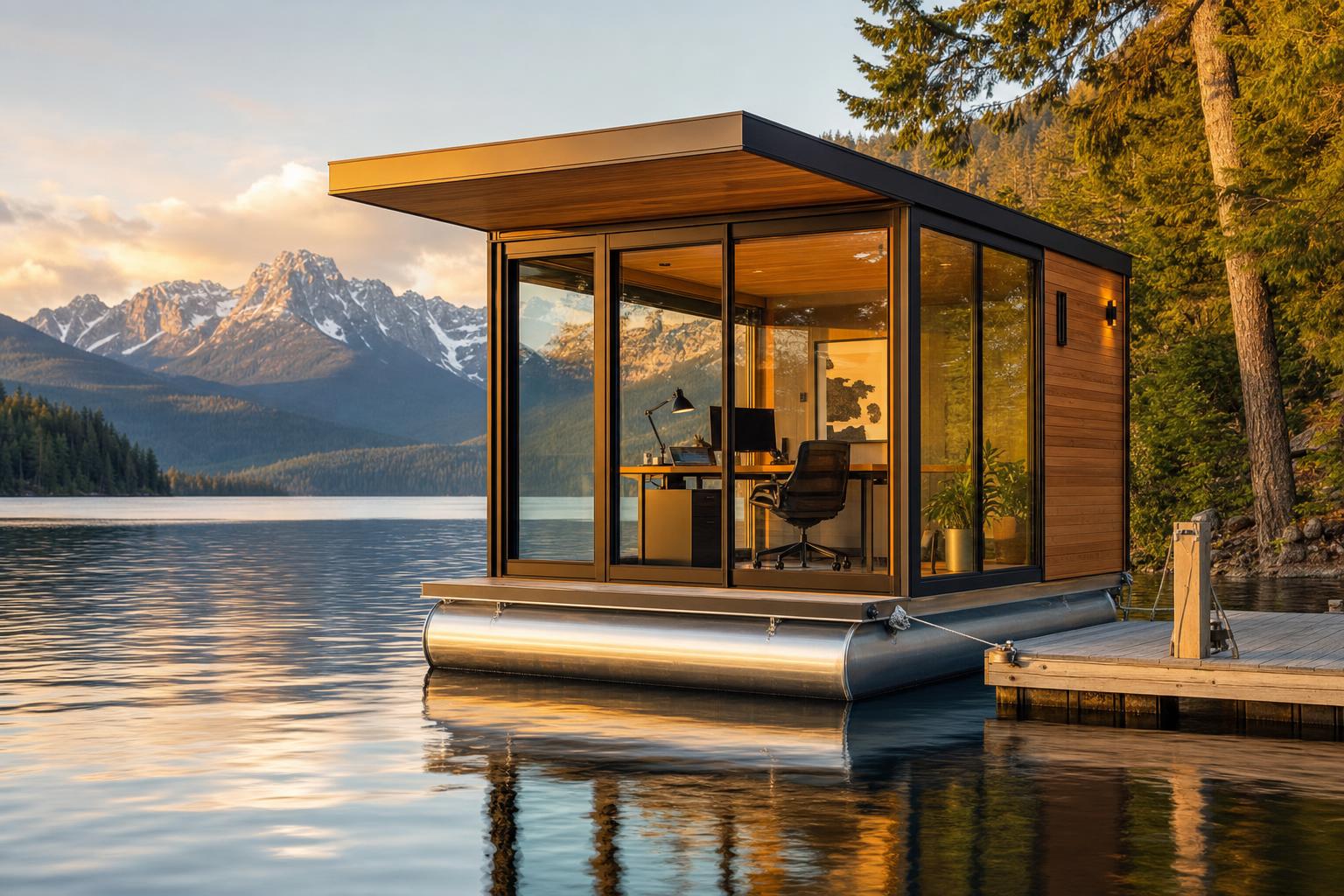
A floating tiny home office is a small-footprint workspace built on water using pontoons, barge platforms, or modular flotation systems. It is designed mainly for work, studio use, or a mix of office and retreat space.
In practice, that can mean:
- a floating tiny home used partly for work
- a floating ADU-style studio used as a dedicated office
- a purpose-built floating workspace for full-time remote work
In Canada, the idea has strong appeal in regions where waterfront living is already part of everyday culture, especially cottage-country Ontario, coastal British Columbia, and Quebec lake regions. Many people want something quieter and more inspiring than a spare bedroom or basement desk.
That is the appeal in one line: a workday that feels calmer, more private, and more intentional.
There is also a note of realism that should come first. Feasibility is never automatic. It depends on local approvals, environmental compliance, insurance, and legal classification. Rules are not the same across Canada, and that means every project needs local due diligence.
Important: Interest in floating workspaces is rising faster than regulatory clarity in some areas. Popularity should never be mistaken for blanket approval.
For background examples and broader context, see Tiny House Talk’s look at a DIY off-grid floating home in Canada, this YouTube example of a Canadian floating home, reporting on floating cottages in Georgian Bay, and global commentary on how floating houses of the future are already being built.
Why the Floating Tiny Home Office Is Trending in 2026
In 2026, hybrid and full remote work continue to shape daily life. Many Canadians still want a workspace that is separate from the main house, but close enough to use every day.
A floating tiny home office answers several needs at once:
- more privacy
- less household noise
- no commute
- better work-life boundaries
- a stronger sense of place
For many people, the problem with a standard home office is not the desk. It is the setting. Working where you also cook, clean, manage family life, and rest can blur the entire day. Even a short walk down a dock can create a meaningful transition between work mode and home mode.
Waterfront living also has obvious emotional pull. Natural light, calm views, and fresh air can make work feel less boxed in. Some owners are also drawn to floating solutions because usable shoreline land may be limited, steep, protected, or already built out.
This trend is not just aesthetic. It sits at the intersection of:
- building design
- marine engineering
- compact utility systems
- off-grid technology
- remote work infrastructure
Canadian innovation is helping push the idea forward through modular construction, climate-aware marine design, and compact utility planning. For more on remote-work demand and flexible workspace trends, see remote work ADU concepts and remote work trends.
Globally, floating structures are being discussed as flexible, movable spaces for offices and waterfront developments, as noted in this look at floating houses of the future. In Ontario, however, public debate around floating cottages shows why rising interest does not remove regulatory complexity.
Benefits of a Floating Tiny Home Office
Productivity and focus
A detached or semi-detached workspace can reduce household distractions in a way that matters for calls, writing, design work, consulting, and any task that needs deep focus.
Common productivity benefits include:
- visual separation from the main home
- strong natural daylight
- easy outdoor breaks
- no driving commute
- fewer interruptions
For many remote workers, this type of separation is more valuable than simply adding another room indoors. For related ideas, see ADU home office options in Canada and remote work retreat concepts.
Lifestyle and wellness
Many people are drawn to waterfront living because it simply feels calmer. Less road noise, more fresh air, and visual access to water can support a better daily rhythm.
This should be seen as a lifestyle benefit, not a medical claim. But the appeal is easy to understand.
A floating office can make routine work feel more peaceful without requiring a full relocation. See related ideas in wellness design ideas and biophilic design for tiny homes in Canada.
Flexibility
A floating tiny home office can serve more than one role. It may work as:
- office by day
- guest suite on weekends
- reading room in spring and fall
- creative studio for music, writing, or art
Some builds are seasonal. Others are engineered for four-season use. That flexibility helps a smaller footprint do more. Explore similar thinking in multi-purpose ADU spaces and flex spaces for tiny homes.
Sustainability potential
A smaller building envelope may use fewer materials than a full detached structure on land. Some floating projects also incorporate:
- solar panels
- battery storage
- composting systems where allowed
- carry-in/carry-out water strategies
- efficient heating systems
One reported Canadian example used solar panels, batteries, a woodstove, propane heat, and a carry-in/carry-out water system, as described by Tiny House Talk and shown in this video tour. For related off-grid planning, see off-grid living for Canadian tiny homes and solar-powered ADUs in Canada.
Property and amenity value
Where approved, a floating office can add utility and uniqueness to a waterfront property. It may improve the site’s appeal for work, guests, or creative use.
Still, value uplift is never guaranteed.
It depends on legality, insurance, buyer demand, and whether future owners see the structure as an asset or a complication.
Practical Design Considerations for a Canadian Floating Home Office
The main challenge is easy to describe but harder to execute well: create a stable, weather-resistant, compact office that still feels open, comfortable, and professional.
For a broader design lens, see floating ADU waterfront living ideas.
Layout and ergonomics
Good layout matters even more in a tiny space. The desk should be placed where glare is controlled, while still preserving the water view. Side lighting often works better than placing a screen directly across from strong sun.
Helpful features include:
- built-in benches
- fold-down desks
- wall storage
- hidden filing
- monitor arms
- under-seat storage
A bench can become guest sleeping space. A full-height storage wall can hide work gear after hours. These choices make the space feel larger and calmer. For inspiration, see tiny home design in Canada and tiny home storage solutions.
Stability and comfort
Motion is one of the biggest design issues. For video calls, desk work, and long concentration blocks, less movement is usually better.
Stability comes from:
- the right float design
- ballast strategy
- weight distribution
- proper mooring
A stable platform protects equipment and improves comfort.
Insulation and winterization
For Canadian use, insulation and air sealing are essential. A shoulder-season or year-round floating office may need:
- high-performance wall, floor, and roof insulation
- tight air sealing
- ventilation for moisture control
- freeze-protected or heat-traced utility lines where allowed
- careful window selection
Heating may come from electric systems, propane, or small solid-fuel systems, depending on code and intended use. Canadian floating-home examples show cold-weather operation is possible, but winterization, wind exposure, ice loading, and emergency access must be treated as core design issues. For related guidance, see winter-proof tiny homes in Canada and a Canadian tiny home winterization checklist.
Foundation and flotation systems
Common support systems include:
- Pontoons: sealed buoyant chambers
- Barge platforms: flat, stable bases for custom structures
- Modular floats: prefabricated buoyancy units joined into one platform
The flotation system must be sized for more than the structure alone. It also has to support:
- dead loads from the building
- live loads from furniture and people
- snow loads
- utility equipment
- stored items
Materials and finishes
Waterfront conditions are demanding. Moisture, UV exposure, and freeze-thaw cycles all affect durability.
Good material choices often include:
- treated or marine-grade timber where suitable
- corrosion-resistant fasteners
- durable cladding
- composite decking or other water-tolerant surfaces
- finishes that resist moisture and temperature swings
For related building material ideas, see eco-friendly building materials in Canada and metal-framed tiny homes in Canada.
Utilities and Connectivity for Remote Work
A beautiful floating office only works if it supports modern remote work every day. Utility planning is not a side issue. It is the backbone of the project.
For broader utility planning, see this guide to tiny home utilities in Canada.
Power options
Main power choices include:
- shore power from the property or marina
- solar PV with battery storage
- hybrid systems with backup generation
The right setup depends on how often the office will be used, whether winter use is planned, how much heating is required, and what local rules allow. Reported Canadian floating-home setups have included solar panels, batteries, and off-grid heating support. For solar sizing and readiness, see how much solar an ADU may need and solar-ready ADU design in Canada.
Water and sewage
Water and waste are among the most sensitive aspects of any floating tiny home project. Possible systems include:
- potable water tanks
- seasonal or permanent dockside water connection where allowed
- holding tanks
- composting toilets where permitted
- carry-in/carry-out water strategies
Sewage should never be improvised. Rules can be strict because shorelines and water quality need protection. See composting toilets for tiny homes in Canada and tiny home wastewater solutions in Canada.
Internet
Stable internet is non-negotiable for video calls, file sharing, and cloud-based work. In 2026, practical options may include:
- cellular hotspots
- signal boosters
- fixed wireless service
- low-earth-orbit satellite internet
- hybrid failover systems
When comparing internet setups, check:
- upload speed
- latency
- weather performance
- signal strength at the dock
- backup connection options
For work on water, a dual-path setup is often safest. See internet for tiny homes in Canada and universal Wi-Fi options for tiny homes.
Greywater and environmental practices
All waste and runoff systems should aim to reduce shoreline and water contamination. Best practice usually means:
- sealed systems
- routine maintenance
- documented service schedules
- local regulator input before installation
This is one area where simple systems often beat complicated ones. For related reading, see a greywater recycling ADU guide and greywater solutions for tiny homes in Canada.
Regulations, Permits, and Insurance in Canada
This is one of the most important parts of the topic. A floating tiny home office is not automatically allowed on every Canadian lake or river.
For broad legal context, see tiny home legal requirements in Canada.
Classification matters
Approvals often depend on whether the structure is treated as:
- a building
- a floating home
- a vessel
That distinction can affect zoning, taxation, environmental review, navigation rules, financing, and insurance. A project that seems simple in concept can become complicated very quickly if the classification is unclear.
For more on floating classifications, see floating ADUs in Canada and floating ADUs and waterfront living.
Ontario and British Columbia nuance
Ontario has seen concern and ambiguity around floating cottages being treated as vessels rather than regulated floating homes, a topic discussed by Georgian Bay advocacy around floating cottages. British Columbia generally has a more established regulatory environment for float homes.
This is only a high-level comparison, but it shows why local rules matter so much. For province-specific reading, see tiny home permits in British Columbia and tiny home permits in Ontario.
Approval layers to investigate
Before moving ahead, check all likely approval paths, including:
- municipal zoning and planning
- provincial building and environmental agencies
- conservation authorities where relevant
- water-lot or mooring agreements
- navigation and transport rules
- marine or specialty insurance requirements
Insurance
Standard residential insurance may not apply. Insurers may request:
- marine engineering reports
- inspections
- surveys
- safety equipment lists
- proof of approved mooring and access
Indigenous land and stewardship
Some shoreline and waterfront locations may involve Indigenous rights, stewardship concerns, or consultation expectations. Respectful local due diligence matters.
Province-by-province fact checking
Available source material does not confirm every 2024 to 2026 provincial change. That means each province should be fact-checked before publication and before any project begins.
Do not assume automatic legality, standard mortgage access, or ordinary residential insurance.
For broader legal and regulatory support, see the Canadian ADU regulations guide and the ADU legal clinic Canada 2026 resource.
Costs, Budgeting, and Financing
A floating office may look small, but total cost can rise quickly because it combines building costs with marine, utility, engineering, and approval costs.
For a general benchmark on small secondary-space costs, see ADU build costs in Canada.
Main cost categories
A realistic budget should include:
- design and engineering
- flotation or platform system
- structural shell and insulation
- windows, doors, and finishes
- electrical, heating, and internet setup
- water and waste systems
- dock integration, anchoring, and mooring
- permits, inspections, surveys, and insurance
- winterization gear and seasonal equipment
Ongoing costs
After construction, expect regular expenses such as:
- float and fastener maintenance
- cladding and decking upkeep
- insurance premiums
- power and internet use
- mooring adjustments
- snow, storm, and ice readiness work
Financing
Conventional mortgages may not fit a floating tiny home office. Financing may instead come from:
- personal loans
- home equity financing
- builder financing
- staged cash-flow builds
What is available often depends on whether the structure is treated more like real property, personal property, or a vessel-like asset. See tiny home financing in Canada, tiny home mortgage options in Canada, and ADU financing in Canada.
Affordability caution
A small footprint can reduce some material costs, but floating infrastructure, utility setup, and permitting can still make the total budget significant.
In other words, small does not automatically mean cheap.
Safety, Climate, and Resilience
A Canadian floating workspace has to be designed for environmental forces, not just aesthetics. Climate resilience is a core requirement.
For related planning, see climate-resilient ADUs in Canada.
Wind, wave, and wake exposure
Sheltered sites are generally easier to manage than exposed waterfronts. Repeated movement can affect:
- comfort during work
- structural wear
- gangway performance
- utility connections
Ice and winter conditions
Cold regions add serious demands. Designers must account for:
- ice pressure
- ice movement
- snow loads
- frozen lines
- safe winter access from shore
Some owners may choose seasonal use or partial winter shutdown instead of full four-season operation. Canadian examples show winter use is possible, but only when risks are taken seriously. For snow-related design issues, see Canadian snow load requirements.
Flood season and water-level changes
Lakes and rivers change through the year. Water-level shifts can affect gangways, dock height, shoreline access, and mooring tension.
Anchoring and mooring
Anchoring and mooring are not the same thing. One concerns holding position in the water. The other may involve securing the structure to dock or shoreline infrastructure. Both need proper engineering.
For related waterfront planning, see floating ADU waterfront living in Canada.
Fire safety and emergency access
Basic safety equipment should include:
- smoke alarms
- carbon monoxide alarms
- fire extinguishers
- clear exit routes
- emergency lighting
Emergency access also matters. First responders may need a clear dock route, accurate site location details, and dependable access conditions. For more, see tiny home fire safety in Canada.
Canadian Case Studies and Regional Use Cases
These examples are illustrative, not legal precedent. They help show how floating office concepts can vary by region.
For general floating ADU context, see floating ADUs and waterfront living.
Ontario cottage-country lake
Imagine a floating tiny home office tied into a private dock system in a sheltered bay. It begins as a summer workspace, then expands into spring and fall use as insulation and heating improve.
The biggest early question is classification: is it treated as a building or a vessel-like structure?
Lesson: early legal clarity matters as much as design.
Sheltered inlet in British Columbia
Now picture a compact remote-work studio in a coastal setting. Here, the design must handle year-round moisture, salt exposure, and more established float-home expectations.
Lesson: exposure level and regulatory path should shape design from day one.
Laurentian lake in Quebec
A smaller seasonal-to-extended-use office on a Quebec lake might focus on strong insulation, battery backup, simple water systems, and low-maintenance finishes.
Lesson: small size and simple systems often reduce both cost and risk.
Build models to compare
- DIY office on a barge platform
Lower upfront build control, but higher complexity and more owner responsibility. - Prefabricated modular floating ADU
Faster installation potential and less site work, but possibly less customization. - Commercially built floating studio
More polished and engineered, but often more expensive.
Trade-offs usually involve cost, speed, customization, and permitting complexity. See prefab ADU vs custom build and prefab housing and modern small-space options.
Canadian innovation in practice
Canadian innovation is especially visible in modular prefabs, off-grid systems, and climate-aware marine engineering. Internationally, floating buildings are already being discussed as flexible spaces for offices and waterfront development, while Canadian examples continue to show year-round potential in cold conditions.
How to Get Started — Step-by-Step Checklist
A floating tiny home office works best when approached as a structured project, not an impulsive one.
For early planning support, see tiny home design consultancy in Canada.
1. Assess the site
Check:
- water depth
- seasonal water-level change
- wave exposure
- wind
- ice conditions
- shoreline access
- dock condition
The key question is whether the site is sheltered enough for comfortable office use.
2. Clarify intended use
Decide if the structure will be:
- a daytime home office
- a mixed office and guest space
- a seasonal retreat with work use
- a four-season floating tiny home office
This choice affects insulation, utilities, and permits.
3. Contact authorities early
Speak with:
- the municipal planning department
- provincial environmental or building bodies
- conservation authorities if relevant
- transport or navigation authorities where relevant
4. Assemble a specialist team
Useful experts may include:
- marine engineer or naval architect
- builder with floating-structure experience
- electrician or utility specialist
- telecom provider for remote-work connectivity
- insurance broker
5. Choose the system design
Select your:
- flotation system
- mooring strategy
- insulation level
- power plan
- internet setup
- water and waste solution
6. Budget conservatively
Add contingency for:
- permit delays
- engineering revisions
- shoreline upgrades
- utility changes
7. Secure approvals and agreements
Do not build first and sort paperwork later. Get permits and written access or mooring agreements before construction.
8. Build, commission, and test
Before regular use, test:
- platform stability
- heating
- electrical loads
- backup internet
- emergency access
9. Create a seasonal operating plan
Include:
- winter shutdown or winter-use rules
- storm checks
- maintenance schedules
- inspection intervals
Feasibility depends on zoning, waterway rules, mooring, insurance, and environmental compliance, so early verification is essential.
Design Inspiration and Workspace Tips
This is the part that makes the space feel serene, usable, and genuinely enjoyable to work in.
For visual direction, see tiny home interior trends.
Interior atmosphere
A floating tiny home office often feels best with:
- light colours
- warm wood accents
- simple finishes
- low visual clutter
Large windows can frame the view beautifully, but they should be placed to reduce screen glare. For more on daylight planning, see tiny home light design.
Motion and acoustics
To reduce the feeling of movement and improve call quality, use:
- rugs
- acoustic panels
- insulated wall assemblies
- secure furniture
- tight storage solutions
Furniture
Choose compact pieces suited to the scale of the room:
- ergonomic chairs
- narrow-depth desks
- wall-mounted monitors
- fold-out guest sleeping
- hidden storage benches
Dock and shoreline integration
Access should feel safe and smooth. Good details include:
- non-slip surfaces
- lighting
- protected transitions
- sturdy handrails where needed
This is also part of the waterfront living experience. A well-designed dock, simple planting, and a small seating area can make arrival feel like stepping into a retreat. For adjacent inspiration, see climate-adaptive decks in Canada and rooftop decks and tiny home design.
Workday routine
For remote work on water, daily habits matter. Helpful routines include:
- checking backup power
- checking internet status
- planning around weather
- ventilating the space
- storing equipment in dry cabinets
Challenges and How to Mitigate Them
A floating tiny home office has real appeal, but it also comes with very real challenges. The key is to approach them directly rather than romantically.
For more on floating project realities, see floating ADUs in Canada.
Permitting delays
Mitigation: Contact authorities early, ask for written guidance, and keep the first design simple.
Budget overruns
Mitigation: Build in phases, add contingency, and define utility needs clearly before construction. See hidden costs in ADU construction.
Harsh Canadian weather
Mitigation: Use strong insulation, engineered mooring, durable materials, and a seasonal operating plan. See climate-responsive tiny home design.
Internet reliability
Mitigation: Use dual-provider thinking, such as a cellular booster with satellite or fixed wireless backup.
Motion and comfort
Mitigation: Choose a sheltered site, improve ballast and stability, and avoid top-heavy designs.
Insurance and resale uncertainty
Mitigation: Keep approvals, inspections, and professional reports carefully organized. For related reading, see tiny home insurance in Canada, ADU resale and Canadian property value, and remote tiny home insurance in Canada.
The strongest Canadian framing is simple: floating homes are possible, and they can be winterized and off-grid, but legality, financing, insurance, and compliance should never be overstated.
The Future — Canadian Innovation and Trends to Watch in 2026+
The future of the floating tiny home office looks promising, but it should be viewed with realism.
For broader forward-looking ideas, see futureproofing tiny homes in Canada.
Modular and prefabricated systems
Canadian innovation is likely to keep showing up in:
- modular hull or platform systems
- factory-built office pods
- utility packages that are easier to install and maintain
Better off-grid performance
Advances in batteries, solar integration, low-energy heating, smart monitoring, and high-efficiency insulation will make more floating projects practical. See solar power basics and net-zero tiny homes in Canada.
More resilient connectivity
As rural broadband improves and satellite internet becomes more capable, full workdays on the water become more viable. That is especially important for video-heavy or cloud-based work.
Policy evolution
Municipalities and provinces may slowly develop clearer paths for floating ADUs and waterfront workspaces in high-demand regions.
That is a possibility, not a promise.
Regulatory easing should never be assumed. For policy-related reading, see provincial housing targets and ADUs and tiny-home-friendly municipalities in 2026.
New use models
Emerging ideas may include:
- floating co-working pods
- seasonal creative studios
- retreat offices for hybrid teams
- small tourism-adjacent office concepts where legal
Globally, floating buildings are already being discussed as flexible, movable structures for offices and modular waterfront development. In Canada, the most credible path forward is through modular construction, off-grid systems, and climate-adapted marine engineering.
A floating tiny home office can offer a uniquely serene version of waterfront living while still meeting the real needs of modern remote work. The strongest benefits are clear:
- better focus
- stronger separation from the main home
- inspiring scenery
- flexible use
The biggest challenges are just as clear:
- permits and classification
- utility planning
- weather and winter conditions
- insurance
- budgeting
A successful floating tiny home or floating home office depends on good design, realistic costs, and careful local due diligence. The smartest first move is a site assessment followed by early conversations with planning staff, marine engineers, and insurance specialists.
Frequently Asked Questions
Are floating tiny home offices legal in Canada?
Sometimes, but not automatically. Legality depends on local zoning, environmental rules, mooring permissions, and how the structure is classified. A floating office may be treated differently depending on the province and municipality.
Can a floating tiny home office be used year-round in Canada?
Yes, in some cases. Year-round use is possible if the structure is properly insulated, winterized, and engineered for ice, snow, wind, and safe access. Some owners may still choose seasonal or shoulder-season use instead.
What is the best flotation system for a floating office?
There is no one best system for every site. Common choices include pontoons, barge platforms, and modular floats. The right option depends on size, stability goals, site exposure, and load requirements.
How do floating tiny home offices get power and internet?
They may use shore power, solar and battery systems, or a hybrid setup. Internet usually comes from cellular, fixed wireless, satellite, or a combination with backup failover.
Is a floating office cheaper than building a land-based backyard office?
Not necessarily. A smaller building footprint may reduce some costs, but marine engineering, flotation, mooring, utility setup, insurance, and permits can make floating projects expensive.
Do floating tiny home offices need special insurance?
Often, yes. Standard residential insurance may not apply. Owners may need marine or specialty coverage and may be asked for inspections, engineering reports, and approved access details.
What is the first step if I want one?
The best first step is a site assessment, followed by early conversations with local planning authorities, a marine engineer or naval architect, and an insurance specialist. That helps confirm whether the idea is realistic before design money is spent.
Leave a Reply