

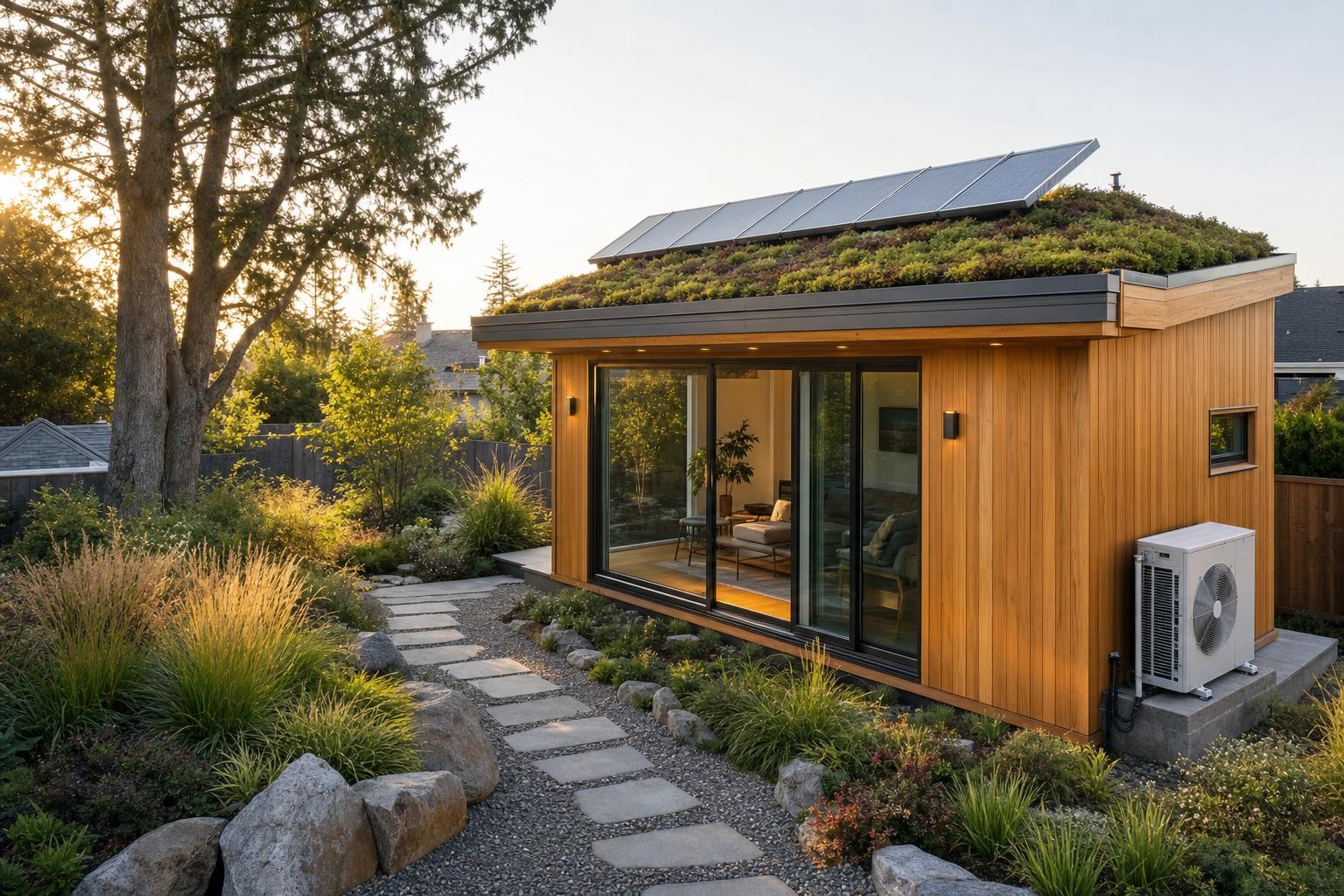
How to Build a Carbon-Neutral ADU in Canada in 2026
Estimated reading time: 14 minutes
Key Takeaways
- A carbon-neutral ADU reduces both operational emissions and embodied carbon as much as possible, with offsets used only as a last resort.
- In 2026, building one in Canada is becoming more realistic because code changes, federal building strategy, and better products are all moving in the same direction.
- The strongest results come from passive design first, then a high-performance envelope, all-electric systems, low-carbon materials, and careful construction planning.
- A carbon-neutral ADU can include laneway houses, garden suites, backyard suites, coach houses, and basement suites.
- Homeowners should always verify local 2026 bylaws, codes, utility rules, and incentives before final decisions are made.
Table of contents
- What is a carbon-neutral ADU in Canada?
- Why build a carbon-neutral ADU in Canada?
- Key concepts homeowners and builders need to understand first
- Design principles for a carbon-neutral ADU
- Building envelope and energy performance: the core of a carbon-neutral ADU
- Low-carbon materials and sustainable building choices
- Zero-emission construction practices for ADUs
- Heating, cooling, and hot water: full electrification
- Solar PV, battery storage, and smart energy systems
- Water, landscaping, and site planning strategies
- Policy, codes, and incentives for carbon-neutral ADUs in Canada
- Costs, financing, and lifecycle economics
- 10-step roadmap to deliver a carbon-neutral ADU
- Canadian case study callouts: what a carbon-neutral ADU can look like
- Homeowner and builder checklist
- Frequently Asked Questions
What is a carbon-neutral ADU in Canada?
A carbon-neutral ADU is a small secondary dwelling designed to cut both operational emissions and embodied emissions as much as possible, then deal with any small remaining emissions only as a last resort.
This guide is for homeowners, builders, and designers who want practical steps rather than theory. It focuses on smart design, better envelopes, all-electric systems, low-carbon materials, zero-emission construction, and local policy checks.
A carbon-neutral ADU can include:
- Laneway houses
- Garden suites
- Backyard suites
- Coach houses
- Basement suites
Operational emissions come from heating, cooling, hot water, lighting, and plug loads.
Embodied carbon comes from extracting, manufacturing, transporting, installing, maintaining, and disposing of building materials.
A carbon-neutral ADU is not just a small suite with solar panels.
It starts by reducing energy demand through good envelope design, efficient systems, and careful material selection. Offsets, if used at all, come after real reductions.
By 2026, Canada’s path toward high-performance housing is becoming more achievable thanks to building code changes and industry shifts, the Canada Green Buildings Strategy, and stronger policy attention documented by Efficiency Canada. For ADU-specific context, see net-zero ADU guidance, ways to minimize an ADU carbon footprint, and bio-based building materials for tiny homes.
Why build a carbon-neutral ADU in Canada?
A carbon-neutral ADU can make sense for homeowners, the environment, and long-term property value.
Homeowner benefits of a carbon-neutral ADU
A well-built eco-friendly secondary suite can lower monthly utility bills. Better insulation, tighter construction, and heat pumps reduce heating demand, which matters in most Canadian climates.
Other homeowner benefits include:
- More stable indoor temperatures in winter and summer
- Better comfort near windows and exterior walls
- Cleaner indoor air when paired with proper ventilation
- Lower risk from future energy price changes
- Optional resilience gains with battery backup
A carbon-neutral ADU can also support rental income. Many tenants value a quiet, efficient suite with low operating costs, making an eco-friendly secondary suite more appealing than a basic code-minimum unit.
Environmental reasons
Buildings produce about 18% of Canada’s greenhouse gas emissions, much of it from space and water heating. A carbon-neutral ADU helps reduce those emissions directly.
ADUs also add gentle density in existing neighbourhoods. When more people can live close to jobs, transit, shops, and services, transportation-related emissions may also fall.
Market and resale value
These terms often matter in the market:
- Net-zero ready
- Low-carbon
- Passive House-inspired
- All-electric
- High-performance
But buyers and tenants usually notice real-life benefits more than labels:
- Lower energy bills
- Better comfort
- Fewer drafts
- Better indoor air quality
- Modern electric systems
Canada’s building sector is being pushed toward stronger performance through net-zero housing upgrades, evolving code direction, and national strategy on net-zero and resilient buildings. For homeowners, that can reduce future upgrade pressure. ADU-specific planning angles are also explored in future-proofing tiny homes in Canada and this ADU investment guide.
Key concepts homeowners and builders need to understand first
Before planning a carbon-neutral ADU, it helps to define the core terms clearly.
Operational carbon
Operational carbon is the emissions created while the ADU is in use. This includes:
- Heating
- Cooling
- Hot water
- Lighting
- Appliances and plug loads
Embodied carbon
Embodied carbon is the lifecycle emissions tied to materials and construction. It includes emissions from:
- Raw material extraction
- Manufacturing
- Transport
- Installation
- Maintenance
- Replacement
- End-of-life disposal
Net-zero energy
Net-zero energy usually means a building produces as much energy over a year as it uses, often through solar PV. In Canadian housing, this usually begins with a highly efficient envelope and systems, then adds renewable generation, as outlined by the Canadian Home Builders’ Association Net Zero program.
Carbon-neutral
Carbon-neutral is broader than net-zero energy because it looks at both operational and embodied carbon. A building can hit net-zero energy and still have high embodied carbon if it relies on carbon-heavy materials.
Zero-emission construction
Zero-emission construction means reducing emissions during the build process itself. In practice, that can include:
- Electric tools
- Less diesel equipment use
- Fewer delivery trips
- Lower site waste
- More prefabrication
- Better construction planning
Sustainable building
Sustainable building is the broadest umbrella term. It includes:
- Energy efficiency
- Durability
- Low toxicity
- Resource efficiency
- Climate resilience
- Healthy indoor air
- Long service life
A truly carbon-neutral ADU needs both low operational carbon and low embodied carbon. Good energy performance alone is not enough. Helpful background can be found in this Canadian ADU glossary, this Passive House ADU guide, and this construction-phase emissions discussion.
Design principles for a carbon-neutral ADU
The biggest carbon savings usually happen early in design, before products and equipment are chosen.
Start with passive design
Passive design lowers demand first.
Key strategies include:
- Put more glazing on the south or southeast side where possible for winter solar gain
- Use overhangs, exterior blinds, or deciduous trees for summer shading
- Keep the building form compact to reduce heat loss
- Use daylight well to cut lighting demand
- Add moderate thermal mass in sunny spaces where it makes sense
A compact shape is powerful. Less exterior wall and roof area usually means less heat loss, fewer materials, and lower cost.
Right-size the ADU
A smaller carbon-neutral ADU is often easier and cheaper to deliver than a larger one. Efficient planning matters.
Smart space-saving ideas include:
- Multifunction rooms
- Built-in storage
- Open living spaces
- Stacked plumbing
- Minimal hallways
These choices reduce floor area without reducing usefulness. See the sweet spot for ADU size in Canada for more on this tradeoff.
Design for flexibility and long life
Sustainable building is also about how long the ADU stays useful.
A good eco-friendly secondary suite may be:
- A rental unit today
- A family suite later
- An aging-in-place home in the future
Useful design moves include:
- Main-floor sleeping option
- Wider circulation where feasible
- Curbless shower where feasible
- Stacked plumbing for simpler future changes
- Durable cladding and roofing
If assemblies last longer, replacement emissions drop too. For related ideas, see future-proof ADU planning for multigenerational living and accessible ADU design in Canada.
Sample image/diagram: a site plan showing ADU orientation, setbacks, solar access, and layout in a Canadian backyard.
Building envelope and energy performance: the core of a carbon-neutral ADU
The envelope is the foundation of a carbon-neutral ADU. It reduces heating and cooling demand before solar or other renewables are added.
Insulation and thermal bridge control
Better-than-code envelope levels are often needed for carbon-neutral goals. One key method is continuous exterior insulation, which helps reduce thermal bridging.
Common thermal bridge areas include:
- Wall studs
- Slab edges
- Rim joists
- Balcony connections
- Window perimeters
If these weak spots are ignored, heat loss rises and comfort drops.
Airtightness
Airtightness means controlling unwanted air leakage through the building enclosure. This is critical in cold and mixed Canadian climates.
A tighter building can improve:
- Comfort
- Energy efficiency
- Moisture control
- Ventilation performance
For a high-performance carbon-neutral ADU, airtightness targets may approach Passive House territory, roughly 0.6 to 1.0 ACH50 where feasible, even without full certification.
Testing matters. Plan for:
- One mid-construction blower door test
- One final blower door test
Mid-construction testing helps catch leaks while they are still easy to fix.
Windows and doors
Windows and doors should support the rest of the envelope.
Good choices often include:
- Triple glazing
- Insulated frames
- Low-e coatings
- Warm-edge spacers
Cold regions usually need stronger thermal performance. Milder regions still need good airtightness, solar control, and overheating protection.
Balanced ventilation
An airtight ADU needs continuous fresh air. That is why balanced HRV or MVHR systems matter.
Heat recovery means the system takes heat from outgoing stale air and uses it to pre-warm incoming fresh air. This improves efficiency while keeping air quality high.
Commissioning and balancing are essential. A poorly set up HRV can reduce comfort and waste energy.
These strategies align well with net-zero-ready code movement in Canada, housing code analysis, and the CHBA Net Zero framework. More ADU-specific guidance is available in cold-climate tiny home construction and this Passive House ADU guide.
Sample image/diagram: wall and roof assembly cross-section showing the air barrier, insulation, thermal break, and window connection.
Low-carbon materials and sustainable building choices
Material choice has a major effect on whether an eco-friendly secondary suite is truly low carbon.
Structural systems
Wood framing and mass timber usually have lower embodied carbon than concrete-heavy or steel-heavy systems. Wood can also store carbon during the life of the building, but that does not remove the need for durable design and responsible sourcing.
Possible options include:
- Standard wood framing
- Advanced wood framing
- Engineered wood
- CLT where spans or speed justify it
For many ADUs, simple wood systems are the most practical low-carbon path.
Foundations and concrete
Foundations are often one of the biggest embodied carbon sources in a carbon-neutral ADU.
Low-carbon concrete uses supplementary cementitious materials such as:
- Fly ash
- Slag
- Calcined clays
These reduce Portland cement content, which lowers emissions. The final mix still needs to meet structural and curing needs, so the engineer and supplier must confirm performance.
Other smart material choices
Other lower-carbon options may include:
- Recycled-content steel where steel is needed
- SIPs for precision and reduced waste
- Insulated timber framing
- Cellulose insulation
- Other lower-carbon insulation products suited to the assembly
Finishes and indoor health
Sustainable building should also support healthy indoor air.
Choose:
- Low- or no-VOC paints
- Low-VOC adhesives
- Low-VOC sealants
- Durable flooring
- Durable finishes that do not need early replacement
Local sourcing and measurement
Buying closer to the project can cut transport emissions and reduce supply risk. It also makes scheduling easier.
To compare options properly, use embodied carbon calculators and product data. A helpful method is setting an embodied carbon target per square metre, then checking each major assembly against that target.
Canada’s policy direction is placing more focus on embodied carbon and low-carbon materials through the Green Buildings Strategy and code and housing reporting. For comparison tools, see EC3. ADU-specific material ideas can be explored in eco-friendly building materials in Canada and upcycling for Canadian ADUs.
| Material or system | Embodied carbon impact | Cost notes | Durability notes | ADU suitability | Tradeoffs |
|---|---|---|---|---|---|
| Standard wood framing | Generally low to moderate | Usually cost-effective | Good with proper moisture control | Excellent for most ADUs | Needs careful air sealing and detailing |
| Advanced wood framing | Lower than standard framing due to less material use | May reduce lumber use | Good when well designed | Very suitable | Requires builder familiarity |
| Low-carbon concrete | Lower than standard mixes | May vary by supplier and region | Can be excellent when engineered properly | Important for foundations | Mix design and schedule coordination matter |
| Cellulose insulation | Often lower than many foam products | Competitive in many assemblies | Good when protected from moisture | Strong option for walls and roofs | Assembly design is critical |
| Triple-glazed windows | Higher upfront product footprint but can reduce operational carbon | Higher first cost | Long service life | Often worth it in colder regions | Needs careful placement and solar control |
Zero-emission construction practices for ADUs
A credible carbon-neutral ADU should reduce emissions during construction, not just during operation.
What zero-emission construction looks like on a small project
In practical ADU terms, zero-emission construction can include:
- Electric hand tools where possible
- Electric or hybrid compact equipment where available
- Less diesel idling
- Fewer repeat trips
- Better material handling
- Less site waste
These steps are especially valuable in a tight Canadian backyard where access is limited and neighbours are close.
Prefabrication
Panelized walls, roof cassettes, and modular methods can improve quality and reduce waste. Factory-built systems often help by:
- Reducing on-site construction time
- Lowering weather exposure
- Improving accuracy
- Reducing errors and rework
- Creating less waste
This can be a strong fit for backyard suites and laneway homes.
Logistics and waste control
Good scheduling cuts emissions.
Helpful practices include:
- Clustering deliveries
- Planning staging space well
- Reducing repeated trade visits
- Sorting wood, metal, drywall, and packaging where facilities exist
- Using cut lists to reduce off-cuts
Neighbour and community impact
Low-emission building is also about site behaviour.
Good practices include:
- Dust control
- Noise control
- Clean staging
- Clear communication
- Careful access planning
Prefabricated and modular approaches can reduce waste and may reduce greenhouse gas emissions in some cases, though results vary by project. For further reading, see this construction-phase emissions post, guidance on minimizing construction waste for ADUs, prefab ADU versus custom build, and zero-waste ADU design.
Sample image/diagram: zero-emission construction workflow from design to prefabrication to on-site assembly.
Heating, cooling, and hot water: full electrification
A carbon-neutral ADU should avoid on-site fossil fuel combustion. Full electrification is the main operational strategy.
Space heating and cooling
Air-source heat pumps are the best fit for most ADUs in Canada. They provide both heating and cooling and work well when the envelope is strong.
Ground-source heat pumps can work in special cases, but they are often harder to justify on a small site because of cost and space limits.
Right-sizing matters. Equipment should be based on:
- Energy modelling
- Climate
- Occupancy
- Envelope quality
- Ventilation loads
An oversized system can cost more and run less efficiently.
Domestic hot water
Heat pump water heaters use much less energy than electric resistance tanks and remove the need for gas.
Plan early for:
- Equipment size
- Noise
- Airflow needs
- Drainage
- Maintenance access
These details matter more in a compact ADU.
Cooking and appliances
All-electric living also includes:
- Induction cooking
- Electric dryers where needed
- Efficient appliances
- Smart plug load planning
Systems integration
A small, high-performance ADU often needs different air distribution and comfort planning than a conventional house. Heat pump design should be coordinated with:
- Ventilation layout
- Room arrangement
- Door undercuts or transfer paths
- Interior zoning
Operational electrification and zero-emission construction are different ideas. One deals with building use. The other deals with the building process.
For system-specific guidance, review heat pump options for tiny homes, water heating for tiny homes in Canada, solar water heating in tiny homes, and this under-floor heating guide.
Solar PV, battery storage, and smart energy systems
Renewables come after load reduction. A carbon-neutral ADU works best when demand is already low.
Solar basics
A high-performance ADU may need only a modest PV array, often around 3 to 6 kW, depending on:
- Climate
- Occupancy
- Equipment
- Roof area
- Shading
Roof orientation, tilt, and nearby trees or buildings all matter. If the ADU roof is too shaded, it may make sense to study the main house roof or a shared system.
Battery storage
Battery storage can add:
- Backup for critical loads
- Better resilience during outages
- Some ability to shift use away from higher-cost times
But batteries are not always required to reach carbon-neutral operation. They are a resilience and control tool first.
Smart controls and monitoring
Real-life performance depends on controls, not just equipment.
Helpful tools include:
- Heat pump scheduling
- Hot water timing
- Load controllers
- Energy monitoring
- Submetering
Future-proofing
Even if an EV charger is not installed now, add:
- Conduit
- Panel capacity
- Space for future equipment
That keeps the ADU ready for later changes. More on this is available in how much solar an ADU needs, solar-ready ADU design, tiny home energy storage in Canada, and solar and smart-grid ADU planning.
Sample image/diagram: PV and battery layout for a compact Canadian backyard ADU.
Water, landscaping, and site planning strategies
Sustainable building extends beyond energy.
Water efficiency
A simple water strategy can include:
- Low-flow fixtures
- Efficient appliances
- Good leak-resistant detailing
- Easy access for maintenance
Stormwater management
Site design can reduce runoff and support healthier landscapes.
Useful measures include:
- Rain barrels or cisterns
- Permeable paving
- Bioswales
- Careful grading
Landscape and microclimate
Native or drought-tolerant plants reduce irrigation demand. Trees and planting can also help with shading and urban cooling.
In a Canadian backyard, placement matters. Fences, nearby homes, existing trees, and accessory buildings can affect:
- Winter solar gain
- Summer overheating
- Solar PV output
- Drainage
- Privacy
Good site planning ties all of these together early. Explore related ideas in ADU landscaping for small spaces, rain garden integration for ADUs, greywater and sustainable landscaping, and this native plants guide.
Policy, codes, and incentives for carbon-neutral ADUs in Canada
Code and policy are highly local. For any carbon-neutral ADU, 2026 requirements, incentives, and permissions must be verified with the right authority before decisions are made.
Visible compliance note
Code requirements, incentives, utility programs, and municipal permissions vary by city, province, and utility territory. Always confirm current 2026 rules before proceeding.
Check with:
- Municipal planning departments
- Municipal building departments
- Provincial code authorities
- Utility providers
- Energy modelers
- Architects or designers
- Structural and mechanical engineers
- Embodied carbon specialists where needed
Municipal bylaw checks
Start by confirming:
- Zoning
- ADU type allowed
- Maximum size
- Lot coverage
- Height
- Setbacks
- Servicing
- Parking rules
- Privacy rules
- Tree protection rules
Laneway houses, garden suites, coach houses, and basement suites may each follow different rules.
Provincial and federal code context
Provinces and territories are responsible for building code adoption and enforcement. At the same time, national code development and federal strategy are pushing toward net-zero-energy-ready performance by 2030, with resilience becoming more integrated by 2026.
Examples often discussed include:
- BC Energy Step Code
- BC Zero Carbon Step Code
- Ontario energy efficiency updates
Local adoption status still needs to be checked.
Incentives and support programs
Potential support may include:
- Utility rebates for heat pumps
- Insulation incentives
- Solar incentives
- CMHC-related financing options
- Provincial or federal programs
- Green lending products
Eligibility may depend on:
- Product type
- Performance tier
- Energy modelling
- Installation method
- Region
Programs change often, so verify details before making financial decisions.
Typical permitting pathway
A normal path looks like this:
- Feasibility check
- Zoning review
- Concept design
- Consultant engagement
- Detailed design
- Permit submission
- Utility coordination
Canada’s direction on building performance is reflected in future net-zero housing and code changes, the Green Buildings Strategy, Efficiency Canada’s housing climate report, and IISD’s net-zero housing analysis. ADU-specific legal and approvals support can also be found in Canadian ADU regulations guidance, ADU grants and municipal incentives, ADU legal clinic guidance, and digital permitting for ADUs in Canada.
Costs, financing, and lifecycle economics
A carbon-neutral ADU usually costs more upfront than a code-minimum build, but the long-term picture is different.
Main cost drivers
Major cost items often include:
- Site access and excavation
- Foundation design
- High-performance envelope
- Triple-glazed windows
- Heat pumps
- HRV or MVHR systems
- Heat pump water heaters
- Solar PV
- Battery storage
- Design, engineering, permits, and energy modelling
Why the extra cost can pay back
A sustainable building approach may reduce costs over time through:
- Lower utility bills
- Lower maintenance risk
- Better durability
- Fewer replacements
- Better future code alignment
- Potential rent premium for an eco-friendly secondary suite
As energy prices and carbon costs evolve, energy efficiency upgrades can significantly reduce household utility bills, as noted by IISD.
Simple comparison example
A code-minimum ADU may cost less on day one, but it often has:
- Higher heating demand
- Lower comfort
- More future upgrade pressure
- Greater exposure to energy price changes
A high-performance carbon-neutral ADU may have:
- Higher initial cost
- Lower monthly bills
- Better tenant appeal
- Better resilience
- Better indoor comfort
The right comparison is not just build cost. It is total lifecycle value.
Financing options
Depending on location and lender, financing may include:
- Construction financing
- Green mortgages
- CMHC-related options
- Utility-backed financing
- Rebate-linked financing
The best financing path depends on timing, eligibility rules, and project type. For more detail, see ADU financing in Canada, ADU mortgages in 2026, green upgrade financing for ADUs, and tiny home financing in Canada.
10-step roadmap to deliver a carbon-neutral ADU
This roadmap is the most practical way to move from idea to finished project.
1. Research local bylaws and incentives
Confirm:
- ADU type allowed
- Size limit
- Setbacks
- Height
- Servicing rules
- Tree limits
- Parking rules
- Available incentives
2. Set clear performance targets
Choose targets early for:
- Energy use
- Airtightness
- All-electric operation
- Embodied carbon
- Offset policy
3. Assemble the project team
A strong team may include:
- Designer or architect
- Builder
- Structural engineer
- Mechanical designer
- Energy modeler
- Embodied carbon consultant
4. Develop passive-first schematic design
Before choosing systems, optimize:
- Orientation
- Glazing
- Shading
- Compact form
- Room layout
5. Select low-carbon materials
Make early decisions about:
- Foundation strategy
- Framing system
- Insulation
- Windows
- Finishes
- Local sourcing
6. Evaluate prefabrication and zero-emission construction methods
Decide:
- What can be panelized
- How to cut trips
- How to reduce site emissions
- How to reduce waste
7. Complete permits and utility coordination
Align:
- Drawings
- Code compliance
- Structural design
- Mechanical design
- Energy compliance
- Utility requirements
8. Build and test the envelope
Focus on:
- Air barrier continuity
- Insulation continuity
- Thermal bridge control
- Mid-construction blower door testing
9. Commission systems and install renewables
Complete:
- Heat pump startup
- Ventilation balancing
- Solar interconnection
- Battery setup
- Monitoring setup
10. Occupancy, monitoring, and tuning
After move-in, track:
- Actual energy use
- Comfort
- Indoor air quality
- Hot water performance
- Control settings
A carbon-neutral ADU works best when design, materials, systems, and zero-emission construction are planned together from the start.
Canadian case study callouts: what a carbon-neutral ADU can look like
These examples are illustrative, not verified measured case studies.
Illustrative case study 1: Vancouver laneway house
Features:
- Small footprint
- Panelized or mass timber structure
- Triple glazing
- High-R envelope
- All-electric systems
- HRV
- Small PV array
Key takeaway: a compact design and strong envelope can allow smaller mechanical systems and lower embodied carbon.
Illustrative case study 2: Toronto garden suite
Features:
- Advanced wood framing
- Continuous insulation
- Cold-climate heat pump
- Heat pump water heater
- HRV
- Rooftop solar
Key takeaway: on urban infill sites, early utility coordination, careful shading control, and strong airtightness planning are critical.
Useful future metrics for real case studies include:
- Floor area
- Energy use intensity
- Airtightness result
- PV size
- Estimated embodied carbon reduction versus baseline
Homeowner and builder checklist
A practical carbon-neutral ADU checklist should cover the items below.
Municipal permit and zoning checks
- Allowed ADU type
- Size
- Height
- Setbacks
- Servicing
- Tree protection
- Parking
- Privacy rules
Performance targets
- R-values
- Airtightness target
- Ventilation type
- All-electric systems
- PV readiness
Material shortlist
- Framing system
- Insulation type
- Window spec
- Low-carbon concrete option
- Low-VOC finishes
Builder questions
- Do you do blower door testing?
- Have you used prefabrication?
- Do you commission ventilation systems?
- What zero-emission construction practices do you use?
Consultant deliverables
- Energy model
- Embodied carbon assessment
- Mechanical design
- Commissioning reports
- Testing reports
Frequently Asked Questions
Is a carbon-neutral ADU possible in cold Canadian climates?
Yes. A strong envelope, cold-climate heat pump, good windows, high airtightness, and careful energy design can make a carbon-neutral ADU possible in cold regions.
How do I measure embodied carbon?
Use embodied carbon or life-cycle assessment tools along with product data such as EPDs. Professional support is often helpful, especially for comparing structure, insulation, and foundation options.
Do I need offsets?
Only after reducing operational and embodied emissions as much as practical. Offsets should be the last step, not the first.
What is the difference between zero-emission construction and all-electric operation?
Zero-emission construction refers to emissions during the build process, such as equipment use, transport, and waste. All-electric operation refers to emissions during use, such as heating, cooling, hot water, and cooking.
Can I still build an eco-friendly secondary suite if solar is not possible?
Yes. Solar helps, but it is not the only path. A very good envelope, full electrification, efficient systems, and low embodied carbon can still create a strong eco-friendly secondary suite.
For deeper research, useful resources include the Canadian Home Builders’ Association Net Zero program, the Natural Resources Canada Green Buildings Strategy, Efficiency Canada’s housing and codes report, IISD on upgrading homes for net zero, Blue House Energy on future Canadian net-zero housing and codes, Passive House Canada, the National Research Council of Canada codes portal, the BC Energy Step Code, the BC Zero Carbon Step Code, the EC3 embodied carbon tool, construction-phase emissions and prefabrication discussion, carbon footprint reduction tips, a net-zero ADU overview, climate-resilient ADUs, ADU certification and higher-performance standards, and solar-ready design guidance.
Building a carbon-neutral ADU in 2026 is achievable in many parts of Canada when the project combines passive design, a high-performance envelope, full electrification, low-carbon materials, zero-emission construction practices, and strong awareness of local code and incentive rules.
Whether the project is in a Canadian backyard or planned as an eco-friendly secondary suite, the best results come from integrated planning from day one.
Before moving ahead, always verify 2026 bylaws, code requirements, incentive details, and utility conditions with the proper local authorities and qualified professionals.
Leave a Reply