
Estimated reading time: 12 minutes
Key Takeaways
- Floating ADUs in Canada are small, self-contained homes built for life on water, usually for seasonal or full-time use.
- The biggest issue is classification: a floating unit may be treated as a vessel, a structure, or sometimes both.
- That classification affects permits, taxes, insurance, financing, and design decisions.
- They can offer extra waterfront living space, rental potential, and unique lifestyle benefits, but they also bring higher complexity and maintenance.
- Site conditions, mooring strategy, utility planning, wastewater management, and winter design are critical in Canadian climates.
- A careful, phased planning process is the smartest way to test whether a floating ADU is realistic for your property or project.
Table of contents
- What are floating ADUs in Canada, and how are they different from houseboats?
- Why Canadians are considering floating ADUs for waterfront living in 2025
- The trade-offs: what floating ADUs and houseboats make more complicated
- Canadian regulations for floating ADUs: the 2025 framework readers need to understand
- Permits and approvals checklist for floating ADUs in Canada
- Year-round vs seasonal floating ADUs: which model makes sense?
- Design and engineering considerations for floating ADUs in Canadian climates
- Choosing the right site and mooring strategy
- Costs, financing, insurance, and taxes for floating ADUs Canada
- Environmental and community responsibilities of floating ADUs
- Step-by-step roadmap for planning floating ADUs in 2025–2026
- Canadian examples that show how floating ADUs can work
- Resources and contacts readers should consult before proceeding
- Conclusion: are floating ADUs in Canada worth considering in 2025?
- Frequently Asked Questions
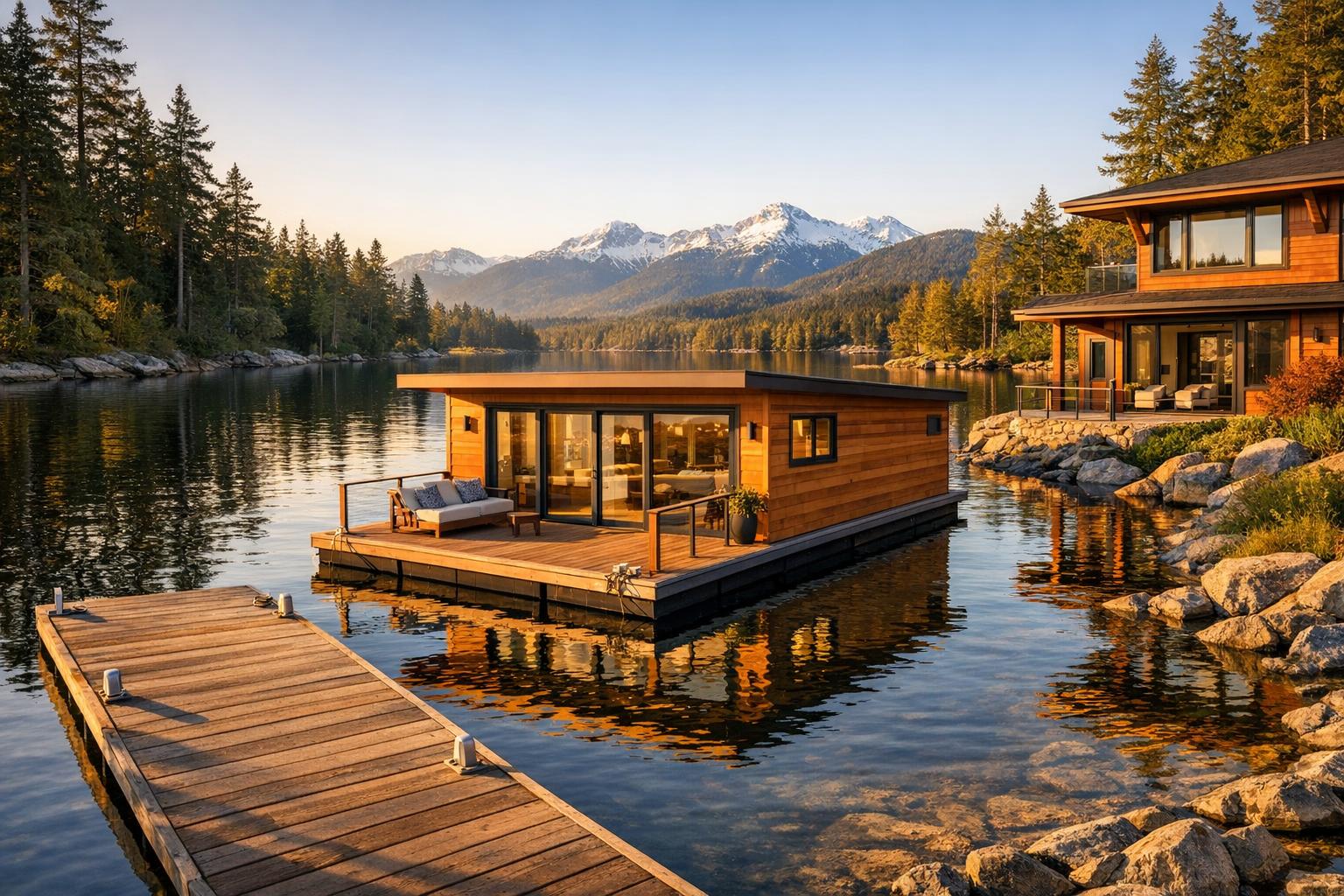
Floating ADUs Canada are small, self-contained homes built to live on water. In simple terms, they are floating accessory dwelling units designed for seasonal or full-time use, usually anchored or permanently moored on lakes, rivers, or sheltered waterfront sites.
Unlike ordinary boats, they are made as living spaces first. That means they often include a kitchen, sleeping area, bathroom, power system, and water or waste setup.
Many people also search for these units as houseboats, float homes, or floating dwellings. Those words can sound similar, but the legal meaning can shift from place to place. In one area, a unit may be treated like a vessel. In another, it may be treated more like a structure.
That one distinction can shape almost everything.
Permits, taxes, insurance, financing, and design choices often depend on how the floating unit is classified.
This guide gives a practical look at waterfront living with floating ADUs in Canada. It covers benefits, trade-offs, regulations, design needs, permits, site planning, costs, and the difference between seasonal and year-round use. For a broader overview, readers can also explore floating ADUs and waterfront living, floating ADU waterfront living, and floating ADUs waterfront living in Canada.
What are floating ADUs in Canada, and how are they different from houseboats?
Floating ADUs Canada projects usually start with one key idea: this is housing on water, not just a boat with a bed inside it.
Floating ADUs are purpose-built for aquatic environments. They are usually designed with full residential features, including:
- A kitchen
- A sleeping or living area
- A bathroom
- Water and waste systems
- Electrical systems
- Heating and ventilation
That makes them different from many traditional houseboats or converted barges. A lot of houseboats began as recreational craft or simple floating platforms. By contrast, floating ADUs are often engineered for stable occupancy and may stay permanently moored in one place for long periods.
That permanence matters. A permanently moored unit can feel more like a compact accessory dwelling than a travelling vessel. It may connect to shore power, use a fixed gangway, and depend on planned pump-out or utility systems instead of mobile boating systems.
Across Canada, though, the words are not used consistently. One authority may call the unit a float home. Another may say floating accommodation. Another may still call it a vessel or houseboat.
Why does that matter?
- If it is treated as a vessel, marine law and Transport Canada floating accommodations guidance may apply.
- If it is treated as a structure, zoning, building permits, taxes, and utility rules may matter more.
- In many cases, both layers can affect the same project.
This one issue can change:
- Permitting timelines
- Insurance options
- Financing choices
- Tax treatment
- Design requirements
So before falling in love with a layout or a waterfront site, it is smart to understand how your local authority is likely to classify the unit. For related land-based comparisons, readers may also want to review tiny home legal requirements in Canada and a tiny home on wheels comparison.
Why Canadians are considering floating ADUs for waterfront living in 2025
Floating ADUs are getting more attention because they offer extra space without using more land. On tight waterfront lots, that can be a major advantage.
For many owners, the shoreline is already built out. There may be no easy room for a garden suite or backyard unit. A floating unit can create added space beside the property instead of on it, where local rules allow.
Common use cases include:
- A guest suite
- Space for adult children
- A home for aging parents
- A seasonal retreat
- A rental unit or vacation stay, if allowed
- A studio or office with a bathroom and sleeping space
One of the biggest reasons people look at floating ADUs is income potential. A legal rental unit on the water can create revenue in markets where waterfront living is in strong demand. That said, short-term rental rules and marina rules can limit this.
Lifestyle is another big draw. Many buyers and owners want:
- Direct water access
- Better views
- Quiet and privacy
- Easy boating, fishing, paddling, or swimming
- A different kind of daily living experience
There can also be an environmental upside, but it needs care. Compared with some shoreline construction, floating ADUs may reduce some land disturbance. Still, they must be planned properly to protect water quality, habitat, and shoreline health.
In some areas, approvals may move faster when there is already a marina or mooring system in place. But this is not automatic. Every site still needs review.
Main benefits at a glance
- Extra living space on waterfront property
- Rental income potential
- Flexible family use over time
- Unique waterfront living and recreational access
- Possible lower land disturbance than a new shoreline structure
- Potentially quicker approvals in select jurisdictions with existing mooring systems
Broader support for ADUs in Canada also helped drive interest through 2025. Readers looking at the wider ADU market can review general info on ADUs, secondary unit benefits in Canada, ADU investment in Canada for 2025, and a cottage ADU lakeside guide.
The trade-offs: what floating ADUs and houseboats make more complicated
Floating ADUs can be smart, but they are not simple. Compared with land-based ADUs, they are niche assets with more moving parts.
The biggest issues often include:
- Limited mooring availability
- Seasonal access problems
- Water level changes
- Insurance challenges
- Financing limits
- Stronger environmental review
- More maintenance
Water can rise, fall, freeze, and move. That affects access ramps, utility lines, mooring tension, and the feel of the unit itself. Moisture, corrosion, and freeze-thaw cycles also create long-term wear.
Year-round waterfront living is much more demanding than seasonal use. Heating costs rise. Winterization gets harder. Ice and snow affect access and safety. Insurance often costs more too.
Houseboats and floating dwellings can also face pushback in busy waterfront areas. In places with tourism pressure or crowded shorelines, neighbours and regulators may watch closely. Complaints about anchoring, safety, visual impact, and environmental harm can lead to tighter enforcement.
These projects work best for people who are ready for ongoing operations, not just the purchase price.
If you want the simplest path to extra housing, a land ADU is usually easier. If you want a special water-based living model and can handle the complexity, floating ADUs may still be a strong fit. Helpful related reading includes hidden costs of ADU construction in Canada, an ADU maintenance checklist, and an ADU insurance guide for Canada.
Canadian regulations for floating ADUs: the 2025 framework readers need to understand
Canadian regulations for floating ADUs are not the same across the country. A floating ADU project may involve federal, provincial, and municipal rules at the same time.
The first question is simple but very important: is the unit treated as a vessel, or as a structure such as a float home?
At the federal level, Transport Canada may treat floating accommodations as vessels under the Canada Shipping Act, 2001 if they are floating objects capable of navigation, even when they do not have their own propulsion. Federal attention has grown because of public concern about long-term anchoring, safety, and environmental effects.
Transport Canada also launched consultation work on October 12, 2023, with discussion continuing into 2024 and 2025. That signals ongoing review and possible tighter rules around anchored floating accommodations.
There is an important British Columbia exception. In some BC situations, permanently moored floating accommodations that are tied to shore and depend on shore services may not be treated as vessels because they are not navigable. This is a strong example of why local legal interpretation matters so much.
At the provincial and municipal level, the rules often turn to land use and building control. Local zoning bylaws may decide whether residential use on water is allowed at all. If a unit is treated more like a structure, it may trigger:
- Building permit review
- Electrical and plumbing approval
- Fire safety rules
- Wastewater controls
- Shoreline development requirements
- Local assessment and tax questions
Some municipalities do not clearly define floating ADUs. Even standard ADU policies may not fit well. In those cases, planners may rely on broader words like residential structure, dwelling unit, or accessory use.
Environmental rules add another layer. Fisheries, sewage disposal, habitat protection, and shoreline disturbance can all affect approval.
How classification changes your project
If floating ADUs or houseboats are classified as a vessel, the focus shifts more toward:
- Marine safety
- Anchoring rules
- Navigation issues
- Marine insurance
- Marine lending
- Federal oversight
If they are classified as a structure, the focus shifts more toward:
- Zoning
- Building permits
- Utility hookups
- Fire code
- Property taxation
- Local occupancy rules
Many projects involve overlap. Being called a vessel does not remove environmental review. Being called a structure does not erase marine safety concerns. Under Canadian regulations, readers should assume they may need approvals from more than one side of the system.
To dig deeper, see the Transport Canada floating accommodations resource, the additional dwelling unit initiative, a Canadian ADU regulations guide, ADU permits in Canadian cities, and again, tiny home legal requirements in Canada.
Permits and approvals checklist for floating ADUs in Canada
For floating ADUs Canada projects, there is no one checklist that fits every site. But there is a practical list of approvals that most owners will need to investigate in 2025.
Common permit and approval areas include:
- Mooring lease or anchor approval
Often handled by a marina operator, local authority, or Crown lands department. You may need a site plan, engineering drawings, and proof that you have permission to use the waterfront area. - Environmental review
This may require a wastewater plan, habitat information, and a shoreline or site survey. - Building permit
If the unit is treated as a structure, you may need building drawings, utility plans, and fire safety details. - Septic, sewage, or wastewater approval
This often includes holding tank design, pump-out plans, testing, or proof of safe disposal. - Electrical or utility hookup approval
You may need load calculations, hookup details, and inspections. - Transport Canada notice or documentation
If vessel rules apply, you may need vessel details, a safety inventory, and anchoring information.
A realistic timeline depends on the site. Straightforward projects may move in about 3 to 9 months. More complex or sensitive sites can take 9 to 18 months.
Quick permit timeline table
| Approval type | Typical authority | Typical lead time | Key documents |
|---|---|---|---|
| Mooring lease/anchor approval | Marina operator, Crown lands, local authority | 1–3 months | Site plan, engineering drawings, ownership/authorization |
| Environmental assessment/review | Provincial environment body, local authority, consultants | 1–6 months | Wastewater plan, habitat details, shoreline survey |
| Building permit | Municipal building department | 2–4 months | Building drawings, utility plans, fire safety details |
| Septic/sewage approval | Health unit, environmental authority, utility body | 1–3 months | Holding tank design, pump-out/discharge plan |
| Electrical/utility hookup | Utility provider, electrical authority | 1–2 months | Load calculations, hookup specs, inspection plan |
| Transport Canada notification/documentation | Transport Canada | 2–8 weeks | Vessel details, anchoring plan, safety inventory |
This is best used as an investigation list, not a promise. More detailed permit and utility guidance can be found through ADU permits in Canadian cities, utility connections for Canadian ADUs, and utility hookups for tiny homes in Canada.
Year-round vs seasonal floating ADUs: which model makes sense?
Many people compare floating ADUs and houseboats without realizing how different seasonal and year-round use really are.
Seasonal use usually means warm-weather occupancy. Systems can be simpler. Winter exposure is lower. Operating costs are often more manageable. A seasonal unit may use a basic holding tank setup, easier plumbing arrangements, and lighter heating needs.
Year-round use means full-time or all-season waterfront living. That requires:
- Better insulation
- Reliable heating
- Freeze protection
- Stronger mooring systems
- Safe winter shore access
- Better power and backup systems
- Strong condensation control
For many Canadian climates, this is a major design jump, not a small upgrade.
Seasonal vs year-round comparison
Seasonal floating ADUs
- Lower operating costs
- Simpler utilities
- Less winterization
- Better for sheltered sites
- Easier maintenance schedule
Year-round floating ADUs
- Higher insulation and heating needs
- More robust shore power
- Backup energy is more important
- Safe winter access is critical
- Higher insurance and maintenance costs
If your budget is tight, seasonal use is often the more realistic starting point. If you want full-time occupancy, plan for a much more advanced build from day one. Related reading includes year-round vs seasonal tiny homes in Canada, a Canadian tiny home winterization checklist, and seasonal tiny home living in Canada.
Design and engineering considerations for floating ADUs in Canadian climates
Floating ADUs are not just tiny cabins on pontoons. They are engineered systems that mix marine design with residential design.
Different hull and platform types suit different sites:
- Catamaran-style platforms
Good stability in wave conditions. Useful where wave control matters. - Barge-style hulls
Strong interior space and good load capacity. Often need deeper water and stronger mooring. - Purpose-built floating home hulls
A middle ground that balances buoyancy, comfort, and appearance. - Pontoon-based systems
Lower cost and useful in sheltered water, but less suited to rougher conditions.
Engineering matters at every step. Buoyancy calculations need to include more than the shell of the unit. They must cover:
- Structure weight
- Furniture
- Occupants
- Water tanks
- Waste tanks
- Electrical gear
- Snow loads where needed
Stability analysis is also key. The centre of gravity must stay low enough for safe use during wind, movement, and wave action. A floating ADU that looks fine on paper can still feel unsafe if weight is not distributed correctly.
Mooring design is just as important. A proper system should consider:
- Redundancy
- Line or chain sizing
- Shock loads
- Wind exposure
- Seasonal water level change
- Ice and freeze-thaw movement
In many Canadian locations, ice loading is one of the biggest design challenges. Winter can stress hulls, gangways, utility lines, and mooring gear.
Utilities and systems needed for safe, livable waterfront living
Power
- Shore power is usually best for year-round occupancy.
- Solar and battery backup can improve resilience.
Heating
- Cold-climate heat pumps are efficient where they suit the site.
- Hydronic systems can give steady warmth.
- Wood stoves can work as backup where legal, but they add fire and venting concerns.
Water
- Freshwater tanks may need filtration and UV treatment.
- Freezing and maintenance must be planned carefully.
Sewage and greywater
- Holding tanks may suit seasonal use.
- Shore pump-out or managed connection is often better for year-round use.
Cooking and backup
- Propane or natural gas may be possible, depending on local code and site setup.
Insulation, condensation control, and winterization
Water contact and moist air make heat loss harder to manage than in many land-based ADUs.
Good practice often includes:
- Hull insulation with spray foam or mineral wool
- SIPs or high-performance wall and roof assemblies
- Triple-glazed or low-E windows
- Mechanical ventilation with heat recovery
- Heat tracing for pipes
- Drain-down strategies
- Exterior drainage and ice management
Winterization protects comfort, but it also protects the life of the building. Poor moisture control can lead to mould, corrosion, and hidden damage.
Interior layout and safety essentials
Compact floating ADUs and houseboats work best when the layout is efficient.
Key design ideas include:
- Compact kitchens with moisture-resistant cabinetry
- Wet baths to save space
- Built-in storage
- More than one escape route where possible
- Universal design for aging in place or mobility needs
Safety systems should include:
- Fire extinguishers
- Carbon monoxide alarms
- Backup lighting
- Emergency communication access
- Life jackets or life rings where appropriate
- Suppression systems where feasible
A good floating unit is not only attractive. It is stable, safe, dry, and easy to maintain in harsh weather. Readers may also want to review flood-resistant ADU design in Canada, climate-resilient ADUs in Canada, and an accessible tiny home guide for Canada.
Choosing the right site and mooring strategy
A good floating ADU project starts with the site, not the floor plan.
Before choosing finishes or layouts, look at the water itself. Key site factors include:
- Water depth for the unit’s draft
- Seasonal water level change
- Seabed type for anchor holding
- Wind, waves, and current
- Distance from shore power and water services
- Winter ice conditions
- Safe access in all seasons
Then compare mooring options.
Marina slip
- Easier access to shore services
- Often better management and oversight
- More annual fees and site rules
Private mooring
- More control over setup
- More owner responsibility
- More approvals and maintenance work
Seasonal mooring
- Lower long-term commitment
- May need relocation or off-season storage planning
Legal rights matter too. In some areas, waterfront rights involve Crown lands, local water lot rules, or Indigenous rights and interests. Those issues must be checked before installation.
Shore access and accessibility details
Good waterfront living depends on safe shore access.
Important details include:
- Fixed versus floating gangways
- Ramp slope, ideally around 1:12 where possible
- Snow and ice management
- Smart placement of utility hookups
- Emergency access for fire or medical response
A site that looks perfect in summer may fail in winter if the ramp becomes unsafe or emergency crews cannot reach the unit. Helpful resources include a water rights guide for rural ADUs, accessible design for tiny homes, and climate-adaptive decks in Canada.
Costs, financing, insurance, and taxes for floating ADUs Canada
Floating ADUs Canada projects can cost far more than many buyers expect.
Typical price ranges are:
- New floating ADU build: $150,000 to $400,000+
- Used floating homes or retrofit houseboats: $50,000 to $250,000
Typical cost pieces include:
- Hull or platform: $80,000 to $250,000
- Utilities and systems: $30,000 to $80,000
- Interior finishes: $20,000 to $60,000
- Mooring infrastructure: $10,000 to $40,000
- Permits and professional fees: $5,000 to $20,000
- Annual mooring: $2,000 to $8,000
- Maintenance reserve: 5% to 10% of value each year
Financing is often harder than for land-based housing. Traditional mortgages may not fit because the asset may not count as real property. More common options include:
- Marine loans
- HELOCs
- Construction financing
- Cash purchase
Lenders often want to see:
- A valid mooring agreement
- Marine survey or inspection
- Engineering certification
- Clear title or ownership records
- Insurance proof
Insurance usually needs separate thought too. Owners may need:
- Hull coverage
- Liability coverage
- Contents coverage
Year-round occupancy often raises premiums because the risk profile is higher.
Tax treatment depends on classification. If the unit is treated as a vessel, property tax may not work the same way as on land. If it is treated as a structure, local assessment, occupancy, and rental-income reporting become more important.
This is one more reason classification should be settled early. A low purchase price does not always mean a low total cost of ownership.
For more detail, see an ADU financing guide for Canada, the ADU insurance guide, ADU taxes in Canadian real estate, and an ADU investment guide.
Environmental and community responsibilities of floating ADUs
Floating ADUs only make sense long term if they protect the water around them.
Wastewater is one of the biggest issues. Good systems may include:
- Holding tanks for blackwater
- Pump-out connections for year-round use
- Controlled greywater treatment or disposal, based on local rules
If the unit uses fuel or has engine-related systems, spill prevention and bilge management also matter.
Habitat protection is just as important. A good project should:
- Avoid spawning areas or sensitive habitat
- Reduce erosion
- Limit shoreline disturbance
- Protect vegetation near shore access points
Under Canadian regulations, water quality and fisheries concerns can affect what is allowed and where.
Community behaviour matters too. Marina rules, neighbour concerns, and short-term rental bylaws can shape whether a project is accepted. Owners who are clear about waste management, noise, and environmental controls often have a better path than those who treat the unit like a private exception.
Floating ADUs and houseboats can be a good fit for waterfront living, but only when environmental care is built into the project from the start. Related resources include a greywater recycling ADU guide, greywater solutions for tiny homes in Canada, and zero-waste design for ADUs and tiny homes.
Step-by-step roadmap for planning floating ADUs in 2025–2026
If you are planning floating ADUs Canada projects, the best path is to move in phases.
Phase 1: Pre-feasibility (0–1 month)
- Identify possible sites
- Confirm access and waterfront rights
- Set a rough budget
- Contact the municipality and marina operator early
- Review provincial and federal context
- Speak with a marine engineer
Phase 2: Feasibility and design (1–3 months)
- Hire a naval architect or marine engineer
- Decide between seasonal and year-round use
- Develop concept drawings
- Build early cost estimates
- Review habitat and environmental sensitivity
- Compare mooring options
Phase 3: Permitting and approvals (3–9 months)
- Submit mooring and environmental applications
- Apply for building and utility approvals if needed
- Address Transport Canada requirements if they apply
- Arrange legal review and insurance planning
Phase 4: Construction or procurement (3–12 months)
- Build or buy the unit
- Install systems and safety equipment
- Complete inspections and surveys
Phase 5: Launch and operation
- Install mooring
- Test and commission systems
- Finalize insurance
- Set a maintenance and winterization schedule
Reader checklist box
- Have I confirmed whether my floating ADU is likely treated as a vessel or structure?
- Have I checked local zoning and mooring rules?
- Is year-round occupancy realistic for my climate and budget?
- Do I have a wastewater and utility strategy?
- Have I consulted a marine engineer or naval architect?
- Have I confirmed insurance and financing options?
- Have I reviewed Crown or Indigenous rights and shoreline permissions where relevant?
A phased approach keeps expensive surprises from showing up too late. Readers in specific provinces may also want an Ontario ADU permitting guide, a British Columbia ADU permitting guide, the Canadian ADU regulations guide, and a tiny home legal clinic guide.
Canadian examples that show how floating ADUs can work
In a sheltered lake setting, a seasonal floating dwelling may work well with a pontoon or barge-style base, a holding tank, solar backup, and simple summer plumbing. The main lesson is often that calm water and easy pump-out access make a huge difference.
In BC, a year-round float home model may depend on shore power, insulated walls and hull, heat recovery ventilation, and a fixed mooring setup. The biggest lesson is that full-time comfort depends on strong winter design, not just extra heaters.
From a municipal or marina point of view, successful projects usually share the same traits:
- Clear classification early
- A realistic wastewater plan
- Proper engineering
- Respect for local mooring rules
- Strong neighbour and environmental management
Projects often stall when owners focus on the unit before they confirm the site, approvals, and year-round operating needs.
Resources and contacts readers should consult before proceeding
Before spending heavily on design, construction, or a used unit, verify your assumptions with the right authorities and professionals.
Useful contacts include:
- Transport Canada
- Fisheries and Oceans Canada
- Provincial lands and environment ministries
- Canadian Coast Guard
- Local municipal planning and building departments
- Marina operators
- Waterfront associations
- Indigenous Nations or Crown land administrators where relevant
- Naval architects
- Marine engineers
- Environmental consultants
- Marine surveyors
- Marine-focused insurance brokers
- Real estate lawyers
It also helps to prepare a basic permit package early. Include:
- A site plan
- Preliminary engineering drawings
- A utility and wastewater concept
- Proof of waterfront authorization
- A safety equipment list
- Insurance and financing notes
This simple package can make early conversations with regulators and service providers much more productive. It also helps expose weak points before you commit major money.
Useful starting points include Transport Canada, the floating accommodations guidance page, ADU permits in Canadian cities, the Canadian ADU regulations guide, and a tiny home legal clinic guide.
Conclusion: are floating ADUs in Canada worth considering in 2025?
Floating ADUs Canada can be a creative housing option for people who want flexible waterfront living, more family space, or rental income. They can work well as guest space, seasonal retreats, studios, or in some cases full-time homes.
But the biggest decision points are clear:
- Legal classification
- Site and mooring feasibility
- Environmental compliance
- Seasonal versus year-round design
- Budget, insurance, and long-term maintenance
Support for ADUs across Canada grew through 2025, but floating ADUs remain more specialized than land-based units. Houseboats, float homes, and floating dwellings may look similar, yet Canadian regulations can treat them very differently.
The smartest planning path is simple.
Start with local planning and mooring conversations. Then speak with a marine engineer or naval architect. After that, move into budget, permitting, and design.
This article is a 2025 snapshot updated in 2026. Because rules continue to shift, especially around floating accommodations and long-term anchoring, every reader should confirm current local requirements before moving ahead. For broader context, review general info on ADUs, floating ADUs and waterfront living, floating ADU waterfront living, and the Transport Canada floating accommodations resource.
Frequently Asked Questions
Are floating ADUs legal in Canada?
They can be, but legality depends on local classification, zoning, mooring rights, environmental rules, and whether the unit is treated as a vessel or a structure.
What is the difference between a floating ADU and a houseboat?
A floating ADU is usually designed as housing first, with residential systems and long-term occupancy in mind. A houseboat may be recreational, mobile, or converted from a vessel platform.
Can I live in a floating ADU year-round in Canada?
Sometimes, yes. But year-round use requires far better insulation, heating, freeze protection, safe winter access, stronger mooring, and often higher insurance coverage.
Do floating ADUs need building permits?
If the unit is classified as a structure, building permits may be required. If it is treated as a vessel, other federal or marine rules may apply instead, or alongside local approvals.
How much do floating ADUs cost in Canada?
New floating ADU builds often range from about $150,000 to $400,000+, while used floating homes or retrofits may range from roughly $50,000 to $250,000 depending on condition, systems, and site needs.
What is the first step before buying or building one?
The first step is to confirm site feasibility and legal classification. That means checking local planning rules, mooring rights, environmental constraints, and speaking with a marine engineer or naval architect early.
Leave a Reply