

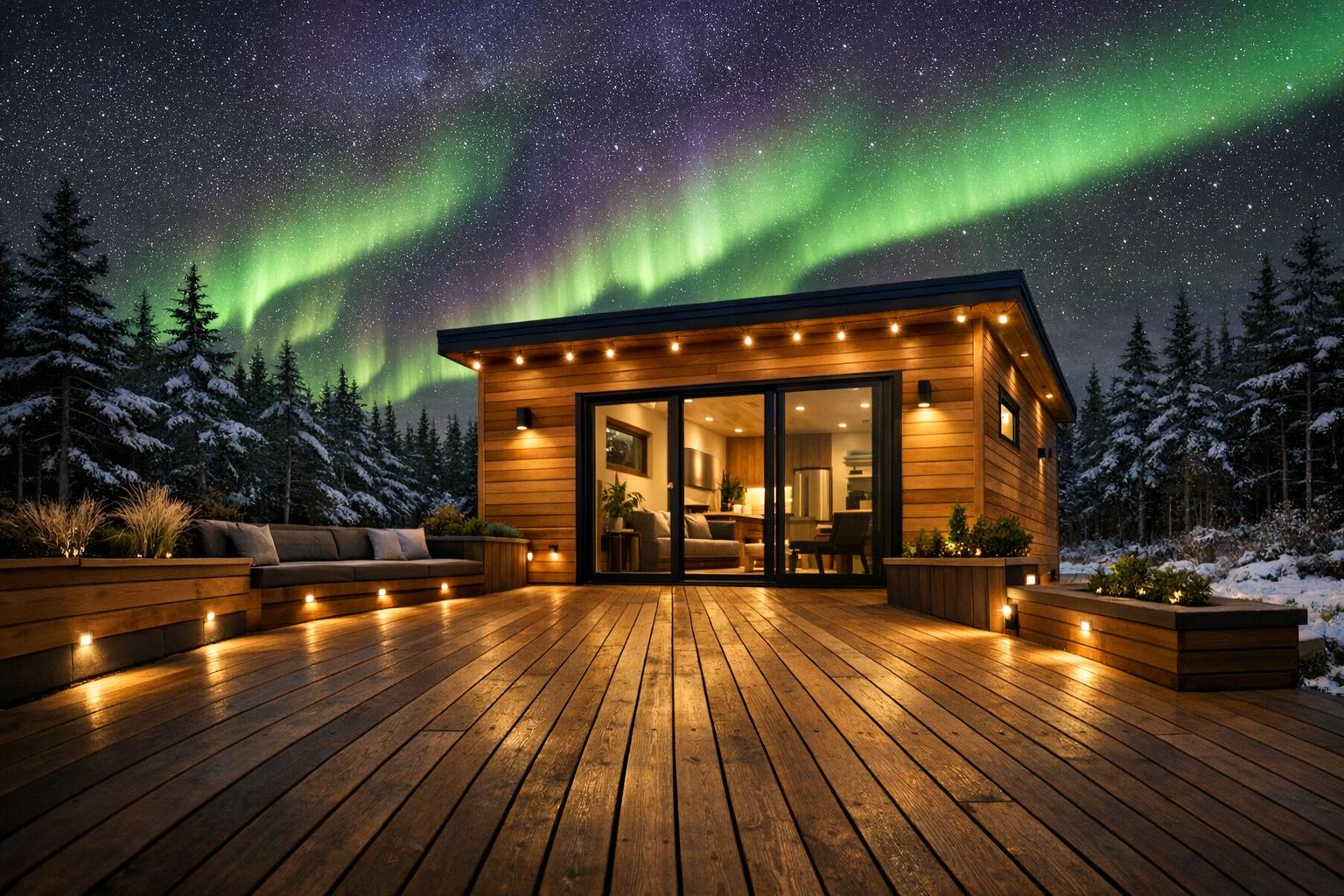
Tiny Home Deck for Northern Lights Viewing in Canada: Design Inspiration for 2026
Estimated reading time: 12 minutes
Key Takeaways
- A tiny home deck can become a *purpose-built outdoor living room* for aurora viewing, rest, and year-round use.
- The best results come from combining a clear northern horizon, low light pollution, and cold-climate construction details.
- Top Canadian regions for aurora-focused deck planning include Yukon, Northwest Territories, northern Manitoba, northern Saskatchewan, northern Ontario, and other dark-sky areas.
- Design choices such as north-facing layouts, low-glare materials, protected seating, discreet heating, and dark-sky lighting make the deck more usable.
- For ideas and inspiration, readers can explore aurora glass chalets, a real-world tiny cabin video example, and compact-home insights from Fritz Tiny Homes.
- In Canada, practical success depends on permits, snow-load engineering, frost-ready foundations, maintenance planning, and climate-smart deck design informed by climate-adaptive deck guidance and biophilic tiny home design principles.
Table of contents
- Why Design Your Tiny Home Deck for Northern Lights?
- Best Canada Locations and Seasonal Timing for Northern Lights Viewing
- Site Selection and Deck Orientation for the Best Aurora Views
- Tiny Home Deck Design Inspiration: Layouts and Features That Work
- Materials and Construction Considerations for Canada’s Harsh Climate
- Outdoor Living Comfort: Heating, Lighting, Storage, and Power
- Night-Sky Optimization and Photography Tips for Your Tiny Home Deck
- Safety, Permits, and Regulations in Canada
- Budgeting and Build Options for a Tiny Home Deck in 2026
- Maintenance and Seasonal Care for Year-Round Northern Lights Use
- Canada Case Studies and Real-World Design Inspiration
- Design Inspiration Resources, Canadian Suppliers, and Expert Help
- Tiny Home Deck Checklist for Northern Lights Viewing
- FAQ About Tiny Home Decks for Northern Lights in Canada
- Conclusion
A tiny home deck is more than a small platform by the door. It is a compact, purpose-built extension of a small home that adds usable space and can be shaped for sky watching, quiet rest, and year-round outdoor living.
In Canada, that matters even more.
A well-planned tiny home deck can become a private front-row seat to the northern lights while also giving you a beautiful place to sit, warm up, and enjoy the landscape in every season. For 2026, this idea feels especially timely. Solar activity remains favourable for aurora viewing, and more Canadians are looking for micro-retreat ideas that turn a small footprint into a richer experience.
This guide shows you how to plan a tiny home deck for northern lights viewing in Canada, from the best locations and seasons to deck orientation, layouts, materials, heating, lighting, photography, permits, budgets, and maintenance.
The goal is simple: create an outdoor living space that feels magical at night and useful every day.
Why Design Your Tiny Home Deck for Northern Lights?
Designing a tiny home deck for the northern lights means making smart choices on purpose. The deck is set up to protect darkness, improve sky views, and keep people comfortable enough to use it often.
That turns an ordinary exterior platform into a true outdoor living room for cold nights, calm mornings, and special moments.
In Canada, this makes sense because much of the country sits close to strong aurora zones. Northern regions often have long dark nights, low light pollution, and wide natural views. That gives many properties a real chance to support regular aurora watching, not just a once-in-a-lifetime event.
There is also a lifestyle benefit. An aurora-focused deck supports:
- Stargazing
- Photography
- Quiet winter relaxation
- Small social gatherings
- Sauna or hot-cold wellness routines
- A stronger link to nature
That emotional side matters. A deck like this can feel like a private retreat. It helps create a sense of escape without needing a large home or a large lot.
By day, it works as an outdoor living zone. By night, it shifts into a dark-sky viewing platform.
The best designs balance both uses, much like the immersive atmosphere seen in Northern Lights Yukon’s aurora glass chalets. This approach also connects well with biophilic design for tiny homes in Canada and the restorative ideas behind tiny homes and mental health. For a more visual sense of deck-and-retreat living, the YouTube cabin example is also worth a look.
Best Canada Locations and Seasonal Timing for Northern Lights Viewing
If you want a tiny home deck built for aurora use, location matters as much as design. The best northern lights regions in Canada combine dark skies, long nights, and low levels of artificial light.
Top places to consider include:
- Yukon: Whitehorse, Dawson City
- Northwest Territories: Yellowknife
- Nunavut: Iqaluit
- Northern Manitoba: Churchill
- Northern Saskatchewan: Prince Albert area and nearby dark-sky regions
- Northern Ontario: Thunder Bay region and farther north
- Alberta: Jasper and darker northern zones
- Newfoundland & Labrador: L’Anse aux Meadows and other dark coastal areas
These places are favourable because they sit closer to the auroral oval, where aurora activity is strongest. They also tend to have clearer horizons and less city glow, which makes your outdoor living space more useful for sky watching.
Timing matters too.
Best viewing timing in Canada:
- Broad season: late August to mid-April
- Best mix of darkness and activity: September to March
- Clear, cold nights often improve visibility
- Full moons can wash out weaker displays
For 2026, planning is smart because solar conditions are still expected to support strong aurora viewing opportunities. That does not guarantee a show every night, but it does make aurora-ready design more worthwhile.
Helpful forecast tools include the NOAA Space Weather Prediction Center, Aurorasaurus, and Canadian Space Agency resources. These tools help you match deck use with aurora probability, cloud cover, and geomagnetic activity.
For broader cold-climate planning, it also helps to review cold-climate tiny home construction guidance. And if you want to see how destination-style aurora stays create appeal, the Northern Lights Yukon chalet model offers useful inspiration.
Site Selection and Deck Orientation for the Best Aurora Views
The most important rule is simple: your tiny home deck should have a clear northern horizon. In much of Canada, the northern lights often appear strongest in the northern part of the sky, especially during moderate activity.
Good site choices include:
- Elevated clearings with fewer trees
- Open lakeside sites with wide sightlines
- Tundra or open terrain with broad sky exposure
- Rural lots far from streetlights and urban glow
Each site type has trade-offs. Lakesides can offer beautiful reflections, but they may also bring more moisture, ice, and wind. Open terrain gives better sky views, but exposed conditions can make winter comfort harder. Forested sites feel sheltered, but trees may block low aurora bands near the horizon.
For orientation, aim to give the main viewing edge a north-facing outlook where possible. A seating area or primary railing line facing roughly 0° to 30° azimuth toward the northern horizon often works well. A deck with a north-south long axis can also give flexibility if wind, privacy, or side views matter.
Before you finalise placement:
- Visit the site after dark
- Check where nearby lights shine
- Look for blocked horizon lines
- Use a compass app
- Take phone photos facing north
- Watch how wind moves across the site
Also think about microclimate. A deck that looks perfect in daylight can become hard to use at night if wind cuts across it, snow drifts pile against the stairs, or fog settles in low spots.
Good design inspiration starts with real site conditions, not just pretty sketches. Resources on climate-adaptive decks in Canada and cold-climate construction can help ground those choices. For a hospitality-style example of building around the aurora experience, see these aurora glass chalets.
Tiny Home Deck Design Inspiration: Layouts and Features That Work
The best design inspiration blends beauty with function. A tiny home deck should look calm and inviting in the daytime, then perform well in darkness, cold, and changing weather.
Small-space design works best when every feature earns its place.
Layouts that suit aurora viewing
Raised viewing platform
A raised deck helps on wooded or uneven land. It can lift your sightline above brush and improve views of the low northern sky.
Multi-level deck
This layout can separate uses. One level can handle entry, boots, and storage, while the upper level becomes the main northern lights viewing zone.
Wraparound deck
A wraparound plan gives more flexibility if the aurora shifts across the sky or if wind makes one side of the deck less comfortable.
Cantilevered viewing bay
This creates a bold look and can push the viewing area beyond wall lines or slope edges. It needs structural engineering, but it can deliver strong design inspiration on premium sites.
Features that make a deck work better
- Glass balustrades or low-visibility rail systems to protect views
- Built-in bench seating with insulated storage
- Space for blankets, boots, thermoses, and camera gear
- Tripod anchor points for windy nights
- A reinforced camera or telescope corner
- Optional hot tub zone only if the structure is engineered for it
Three style directions
Scandinavian minimalism
Dark cladding, simple forms, pale wood accents, and very little visual clutter. This style suits strong landscape views and modern tiny home deck design.
Warm cedar cabin
Natural timber, cozy seating, warm texture, and soft low lighting. This is classic outdoor living for cold Canadian settings.
Modern glass pavilion
Clean lines, slim metal details, transparent guardrails, and discreet built-in lighting. This gives a more polished retreat feel.
No matter the style, the goal stays the same: support outdoor living by day and northern lights viewing by night.
For ideas, browse tiny cabin design inspiration from Cottage Life, compact-living examples from Fritz Tiny Homes, and Canadian guides to tiny home design and luxury tiny home design.
Materials and Construction Considerations for Canada’s Harsh Climate
A tiny home deck in Canada has to handle more than looks. It must deal with cold, snow, thaw cycles, moisture, and icy surfaces.
Material choice affects safety, maintenance, and the quality of the night-sky experience.
Good decking material options
Western red cedar
- Naturally rot-resistant
- Warm, natural look
- Usually low glare
- Good for rustic and cabin styles
- Needs regular sealing
Thermally modified wood
- Heat-treated for better stability
- Works well in freeze-thaw conditions
- Strong premium option
- Higher price
Composite decking
- Lower maintenance
- Often good slip resistance
- Wide colour range
- Quality varies by brand
- Some products look less natural
What to look for
Choose decking with:
- Anti-slip texture
- Matte or low-gloss finish
- Low reflectivity
- Good drainage detail
- Strong winter durability
Avoid shiny finishes. Gloss can reflect house lights and reduce the dark-sky feel that makes northern lights viewing special.
Structural details that matter
A deck in snowy parts of Canada must be built for local snow loads. Foundations also need to handle frost. Poor footings can shift as ground freezes and thaws. Helical piles are often a smart choice because they help reduce movement in cold regions.
Other practical details include:
- Corrosion-resistant fasteners
- Slight slope for drainage
- Strong stair treads with winter grip
- Wind buffering below exposed decks
- Careful water management around hot tubs or showers
This is where smart outdoor living meets solid building science. If the deck cannot handle winter, it will not get used when aurora season is at its best.
Helpful references include Canadian snow load requirements, tiny home foundation options in Canada, and climate-responsive tiny home design. For compact-home build context, Fritz Tiny Homes is also a useful reference point.
Outdoor Living Comfort: Heating, Lighting, Storage, and Power
Most aurora viewing happens in cold, dark weather. That means outdoor living comfort is not a luxury. It is what makes the deck usable.
Heating options
Infrared heaters
These give direct heat to people instead of warming the whole air space. They are often a strong fit for compact seating zones.
Portable propane heaters
Useful in some cases, but they need proper clearance, ventilation, and safe use.
Heated benches or seat pads
A good choice for a tiny home deck because they warm the body directly and use less space.
Fireplaces or fire features
They look attractive, but smoke, glare, and code issues can make them less ideal for northern lights viewing.
Lighting strategy
Good lighting should help you move safely without ruining your night vision.
Use:
- Dimmable red or very warm low-level lights
- Downward-shielded path lights
- Motion-activated safety lights
- Small task lighting near storage
Avoid:
- Bright overhead fixtures
- Blue-white LEDs
- Unshielded wall packs
- Reflective surfaces facing the deck
Storage and convenience
Cold-night use gets easier when gear has a place.
Helpful additions:
- Dry blanket storage
- Glove and hat boxes
- Shelves for batteries and headlamps
- Hooks for parkas
- Bench compartments for cleats and tripods
Power choices
- Grid-tied power is easiest where available
- Solar plus battery can support lighter loads
- Generators work in remote settings but add noise
- Weatherproof outlets help with phones, cameras, and hand warmers
The goal is to keep the deck calm, dark, and easy to use. If comfort systems are too bright, noisy, or bulky, they will weaken the retreat feel.
For more direction, see solar-ready design guidance, advice on a heat pump for a tiny home, and visual inspiration from aurora-focused chalet design. The YouTube retreat example also shows how comfort features shape the experience.
Night-Sky Optimization and Photography Tips for Your Tiny Home Deck
A tiny home deck designed for the northern lights should also work well for photography. That means less vibration, less glare, and enough room to move safely with gear.
Photography-friendly deck details
- Reinforced corner or camera pad
- Tripod anchor points in windy areas
- Minimal bounce near the shooting zone
- Dry storage for spare batteries
- Low-glare task light near equipment
- Safe cable-free circulation space
Cold weather drains batteries fast, so easy access to warm storage matters more than many people expect.
Simple beginner aurora settings
A basic starting point:
- Wide-angle lens
- Aperture around f/2.8 if possible
- ISO 1600 to 3200
- Exposure 10 to 20 seconds
Then adjust as needed.
Why settings change:
- Fast-moving aurora needs shorter exposure
- Bright aurora can overexpose
- Moonlight brightens the scene
- Snow cover reflects more light
- Different lenses gather different amounts of light
Forecast tools worth using
- Aurorasaurus
- NOAA Space Weather Prediction Center
- Canadian Space Agency resources
- My Aurora Forecast or similar apps
Strong design inspiration for night-sky decks is not just visual. It includes practical details that make it easy to step outside, set up a camera, and enjoy the sky without fighting the space.
For low-glare illumination strategies, see tiny home light design. For experiential references, aurora chalet viewing spaces remain a useful benchmark.
Safety, Permits, and Regulations in Canada
A beautiful deck still needs to be legal and safe. In Canada, rules vary by province and municipality, so always check local requirements before building.
A common rule of thumb is that permits are often needed once a deck passes certain size or height limits, but the exact threshold depends on where you live.
Common code issues include:
- Guardrail height
- Spacing between balusters or openings
- Stair rise and run
- Load calculations
- How the deck attaches to the tiny home
- Frost depth and foundation type
Safety issues specific to aurora decks
- Snow and ice slip hazards
- Heater safety and carbon monoxide concerns
- Outdoor extension cord risks
- Weatherproof electrical requirements
- Hot tub moisture and heavy point loads
- Safe egress in darkness
Remote sites may need extra review. Shoreline rules, septic setbacks, and insurance requirements can also affect deck placement and design. Elevated decks, cantilevers, and heavy snow zones may need an engineer.
Use careful language when planning: a feature may be possible, but it is only practical if it also meets code and site conditions.
Start with your local authority and provincial rules such as the Ontario building permit guide or Alberta safety codes. Federal information from Canada.ca can also help, while region-specific explainers like tiny home permits in Ontario and tiny home permits in British Columbia provide additional context.
Budgeting and Build Options for a Tiny Home Deck in 2026
A tiny home deck budget can range from modest to premium depending on site, structure, and comfort features. The main point is to plan for the real drivers of cost, not just the boards on top.
Three common build paths
DIY materials-only build
Lower labour cost, but materials, foundations, fasteners, and winter-ready details still add up.
Contractor-built custom deck
Often a mid- to higher-range option. Site access, snow-load design, and permit needs affect the total.
Turnkey prefab or professionally designed add-on
Usually the highest cost, especially if the deck includes engineered framing, glass railings, integrated heating, or utility connections.
Main cost drivers
- Foundation system, especially helical piles
- Material choice
- Railing type, especially glass
- Lighting and heating
- Hot tub reinforcement
- Access for labour and materials
- Permit and engineering fees
Timeline notes for 2026
- Simple builds can move quickly in good weather
- Remote northern regions often have short building seasons
- Shipping delays can affect specialty products
- Ordering early in 2026 helps reduce wait times
Think in terms of value per experience, not only cost per square foot. A well-planned deck can function as an outdoor living room, a viewing platform, and a destination-quality feature for a tiny retreat.
Helpful budgeting references include budget tiny home tips for Canada and hidden construction costs. For examples of compact-home offerings, see Fritz Tiny Homes, and for a visual inspiration source, revisit the featured tiny retreat video.
Maintenance and Seasonal Care for Year-Round Northern Lights Use
A tiny home deck for winter northern lights use needs a maintenance plan from day one. If snow, ice, or wet gear make the space hard to use, the deck will sit empty when it matters most.
Routine care
- Sweep snow with plastic tools, not metal shovels
- Check anti-slip strips before winter starts
- Keep drainage paths open
- Inspect railings after freeze-thaw cycles
- Test lights and replace weak bulbs early
Material-specific care
Cedar
May need regular re-sealing to keep out moisture.
Composite
Still needs washing even if it does not need stain.
Glass railings
Need more cleaning in wet, snowy conditions to keep views clear.
Winterising systems
- Drain seasonal water lines
- Store portable heaters where needed
- Test exterior outlets
- Check weatherproof covers
- Keep batteries in warmer storage
Make the deck easy to use
Keep a few basics ready at all times:
- Blankets
- Traction aids
- Warm gloves
- Thermos setup
- Spare headlamp
- Charged battery pack
Good outdoor living in Canada depends on small habits. A clean, ready deck gets used more often, especially on short-notice aurora nights.
Useful checklists include an ADU maintenance checklist for Canada and a tiny home winterization checklist. Compact-home references from Fritz Tiny Homes and the tiny retreat video can also help frame how year-round use should feel.
Canada Case Studies and Real-World Design Inspiration
Real examples help turn abstract ideas into practical design inspiration. These three concepts show how a tiny home deck can respond to different Canadian sites and budgets.
1. Yukon micro-retreat
Location
Yukon
Main challenge
Trees and uneven ground blocked low-sky views.
Deck solution
A small raised platform on helical piles with a clean northern sightline.
Key materials and features
- Low-glare lighting
- Bench seating
- Blanket storage
- Simple weatherproof gear box
Why it worked for aurora viewing
The elevation improved horizon access and strengthened the sense of immersion in the landscape. The deck felt like part of the aurora experience, not an add-on.
Budget level and audience
Mid to premium. Best for couples or micro-retreat stays. See the model in Northern Lights Yukon’s aurora chalet experience.
2. Northern Ontario lakeside tiny cabin
Location
Northern Ontario
Main challenge
Lake wind, moisture, and frost heave risk.
Deck solution
A wraparound tiny home deck with one sheltered seating side and a frost-conscious foundation.
Key materials and features
- Cedar decking
- Photography corner
- Solar-supported power setup
- Shoulder-season heating
Why it worked for aurora viewing
The wraparound layout gave flexibility as weather changed. It also doubled as strong outdoor living space during the day for family use.
Budget level and audience
Mid range. Good for family cabins and semi-off-grid use. Explore a similar visual mood in this tiny cabin video example and waterfront planning ideas in waterfront living guidance.
3. Saskatchewan dark-sky access-focused deck
Location
Near a Saskatchewan dark-sky area
Main challenge
Keep the build low-maintenance, accessible, and dark-sky friendly.
Deck solution
A composite multi-level deck with wide turning space and stable photography points.
Key materials and features
- Composite boards
- Simple red path lights
- Northward orientation
- Easy-access circulation
Why it worked for aurora viewing
The design kept maintenance low while still giving reliable northern lights access. It showed that function-first planning can still deliver strong design inspiration.
Budget level and audience
Budget to mid range. Good for practical owners who want year-round use with less upkeep. Helpful references include Canadian Space Agency resources, Cottage Life tiny cabin inspiration, and guidance on climate-adaptive decks.
Design Inspiration Resources, Canadian Suppliers, and Expert Help
If your project goes beyond a simple platform, expert help is often worth it. The right team can protect both safety and the quality of the final outdoor living experience.
Professionals to consider
- Deck builder familiar with snow loads and frost heave
- Architect or designer with tiny-home experience
- Structural engineer for elevated or cantilevered decks
- Electrician for low-glare exterior lighting and weatherproof outlets
Useful Canadian resources
- Canadian tiny-home builders for compact-space ideas
- Canadian Home Builders’ Association for local professionals
- Royal Astronomical Society of Canada for night-sky awareness
- Aurora forecast sources such as NOAA, Aurorasaurus, AuroraMax, and Canadian Space Agency resources
Good questions to ask a builder
- Have you built in heavy snow zones?
- Do you use helical piles?
- How do you design low-glare lighting?
- Can you engineer for a hot tub or cantilever?
- Have you worked on off-grid or tiny-home projects?
Strong design inspiration should always be backed by technical skill, especially in Canada’s cold climates.
To start your research, look at Fritz Tiny Homes, official science and sky resources from the Canadian Space Agency, forecasting through NOAA and Aurorasaurus, and contractor guidance on how to find a contractor for a tiny home.
Tiny Home Deck Checklist for Northern Lights Viewing
Use this simple planning checklist for a tiny home deck in Canada built for northern lights viewing.
Site checklist
- Clear northern horizon
- Dark enough after 9–10 p.m.
- Nearby lights can be controlled
- Wind exposure is manageable
- Trees do not block low sky
Design checklist
- Main viewing edge faces north
- Space for at least 2 chairs
- Room for 1 tripod
- Built-in seating or flexible furniture
- Dry gear storage included
Materials checklist
- Slip-resistant surface
- Snow-load suitable structure
- Frost-resistant foundation plan
- Low-glare finish
- Corrosion-resistant fasteners
Comfort checklist
- Safe heat source
- Low-glare lighting
- Blanket storage
- Battery storage
- Weatherproof outlets
Safety checklist
- Permit status checked
- Rail design meets local rules
- Stairs sized safely
- Heater safety reviewed
- Safe dark-night access planned
Photography checklist
- Tripod ready
- Spare batteries
- Warm gloves
- Forecast app installed
- Red task light available
This kind of design inspiration works best when it is easy to carry into real planning. A short checklist helps keep the project practical from the start.
Useful planning references include Aurorasaurus, the NOAA forecast centre, compact-home examples from Fritz Tiny Homes, ideas from aurora glass chalets, and design support on tiny home privacy strategies.
FAQ About Tiny Home Decks for Northern Lights in Canada
When can I see the northern lights in Canada?
The broad season runs from late August to mid-April. In many places, September to March gives the best mix of darkness and activity. Northern regions of Canada usually offer the most reliable viewing. For more, see Northern Lights Yukon and the Canadian Space Agency.
Do I need a permit for a tiny home deck?
Often, yes. Many municipalities in Canada require permits based on deck height, size, and structure. Exact rules vary, so check with your local authority before building. Helpful starting points include the Ontario building permit page, Alberta safety codes, Ontario tiny home permit guidance, and British Columbia tiny home permit guidance.
Can I put a hot tub on my tiny home deck?
Yes, but only if the tiny home deck is engineered for the concentrated load, moisture control, and electrical safety needs. Hot tubs are heavy, so this should never be treated as a simple add-on. Review relevant information through Alberta safety codes, Canada.ca, and planning ideas in tiny home pool and hot tub ideas.
How do I avoid light pollution on my deck?
Use red or very warm dimmable lights, shield fixtures downward, and avoid bright overhead lighting. Site choice also matters. A deck away from urban glow will protect northern lights visibility and improve outdoor living comfort. For examples, see aurora chalet design and guidance on smart lighting for Canadian tiny homes.
What is the best deck material for a cold Canadian climate?
There is no single best answer. Cedar, thermally modified wood, and composite can all work well in Canada. The right choice depends on your budget, maintenance goals, and design inspiration. For compact-home context and material direction, see Fritz Tiny Homes and sustainable material options for tiny homes.
What size should a northern-lights viewing deck be?
A compact deck can work well if it fits seating, safe movement, and one photography setup. Plan around function first. A small, well-designed tiny home deck often works better than a larger one with poor layout. For layout thinking, review Fritz Tiny Homes, the tiny retreat video example, and ideas for tiny home storage solutions.
Conclusion
A tiny home deck can become one of the most memorable outdoor living features a small home or retreat can have in Canada. When it is planned for the northern lights, it does more than add square footage.
It creates a place to pause, watch the sky, and use the landscape in a deeper way.
The key ideas are clear:
- Choose the right location
- Protect a clear northern horizon
- Use cold-climate materials
- Add low-glare comfort features
- Plan for safety, permits, and photography
- Maintain the deck for real winter use
The best design inspiration is not only beautiful. It is practical, climate-ready, and built around how people actually live.
In 2026, with strong interest in micro-retreats and continued aurora appeal, a well-designed tiny home deck is a smart way to turn compact living into a richer Canadian experience.
For further inspiration, explore Northern Lights Yukon’s aurora glass chalets, compact-home ideas from Fritz Tiny Homes, the lifestyle benefits of tiny home living, and practical guidance on climate-adaptive decks in Canada.
Leave a Reply