

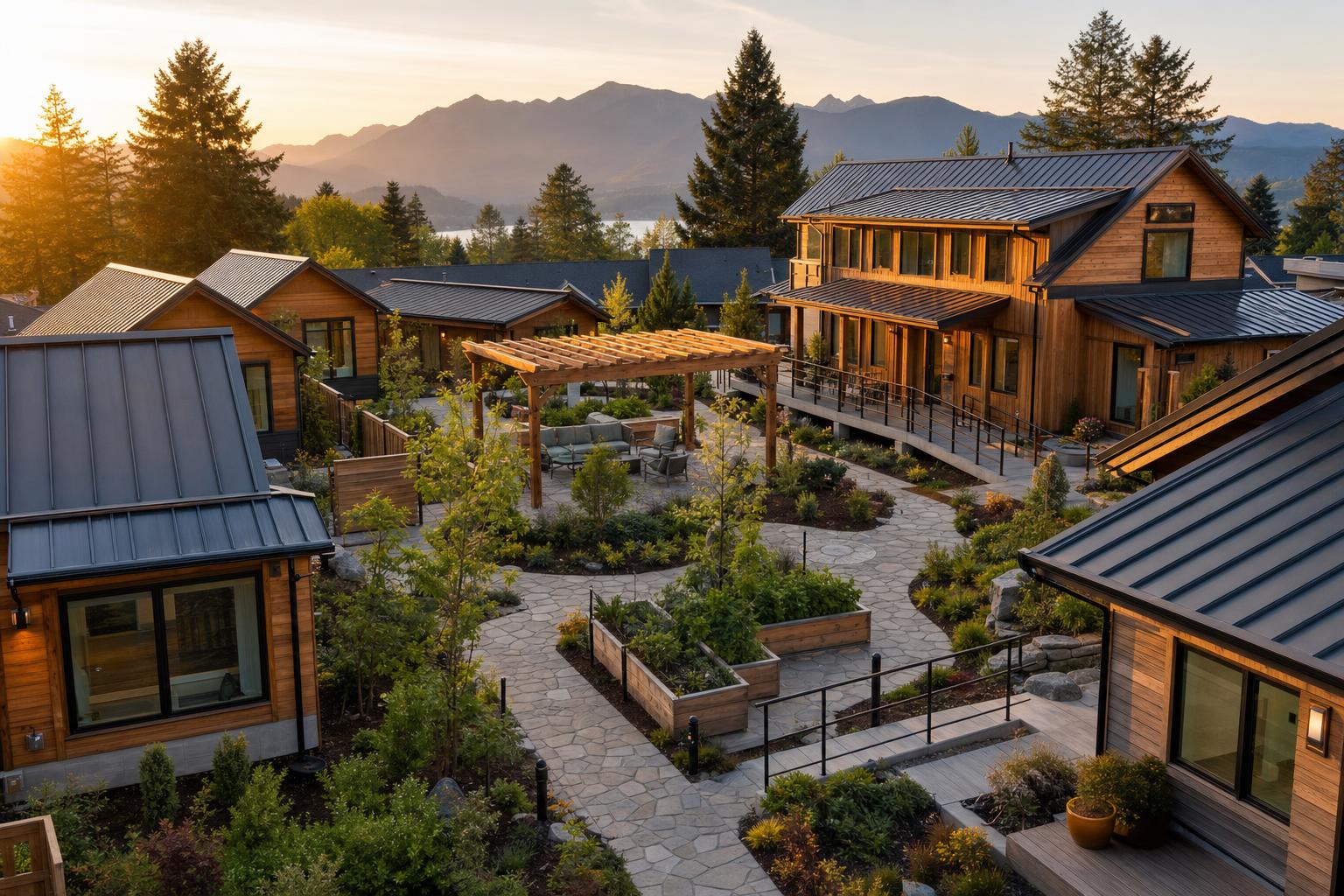
Intergenerational ADU Village Planning in Canada: Design, Financing, and Governance for 2026
Estimated reading time: 11 minutes
Key Takeaways
- Intergenerational ADU villages give families a way to live close together while preserving privacy, independence, and shared support.
- They fit major Canadian housing trends including aging demographics, delayed homeownership, and demand for more flexible housing.
- Good layouts balance private homes with shared amenities, using accessibility, universal design, and thoughtful outdoor planning from the start.
- Successful projects need more than design; they also need realistic budgeting, local zoning review, legal clarity, and written household agreements.
- In 2026, ADU communities and family compounds are moving from a niche concept toward a practical form of gentle density in Canada.
Table of contents
- Why choose an intergenerational ADU village?
- Design models and layouts for ADU communities and family compounds
- Practical steps to plan your intergenerational ADU village
- Financing, zoning, and policy in Canada (2026)
- Community governance, operations, and conflict resolution
- Case studies and inspiration
- Practical decision checklist
- Frequently Asked Questions
Intergenerational ADU village planning is moving from niche idea to practical housing model, and that shift lines up with today’s Canadian reality. An intergenerational ADU village is a deliberately planned cluster of small homes, suites, or secondary dwellings arranged so multiple generations can live close together with both private space and shared amenities.
This is more than adding a backyard suite. It is a way to shape intergenerational living so families can stay connected without giving up independence. A well-planned layout can support aging in place, childcare help, flexible use of land, and lower per-household costs.
In 2026, that matters. High home prices, delayed homeownership, an aging population, and growing interest in gentle density are pushing more families to rethink how they live. Many households want to stay near each other, but not under one roof. That is where ADU communities and small family compounds can make sense.
This guide covers the key parts of making an intergenerational ADU village work in Canada: design models, a planning checklist, financing and zoning basics, governance rules, and case study inspiration. For context on the national picture, see Statistics Canada housing data and the CMHC housing market outlook.
Why choose an intergenerational ADU village?
Intergenerational living is no longer only a short-term fix or a cultural tradition. For many households, it is becoming a long-term housing strategy. Families want to be close enough to help each other, separate enough to keep privacy, and flexible enough to adapt as life changes.
That is the core strength of an intergenerational ADU village.
Social support in everyday life
When homes are near each other, help becomes easier and more natural.
- Grandparents can help with school pickups or childcare
- Adult children can help older parents with errands, rides, and technology
- Older adults may feel less isolated than they would in a detached home far from family
- Children and teens can build stronger daily ties with parents and grandparents
Cost-sharing and financial resilience
Shared housing can reduce pressure on each household.
- Families can split costs for snow removal, landscaping, internet, roofing, and repairs
- Smaller homes usually cost less to heat, cool, clean, and maintain
- A secondary suite or ADU may create rental income that supports a mortgage or retirement budget
- Building over time can spread costs across phases
This is one reason family compounds are gaining attention. They let households share land and systems while keeping separate living space.
Caregiving and aging in place
A purpose-built suite can support independence for longer.
Features like step-free entry, wider doors, and a simple one-level floor plan can help older adults stay in their own home. At the same time, being near family makes it easier to respond if care needs grow.
Emotional and cultural value
Many families want a built form that matches how they already live.
Regular meals, quick check-ins, shared celebrations, and nearby support can make day-to-day life feel lighter.
For households with strong traditions of multigenerational living, this model offers a better fit than conventional suburban layouts.
Why this matters in 2026
Canadian housing trends point in this direction. Housing costs remain high, many younger adults live with parents longer than in past decades, and policy conversations around gentle density and aging in place are growing. That makes shared housing, ADU communities, and family compounds more than a workaround. They are becoming part of the long-term housing mix.
For a broader view, review national housing trends, the CMHC outlook, this 2026 ADU accessory dwelling unit guide, a video overview of ADU and multigenerational housing, the Canadian housing market forecast for 2025 and 2026, and Canada markets to watch.
Design models and layouts for ADU communities and family compounds
There is no single blueprint for an intergenerational ADU village. The right layout depends on your lot, budget, family structure, privacy needs, and local rules. The best designs treat the site like a small living system, not a collection of extra units.
Model A — Clustered ADUs around a shared courtyard
This layout uses a main house or common building with three to six smaller dwellings around a shared courtyard, lawn, or gathering area.
It often works best on:
- Medium or large lots
- Rural land
- Small-town properties
- Deep urban lots where several units are allowed
The key is a clear privacy gradient:
- Private interiors for each household
- Semi-private porches facing the centre
- A clearly shared courtyard for meals, play, and gatherings
Shared amenities may include:
- Common kitchen or dining room
- Laundry hub
- Tool shed or workshop
- Food garden
- Play space for children
To support intergenerational living, this model should use universal design and low-maintenance planning from the start:
- Level entries
- 36-inch doors
- Curbless showers
- Turning space for mobility aids
- Good lighting
- Slip-resistant paths
- Solar-ready roofs
- High-performance insulation
- Heat pumps
- Permeable paving for rain and snowmelt
This type of courtyard layout can make ADU communities feel connected without forcing households to share too much. It also aligns with broader Canadian goals around efficient, lower-carbon housing. See the housing market outlook, universal design principles, and community governance for tiny homes in Canada.
Model B — Single-lot family compound
Family compounds usually mean a main house plus one or more attached or detached secondary units on the same property.
Common combinations include:
- Main house plus garden suite
- Main house plus laneway suite
- Basement suite plus garage conversion
- Side-yard tiny home where permitted
This model is often the easiest starting point because it can be built in stages. A family may begin with one detached ADU for aging parents, then add a basement suite later for a younger adult, caregiver, or tenant.
Roles can be matched to life stage:
- Barrier-free one-bedroom unit for older parents
- Compact studio for a student, caregiver, or adult child
- Two-bedroom ADU for a sibling’s family
Strong single-lot layouts usually include:
- The main house as the social hub
- Separate patios for quiet retreat
- Shared vegetable garden or storage area
- Careful window placement
- Sound separation between dwellings
This approach works well for people who want to stay on their property and adapt it over time. It also reflects Canadian housing trends, as more municipalities allow at least one secondary suite, and some now permit added density through broader housing reforms. Helpful references include this ADU and multigenerational housing video, the CMHC outlook, Canada markets to watch, future-proof ADU multigenerational living, and ADUs for caregiving and flexible housing.
Model C — Street-scale ADU communities
Not every intergenerational ADU village sits on one lot. Some ADU communities form across several nearby properties owned by relatives or close family friends.
This model works well for:
- Families who want separate titles
- Households that want more autonomy
- Friend groups exploring co-housing-style shared housing
- Urban or suburban streets with flexible infill options
Design ideas include:
- Gates or paths linking backyards
- One shared garden lot
- A common guest suite or studio
- Shared coworking or hobby space
- Coordinated landscape design across lots
This creates a micro-neighbourhood feel without requiring full shared ownership. It can be a smart middle ground between independence and connection. See ADU cohousing in Canada, co-building tiny home developments, and tiny home community startups in Canada.
Floorplan ideas that support multigenerational life
Universal design means making homes work for people of all ages and abilities without major later changes.
Must-have features include:
- Step-free entry
- One accessible bathroom in each dwelling
- Reinforced walls for future grab bars
- Wider hallways and circulation space
- Strong lighting with low glare
Flexible floorplans also help:
- Den or office that can become a bedroom
- Sliding or pocket doors
- Junior suite for a teen or semi-independent adult child
- Bedrooms placed away from shared living zones for better acoustics
Outdoor areas matter too.
- Snow-friendly, slip-resistant walkways
- Benches for rest stops
- Clear sightlines to children’s play areas
- Quiet corners for retreat
The best intergenerational ADU village layouts support both shared housing and healthy boundaries. That is what makes them livable over time.
Practical steps to plan your intergenerational ADU village
A strong idea becomes a buildable project when families use a simple planning checklist. These steps can help turn intergenerational living goals into a clear plan.
1. Clarify family goals and non-negotiables
Before sketching layouts, talk honestly about what the village needs to do.
Discuss:
- Who may live there in 5, 10, and 20 years
- Caregiving needs now and later
- How much privacy each household wants
- Mobility, sensory, or cognitive needs
- Pets, home businesses, music, tools, or noisy hobbies
Write down:
- Shared priorities
- Red lines
- Likely future scenarios
This step matters because hidden assumptions often become design mistakes later.
2. Analyze the site
Look at the land in practical terms.
Check:
- Lot size and shape
- Sun and shade
- Privacy from neighbours
- Existing trees
- Utility connections
- Emergency access
- Space for snow storage
- Slope and drainage
Even if broader policy is becoming more ADU-friendly, local zoning details still vary a lot by city, district, and lot type. Review the CMHC housing market outlook, Canada markets to watch, and tiny home friendly municipalities in 2026.
3. Build the right design team
Most intergenerational ADU village projects need more than a builder.
A useful team may include:
- Architect or residential designer for plans and code compliance
- Builder or general contractor for pricing and sequencing
- Landscape architect for paths, privacy, and shared outdoor rooms
- Accessibility consultant or occupational therapist for aging-in-place design
- Planner or zoning consultant for approvals
Choose people with experience in ADU communities, infill housing, or shared housing projects. See how to hire an architect for my ADU, special skills to build an ADU, and the ADU legal clinic Canada 2026.
4. Choose a phasing strategy
You do not need to build everything at once.
A phased plan may look like this:
- Build one detached ADU first
- Add a basement suite later
- Rough in utilities for a future unit
- Prepare a future pad site while landscaping the yard
Phasing can lower upfront cost, reduce risk, and let the family learn from real use before expanding.
5. Create a realistic budget
Budgeting should cover more than construction.
Include:
- Hard costs: labour, materials, structure, systems, finishes, landscaping
- Soft costs: design fees, permits, engineering, surveys, legal work, financing fees, energy modelling
- Carrying costs: taxes, insurance, loan interest during construction
- Operating costs: utilities, snow removal, internet, repairs, shared maintenance
Also decide:
- Who pays into a common fund
- How unequal utility use is handled
- Whether rental income supports one household or all households
- How much contingency money is set aside
Soft costs and delays can change the full project picture more than many families expect. Review housing costs, delays, and unintended consequences, hidden costs of ADU construction in Canada, and ADU finance for intergenerational living in Canada.
6. Plan maintenance and operations before move-in
Daily operations should not be left vague.
Set written rules for:
- Lawn care
- Snow removal
- Garbage and recycling
- Emergency repairs
- Shared purchases
- Reserve or sinking fund
- Approval process for major replacements
7. Map the timeline
A sample timeline for an intergenerational ADU village may be:
- Feasibility: 1 to 3 months
- Design and approvals: 3 to 9 months
- Construction: 6 to 12 months or more
Add checkpoints for:
- Concept approval
- Budget approval
- Contractor selection
- Finish selections
- Move-in readiness
- Final governance agreements
That kind of structure helps intergenerational living projects stay calm, clear, and realistic. For permitting context, see ADU digital permitting in Canada.
Financing, zoning, and policy in Canada (2026)
Canadian housing trends in 2026 increasingly treat secondary suites and ADUs as part of the answer to affordability and housing supply. Still, rules and funding options differ a lot by municipality, so every intergenerational ADU village needs local review.
Zoning and approvals
Start with the basics:
- How many units are allowed
- What kinds of units are allowed
- Maximum floor area
- Lot coverage
- Setbacks
- Height limits
- Parking rules or waivers
- Fire access
- Laneway or garden suite design rules
A pre-application meeting with the municipality can save time because the fine print changes quickly. Cities such as Toronto, Vancouver, Edmonton, and Calgary are often part of the ADU conversation, but 2026 rules still need to be checked on each site. Secondary suites and detached backyard units are becoming more common in policy, and some places are allowing more through multiplex reforms.
Useful references include the CMHC housing market outlook, Canada markets to watch, the multigenerational ADU video overview, the Canadian ADU regulations guide, and tiny home bylaws in Canada.
Financing models
Possible financing paths include:
- Traditional mortgage supported by projected ADU income
- Shared equity between siblings or family branches
- Cross-generational loans
- Co-ownership with formal equity shares
- Renting one unit to a non-family tenant for cash flow
- Accessibility or affordability incentives where available
Some lenders are showing more comfort with ADU income in markets where demand is established. CMHC and local programs are worth checking because supports can change by place and year. See the 2026 ADU guide, the ADU financing video overview, the CMHC outlook, ADU financing Canada guide, ADU mortgage Canada 2026, and intergenerational ADU finance guidance.
Tax and legal considerations
Keep the legal side simple and clear from the start.
Important points:
- Rental income is usually taxable
- Some expense deductions may apply
- Certain arrangements may affect the principal residence exemption
- Landlord-tenant rules apply if a unit is rented to a non-family tenant
- Short-term rental limits may apply
- Wills and succession plans should match the ownership structure
Ownership models may include:
- Joint tenancy
- Tenants-in-common
- Trust or company structures for more complex family compounds
For more detail, review ADU taxes in Canadian real estate, tiny home co-ownership 2026, and fractional ownership for tiny homes in Canada.
Community governance, operations, and conflict resolution
A well-designed intergenerational ADU village still needs rules. Design shapes the space, but governance shapes daily life. The most successful shared housing setups make expectations clear instead of leaving them unspoken.
Household agreements for shared housing
A household agreement is a written set of expectations for how people use space and share responsibility.
It should cover:
- Quiet hours
- Overnight guests
- Parking
- Shared kitchen, workshop, or garden use
- Pet boundaries
- Caregiving expectations
- Food-sharing habits
- Event hosting norms
Review it each year because intergenerational living changes as children grow, parents age, and work patterns shift. See community governance for tiny homes in Canada, shared ADUs, and privacy in tiny homes.
Formal governance options
Larger family compounds and multi-lot ADU communities may need more formal documents.
These may include:
- Co-ownership agreement
- Rental or cost-sharing agreement
- Small HOA-style charter for shared spaces
These documents should explain:
- How decisions are made
- Who approves budgets
- Who pays for improvements
- What happens if someone wants to leave or sell
Maintenance rules and dispute resolution
Write down:
- Maintenance schedules
- Renovation notice rules
- Repair approval steps
- Process for disagreements
- When to use neutral mediation
Healthy intergenerational living depends on both closeness and boundaries. Good rules protect both.
Case studies and inspiration
Real examples help an intergenerational ADU village feel possible. The cases below reflect common Canadian patterns and should be paired with verified local project details before publication.
Urban laneway village in Toronto-style context
On a deep urban lot with lane access, a family created a laneway suite, kept a basement suite in the main house, and used the middle yard as a shared courtyard.
- Who lived there: older parents in the main home, adult child in the laneway suite
- Key layout feature: separate outdoor sitting areas on each side of the yard
- Accessibility feature: no-step rear entry and wide bathroom in the laneway suite
- Cost lesson: rental income from one suite helped support financing
- Main takeaway: privacy design had to be solved early
This kind of layout shows how ADU communities can emerge even on one city lot.
Western Canada family compound
A bungalow property added a detached accessible ADU for an older parent and planned space for a future caregiver suite.
- Who lived there: parent in the ADU, adult child’s family in the main house
- Key layout feature: shared patio near the garden, private bedroom wing in each unit
- Accessibility feature: curbless shower and wider doors
- Governance takeaway: a formal co-ownership agreement reduced confusion
- Main lesson: planning future care space early avoided later retrofit costs
This is a strong example of how family compounds can support changing needs.
Rural Atlantic intergenerational ADU village
A rural property used a main house and two detached ADUs around a shared green.
- Who lived there: grandparents, one adult child, and one young family
- Key layout feature: central lawn with clear paths between homes
- Accessibility feature: level entries and rest benches along the walkways
- Budget lesson: utility rough-ins for future units reduced later expansion cost
- Main takeaway: future-proofing works best when done at the first phase
These examples show that intergenerational living can work in urban, suburban, and rural settings when design, budgeting, and governance align. For more inspiration, see multi-generational living in tiny homes, multi-generational living with ADUs, and ADU income case studies in Canada.
Practical decision checklist
A good intergenerational ADU village starts with a clear checklist, not a rushed sketch. Before moving ahead, confirm zoning, construction access, utility locations, title and survey issues, accessible design must-haves, privacy and acoustic separation, future utility rough-ins, shared maintenance funding, rental strategy, and a draft co-ownership or household agreement.
Use a simple decision frame:
- Build new or retrofit what already exists?
- Choose single-lot family compounds or multi-lot ADU communities?
- Prefer fully private units or more integrated shared housing?
- Need short-term flexibility or long-term aging-in-place design?
In 2026, intergenerational living is a practical response to Canadian housing trends, caregiving needs, and the wish for stronger family ties. The strongest projects combine thoughtful design, realistic budgeting, legal clarity, and written household agreements. A family conversation, site review, and concept sketch are often the best first steps.
Frequently Asked Questions
What is an intergenerational ADU village?
An intergenerational ADU village is a planned group of small homes, suites, or accessory dwelling units arranged so different generations of a family can live near each other with a mix of privacy and shared space.
How is this different from a standard backyard suite?
A standard backyard suite is usually a single added unit. An intergenerational ADU village is planned as a broader living system, often with shared amenities, phased growth, accessibility features, and governance rules.
Are intergenerational ADU villages legal in Canada?
They can be, but legality depends on local zoning, lot size, servicing, fire access, setbacks, and unit limits. Start by checking municipal rules and resources such as the Canadian ADU regulations guide.
What design features matter most for aging in place?
Key features include step-free entry, wider doors, one-level layouts, curbless showers, good lighting, reinforced bathroom walls, and safe outdoor paths. Universal design is especially important in multigenerational settings.
Can one unit be rented out to help cover costs?
Yes, in many cases one suite or ADU can be rented to generate income, but tax rules, lender requirements, and local landlord-tenant laws need to be reviewed first.
What is the biggest mistake families make?
The biggest mistake is assuming closeness alone will make the arrangement work. The strongest projects plan for privacy, sound separation, maintenance, budgets, and conflict resolution before anyone moves in.
Leave a Reply