
Eco-Village Canada 2026: How Canadian ADUs, Tiny Home Communities, and Shared Resources Make It Possible
Estimated reading time: 16 minutes
Key Takeaways
- An eco-village in Canada can now grow incrementally through a Canadian ADU, a tiny home community, and coordinated shared resources.
- Permaculture is not just gardening. It is a whole-systems design method that helps link homes, food, water, energy, and land stewardship into one low-impact model, as explored in guides to urban homesteading.
- More Canadian cities and provinces are opening doors to secondary suites and missing-middle housing, while builders such as Acorn Tiny Homes, Minimaliste Houses, and resources like this 2026 tiny home guide show the market is maturing.
- ADUs and tiny homes matter because they improve density, affordability, flexibility, and multi-generational living while reducing land disturbance and infrastructure duplication.
- The strongest projects combine legal due diligence, cold-climate design, governance, financing, and clear systems for managing community assets.
Table of contents
- Introduction
- Why ADUs and tiny homes matter for eco-villages
- Permaculture as the organizing design principle
- Canadian ADU — legal, zoning and policy landscape (2026)
- Designing a tiny home community within an eco-village
- Governance, finance and operational models for intentional living
- Case studies and examples (Canadian-focused)
- Measurable benefits: sustainability, resilience and community outcomes
- Challenges, trade-offs and solutions
- Step-by-step guide: From idea to inhabited eco-village
- Resources, tools and next steps
- Frequently Asked Questions
Introduction
An eco-village in Canada no longer has to mean one large rural project built all at once. In 2026, it can also grow through a Canadian ADU, a tiny home community, and smart shared resources that link homes, land, food, water, and energy into one low-impact system.
An eco-village is a low-impact, community-governed neighbourhood or settlement. It brings together housing, food systems, water, energy, social life, and care for the land. These are also intentional living communities, which means people choose shared values, shared decision-making, and some shared infrastructure.
In Canada, that can happen bit by bit through backyard secondary suites, garden suites, laneway homes, small clusters of tiny houses, and common systems like tool libraries, gardens, workshops, and energy systems. Permaculture helps make this work because it is a whole-systems design method, not just a style of gardening. Resources on urban homesteading, shared workshops, tool libraries, and community tool sharing show how this is already taking shape.
This model is becoming more practical because many provinces and cities are opening the door to secondary suites and other missing-middle housing types. At the same time, the Canadian small-home sector now includes more 4-season, code-compliant, CSA-certified homes that can work as ADUs or as part of a community layout, with examples from Acorn Tiny Homes, HomeSmart Living’s 2026 guide, and Minimaliste Houses.
Why ADUs and tiny homes matter for eco-villages
A strong eco-village needs homes that are affordable, flexible, and light on the land. That is why the Canadian ADU and tiny home community model matter so much. They let people add homes without waiting for a huge project, a huge budget, or a huge parcel of land.
They also work well with shared resources. When each household uses less private space, the community can put more money into the systems everyone uses together. That is a key idea behind ADU cohousing, multi-generational tiny home living, and shared ADU models.
Density, affordability, and ecological footprint
A Canadian ADU adds gentle density to an existing lot. That means more homes in a neighbourhood without a high-rise or a large subdivision. A garden suite, basement suite, or laneway house can create housing while keeping the basic shape of the neighbourhood, as shown in guides to urban infill and backyard homes in Canada.
A tiny home community can do something similar on a larger site. Several small homes can fit on a modest piece of land, leaving more room for:
- food growing
- trees and habitat
- common space
- play areas
- workshops
- shared energy and water systems
Many Canadian tiny homes fall in the 250–550 sq ft range. That small size matters in a cold climate. Less heated floor area usually means less energy needed for heating, cooling, and upkeep.
Good small homes often include:
- high-performance insulation
- triple-glazed windows
- careful air sealing
- solar-ready roofs
Smaller homes also use fewer materials than full-size detached houses. That lowers both cost and embodied carbon. In an eco-village, the savings can support better shared resources such as a greenhouse, a tool shed, a laundry room, a battery system, or a common house.
Some tiny homes also include composting toilets, low-flow fixtures, and small renewable systems. Real-world examples show the affordability potential too. Bluegrass Meadows Micro Village in BC has often been cited for micro homes up to about 480 sq ft, with rents starting around $700 per month in some reports. See references from this video overview, cozy Canadian communities, affordable eco-living communities, and the eco tiny homes challenge.
Flexibility: incremental growth and multi-generational living
One of the biggest strengths of the Canadian ADU model is flexibility. An eco-village does not always need to start with a full master plan and many homes. It can start with one legal secondary suite or garden suite. Then it can grow.
For example, a site might phase in like this:
- Main house plus one ADU
- Shared garden and tool storage
- Second small dwelling or garden suite
- Common outdoor eating area
- Shared workshop or laundry
- Larger food-growing and water systems
This phased approach spreads cost over time. It also gives the group time to test how they live together and how they manage shared resources.
ADUs also help multi-generational living. They can give seniors a place to age in place, let adult children stay close, or house a caregiver on site. A tiny home community can also grow in stages, which reduces risk for founders and small developers. Build the core paths, utility connections, and common systems first. Add homes as demand, financing, and governance become stronger. Useful references include retiring with an ADU, future-proof multi-generational ADUs, ADUs for caregiving, and multi-generational ADU compounds.
Permaculture as the organizing design principle
Permaculture is the design logic that helps an eco-village function as one living system. It is not only about gardens. It is a way to plan homes, land, energy, water, waste, and shared resources so they support each other. See related ideas in urban homesteading, cold-climate gardening, and urban gardening tips.
Key permaculture principles relevant to community-scale housing
Permaculture is a design framework that learns from natural systems. The goal is a place that is resilient, productive, and low in waste.
Observe and interact
Start by studying the site. Look at:
- sun and shade
- slope
- wind
- drainage
- soil
- trees
- wildlife paths
- snow movement
- access routes
Catch and store energy
Design homes for winter sun. Add rooftop solar where it fits. Use rainwater tanks, healthy soils, and battery storage if the project supports them. Explore solar-powered ADU communities, a solar-ready ADU design guide, and winter solar basics.
Obtain a yield
A good eco-village should produce useful things. That might include:
- kitchen gardens
- herbs
- berries
- greenhouse crops
- orchards
- food forests
- eggs, where legal
Use and value diversity
Mix different dwelling types, ages of residents, plant species, and skill sets. A diverse place is usually more resilient.
Produce no waste
Use composting, repair culture, reclaimed materials, and legal greywater reuse where possible. See guides on greywater recycling, recycling tips, and reclaimed materials for tiny homes.
Integrate rather than segregate
Place homes, paths, gardens, and gathering spaces so that daily life naturally supports stewardship and neighbour connection.
This is where shared resources become a permaculture outcome. Instead of every home duplicating tools, laundry, workshops, guest rooms, or water systems, the community can share them. That approach aligns with community governance, communal kitchens, and shared workshops.
Zoning, sector, and guild design applied to ADU/tiny home clusters
Permaculture tools can shape an eco-village built from a Canadian ADU network or a tiny home community.
Zones 0–5
- Zone 0: the home itself
- Zone 1: high-use spaces near the home, like herbs, salad beds, compost, bike storage, and rain barrels
- Zone 2: bigger garden beds, greenhouse, and chickens where bylaws allow
- Zone 3: orchards and staple crops
- Zone 4: managed woodland or coppice on rural land
- Zone 5: wild habitat left mostly alone
Sector analysis
This looks at outside forces moving across the site. In many Canadian climates, that means:
- placing homes to catch winter sun
- adding windbreaks on north and west sides
- planning snow storage carefully
- keeping flood, storm, and wildfire risk in view
Guild design
A fruit tree guild is a simple example. One fruit tree is supported by other plants around it, such as:
- nitrogen-fixers
- pollinator flowers
- mulch plants
- species that confuse pests
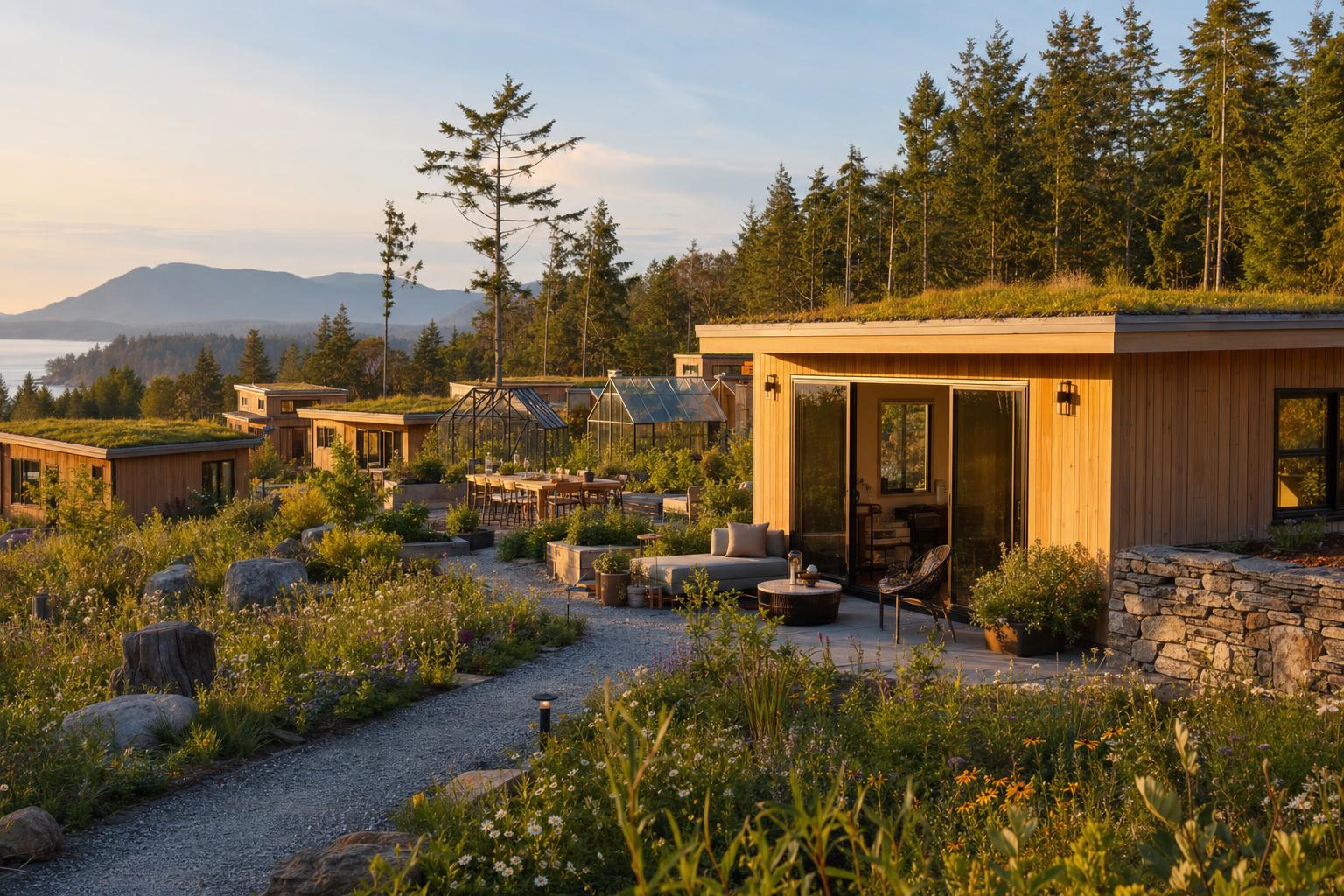
At the site scale, a practical layout might include:
- 6–20 dwellings around a common house
- a shared greenhouse near the centre
- workshop and tool storage close to daily paths
- parking at the edge so the middle stays walkable
That kind of layout works well for shared resources and social life. Related ideas appear in community gardens, ADU rooftop gardens, and urban pocket parks.
Canadian ADU — legal, zoning and policy landscape (2026)
A Canadian ADU can be a secondary suite, basement suite, laneway house, coach house, or garden suite on the same lot as a main home. This is one of the clearest legal paths for small-scale infill in many parts of the country.
Rules still vary by province and city, so every project must verify local regulations before moving ahead. Start with a Canadian ADU regulations guide, review tiny home bylaws in Canada, and watch evolving lists of tiny-home-friendly municipalities in 2026.
Provincial and municipal trends and where to look for updates
The broad trend in 2026 is more support for secondary units and gentle density. That is good news for the eco-village model, because it means more room for small homes on existing lots.
Key trends include:
- Ontario: reforms linked to Bill 23 have expanded opportunities for more units on many residential lots. In some cases, this means a main dwelling plus a secondary suite plus a garden or laneway suite.
- BC: laneway houses and infill are already familiar in many places, especially around Metro Vancouver. Missing-middle and small-lot infill momentum remains strong.
- Prairies and Atlantic Canada: some municipalities still use minimum dwelling size rules, sometimes around 800 sq ft, which can block tiny homes as primary dwellings.
If you are checking rules, start with:
- provincial housing ministry pages
- municipal planning pages
- search terms such as “secondary suite,” “garden suite,” “coach house,” and “laneway house”
Because bylaws can change fast, verify all local rules right before publication in 2026 and right before permitting. General market references include The Tiny Life builder guide, Canadian tiny home community examples, and the builder sites already mentioned above.
Practical checklist for permitting an ADU in Canada
Use this 10-step process for a Canadian ADU permit path:
- Confirm zoning and whether a secondary suite, garden suite, coach house, or laneway house is allowed.
- Check minimum lot size, setbacks, lot coverage, height, and parking rules.
- Confirm whether the unit counts toward the maximum number of dwellings on the lot.
- Verify building code requirements and whether CSA or other certification is needed.
- Order a site survey and map all utility connections.
- Prepare a concept plan with a designer who knows local ADU rules.
- Find out if you need a variance or development permit.
- Submit permit drawings with structural and servicing details.
- Plan water, sewer, and electrical servicing, including whether legal greywater or rainwater systems are possible.
- Arrange financing and insurance early, because ADUs and tiny homes are not always treated the same.
Helpful references include ADU financing in Canada, ADU insurance guidance, and permit pathways in Canadian cities.
Code compliance and certification matter. So do insurance and financing. These areas are improving, but they are still changing.
Designing a tiny home community within an eco-village
A tiny home community works best when it is planned as part of a full eco-village system. The goal is not only to place homes. The goal is to place homes, gardens, paths, energy systems, and shared resources so they support each other. Related concepts appear in ADU cohousing, urban infill, and urban renewal ADU communities.
Site planning and placement of tiny homes and ADUs
There are three common layout patterns.
Clustered around a commons
Best for strong social connection. It makes shared kitchens, gardens, workshops, and play space easy to reach.
Linear along a lane
Useful for urban infill and Canadian ADU retrofits, especially where laneway housing already exists.
Pocket neighbourhood
Small homes face a shared green. This often gives the best mix of privacy and community.
In Canada, site planning should also account for:
- passive solar orientation for winter heat gain
- roof pitch and snow shedding zones
- snow storage
- emergency access
- wildfire buffers in rural areas
- drainage and frost protection
- keeping cars at the edge where possible
These are not small details. They shape how safe, efficient, and social the place feels.
Shared resources infrastructure: energy microgrids, rainwater capture, greywater, food forests
This is where many eco-village plans succeed or fail. Shared resources often make the economics and ecology work better than isolated homes.
Energy
A small microgrid is a shared energy system. It may combine:
- solar panels
- batteries
- efficient HVAC
- one or more grid connections
Even a grid-tied project can use shared solar to lower demand. See community solar for tiny homes, solar panel sharing in Canada, and solar smart-grid ADU systems.
Water
Multiple roofs can feed one shared cistern for irrigation. Some sites may allow treated potable systems, but that depends on code. Greywater reuse may support landscape irrigation where legal, but it needs professional design. Related references include rainwater harvesting, urban ADU rainwater recycling, and greywater for sustainable landscaping.
Food systems
A strong permaculture plan might include:
- kitchen gardens
- a greenhouse
- orchard rows
- food forests
- compost hubs
- edible landscaping along paths
Other shared resources
- common house or community kitchen
- tool library
- workshop
- laundry room
- co-working room
- bike shed
- EV charging
One larger, well-designed system can often serve many households more cheaply than many small, separate systems. Canadian builders now offer solar-ready packages, high-R insulation, and efficient systems that support these setups, including examples from Minimaliste Houses, Acorn Tiny Homes, and Armelands.
Material choices, durability, and low-carbon builds
A sustainable Canadian home must survive winter well. If a low-impact home fails in freeze-thaw weather, it is not resilient.
Good practice includes:
- high R-values
- strong air sealing
- moisture control layers
- heat recovery ventilation where needed
- durable roofing such as metal
- raised foundations or moisture-protected assemblies in wet areas
- responsibly sourced wood framing
Some projects may also use code-accepted alternatives such as:
- straw bale
- hempcrete
- panelized systems
Smaller homes lower embodied carbon simply by using fewer materials. But material choice still matters. Many Canadian builders now market 4-season, high-performance units built for cold climates. For more, see eco-friendly building materials in Canada and bio-based building materials for tiny homes.
Governance, finance and operational models for intentional living
An eco-village is not just a cluster of homes. It also needs ownership rules, financial structure, and clear systems for managing shared resources. Helpful starting points include tiny home co-ops, co-ownership in Canada, co-building developments, and community governance.
Co-op, land trust, community land ownership, and financing options
Different structures shape cost, control, and long-term mission.
Housing co-op
Residents collectively own land or buildings. This can support affordability and shared stewardship.
Community land trust
A trust holds the land. Homes may be leased, owned, or co-owned. This can reduce speculation and protect affordability.
Shared freehold, strata, or condo models
These can help formally divide private units and common areas in some provinces.
Financing options may include:
- conventional mortgages for permanent ADUs
- personal loans for some small homes
- RV-style financing for tiny homes on wheels
- community bonds
- member equity
- phased development financing
In general, financing is easier for permanent, code-compliant homes than for mobile units. General references include HomeSmart Living’s 2026 guide.
Governance models: consensus, sociocracy, community agreements
Governance decides whether a community stays healthy as it grows.
Consensus
Everyone works toward a decision all can support. This can build trust, but it may be slow.
Modified consensus
There is still a strong push for agreement, but fallback thresholds exist.
Sociocracy or dynamic governance
Uses circles, clear roles, feedback loops, and consent-based decisions. This often helps operations move faster.
Every intentional community should have written agreements on:
- noise
- pets
- guests
- parking
- land use
- work expectations
- conflict resolution
- maintenance
- booking and care of shared resources
See related resources on shared ADUs and noise bylaws for ADUs.
Shared resources management and scheduling systems
Shared systems need active management. Goodwill alone is not enough.
Useful tools include:
- simple booking calendars
- shared apps or spreadsheets
- rotating maintenance teams
- stewardship circles
- timebanking or work-trade systems
These systems help manage:
- guest rooms
- common house use
- tools
- vehicles
- workshop time
- laundry schedules
If duties are unclear, burnout can happen quickly. Helpful references include ADU community events, community tool sharing, and shared mobility for tiny home communities.
Case studies and examples (Canadian-focused)
Canadian examples show that eco-village ideas are not only theory. They already appear in rural micro-villages, urban infill, and small clusters with shared resources.
Rural eco-village with permaculture and tiny homes
In Canada, formal rural eco-villages vary widely, so a farm-based micro-village or off-grid cluster is often the best real-world comparison. These examples show the same key lessons:
- talk to building officials early
- winterize all off-grid systems well
- plan food, water, and energy together
- be clear about community labour and private space
These rural models often use small dwellings, shared growing space, and strong permaculture thinking, even if they do not always use the eco-village label. General references include Canada tiny house news and The Tiny Life builder guide.
Urban and near-urban Canadian ADU retrofit project
In cities such as Vancouver and Toronto, backyard suites, laneway homes, and garden suites already show how a micro eco-village can form on existing lots.
The big lesson is that a Canadian ADU can do more than add rental income. It can also support:
- family care
- co-living
- shared gardens
- bike storage
- tool sheds
- shared laundry
- a small social area
An urban lot can become more productive and more social without becoming crowded, especially when landscaping and common storage are designed well. See backyard home value, co-living ADU developments, and urban pocket parks.
A successful tiny home community with shared resources
Bluegrass Meadows Micro Village near Terrace, BC, is often cited as one of Canada’s first tiny house communities. It is a useful tiny home community example because it shows how small homes and shared layout can support affordability.
Key details often cited include:
- homes under about 480 sq ft
- lower monthly housing cost than many conventional rentals
- practical questions around utilities and full-time occupancy
- community life shaped by paths, common areas, and shared infrastructure
The main lesson is simple: even very small homes work better when the site itself is planned as a community, not just as a parking area for units. See community examples, Canada tiny house news, and affordable eco-living.
Measurable benefits: sustainability, resilience and community outcomes
A good eco-village should not rely on vague claims. It should track results. Useful frameworks include net-zero ADU communities, Canadian eco-friendly home strategies, and ways to minimize ADU carbon footprint.
Carbon, water, land-use reductions — suggested metrics and templates
To show that a tiny home community or Canadian ADU-based eco-village works, track it every year.
A simple reporting table can include:
- kWh per square metre per year
- percent of energy from on-site renewables
- litres of water per person per day
- rainwater harvested
- built footprint per resident
- square metres in food production
- number of native species or guilds planted
- waste diverted through composting and reuse
These metrics matter because they:
- compare results with normal housing
- support grant or funding applications
- show where the community can improve
- make shared resources visible and accountable
Social benefits: affordability, care networks, mental health
The value of an eco-village is also social.
Potential benefits include:
- lower housing, utility, and maintenance costs
- better childcare and eldercare support
- stronger day-to-day neighbour help
- more access to gardens and green space
- more belonging through shared meals and work parties
- stronger resilience during storms, outages, or other crises
These benefits are often linked to lower costs and lighter living in tiny homes and tiny home communities. General references include Canadian tiny home communities.
Challenges, trade-offs and solutions
Every eco-village faces trade-offs. Honest planning is better than idealism. See related concerns around noise bylaws, insurance, and construction delays.
Regulatory barriers and how communities are overcoming them
Tiny homes still face legal uncertainty in many places, especially when they are on wheels. A Canadian ADU route can sometimes be easier because the zoning category is clearer.
Common barriers include:
- minimum dwelling size rules
- limits on number of units
- parking requirements
- tiny homes on wheels treated as RVs
Common solutions include:
- using ADU categories where possible
- building to CSA standards and code rules
- proposing pilot projects
- working with non-profits or demonstration sites
These steps can help reassure regulators and insurers. Useful references include tiny home legal requirements in Canada, community examples, and builder guidance.
Site-specific issues: seasons, wildlife, remote infrastructure
Canadian sites bring real design limits. A good permaculture plan must be climate-specific.
Important issues include:
- freeze-thaw durability
- snow load and snow management
- bear-safe food and compost storage
- deer pressure on gardens
- year-round road access
- backup power
- on-site water systems
- reliable internet in remote areas
A tiny home community that ignores these issues will struggle. See cold-climate tiny home construction, tiny home emergency preparedness, and internet connectivity for tiny homes.
NIMBYism, insurance, and financing hurdles
Public support matters. Neighbours may worry about:
- parking
- appearance
- property values
- temporary-looking buildings
Good responses include:
- high-quality design
- clear management plans
- early neighbour conversations
- attractive landscaping
- transparent rules for shared resources
Insurance and financing also remain easier for permanent, code-compliant homes than for tiny homes on wheels. Lenders and insurers familiar with ADUs, modular homes, and co-op structures are often the best fit.
Step-by-step guide: From idea to inhabited eco-village
A practical roadmap helps turn a vision into a place people can actually live.
10-step implementation checklist
Step 1: Clarify the eco-village vision
Define values, target size, level of affordability, and how much sharing the group wants.
Step 2: Complete a permaculture site survey
Study sun, slope, wind, water flow, soil, access, and habitat.
Step 3: Review Canadian ADU and tiny home rules
Check zoning, code, setbacks, servicing, and occupancy rules using guides to Canadian ADU regulations and tiny home bylaws.
Step 4: Form a core group
Choose a preliminary ownership and governance model with help from tiny home co-ownership and tiny home co-op resources.
Step 5: Co-design the site plan
Place homes, gardens, paths, parking, and shared resources together. See co-building tiny home developments.
Step 6: Build a phased budget
Plan land, infrastructure, construction, insurance, and reserves using references on ADU building costs and hidden construction costs.
Step 7: Complete permits and servicing design
Prepare drawings, engineering, and utility plans with help from digital permitting and city permit guides.
Step 8: Build core infrastructure and first homes
Focus on access, drainage, power, water, and the first dwellings.
Step 9: Launch shared systems
Start the tool library, food production, energy systems, water systems, and booking tools using ideas from community solar and communal kitchens.
Step 10: Move in and improve
Review agreements, gather feedback, and keep refining the place.
Resources, tools and next steps
A strong eco-village plan needs good information sources.
Permaculture training, ADU permit links by province and municipality, tiny-home builders, funding sources
Useful research paths include:
- Canadian permaculture design course providers and local training groups
- provincial housing ministry pages
- municipal planning pages for secondary suites, coach houses, laneway houses, and garden suites
- Canadian small-home builders offering 4-season or CSA-certified options
Examples of builder and supplier references include this tiny home community video, Minimaliste Houses, Acorn Tiny Homes, Armelands, and HomeSmart Living’s 2026 guide.
Possible funding paths may include:
- housing co-op financing
- green grants
- community bonds
- member equity
- local or regional housing funds
- Indigenous housing and community development programs where relevant
For financing research, see ADU grants and municipal incentives and ADU financing for co-ownership.
Frequently Asked Questions
What is an eco-village in Canada and how is it different from co-housing?
An eco-village is usually broader than co-housing. It plans housing, land, food, water, energy, governance, and stewardship as one system. Co-housing often focuses more on social design and shared spaces around private homes.
What is a Canadian ADU and how big can it be?
A Canadian ADU is an accessory dwelling unit on the same lot as a main home. It may be a basement suite, garden suite, coach house, or laneway home. Size depends on local bylaws, lot size, setbacks, and the type of building allowed.
Are tiny home communities legal in Canada in 2026?
A tiny home community may be legal in one municipality and not in another. Legality depends on zoning, servicing, whether homes sit on wheels or foundations, and whether they meet code. Always check local rules before planning. Good starting points include The Tiny Life guide and this 2026 tiny home overview.
Can I live full-time in a tiny home on wheels in my city?
Often, no. Many municipalities still classify tiny homes on wheels as RVs, not permanent dwellings. Some places allow seasonal or limited use, while others do not. Local zoning and occupancy rules decide this. See The Tiny Life guide and HomeSmart Living’s 2026 article.
How do shared resources like microgrids and tool libraries work in small communities?
Shared resources work best with clear rules. Communities usually set cost-sharing, maintenance duties, booking systems, and repair plans. A tool library, common laundry, or energy microgrid reduces duplication and lowers per-person cost.
How does permaculture improve a tiny home community or ADU-based development?
Permaculture improves layout, water use, soil health, biodiversity, food growing, and long-term resilience. It helps a tiny home community or Canadian ADU cluster function as one living system instead of a group of isolated units.
Leave a Reply