

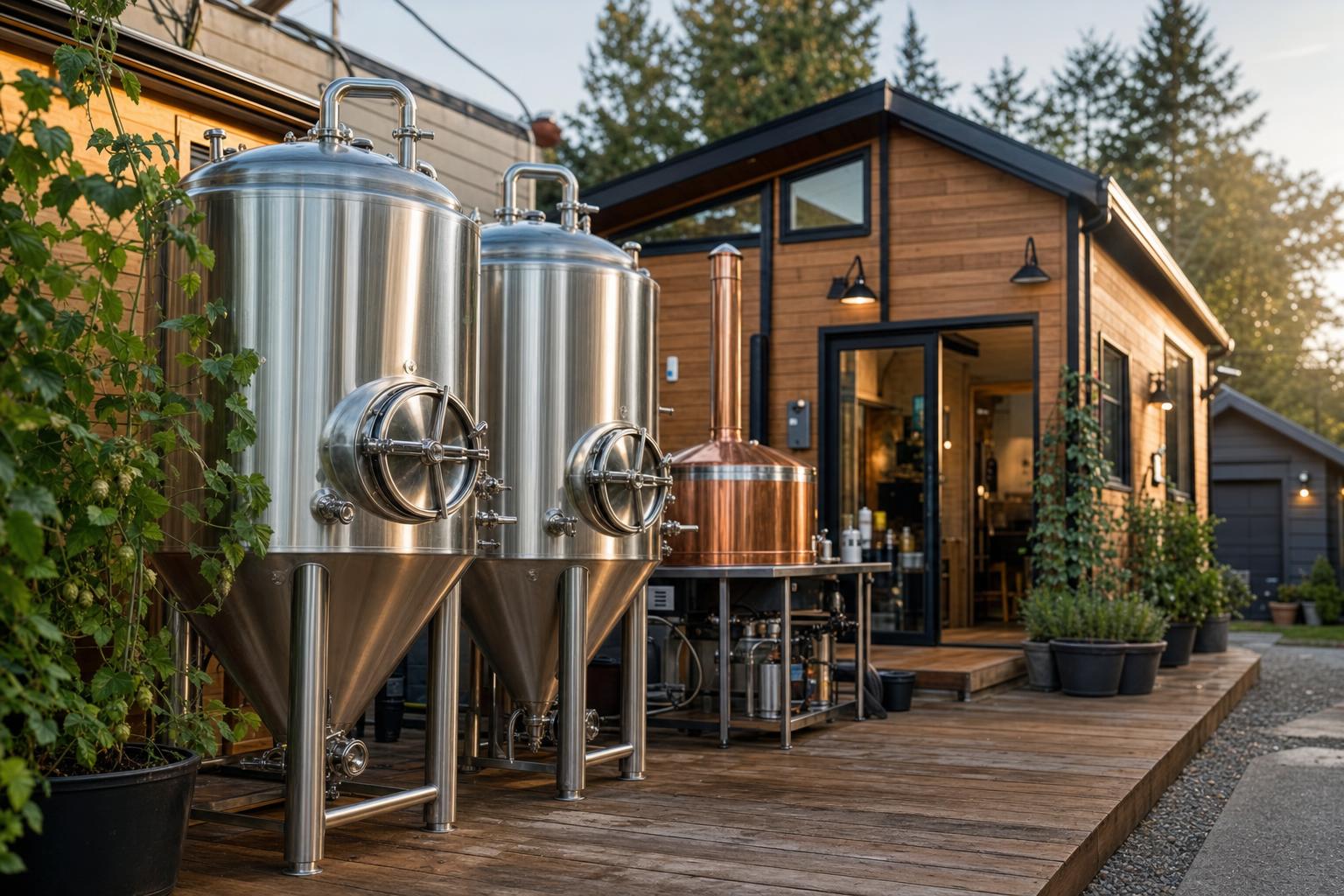
Tiny-Home Microbrewery in Canada (2026): Legalities, Design, Gear, Costs, and Floorplans
Estimated reading time: 14 minutes
Key Takeaways
- A tiny-home microbrewery is a very small brewing setup that fits production, cleaning, storage, and sometimes a limited tasting area into one compact structure.
- The biggest 2026 challenge is not equipment size. It is proving the building is legal, safe, sanitary, ventilated, and code-compliant for commercial brewing in Canada.
- Before spending on gear, confirm zoning, building permits, provincial liquor approvals, sanitation requirements, and federal tax or excise obligations.
- Many of the best compact brewery ideas still come from small-scale adaptive design thinking and practical small-space business layout models.
- A tiny-home brewery can work well for pilot batches, recipe testing, premium local sales, and slow growth, but not if ventilation, wastewater, and fire safety are treated as afterthoughts.
- In Canada, tiny-home legality is highly local, and project success depends on both provincial and municipal approval rather than one national rule, as shown by guides on legal conversion paths and Ontario permit realities.
Table of contents
- What a tiny-home microbrewery actually is
- Canadian legalities for a tiny-home microbrewery
- 2025 design principles for a tiny-home craft beer space in 2026
- Essential microbrewery gear for tiny-home craft beer in 2025/2026
- Utilities, sanitation, waste management, and safety systems
- Operations, output limits, and business model choices
- Startup costs, timeline, and sample floorplans
- Practical permit checklist and documentation pack
- FAQ
What a tiny-home microbrewery actually is
A microbrewery in a tiny home is a very small commercial or near-commercial brewing setup that fits brewing, cleaning, storage, and sometimes a compact tasting corner into a minimal footprint.
A microbrewery is a small commercial beer operation. A nano-brewery is usually even smaller and closer to pilot scale. In practice, the label matters less than the rules. Regulators care more about land use, manufacturing activity, sanitation, alcohol production, and sales than whether the business calls itself a microbrewery or a nano-brewery.
A tiny home is also not automatically legal just because it exists. Canadian approval usually depends on provincial building rules and municipal permit pathways, along with broader guidance on how small structures are legally converted into habitable or usable space.
The line that matters most:
Hobby brewing is for personal use only. Once beer is made for sale, the project moves into licensing, reporting, inspections, sanitation, and business regulation.
Why this model appeals in 2026:
- Lower startup scale than a full brewery
- Easier local recipe testing
- Better proof of demand before expansion
- Useful as a pilot, R&D, or limited direct-sales site
That said, small space does not mean light regulation. A brewery may be treated as commercial or light industrial use rather than a standard home business. Research on small-scale growth and spatial adaptation supports the idea that compact ventures can work, but only when the regulatory environment is respected from the start, as discussed in this study on growth, regulation, and small-scale development.
It also helps to understand that tiny-home rules, bylaw constraints, and air-quality realities are already complex before brewing enters the picture, especially in Canadian tiny-home bylaw frameworks, tiny-home legal requirement overviews, and guidance on air quality in compact structures.
Canadian legalities for a tiny-home microbrewery
Important: Canadian legalities vary by province and municipality. Rules, licence types, and enforcement can change. Before buying equipment or starting construction in 2026, verify current requirements with your provincial liquor authority, municipal planning office, and a qualified lawyer or planner.
This is the part that decides whether the idea works at all.
Canadian legalities for a tiny-home brewery usually work on three levels:
- Federal excise, tax, and some import obligations
- Provincial liquor and manufacturing approvals
- Municipal zoning, building, and site-use permission
A tiny-home brewery adds commercial brewing layers on top of the normal issues already seen in tiny-home legal guidance in Canada, municipal friendliness comparisons, and broader Canadian small-structure regulation guides.
Start with federal excise, tax, and registration obligations
If beer is made for sale, federal obligations may apply. In plain terms, excise duties are taxes and reporting rules tied to alcohol production. Registration steps can also vary depending on whether the business brews only, imports supplies, or handles finished goods.
This is often the first real compliance checkpoint. A well-built brewery can still be blocked if the tax and registration structure is incomplete. Early professional review is wise, especially when using a small structure for business activity, as also noted in Canadian tiny-home business guidance and 2026 legal clinic resources for small-space projects.
Provincial brewery and liquor licensing by province
Provincial liquor authorities control who can make, store, sample, distribute, and sell beer. The path may include separate approvals for:
- Manufacturing
- Storage
- Distribution
- Onsite sampling or taproom service
- Retail or offsite sales
Ontario
Expect building permits, liquor review, and commercial-use review. A residential zone does not usually allow brewery use automatically, which lines up with practical permit discussions in Ontario tiny-home permit guidance and Ontario permitting overviews.
British Columbia
Provincial approvals and local zoning both matter. A change-of-use or commercial conversion review may be triggered, and early reference to British Columbia permitting guidance can help frame the questions to ask.
Alberta
Land-use controls can be strict in residential areas. Brewery activity is usually not treated like a normal home occupation.
Quebec
Local and provincial restrictions can be significant, especially where dwelling use and commercial activity overlap.
Ask your provincial authority early:
- Can this site be approved as a production location?
- Is onsite tasting allowed?
- Are offsite sales or distribution allowed?
- What floorplans are required?
- What sanitation documents are required?
This matters because tiny homes do not sit in a single national legal category. Resources from Canadian tiny-house builder and legal guides and updates from the tiny-home industry association in Canada reinforce how province-by-province and city-by-city the process really is.
Municipal zoning is the make-or-break step
Municipal zoning is often the biggest reason a tiny-home microbrewery project fails.
A home-based business rule is not the same as permission to run a brewery. Brewing includes:
- Manufacturing
- Steam and odours
- Noise
- Wastewater
- Visitor traffic
- Storage
- Safety systems
Ask planning staff these exact questions:
- Is commercial brewing allowed on this lot?
- Is food or beverage manufacturing allowed?
- Is onsite tasting or retail allowed?
- Is there enough parking or loading allowance?
- Are exterior exhaust systems allowed?
- Are floor drains and wastewater discharge permitted?
- Does the site need a change of use, variance, or rezoning?
Do this before drawing the layout. It saves time, money, and false starts. For many owners, zoning research begins with broader references like municipality comparisons, urban infill guidance, and local-use restrictions discussed in tiny-home bylaw resources.
Building, plumbing, electrical, and mechanical permits
Even a small tiny home can trigger a full permit path. A brewery usually adds more review than a standard small-home build.
Simple permit definitions:
- Building permit: structure and occupancy
- Plumbing permit: water, drains, backflow, wastewater
- Electrical permit: circuits, panel loads, equipment power
- Mechanical permit: ventilation, exhaust, HVAC, and sometimes gas
Regulators often want technical documents before approval, including:
- Site plan
- Floor plan
- Utility plan
- Drainage and waste plan
- Ventilation plan
- Equipment list
- Fire-safety details
- Food-safety and sanitation plan
These are the same categories often emphasized in compact-building permit guides such as permit requirements across Canadian cities and practical tiny-home conversion references from legal conversion planning.
Health, sanitation, safety inspections, and record-keeping
Commercial craft beer is inspected differently from hobby brewing because the product enters the market.
Inspectors may review:
- Sanitation procedures
- Ingredient storage
- Process hygiene
- Pest control
- Worker safety
- Food-safety training and records
Keep clear records:
- Production logs: what was brewed and when
- Inventory records: ingredients and finished stock
- Lot and traceability records: what batch went where
- Tax and excise records: how much was produced and sold
Insurance and fire-safety planning also belong here. Resources on tiny-home insurance in Canada and fire safety for compact buildings are particularly relevant once alcohol production, hot work, and visitors are involved.
Approval milestones and what happens if you skip them
A practical approval path looks like this:
- Confirm zoning and land use
- Confirm brewery use is allowed
- Secure building and trade permits
- Obtain provincial brewery and liquor approvals
- Complete construction and inspections
- Pass sanitation and fire-safety checks
- Register tax and excise accounts
- Launch only after written sign-off
If you skip steps, the results can be serious:
- Stop-work orders
- Failed inspections
- Fines
- Denied occupancy or use approval
- Equipment removal
- Forced closure
- Insurance trouble
- Lower resale value
This is not alarmist. It is just what regulated alcohol production looks like when done in a highly constrained building type.
2025 design principles for a tiny home craft beer space in 2026
Here, 2025 design means compact, modular, sustainable, easy-to-clean, and tech-enabled ideas that became popular in 2025 and still make sense in 2026.
Once zoning and code feasibility are clear, layout becomes the next major success factor. The most useful principles come from compact-space planning, including Canadian tiny-home design guidance, 2025 layout and finish trends, multi-purpose small-space design, and tiny-home interior trends.
Core layout principles
Modular equipment
Choose equipment that can move, shift, or come apart for cleaning and service.
Linear workflow
Set the process in one direction: mash, boil, chill, ferment, package.
Vertical storage
Use wall shelves and overhead storage for hoses, clamps, tools, and dry goods. See ideas from tiny-home storage solutions.
Integrated cleaning
Make room for cleaning chemicals, hose drying, drain access, and CIP-style cleaning.
Minimalist tap corner
If there is any public-facing area, keep it small and physically separate from brewing.
Tech-enabled monitoring
Use compact sensors and controllers to reduce manual checks and bulky hardware, similar to trends in smart monitoring systems for compact spaces.
Good workflow reduces contamination risk, keeps exits open, and makes inspections easier.
Materials, finishes, and sanitation-friendly surfaces
A tiny-home brewery needs smooth, washable, moisture-resistant finishes. Brewing creates steam, spills, splash, and repeated chemical cleaning.
Good surfaces should be:
- Non-porous
- Easy to wipe down
- Resistant to moisture
- Resistant to cleaning chemicals
- Safe near hot and wet areas
Weight matters too. Heavy finishes may affect trailer limits or structural loads. It helps to compare flooring options for tiny homes and eco-friendly building materials in Canada before choosing surfaces.
Ventilation, HVAC, and fermentation climate control
A compact brewery needs two separate climate strategies:
- Steam extraction near the boil area
- Stable temperature control near fermentation and storage
Poor ventilation is dangerous because it can:
- Cause condensation
- Damage walls and finishes
- Raise mould and corrosion risk
- Create heat buildup
- Hurt beer quality
Fermentation also creates CO2. In a tiny home, that gas must be safely vented. Ventilation is a life-safety system, not a convenience. For context, review air-quality challenges in tiny homes and efficient heating and mechanical planning for small structures.
Sustainability and utility-smart 2025 design ideas
Modern compact brewery design should also reduce utility strain.
Useful ideas include:
- Heat recovery where practical
- Solar-ready electrical planning
- High-efficiency insulation
- Low-water cleaning methods
- Greywater planning where local rules allow
These matter because utility capacity in tiny structures is limited. Helpful references include solar-ready design guidance, greywater planning for tiny homes, and solar water heating options.
Example mini-layouts
Mobile microbrew cart
A wheeled 1–2 vessel pilot system. Best for recipe testing, demos, and tiny production runs.
100–500 L compact system
Often the most realistic small commercial range if utilities, structure, and zoning support it.
Two-fermenter plus single brew-kettle setup
A clean one-operator layout with simple piping and less congestion.
Exact dimensions should always be based on local code and equipment specifications. For visualization ideas, compare compact-space examples such as tiny-home showroom layouts.
Essential microbrewery gear for tiny-home craft beer in 2025/2026
The best gear is not the biggest or the cheapest. It is the gear that fits the licence, output target, utility capacity, and maintenance access available inside the structure.
Compact brewery planning is far easier when equipment choices are matched to small-space business realities, as outlined in tiny-home brewery guidance and related compact workspace planning like small studio-style utility and space use models.
Core brewing equipment checklist
- Compact brew kettle: boils wort
- Mash tun: turns grain starch into fermentable sugar
- Transfer pump: moves liquid safely between stages
- Plate or counterflow chiller: cools wort fast before fermentation
- Fermenters, ideally conical or jacketed: where yeast makes alcohol
- Glycol chiller or alternative cooling system: keeps fermentation temperature stable
- CO2 system: for carbonation and keg service
- Kegging or packaging setup: gets finished beer ready for sale
Also confirm that utilities can support the equipment by reviewing a practical tiny-home utilities guide for Canada.
Features to look for in compact 2025-era systems
Look for:
- Stackable vessels
- Quick-disconnect fittings
- Tri-clamp sanitary connections
- Integrated pumps and controllers
- Mobile casters with locking feet
- Wall-mountable control panels
These features help with faster disassembly, better sanitation, easier inspections, and future layout changes. Compact storage logic from small-space storage planning and system efficiency from smart compact-tech integration apply well here.
Packaging choices for craft beer in a tiny home
Kegging
Usually the best fit for tiny operations. It uses less space and simplifies packaging.
Canning
Good for retail and wider distribution, but it needs more floor space, more money, and more process control.
Bottling
Can cost less to start, but it is often slower and more labour-heavy in a compact commercial space.
Packaging affects licensing, storage, labeling, traceability, and sanitation workload. Many tiny-home operations should start with kegging unless packaged retail is central to the business model. Small-format retail concepts explored in mobile shop planning can help owners think through the sales side.
Cleaning, sanitation, monitoring, and safety gear
Cleaning gear
- CIP spray ball or small cleaning manifold
- Food-safe sanitizer
- Drain boards, squeegees, and brushes
- Chemical storage cabinet
- Hose reels and quick-drain slopes
Monitoring and automation
- Small digital controllers
- Wireless temperature logs
- Cloud-based fermentation records
Safety gear
- PPE for caustics and heat
- Fire suppression near the boil area
- Ventilation hoods and exhaust systems
In a small brewery, poor cleaning design often causes more quality trouble than a small brewhouse does. See related safety references on tiny-home safety in Canada and maintenance routines for compact spaces.
Utilities, sanitation, waste management, and safety systems
Utility planning often decides whether a tiny-home brewery is feasible at all.
Water quality and water demand
Brewing needs steady water quality. Some water sources need filtration or treatment depending on style and local supply.
Water demand includes:
- Mashing
- Boil losses
- Cleaning
- Sanitation
In a tiny home, water supply and storage may be limited. That makes utility planning essential, especially where owners are considering systems discussed in Canadian tiny-home utility planning or supplementary approaches like rainwater harvesting for tiny homes.
Plumbing, drains, and wastewater
A brewery should be planned around wet cleaning from day one.
Key needs include:
- Adequate drains
- Floor slope to drain
- Splash-resistant surfaces
- Backflow protection where required
- Wastewater handling that fits trade-waste rules
Municipalities may care about yeast, solids, chemicals, and hot wastewater entering the system. This is one of the hardest issues to solve in a tiny home, especially on lightly serviced sites. Useful references include wastewater solutions for Canadian tiny homes and greywater recycling guidance.
Electrical loads and dedicated circuits
Brewery loads are often bigger than expected because several systems may run at once:
- Kettle
- Pumps
- Glycol chiller
- HVAC
- Packaging gear
- Lighting and controls
A load calculation checks whether the electrical service can safely power everything at once. Dedicated circuits reduce overload risk and improve inspection outcomes. Additional context can come from electrical load planning examples and off-grid and solar appliance considerations.
Ventilation, CO2 evacuation, fire, and structural safety
This covers both worker safety and building safety.
A good plan should include:
- Steam removal from the boil area
- CO2 evacuation from fermentation
- Heat-safe clearances
- Fire suppression suited to the room
- Safe propane or electric design
- Structural review for tanks and equipment loads
- Clear exit paths
Liquids and stainless equipment are heavy. A tiny-home floor or trailer must safely carry those loads. Fire and resilience planning references such as FireSmart-style upgrades and disaster-proofing strategies for tiny homes are useful here.
Operations, output limits, and business model choices
A tiny-home brewery should usually be treated as a nano-scale business, even if the owner uses the word microbrewery for branding.
This format works best for low-volume, premium, local craft beer, not mass production.
Realistic production scale
Output depends on:
- Tank count
- Batch size
- Turnaround time
- Utility capacity
- Local approvals
The basic logic is simple:
- Fewer tanks mean fewer batches in progress
- Longer fermentation reduces throughput
- Packaging days can slow everything down
This model is strongest for pilot recipes, limited SKUs, highly local sales, and premium pricing.
Onsite tasting vs distribution
Onsite tasting can improve margin because the brewer keeps more retail value. But it also increases zoning and licensing complexity because the public enters the site.
Distribution gives wider reach, but adds:
- Packaging
- Labeling
- Storage
- Tax and reporting
- Logistics
A production-only model is often easier to approve than production plus tasting. If a public component is being considered, concepts from pop-up retail in compact structures may help frame what is practical.
Staffing, workflow, and automation
Most tiny-home breweries are run by one or two people. That means:
- Brew days must stay simple
- Cleaning must be fast
- Packaging must avoid heavy manual work
- Digital monitoring should reduce repeat checks
This is where modular layouts and selective automation have real value.
Scaling roadmap beyond the tiny home
A practical growth path looks like this:
- Brew pilot batches in the tiny home
- Validate recipes and local demand
- Move packaging offsite or use contract packaging if needed
- Expand into a larger commercial unit
- Keep the tiny home for R&D, pilot brewing, or hospitality use if allowed
This approach treats the tiny-home brewery as a smart first phase. Resale and long-term flexibility may also matter, which is why some owners look at tiny-home resale implications before locking in major structural changes.
Startup costs, timeline, and sample floorplans
Most first-time founders underestimate permit costs and utility upgrades more than equipment costs.
Startup budget ranges
- Low: roughly CAD 25,000–60,000 for a very basic compact system with limited build-out
- Medium: roughly CAD 60,000–150,000 for better utilities, sanitation, and modest packaging capability
- High: CAD 150,000+ for taproom features, major mechanical work, and more automation
What pushes cost higher:
- Zoning or change-of-use complexity
- Electrical upgrades
- Drainage and wastewater work
- Ventilation install
- More fermenters
- Better packaging
- Public tasting area
Budget reality is often shaped by hidden construction items, as reflected in hidden build-cost guides and broader Canadian cost planning references.
Sample 6–9 month timeline
- Month 1: zoning check, concept plan, licensing research
- Month 2: site plan, floor plan, utility planning, pre-consultations
- Month 3: submit permits and provincial applications
- Months 4–5: order equipment and begin build-out
- Month 6: install utilities, ventilation, plumbing, electrical
- Month 7: inspections, sanitation checks, test batches
- Months 8–9: corrective work, final approvals, first commercial batch
Delays are common when zoning is unclear or drawings need revision. Tools like construction delay planning and digital permitting workflows can help keep the timeline realistic.
Sample floorplan A — production-focused tiny-home microbrewery
- Front: compact entry and dry storage
- Middle: mash tun, brew kettle, transfer station
- Rear: fermenters and chiller
- Side wall: sink, chemical cabinet, cleaning station
- Rear alcove or exterior zone: mechanical and HVAC area
Why it works:
- Linear movement
- Clear production zones
- No public access needed
- Easier sanitation separation
Layout planning can borrow from tiny-home design examples while also considering screening and separation ideas from privacy strategy guides.
Sample floorplan B — tiny home with a small tap corner
- Front corner: two-seat tasting counter
- Centre: brewing line
- Back wall: fermentation and cold storage
- Partition: hard separation between visitors and production
- Dedicated wash zone: kept away from public access
This can improve margins, but only if zoning, liquor rules, life safety, and sanitation separation are all approved. Public-facing compact hospitality concepts from tiny-kitchen pop-up layouts and accessibility ideas from barrier-free small-space planning may be useful during concept development.
Practical permit checklist and documentation pack
This is the section to copy into your project file before spending heavily on equipment.
Permit and approval checklist
- Federal excise and tax registration review
- Provincial brewery or manufacturing licence review
- Municipal zoning confirmation
- Development or change-of-use approval
- Building permit
- Plumbing permit
- Electrical permit
- Mechanical or ventilation permit
- Fire-safety review
- Health and sanitation review
- Insurance quote and proof of coverage
- Wastewater or trade-waste agreement
- Final inspections and occupancy approval
Do not order major equipment until zoning and use approval look feasible. City-by-city permit references such as Canadian permit guides and risk planning through insurance guidance can support this checklist.
Documents to prepare for regulators
- Site plan
- Scaled floor plan
- Utility plan
- Ventilation plan
- Drainage and waste plan
- Equipment schedule
- Sanitation and cleaning plan
- Basic HACCP-style process notes
- Fire-safety details
- Insurance details
These documents prove different things:
- Site and floor plans prove layout and use
- Utility and drainage plans prove technical feasibility
- Sanitation plans prove hygiene control
- Fire-safety details prove life-safety compliance
Contact list the reader should build
- Provincial liquor authority
- Municipal planner
- Building department
- Electrician, plumber, and mechanical contractor
- Fire department or fire inspector
- Food-safety course provider
- Insurance broker
- Compact brewing equipment suppliers
This reduces delays because many approvals happen in sequence, not all at once.
FAQ
Can you legally run a microbrewery from a tiny home in Canada?
Sometimes, yes in concept, but only if zoning, permits, licensing, sanitation, ventilation, wastewater handling, and safety rules all support that exact use.
What are the main Canadian legalities for a tiny-home brewery in 2026?
The main layers are federal excise and tax obligations, provincial liquor and brewing approvals, and municipal zoning and building permissions.
What size system works best for a tiny-home craft beer setup?
A pilot cart or compact 100–500 L system is often the most realistic, depending on structure, utilities, and local approvals.
Are 2025 design trends still relevant in 2026?
Yes. Compact modular layouts, vertical storage, integrated cleaning, and digital monitoring still make excellent sense in tiny brewing spaces.
Is kegging better than canning for a tiny-home microbrewery?
Usually yes. Kegging takes less space, costs less to launch, and is easier to manage in a constrained production area.
What is the biggest mistake people make?
The most expensive mistake is skipping zoning confirmation and buying equipment before legal use is clear.
What are the most common design mistakes?
The main ones are undersized ventilation, poor drain planning, oversized equipment, weak cooling capacity, and no clean separation between production and public-facing space.
How should owners troubleshoot sanitation and fermentation in such a small space?
Keep the system simple:
- Keep fermentation temperatures stable
- Reduce contamination points by using fewer hoses and fittings
- Do not crowd fermenters
- Keep valves and sample ports easy to inspect
- Store chemicals away from ingredients
- Clean immediately after packaging or transfer
Tiny spaces magnify small mistakes. That is why air quality, cleaning access, and maintenance discipline matter so much, especially in guidance such as tiny-home air-quality planning, tiny-home safety practices, and maintenance systems for compact buildings.
Final thought: A tiny-home microbrewery is possible in concept, but legal viability must come before equipment. In 2026, the strongest path is to combine careful Canadian legal research with compact design thinking, using resources like tiny-home brewery planning guidance and local permit research tools. This guide should be reviewed again in 2027, because rules and enforcement can change.
Leave a Reply